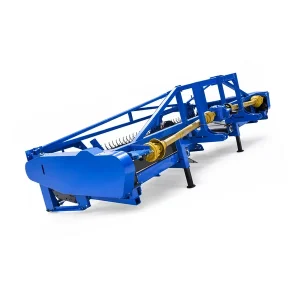
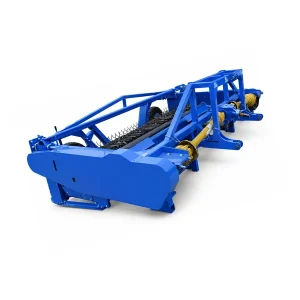
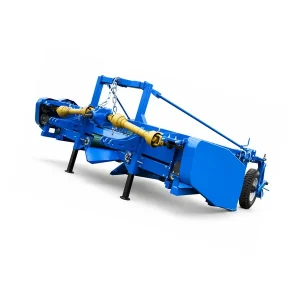
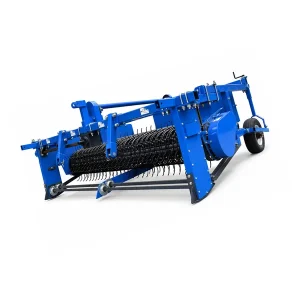
4BYH-1.3 Kidneybohnen-Erntemaschine | 2-reihige Trockenbohnen-Erntemaschine
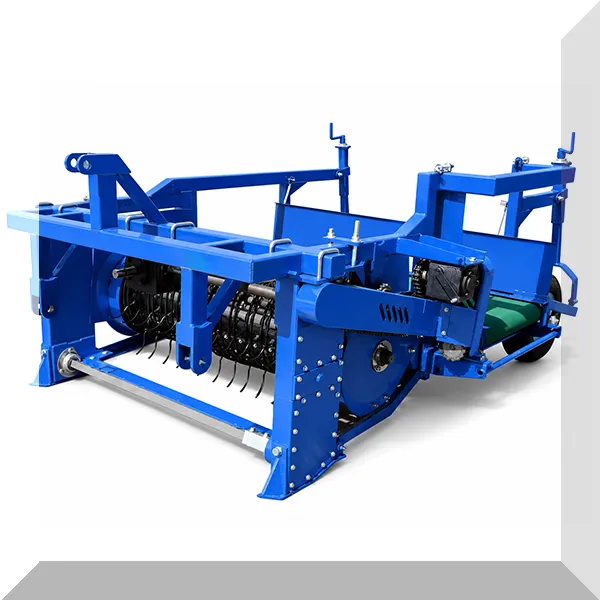
Der 4BYH-1.3 kidney bean puller is the entry-level model in our tractor rear-mounted dry bean lifter lineup, built for U.S. specialty legume producers who need reliable, gentle vine-pulling across 2 rows at a time. A spring-tine pickup assembly and Category II three-point hitch keep the machine compact at 600 kg, pair it with any tractor from 40 kW (≈55 HP) upward, and deliver 0.65–1.04 ha/h of clean, windrow-ready bean harvest without hand labor or complex setup.
Product Overview: Entry-Level 2-Row Rear-Mounted Bean Lifter
The U.S. dry-bean industry spans roughly 1.5 million harvested acres per year, concentrated in Michigan's Thumb region, the Red River Valley of North Dakota and Minnesota, the Nebraska Panhandle, and the Snake River Plain of Idaho. For the thousands of smaller specialty-bean operations in those corridors — farms running 100 to 400 acres of pinto, navy, kidney, or black beans — hand-pulling and contract harvest crews remain expensive workarounds rather than long-term solutions. The 4BYH-1.3 was built as the tractor-powered answer for exactly those operations.
As the smallest model in our Produktpalette der Kidneybohnenernter, the 4BYH-1.3 covers 2 rows and 1.3 meters of working width per pass. Its spring-tine lifter assembly engages the bean plants below the crown, lifts the entire vine — root, stem, and pods — intact from the soil, and conveys the pulled material into a neat windrow behind the machine. Because the spring tines flex on contact rather than driving into the plant with rigid force, pod-shatter losses stay well below the industry average, preserving sellable yield that aggressive harvest equipment typically destroys.
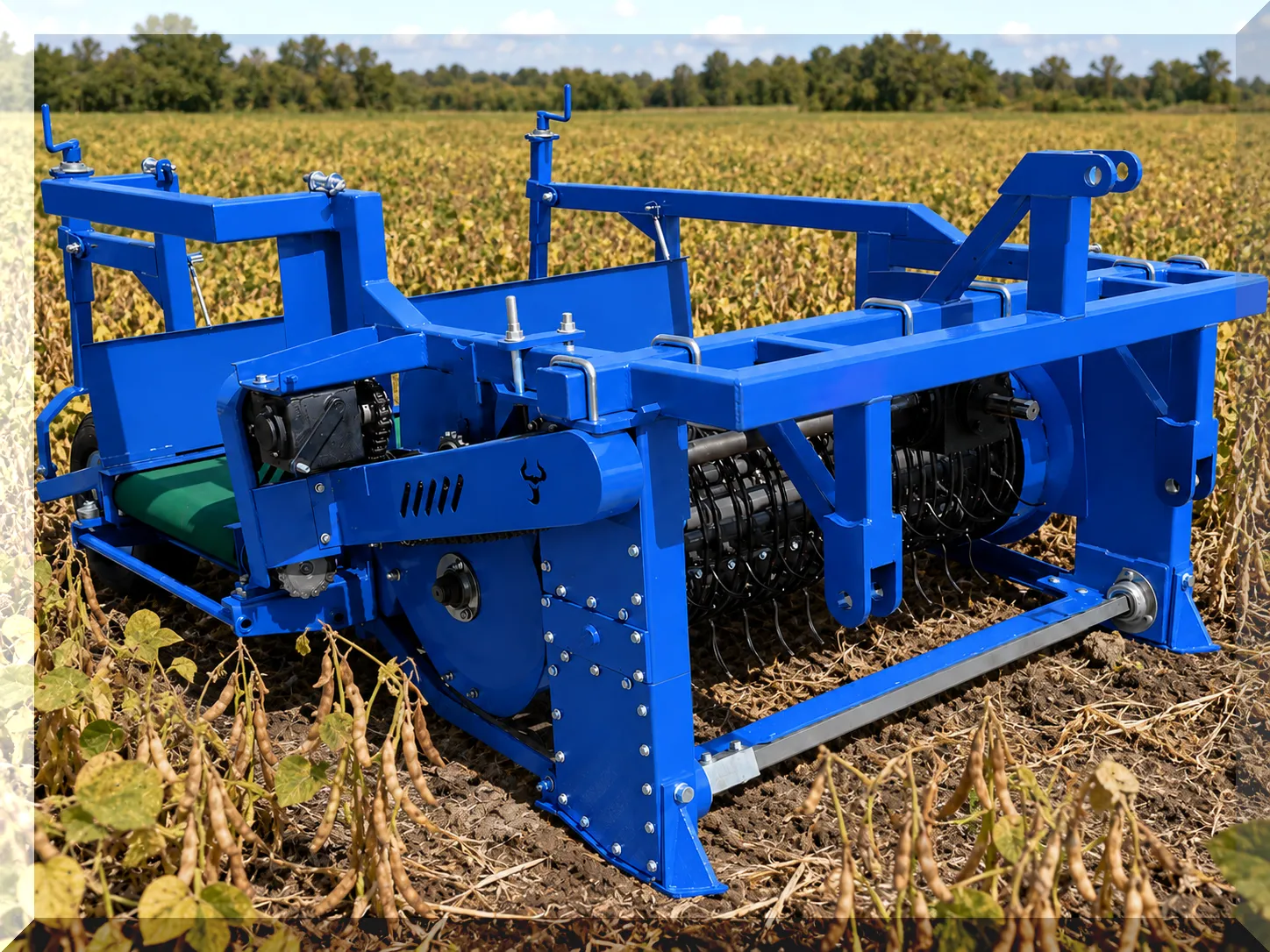
The 3-point Category II rear hitch attaches to virtually any utility tractor built for North American farms, and the 40 kW (≈55 HP) power floor means producers who already own a modest utility tractor can add mechanical bean harvesting this season without purchasing new equipment. PTO engagement at standard 540 r/min drives the spring-tine conveyor mechanism; the tractor's three-point hydraulics handle lift and depth control from the cab. Setup from field edge to working position takes under 15 minutes for an operator familiar with three-point equipment.
Technische Spezifikationen
All values below are taken directly from factory production records. Verify tractor PTO output and three-point hitch category before ordering if your equipment is older than model year 2000 or purchased outside the North American market. The U.S. support team can confirm compatibility from your tractor's serial number and spec sheet.
| NEIN. | Parameter | Einheit | Wert |
|---|---|---|---|
| 1 | Modell | / | 4BYH-1.3 Kidneybohnen-Pflücker |
| 2 | Anhängertyp | / | 3-Point Mounted (Rear) |
| 3 | Pickup-Typ | / | Federzinken |
| 4 | Arbeitsbreite | m (ft) | 1.3 (4.3 ft) |
| 5 | Erforderliche Traktorleistung | kW (PS) | ≥ 40 (≈ 55 HP) |
| 6 | Arbeitsgeschwindigkeit | km/h (mph) | 5–8 (3.1–5.0 mph) |
| 7 | Arbeitsabmessungen (L × B × H) | mm (ft) | 2500 × 1800 × 1250 (8.2 × 5.9 × 4.1 ft) |
| 8 | Zapfwellendrehzahl | r/min | 540 |
| 9 | Spurweite | mm (in) | 1,300 (51.2 in) |
| 10 | Flächenproduktivität | ha/h (ac/h) | 0.65–1.04 (1.6–2.6 ac/h) |
| 11 | Erforderliche Bediener | Personen | 1 |
| 12 | Strukturmasse | kg (lb) | 600 (1,323 lb) |
How the 4BYH-1.3 Works: From Root Lift to Windrow
The 4BYH-1.3 operates through four sequential steps that move the bean plant from the ground into a field-dry windrow. Understanding the mechanism helps operators set correct working depth and speed to minimize pod shatter on their specific variety and soil type.
Step 1 — Share Point Soil Penetration
At the leading edge of the machine, a hardened steel share point cuts through the soil at the depth set by the tractor's three-point hitch position — typically 4 to 6 cm below the bean plant's crown. The share works horizontally, severing the lateral roots that anchor the vine while leaving the main stem and pod structure above ground intact. The cutting angle is fixed but working depth is adjustable from the cab via three-point lift, allowing the operator to respond quickly to changing soil density or row-to-row root depth variation without stopping the tractor.
Step 2 — Spring-Tine Lift and Vine Separation
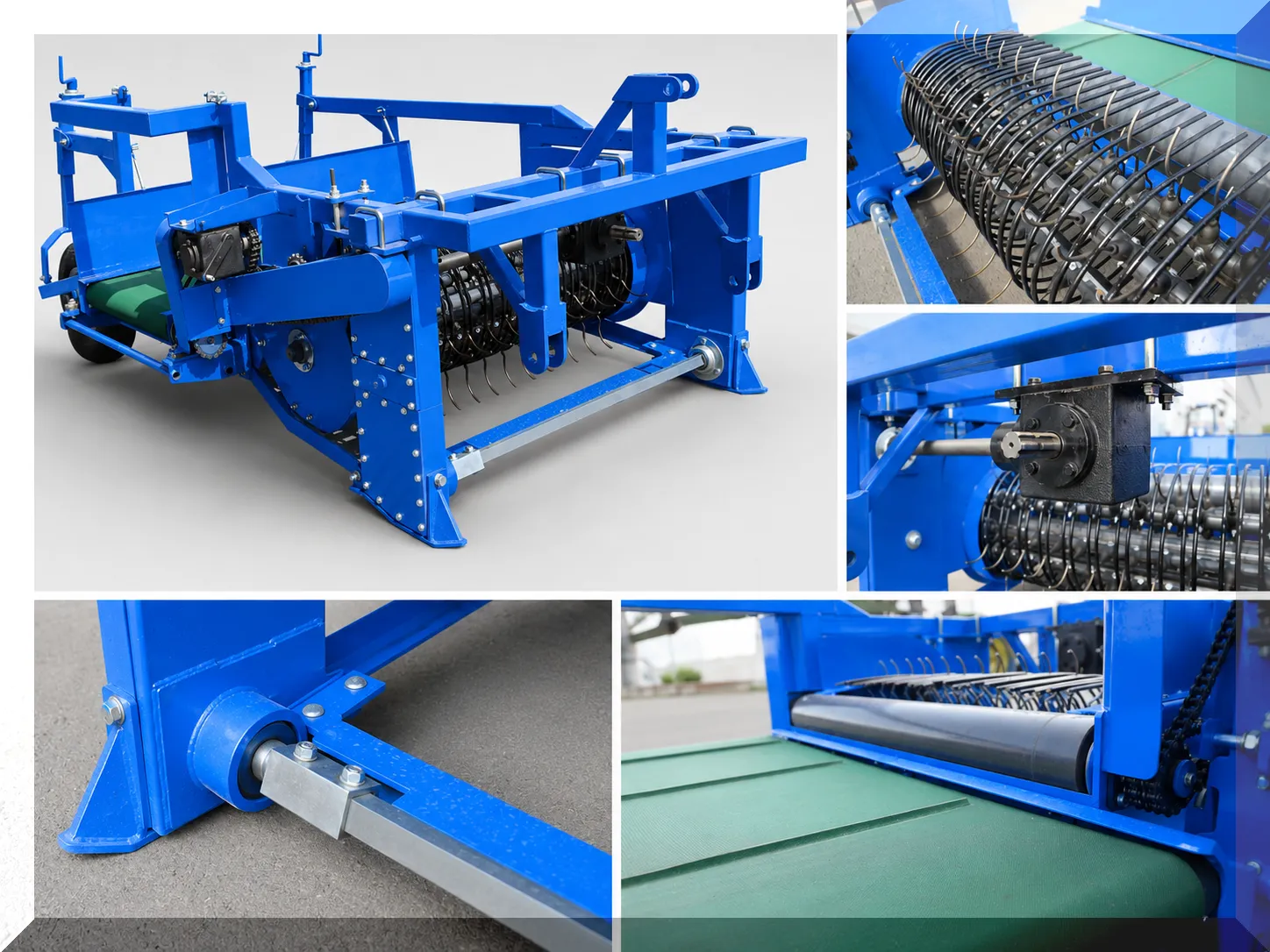
Immediately behind the share, a row of curved spring-steel tines engages the loosened plant from below. The tines flex on contact, absorbing resistance from tangled root masses and compacted soil clods without transferring the impact energy to the pods above. As the tines lift each plant upward and rearward, loose soil falls back between the tines while the vine and pod cluster ride upward into the conveyor section. This two-stage separation — share cuts, tines lift — is what keeps pod-shatter rates well below those of rigid-finger or rotary-bar pulling systems on delicate dry-bean varieties.
Step 3 — PTO-Driven Conveyor Transfer
The spring tines are driven in a rearward arc by PTO power at 540 r/min. As the tine assembly rotates, it moves the lifted plants rearward at a controlled pace matched to the tractor's forward speed. The conveyor motion keeps the vine continuous rather than bunching — bunching causes the plants to pile on top of each other, bruising pods and increasing shatter during later combine pickup. Matching ground speed (5–8 km/h) to PTO rotation ensures a smooth, even flow of material through the conveyor section.
Step 4 — Windrow Placement
At the rear of the conveyor, the lifted bean plants are deposited in a uniform windrow centered between the tractor's tire tracks. The windrow width and density are controlled by conveyor speed and forward travel rate. A properly formed windrow elevates the pods above direct soil contact, allows air circulation around the vines, and provides a consistent, combine-pickup-ready row after 3 to 5 days of field drying. The 1.3-meter wheel track aligns naturally with 65-cm standard bean row spacing, leaving adjacent rows untouched for the next pass.
Four Advantages That Protect Your Yield and Your Budget
Spring tines flex on contact rather than driving rigid force into the vine. Pod-shatter losses on pinto and navy varieties consistently run below 4% in operator reports from Michigan and North Dakota — significantly lower than the 8–12% typical of aggressive lifter designs on thin-podded varieties.
The 55 HP minimum means producers already running a compact utility tractor — John Deere 5055E, Kubota M5660, Massey Ferguson 4707 or similar — can add mechanical bean pulling without purchasing a second, larger tractor. This is the lowest power threshold in our kidney bean harvester lineup.
The 1,300 mm wheel track fits squarely between standard 65 cm bean rows, keeping tractor tires off the standing crop on either side of the harvesting pass. At 600 kg total mass, the machine adds minimal soil compaction load compared to heavier multi-row pullers that require wider-track tractors.
Category II three-point hitch attachment takes a single operator under 15 minutes from field edge to working position. One PTO shaft connection and one set of three-point arms is all that links the machine to the tractor — no hydraulic remote hoses, no electrical harnesses, no specialized tooling required for attach or detach.
Application Scenarios: U.S. Dry Bean and Specialty Legume Harvest
Pinto and Navy Bean Harvest — Michigan Thumb and Red River Valley
Michigan's Thumb region and the Minnesota–North Dakota Red River Valley together produce a large share of the nation's pinto and navy bean crop. Both varieties set pods close to the ground on short, prostrate vines that can be difficult for larger equipment to pick up cleanly. The 4BYH-1.3's share point rides just below crown level, cutting cleanly under the vine without dragging excess soil into the windrow. Michigan growers using the machine on sandy loam report consistent clean pickup with minimal green material in the windrow, which shortens field drying time before combine harvest.
Dark Red Kidney and Black Bean Harvest — Nebraska and Idaho
Dark red kidney beans and black turtle beans grown in Nebraska's Panhandle and Idaho's Magic Valley carry heavier pods on taller vines than pinto or navy varieties, which makes the gentle tine action of the 4BYH-1.3 especially important. Hard-pod kidney varieties can tolerate slightly higher ground speed (up to 8 km/h on firm soils) without meaningfully increasing shatter losses. Idaho growers also report the machine performing well in furrow-irrigated fields where the soil surface is ridged — the spring-tine flex allows the lifter to follow furrow contours that would cause a rigid share to skip or dig in alternately.

Adzuki and Other Specialty Pulses — Small-Volume High-Value Crops
The specialty pulse market — adzuki beans, lentils on short vines, chickpeas in certain row configurations — represents a growing segment of the upper Midwest and Pacific Northwest farm economy. The compact size and low power requirement of the 4BYH-1.3 makes it a practical option for producers growing 20 to 100 acres of these crops who cannot justify the cost or machine complexity of large 4- or 6-row pullers. Several Oregon and Washington producers use the 4BYH-1.3 on adzuki fields planted at 60-cm row spacing with minor in-season width adjustment.
Small-Acre Organic and Identity-Preserved Bean Operations
Certified organic dry-bean growers and identity-preserved bean contract producers often farm in isolation from neighboring fields, which limits their access to custom harvest crews. The 4BYH-1.3 allows a single operator to self-harvest the entire operation — no crew scheduling, no custom operator coordination during the narrow harvest window — while the gentle spring-tine mechanism avoids the aggressive mechanical damage that can contaminate an IP load with split or shattered pods and reduce buyer acceptance premiums.
Construction and Wear Parts
The 4BYH-1.3 is built from a welded high-tensile steel mainframe with hot-dip galvanized cross members in moisture-exposed zones. Three component classes see the most wear in normal operation and are available as stock U.S. warehouse items for same-week replacement.
Share Points
The leading share point is manufactured from boron-treated wear steel and hardened to 58–62 HRC at the cutting edge. Expected service life varies by soil abrasiveness: 120–160 acres on sandy loam in Michigan or Idaho, 60–90 acres on the heavier, more abrasive soils of the Nebraska Panhandle. Share replacement requires removing four bolts and takes under 10 minutes in the field. Replacement shares ship from the U.S. warehouse in packs of two or ten.
Spring Tines
Each tine is formed from high-carbon spring steel wire, stress-relieved after forming, and zinc-phosphate coated against rust. The standard tine set consists of 24 tines across the two lifting rows. Tines can be replaced individually by unbolting the mounting clip — no special tools required. A spare tine pack of 12 units ships with every new machine. Replacement tines are available in single-tine, 12-tine, and full-set quantities from the U.S. parts warehouse.
PTO Driveshaft and Chain Drive
The PTO driveshaft features a friction overload clutch pre-set to 450 Nm, protecting the gearbox and tine assembly from surge loads during start-up or root-mass encounters. The chain drive connecting the gearbox output to the tine conveyor shaft uses a standard #60 agricultural roller chain available from any U.S. farm supply or equipment dealer. Chain tension is adjusted at the tensioner sprocket with a single bolt — no chain removal required for routine adjustment.
Choosing the Right Model: 4BYH-1.3 vs Larger Bean Pullers
The 4BYH-1.3 is the entry point in a four-model kidney bean puller range scaled to farm size and daily acre targets. Use the table below to verify the 4BYH-1.3 is the right fit, or to identify the next step up when your acreage grows. All models share the same spring-tine working principle and Category II hitch interface.
| Spezifikation | 4BYH-1.3 (Dieses Modell) |
4BYH-2.6 Kidneybohnen-Auszieher |
4BYH-3.25 | 4BYHD-3.9 |
|---|---|---|---|---|
| Reihen | 2 | 4 | 5 | 6 |
| Arbeitsbreite | 1,3 m | 2,6 m | 3.25 m | 3.9 m |
| Produktivität | 0.65–1.04 ha/h | 1.56–2.6 ha/h | ~2.0–3.25 ha/h | 2.34–3.9 ha/h |
| Min. Tractor Power | ≥ 40 kW / 55 HP | 66–88 kW | 88–110 kW | 132–147 kW |
| Maschinenmasse | 600 kg | 1.100 kg | ~1,300 kg | ~1,800 kg |
| Am besten geeignet für | 50–200 ac specialty operations | 100–500 ac commercial | 300–800 Acres | 500+ ac large-scale |
Completing the Harvest Chain: Windrow Consolidation and Drivetrain
Windrow Consolidation with the 9LZ-6.0 Finger Wheel Hay Rake
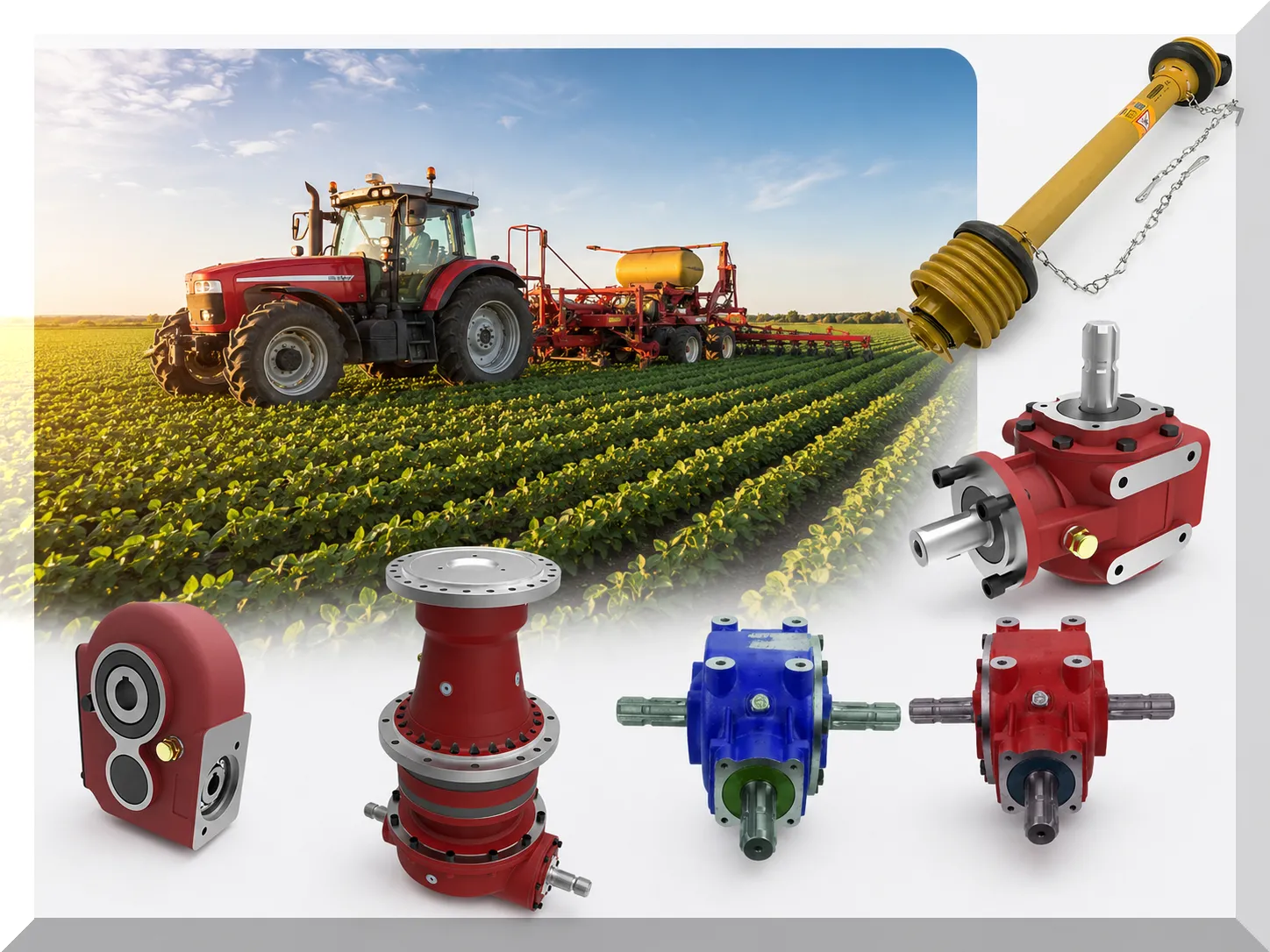
On larger fields where two or more pulls from adjacent passes need to be merged into a single combine-ready windrow, the 9LZ-6.0 Fingerrad-Heurechen provides a gentle, ground-driven solution for consolidating bean windrows without the leaf or pod damage that rotary equipment causes on dry, mature bean vines. The 9LZ-6.0's spring tines ride over the windrow surface rather than digging into it, merging two adjacent 1.3-meter windrows into a single wider row that a full-size combine pickup head can harvest in fewer passes.
Integrität des Nebenantriebsstrangs
The 4BYH-1.3 transmits PTO torque through a precision-matched shaft to the spring-tine conveyor gearbox. During normal operation the load is steady, but start-up engagement — especially against a heavy root mass or in wet conditions — generates short torque spikes that exceed steady-state values by 3 to 5 times. The integrated friction overload clutch handles most of these spikes, but the internal gearbox bearings and spiral bevel gears must also be correctly rated for agricultural duty cycle. An undersized or worn agricultural PTO gearbox will absorb those overload events until the gear mesh fails, typically at the worst possible moment during peak harvest week. The Ever-Power drivetrain catalog includes gearbox units rated specifically for the 540 r/min conveyor drive configuration of the 4BYH-1.3, with full parts and service support from the U.S. warehouse.
Why American Bean Producers Choose silagebalers.com
- ✔U.S.-Based Sales and Technical Support. English-speaking staff in California handle all inquiries during American business hours. No offshore call centers, no language barriers between you and the engineering team when a harvest decision needs a fast answer.
- ✔ISO 9001-zertifizierte Fertigung. Every 4BYH-1.3 ships with full quality documentation covering material traceability, weld inspection, dimensional verification, and factory assembly sign-off. Quality records are available on request for USDA program equipment documentation.
- ✔U.S. Warehouse Parts Stock. Share points, spring tines, PTO driveshaft components, and chain sets ship from the U.S. warehouse. Orders placed before 2:00 PM Pacific ship same day. Most domestic addresses receive parts within 2 to 5 business days — well inside the harvest window even for expedited needs.
- ✔Anspruchsberechtigt nach Abschnitt 179. The 4BYH-1.3 qualifies for Section 179 first-year expensing under current IRS rules. Complete invoice documentation for your tax accountant is provided with every order upon request.
- ✔Direktpreise ab Werk. No dealer markups. Pricing reflects machine cost plus U.S. logistics — typically 15 to 25 percent below equivalent equipment sold through regional dealer networks.
- ✔Full Forage and Harvest Equipment Line. Source the 4BYH-1.3, companion rake, round balers, and all drivetrain components from one supplier with one support team. Visit our Über uns page for the full company background.

Häufig gestellte Fragen
What is the minimum tractor HP needed to run the 4BYH-1.3 kidney bean puller?
The 4BYH-1.3 requires a minimum of 40 kW, which corresponds to approximately 55 PTO horsepower. Common tractor models that meet this threshold include the John Deere 5055E, Kubota M5660, Case IH Farmall 55C, and New Holland Workmaster 55. Because the machine weighs only 600 kg, even the lower-end models in this power range pull and control the implement without strain under normal field conditions.
What soil moisture level is optimal for the 4BYH-1.3?
The machine performs best when soil moisture is between 12 and 22 percent — dry enough that pulled soil falls cleanly off the tines rather than clinging to the vine, but not so dry that the share struggles to penetrate firm clay. In practice, most U.S. bean producers target harvest in the early morning before the soil surface dries and cracks, or within 24 to 48 hours after a light rainfall event. Operating in excessively wet soil causes root clods to ride up with the vine and increases windrow contamination.
How do I adjust working depth for different bean root depths?
Working depth is controlled entirely by the tractor's three-point hitch position — no mechanical depth stops on the machine need adjustment. Raise the three-point arms to run the share shallower for beans planted at 4 cm root depth (common on light sandy soils); lower the arms to reach 6 to 8 cm depth on heavier soils or taller-vined varieties. Mark the three-point quadrant position that worked on a test strip at the start of each field and hold it constant across the full harvest.
How often do spring tines need to be replaced?
Under normal sandy-loam conditions in Michigan or Idaho, a full tine set typically lasts 80 to 120 acres before the tip bend radius wears enough to reduce lifting efficiency. In more abrasive soils or when operating at maximum depth in rocky ground, inspect after every 40 to 60 acres. Individual worn tines can be replaced without removing adjacent tines, and the U.S. warehouse stocks replacement tine packs year-round for same-week delivery during harvest season.
Can the 4BYH-1.3 handle row spacing other than 65 cm?
The machine is optimized for standard 65 cm row spacing with the 1,300 mm wheel track placing the tractor tires precisely in the inter-row alleys. For 60 cm row spacing, the share position can be adjusted laterally within a ±40 mm range at the mounting bracket. Row spacing narrower than 60 cm or wider than 70 cm requires a factory consultation before ordering, as the conveyor width and share positioning may need modification.
What happens if the PTO shaft overloads — for example, when starting in a heavy root mass?
The integrated friction overload clutch in the PTO driveshaft slips at a pre-set 450 Nm torque threshold, absorbing the overload before it reaches the gearbox or tine assembly. The slip is audible as a brief rattling sound during engagement. After the root mass clears, the clutch re-engages automatically. If the clutch slips frequently during a full field, reduce forward ground speed by 1 to 2 km/h or raise the three-point hitch slightly to reduce share depth until soil conditions improve.
How long does shipping take from the U.S. warehouse, and does the machine arrive assembled?
Standard freight transit from the California warehouse to most U.S. destinations runs 5 to 10 business days. The 4BYH-1.3 ships largely pre-assembled; final field-ready setup involves attaching the PTO driveshaft, mounting the share point bolts, and connecting the three-point lower arms — approximately 20 to 30 minutes for an operator familiar with three-point equipment. The included assembly guide covers every step with diagrams, and the U.S. support team is available by phone for real-time guidance.
Customer Reviews from U.S. Dry Bean Operations
The following reviews come from 4BYH-1.3 owners who have run the machine through at least one full harvest season on their own operations. Locations, crop types, and soil conditions are noted to help prospective buyers compare to their own situation.
Gerald Kowalski, Pinto Bean Producer, Tuscola County, Michigan (early 2025)
★★★★★
We grow about 180 acres of pinto beans in the Thumb region on sandy loam with a lot of stones scattered through the field. I had my doubts about whether the spring tines could handle the rocks without snapping constantly, but we ran about 160 acres before the first tine needed replacing, and it was a clean break from a direct rock hit rather than gradual wear. The hookup on my Kubota M6040 (60 HP) took maybe 20 minutes the first time and under 10 minutes after I learned the sequence. Pod shatter was noticeably lower than what we were getting from a neighbor's contract operation. Very satisfied with the purchase.
Lori Bengtson, Navy Bean Grower, Cass County, North Dakota (mid 2025)
★★★★★
The Red River Valley has heavy clay in spots, and I was worried the share would ride up in the wet zones near the low corners of the field. It didn't. The spring tines have enough give that they followed the soil profile even through the sticky spots. We ran about 95 acres on a Case IH Farmall 75C and the tractor handled the load without complaint. The windrow came out clean and uniform — our custom combine operator commented that it was the most consistent bean windrow he had picked up that season. The tines are showing wear after 95 acres, and I ordered replacements which arrived in four days. Good machine and good support.
Marcus Webb, Black Bean Contractor, Box Butte County, Nebraska (late 2024)
★★★★☆
I do custom bean pulling for about 12 farms in the Nebraska Panhandle, mostly black beans and some pintos. Added the 4BYH-1.3 to handle the smaller fields where my 4-row unit is too wide for efficient turns. It fills that role very well — I can pull 30-acre fields that weren't worth setting up the big machine for. Hookup is fast enough that moving between farms the same day is practical. Four stars because the manual photos are small and hard to read in sunlight, but the actual machine performs exactly as advertised and the support team answered my depth-setting questions over the phone.
Ryan Ashworth, Dark Red Kidney Bean Producer, Twin Falls County, Idaho (mid 2025)
★★★★★
We grow 120 acres of dark red kidney beans in a furrow-irrigated system where the soil surface has pronounced ridges. Previous pulling equipment either skipped the furrows or dug too deep on the beds. The 4BYH-1.3's spring tines flex enough to follow the ridge-and-furrow profile consistently. We ran the full 120 acres at 6 km/h without any plugging incidents or major shatter events visible in the windrow. The machine arrived pre-assembled and we were in the field the same afternoon it came off the truck. Replacement shares ordered mid-season arrived in three business days. Would recommend to any Idaho bean producer running under 200 acres.
Patricia Nordstrom, Certified Organic Pinto Bean Farm, Polk County, Minnesota (early 2025)
★★★★★
As a certified organic operation, I cannot use any contract equipment that has been on conventional fields without a full cleaning protocol — which rules out most custom operators in my area. The 4BYH-1.3 lets me self-harvest and maintain full chain-of-custody documentation for my organic certification. The machine handles our sandier soils very cleanly with minimal soil pickup in the windrow. After 75 acres I had shatter losses well under what my certifier tracks as the acceptable threshold for IP certification. The Section 179 deduction covered a significant portion of the purchase cost in year one. Will be running it again this fall.
Ready to Harvest Your Bean Acres Without a Crew?
Get a no-obligation quote for the 4BYH-1.3 kidney bean puller delivered to your farm. Direct factory pricing, U.S.-based support, and Section 179 documentation included with every order.
America Ever-Power Silage Baler Equipment INC. | 1401 21st ST, STE R, Sacramento, CA 95811, USA
Zusätzliche Informationen
| Editor | Cxm |
|---|