
Henificador de rueda de dedos plegable hidráulico 9FZ-2.0 | 3 ruedas
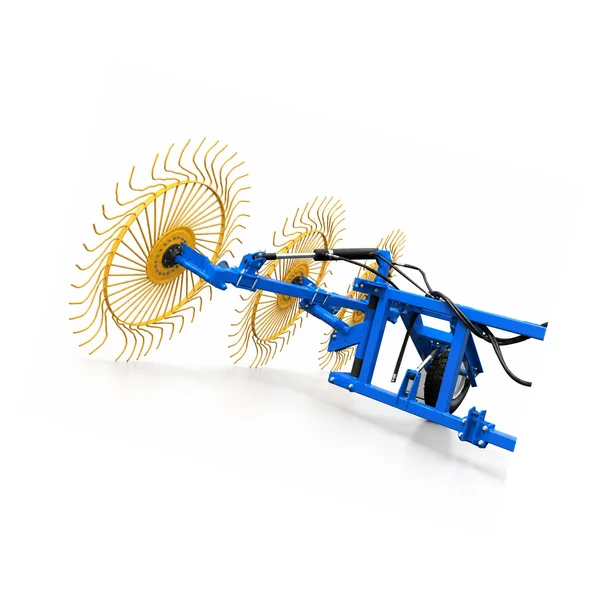
El 9FZ-2.0 finger wheel tedder is a three-disc hydraulic folding hay tedder that converts cut forage from a flat, slow-drying swath into a fluffed, aerated mass — cutting field drying time by 30 to 40 percent. With 120 spring tines across three Ø 1,500 mm discs, it covers 2.0 meters per pass on ≥35 HP compact tractors, hydraulically folds to transport width in under two minutes, and is built to the JB/T 7766-2011 agricultural machinery standard. For operations where the margin between first-quality hay and weather-damaged downgrade is measured in hours, the 9FZ-2.0 rastrillo de heno is the implement that shrinks that margin.
Every Hour the Hay Lies Flat Is an Hour Weather Owns
Hay quality is a race against two things simultaneously: moisture level and weather probability. The faster cut forage dries to baling moisture — and the faster a rastrillo de heno can accomplish that (14–18% for dry hay, 45–60% for haylage), the fewer weather exposure events it faces during the critical drying window. A rastrillo de heno does not simply speed up drying as a convenience — it compresses the weather-exposure window by 30 to 40 percent, which directly translates to fewer rain events, fewer dew cycles, and fewer oxidative losses per cutting.
Especificaciones técnicas
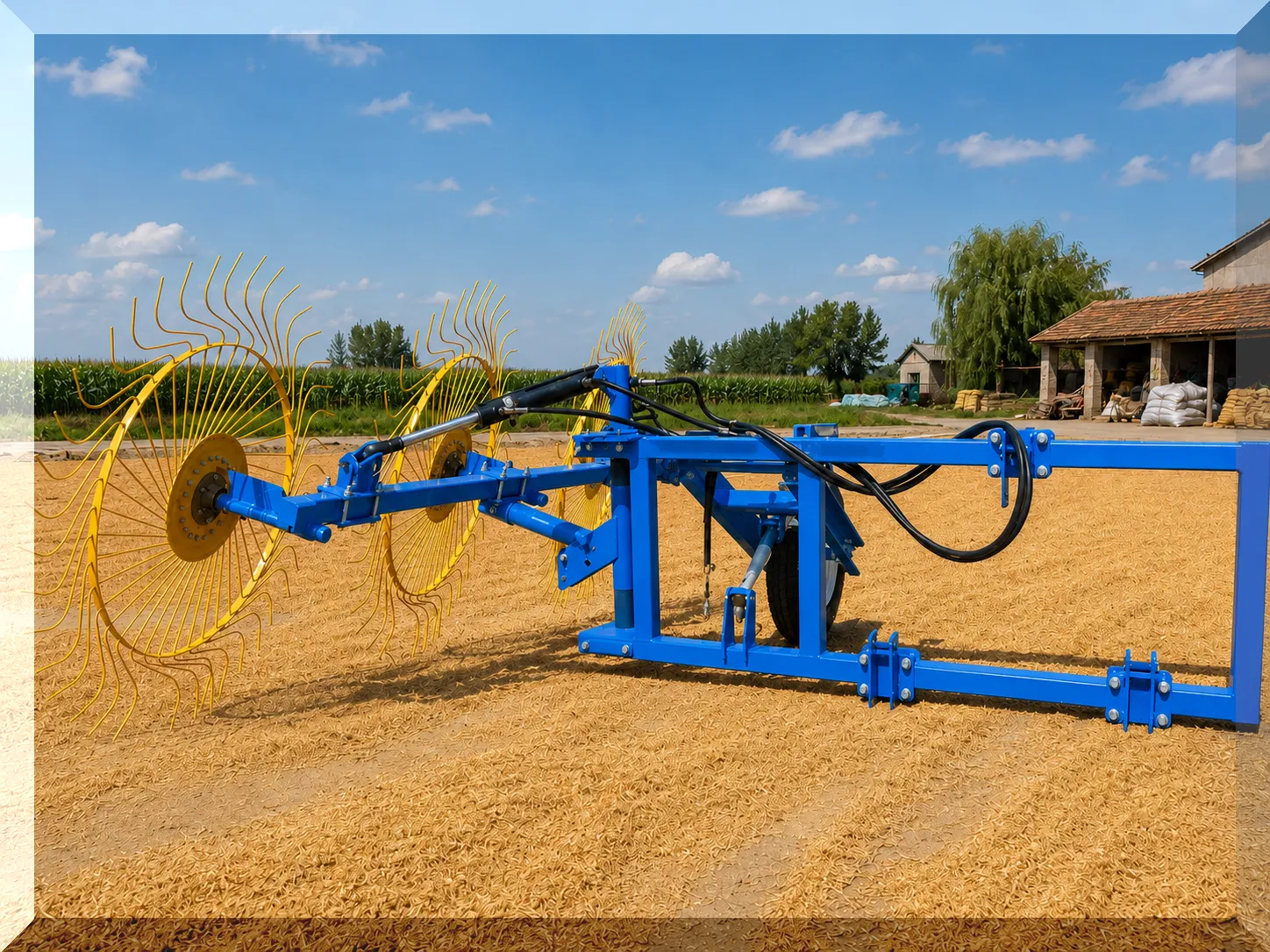
El 9FZ-2.0 hay tedder mounts to the tractor's rear three-point hitch Category I or II. The hydraulic fold uses one rear SCV outlet — no PTO shaft connection required. Tractor HP of ≥25.73 kW (≈35 HP) ensures adequate drawbar pull at working speed and stable three-point hitch control during transport.
| No. | Parámetro | Unidad | Valor |
|---|---|---|---|
| 1 | Producto | / | 9FZ-2.0 Finger-Disc Hay Tedder |
| 2 | Tipo de enganche | / | Montaje de 3 puntos (trasero), Cat I / II |
| 3 | Fold Mechanism | / | Hydraulic (1 SCV outlet required) |
| 4 | Púas de resorte totales | piezas | 120 (40 tines/disc × 3 discs) |
| 5 | Disc Quantity | piezas | 3 |
| 6 | Disc Diameter | mm (pulg.) | Φ 1,500 (59.1 in) |
| 7 | Tedding Width | metros (pies) | 2.0 (6.6 ft) |
| 8 | Potencia requerida del tractor | kW (HP) | ≥ 25.73 (≈ 35 HP) |
| 9 | Velocidad de trabajo | km/h (mph) | 7–10 (4.3–6.2 mph) |
| 10 | Dimensiones de trabajo (L×An×Al) | mm (pies) | 3,500 × 3,500 × 1,500 (11.5 × 11.5 × 4.9 ft) |
| 11 | Masa estructural | kg (lb) | 372 (820 lb) |
| 12 | Executive Standard | / | JB/T 7766-2011 |
The Engineering Behind 30–40% Faster Drying: Disc Geometry and Tine Mechanics
The 30 to 40 percent drying time improvement of a finger wheel hay tedder over untreated hay is not simply a product of "turning it over." The mechanism by which tine-disc tedders accelerate drying is more specific: it involves simultaneous swath inversion, mechanical swath expansion, and plant-stem fracturing at the nodes — three drying mechanisms that act in combination.
The Φ 1,500 mm Disc: Why Size Matters for Tine Entry Angle
El 9FZ-2.0 hay tedder's three discs are each 1,500 mm (59.1 inches) in diameter. At this diameter, the 40 tines on each disc sweep the crop at a relatively shallow entry angle — approximately 15 to 22 degrees relative to the soil surface at standard working height. This shallow angle is mechanically significant: the tines slide under the hay mat rather than driving into it from above, which lifts the entire swath uniformly rather than creating patches of overtedded (shattered leaf) and undertedded (still-matted) material within the same pass.
Smaller-diameter discs at the same tine count produce a steeper entry angle, which increases the proportion of hay that is struck and thrown rather than lifted and turned. For legume hays (alfalfa, clover) where leaf shatter during tedding directly reduces protein content and therefore hay value, the shallow-entry geometry of a large-diameter disc is agronomically preferable — it moves more material with less impact force per tine contact.
40 Spring Tines Per Disc: Contact Density and the Stem Fracture Effect
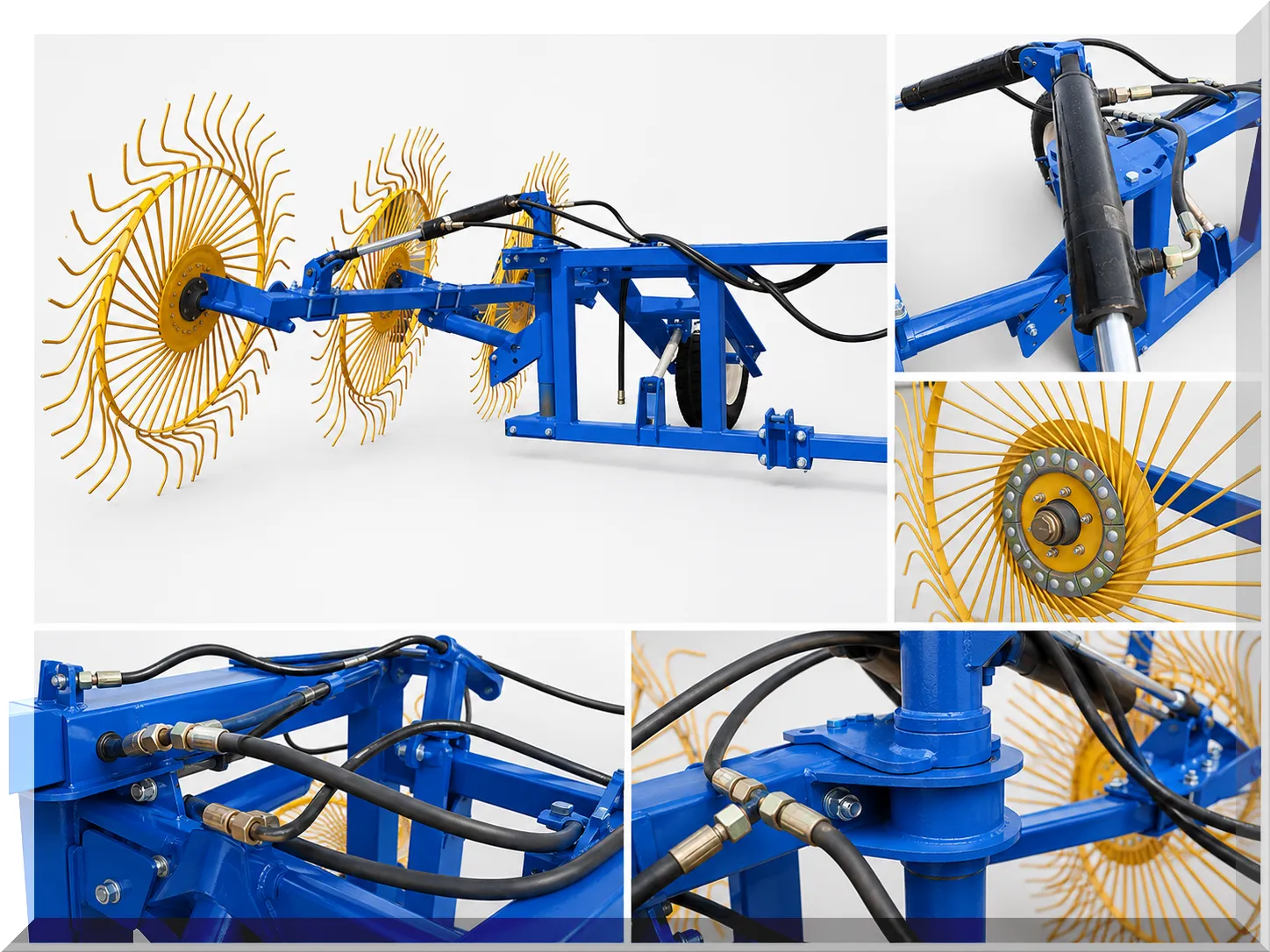
Each of the three discs on this rastrillo de heno carries 40 spring-steel tines in two rows of 20, staggered to ensure continuous tine contact across the full disc rotation rather than gapped pulses. At 7 to 10 km/h working speed, the 120 total tines across the three discs process the full 2.0-meter swath with approximately 160 to 230 tine contacts per square meter of hay mat — enough density to lift and aerate effectively without the redundant overlapping contacts that cause excessive leaf shatter at higher tine counts.
The spring-steel tine construction is critical for a second reason beyond lifting: as each tine runs through the hay stem, it creates micro-fractures along the stem wall at the leaf node positions. These fractures accelerate moisture loss from the stem interior — which dries substantially more slowly than the leaf surface — by providing additional escape pathways for internal moisture vapor. This stem-fracture mechanism is why tedded alfalfa dries more evenly across the full stem cross-section rather than producing the characteristic "dry leaf, wet stem" profile of untedded hay.
Ground-Driven Rotation: No PTO Required, Ground Speed Controls the Process
El 9FZ-2.0 discs are ground-driven — disc rotation is powered by ground contact through the disc's peripheral tines, not by a PTO shaft. This means: no PTO shaft connection needed, no risk of PTO overload events, and — most practically — the tractor's rear PTO remains completely free for other implements during the same field session. The tractor's 35 HP requirement is for drawbar pull at 7 to 10 km/h working speed and three-point hitch load bearing — not for PTO power generation.
Ground-driven rotation also means that tine contact intensity scales directly with ground speed. At 7 km/h, the tines make more rotations per meter of travel — more contacts, more intensive fluffing, suitable for dense alfalfa mats. At 10 km/h, fewer rotations per meter — lighter treatment, appropriate for thin grass hay where aggressive tedding would shatter stems without benefit. The operator controls tedding intensity with the throttle and ground speed selector, without adjusting any mechanical setting on the implement.
The Hydraulic Fold: 3.5 m Working Width to Transport Configuration in Under 2 Minutes
- ▸All three discs deployed laterally at full working spacing
- ▸2.0 m effective tedding coverage per pass
- ▸All tines in ground contact across full width
- ▸Outer discs fold inward and upward via hydraulic cylinder
- ▸Transport width reduced for road transit and gate passage
- ▸Fold and unfold cycle: under 2 minutes from tractor cab
On a 100-acre operation with multiple small fields separated by county roads and farm lanes, the time spent transitioning between fields adds up across a cutting season. A manual fold mechanism requires dismounting, unbolting, repositioning, and re-bolting — typically 8 to 15 minutes per fold event. Hydraulic fold at the SCV lever from the cab takes under 2 minutes and requires no dismounting. On a cutting day with 4 to 6 field moves, that difference is 30 to 50 minutes recovered per cutting day, every cutting season.
from tractor cab
When to Ted: The Application Timing Decision Guide
Knowing when to run the rastrillo de heno — and when not to — determines whether the 30 to 40 percent drying benefit is actually realized. The most common finger wheel tedder timing errors are: tedding too early at excessive moisture (above 70%), which causes more leaf shatter loss than drying benefit; and not tedding at all on sunny days above 25°C because "it will dry anyway," which wastes the weather window by accepting a slower natural drying rate when the machine could accelerate it.
| Tipo de cultivo | First Ted — When | Second Ted — When | Velocidad de trabajo | Key Caution |
|---|---|---|---|---|
| Alfalfa (alto contenido de hojas) | 4–6 hrs after mowing (50–60% moisture) |
If moisture >30% next morning AM |
7–8 km/h only | Leaf shatter risk above 8 km/h at <40% moisture — a rule specific to alfalfa on any rastrillo de heno — slow down as hay dries |
| heno de pastos mixtos | 3–5 hrs after mowing (55–65% moisture) |
Morning of Day 2 if moisture >25% |
8–10 km/h | Grass stems more durable — slightly higher speed acceptable |
| Hierba timotea / pasto ovillo | Same day as mowing 2–4 hrs after |
Morning Day 2 if swath thick |
8–10 km/h | Good response to tedding — DM losses from tedding are minimal on grass-dominant stands |
| Native grass / CRP | 4–8 hrs after mowing (dense swaths only) |
Usually not needed if thin stand |
7–9 km/h | Thin native grass stands may not benefit enough to justify the fuel and time cost — assess swath thickness before tedding |
The 9FZ-2.0 in the Complete Hay-Making Chain
A rastrillo de heno is the second step in a four-step hay-making sequence. Its position in the chain is often skipped on small operations where every extra field pass seems like additional cost — but the pass it enables (a 1-day reduction in field time) typically recovers that cost in improved hay grade on every cutting where weather poses any threat.
On foragebaler.com, the complete four-step chain — mowing equipment, tedder, hay rakes, and round balers — is available from one U.S.-based supplier with one parts warehouse and one support team. The 9FZ-2.0 was specifically designed to operate on the same compact 35+ HP tractor that runs our smaller-class balers and rakes, keeping the full system accessible to small-to-mid farm operations without requiring a second tractor for each step.
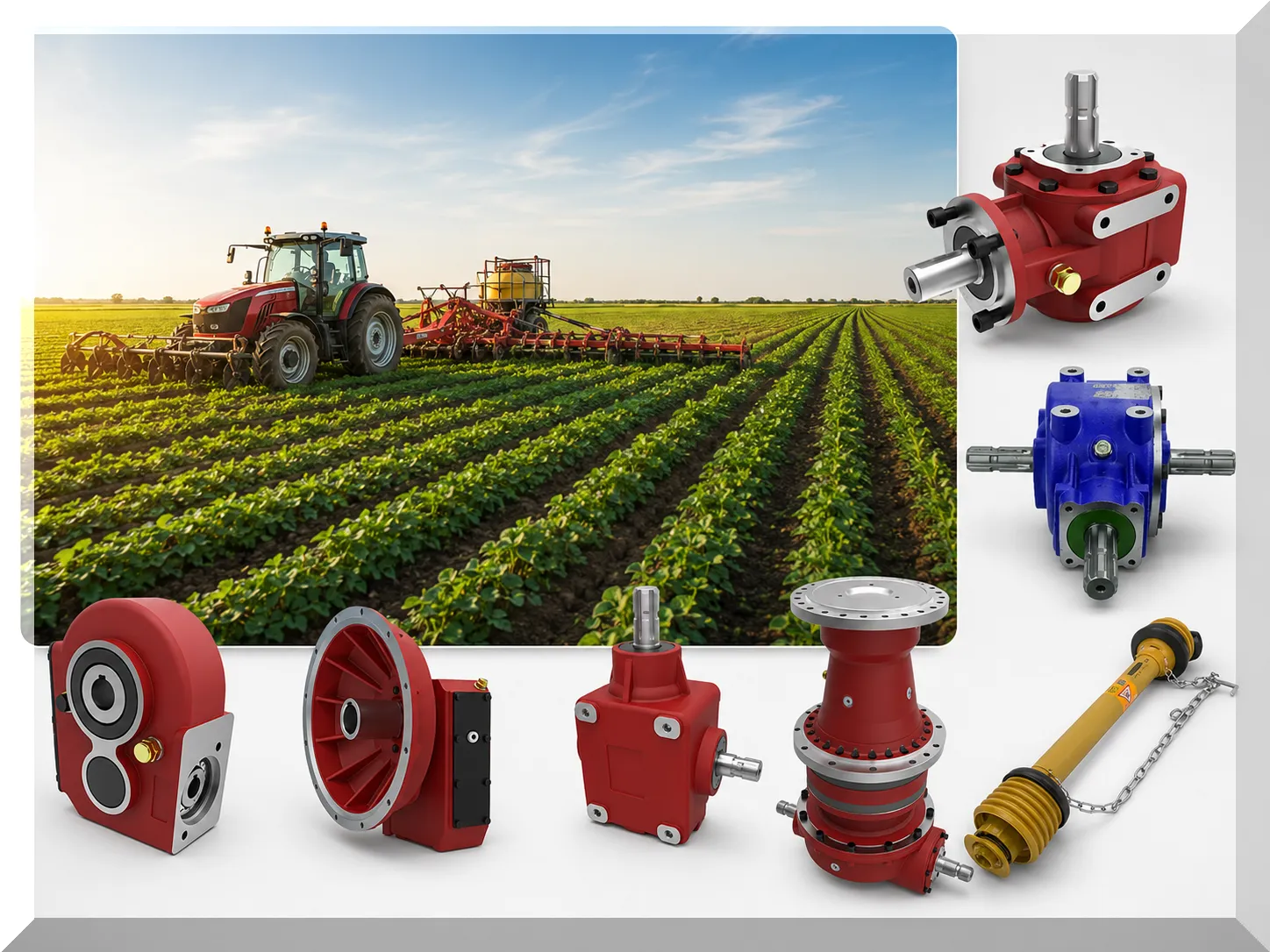
The round baler at the end of this rastrillo de heno-to-baler chain operates a 540 rpm PTO driveline that handles both continuous compaction torque and instantaneous pickup loads. A correctly sized agricultural PTO drive gearbox in the baler's driveline ensures the baling step stays running at full pace throughout the hay-making day — which the faster drying enabled by the 9FZ-2.0 makes all the more critical, since the baler window shortens from 3 to 4 days without a tedder to 1 to 2 days with one.
Five Engineering Advantages of the 9FZ-2.0 Hydraulic Folding Finger Wheel Tedder
Hydraulic 2-Minute Fold — From One Seat
The single-SCV hydraulic fold mechanism converts the 9FZ-2.0 from its 3.5-meter working footprint to transport configuration without the operator leaving the tractor cab. Road transit between fields, gate passage, and roadside parking all work within the folded profile. No manual disconnection of discs, no loose hardware, no tool requirement for the fold cycle.
120 Spring-Steel Tines — Balanced Density
40 tines per disc in two staggered rows of 20 delivers continuous contact density without the redundant overlapping action that shreds leaves at higher tine counts. The spring-steel tine material absorbs impact loads from hard soil patches and rock contacts without breaking — the same elastic behavior that makes spring-tine pickups durable on rocky ground applies to tedder tines on stubble fields with surface irregularities.
−30–40% Cure Time — Verified Range
El rastrillo de heno's 30 to 40 percent drying time reduction is a verified agronomic finding from commercial hay production trials, not a marketing claim. The range reflects real-world variation by crop type, weather conditions, and swath density. Alfalfa in humid conditions, where the dense leaf canopy slows drying most severely, sees the higher end of the range. Grass hay on dry windy days may see only 20 to 25 percent improvement — still worth the two field passes on any day where rain probability is non-trivial.
35 HP Low-Entry Power Requirement
At ≥25.73 kW (≈35 HP), the 9FZ-2.0 finger wheel tedder runs on the same compact utility tractors that operate small-class round balers and hay rakes. No dedicated heavy tractor required. The ground-driven disc rotation means the tractor provides only drawbar pull and hydraulic power for the fold mechanism — the discs add no additional PTO load. This HP class covers Kubota M5660, John Deere 4052R, Massey Ferguson 2706E, and equivalents.
JB/T 7766-2011 Certified — Standardized Quality
JB/T 7766-2011 is the Chinese agricultural machinery industry standard for hay tedders, covering dimensional tolerances, material specifications, weld quality, and functional performance criteria. Compliance with this standard confirms that the 9FZ-2.0 hay tedder meets defined engineering benchmarks for disc balance, tine retention force, hydraulic system operating pressure, and folded-state structural integrity — not merely that it "passes inspection."
Tractor Compatibility: 35 HP Floor, Wide Practical Range
El 9FZ-2.0 finger wheel tedder requires Category I or Category II three-point hitch and one rear SCV hydraulic outlet for the fold mechanism. No PTO shaft. The following tractor classes are confirmed compatible across the U.S. compact and utility tractor market. Note: Brand names listed for buyer reference only; foragebaler.com has no affiliation with these manufacturers and this listing does not imply endorsement.
| Rango de HP | Hitch Category | Compatible Tractor Examples (U.S.) | Notas |
|---|---|---|---|
| 35–50 HP | Cat I / II | Kubota MX5400, JD 4052R, Mahindra 3540, LS MT347, Massey 2706E | Minimum viable range; flat terrain preferred |
| 50–75 HP | Cat I / II | Kubota M7060, JD 5055E, NH T4.75, Case Farmall 65C, Kioti DK5510 | Comfortable range; handles any terrain |
| 75–100 HP | Cat II / III | JD 5085E, Massey MF 5711, NH T5.100, Case Maxxum 100 | Overspecified for this implement; fully functional |
Maintenance: Ground-Driven Simplicity
With no PTO driveshaft, no chains, and no belts in the disc drive system, the 9FZ-2.0 hay tedder maintenance schedule involves three service points:
⚙️ Every 8–10 Field Hours
🔩 Every 50 Hours or Seasonally
📦 Pre-Season / Storage
Why U.S. Hay Producers Choose foragebaler.com
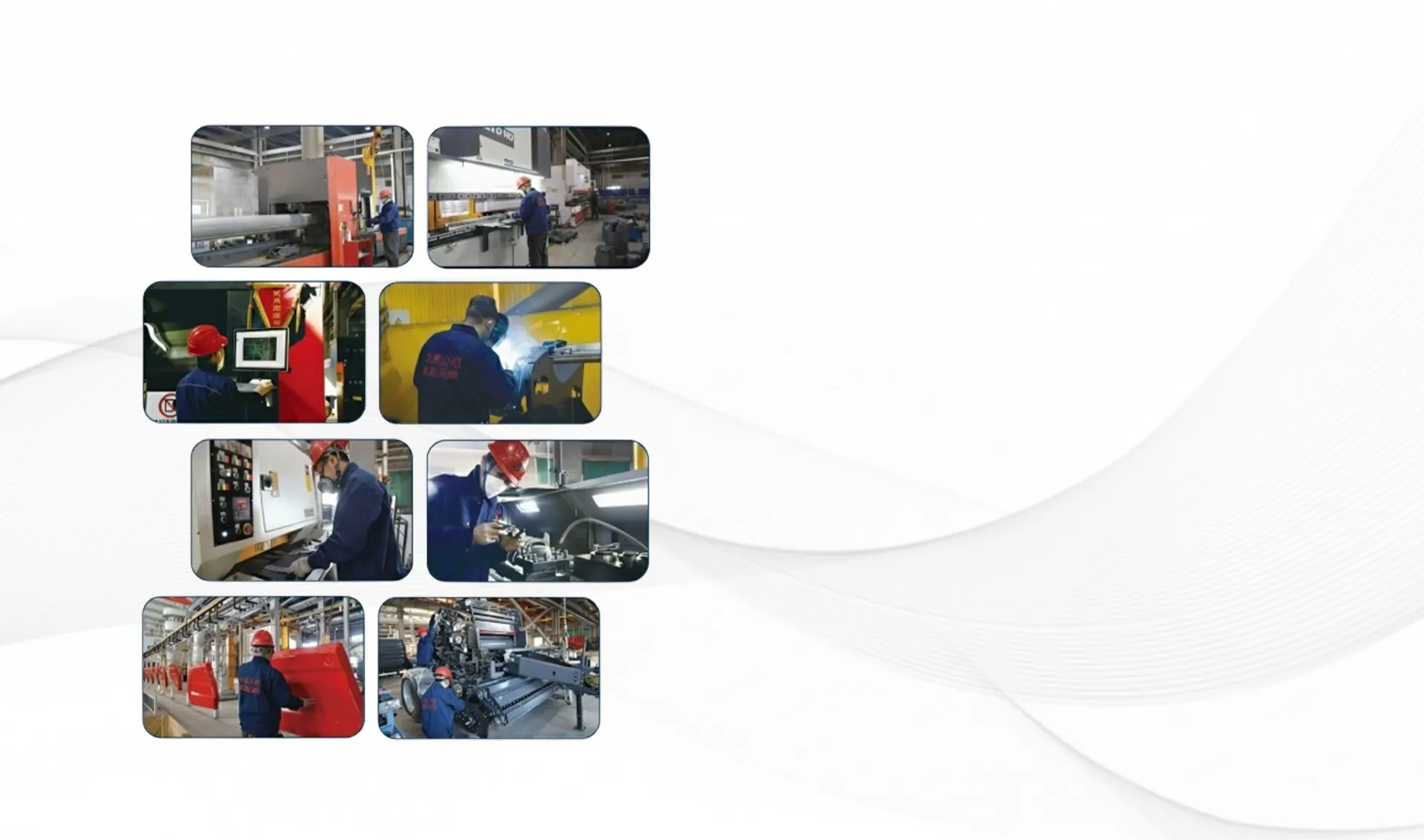
- ✔Complete Hay System, One Supplier. El Henificadora hidráulica plegable 9FZ-2.0 fits into a full field system available at foragebaler.com — mowing equipment, hay rakes, tedder, and round balers — supported from the same California warehouse and U.S.-based team.
- ✔Verifique la compatibilidad con el tractor antes de realizar el pedido. Three-point hitch category, SCV hydraulic pressure, and HP class confirmed from your tractor model and year at no charge before the machine ships — preventing the most common installation issues on three-point mounted implements.
- ✔U.S. Warehouse — Same-Day Parts Dispatch. 9FZ-2.0 hay tedder spring tine replacement sets (40-piece per disc, 120-piece full set), disc hub bearing kits, and hydraulic hose assemblies stocked year-round. Orders before 2:00 PM Pacific ship same business day.
- ✔JB/T 7766-2011 Quality Documentation. ISO 9001-certified manufacturing with full material traceability and production test records. Complete documentation package for Section 179 first-year expensing and USDA FSA equipment records on request.
- ✔Direct Factory Price. No dealer intermediary. The price reflects machine cost and U.S. logistics — typically 15 to 22 percent below equivalent equipment through dealer channels at the same specification level.

Preguntas frecuentes
Six Season Reports from U.S. Hay Operations
First-cut alfalfa in Dane County with a 3-day weather window — we used to lose 15 to 20 percent of first cut to weather damage every year. Since adding the 9FZ-2.0, we ted the morning after mowing and bale on day two almost every first cut. Two seasons in, zero weather-damaged first cut. The 7 km/h speed limit on alfalfa is real — I tried 9 km/h on a dry afternoon and the shatter was visible in the field. At 7 km/h: completely clean. Pairs with our Kubota M7060 without any strain.
Paul Reinhart — Dane County, WI (mid 2025) — 9FZ-2.0 hay tedder
We run 180 acres of mixed orchardgrass and timothy in the Finger Lakes region — summer weather here is very unpredictable and we typically get 40 to 50 percent of July days with afternoon showers. Before the tedder, second cut was our quality wildcard. Now we ted at 8 km/h on orchardgrass and consistently bale on day two. The hydraulic fold is the feature I didn't know I needed — we cross two county roads to reach our back fields and folding from the cab at the road edge takes about 90 seconds. Previous manual-fold tedder took 12 to 15 minutes per transition.
Greg Hoffman — Yates County, NY (early 2025)
90 acres of native grass and alfalfa in Winona County. The tedder has been a net positive, particularly on the alfalfa stands where we've reduced weather-related quality downgrades from about 25 percent of cuttings to around 10 percent. Four stars because on our thinner native grass stands, the tedding benefit is marginal — the grass is open enough that it dries without intervention and the extra pass doesn't add much. The machine is excellent on the alfalfa-heavy fields; on thin native grass, I now skip the pass entirely and save the time. Knowing when NOT to use it was the learning curve.
Joan Tessmer — Winona County, MN (mid 2025)
120-acre certified organic operation in Addison County, Vermont — the foggiest and most difficult drying climate in the Northeast. We have historically lost 30 to 40 percent of our haylage to over-fermentation from delayed baling at too-high moisture. The 9FZ-2.0 has been the single biggest change in our hay quality consistency. We ted the morning after mowing on every cutting, bale the following day for haylage at 45 to 55 percent moisture, and the fermentation profiles from our nutritionist have improved consistently across two full seasons. The machine cost paid for itself in the first season from reduced feed waste alone.
Ellen Bourque — Addison County, VT (late 2024)
Custom hay operation in the Snake River Plain doing about 600 acres per season. The 9FZ-2.0 runs on a dedicated 45 HP Kubota M5660 between the mowing tractor and the baling tractor in a three-machine workflow on large fields. Ground-driven operation means the dedicate ted-tractor needs nothing special — just a drawbar and one SCV outlet on a tractor that's otherwise too small for most commercial hay equipment. The 2-minute fold between fields is critical on our commercial pace — I'm moving machines across roads multiple times daily. Machine has been zero-downtime across the full season.
Dale Christoffersen — Twin Falls County, ID (mid 2025)
We farm 75 acres of mixed hay in Morrow County, Ohio — primarily for local horse hay sales where customer quality expectations are high and the $10 to $15 per bale premium for Grade 1 versus Grade 2 is meaningful. Ohio summer weather presents persistent rain risk between cuttings. In three seasons with the 9FZ-2.0, we have not had a single quality downgrade due to weather on any cutting where we used the tedder. The pre-purchase tractor check was very useful — we were on the fence about whether our 38 HP John Deere 3038E could handle it, and the U.S. team confirmed the hydraulic specs from our serial number before ordering. It's been fine on flat fields.
Laura Finney — Morrow County, OH (early 2025)
Cut Your Hay Drying Time by a Third — 9FZ-2.0 Hay Tedder
Tractor compatibility (hitch category, SCV pressure, HP class) verified from your model and year before shipment. Direct factory pricing, JB/T 7766-2011 quality documentation, Section 179 invoice package, and U.S. support included with every order.
America Ever-Power Forage Baler Equipment INC. | 1401 21st ST STE R, Sacramento, CA 95811
Información adicional
| Editor | Cxm |
|---|
Productos relacionados
-
Cosechadora trilladora de frijoles 4DQ-5 | Trilladora arrastrada de 5 hileras
-
Transportador de pacas redondas 9JYY-4.5 | Transportador de 4500 kg
-
Empacadora-envolvedora de ensilaje 9YCM-850 | 30–40 pacas/hora
-
Trituradora de forraje 9F-70 | Molino de martillos con toma de fuerza
-
Remolque transportador compacto de pacas redondas 9JYY-2.5


