Sélectionner une page

Humidity Management Guide · Southeast Strategies · Hay Preservatives

Baling Hay in High Humidity: Safety, Timing and Quality Guide

High humidity during hay baling is not simply inconvenient — it directly affects the moisture content of bales, the quality that reaches the buyer and the safety of stored hay in the barn. Understanding exactly what humidity does to a windrow and how to manage the risk separates operations that consistently produce premium hay from those that struggle with heating and rejection.

Covers: how humidity re-wets hay · RH vs dew point · safe thresholds · bale heating risk · Southeast strategies · hay preservatives · machine adjustments

How Humidity Re-Wets a Cured Windrow

A windrow that reached 15% moisture at 14:00 on Day 3 of curing can register 20–22% moisture core readings the following morning without any rain. This is not a measurement error — it is the result of moisture vapour from humid air being absorbed into the hay fibre when air temperature falls below the dew point temperature overnight.

The re-wetting process works through the same mechanism as curing but in reverse: as air temperature falls after sunset, relative humidity rises toward 100% and eventually reaches the dew point temperature at which the air can no longer hold all its moisture vapour. Below the dew point, moisture condenses onto surfaces — including hay fibres in the windrow. The outer layers of the windrow absorb this condensate first. By dawn, the windrow surface may have absorbed 4–8 percentage points of additional moisture compared to its peak-dry late-afternoon reading.

The critical insight: this re-wetted surface moisture is real moisture that enters the bale during compression. It is not simply cosmetic surface dampness. A probe moisture meter reading from the windrow core at 08:00 reflects both the residual core moisture from the previous day and the moisture that has migrated from the re-wetted surface inward overnight. Baling at this early morning reading produces bales that will heat.

Relative Humidity vs Dew Point — Which Indicator to Use

Why RH Alone Is Insufficient

Relative humidity tells you what percentage of the maximum possible moisture the air currently holds at its current temperature. It does not tell you how much moisture that is in absolute terms. At 10°C, air at 80% RH holds approximately 7.0 g/m³ of water vapour. At 30°C, air at 35% RH holds approximately 10.7 g/m³. The warm afternoon air at 35% RH holds more moisture per cubic metre than the cool morning air at 80% RH — yet the morning reading sounds more alarming.

Dew point temperature is stable through the day (assuming no weather fronts move through) and directly indicates at what temperature condensation will occur. A dew point of 15°C means that any surface cooler than 15°C will collect condensation from the air. If the nighttime temperature falls below 15°C — which it will in most regions except the Gulf Coast in peak summer — the windrow surface will be wetted. The lower the dew point relative to the predicted nighttime minimum temperature, the less overnight re-wetting will occur.

Dew Point Below 10°C

Low overnight re-wetting. Morning baling may be feasible if previous afternoon core moisture was below 17%. Check with probe meter before starting.

Dew Point 10–16°C

Moderate overnight re-wetting. Standard afternoon baling window applies (13:00–18:00). Probe test windrow core before starting each session.

Dew Point 17–21°C

Significant overnight re-wetting common. Narrow afternoon window (14:00–17:00). Southeast and Gulf Coast summer conditions. Consider preservatives.

Dew Point Above 21°C

Heavy re-wetting and short window. Gulf Coast peak summer. Window may be only 2–3 hours. Preservatives likely required for any mid-season baling.

What Happens to Bales Made at High Moisture

The Heating Timeline

All hay bales heat initially after baling — this is normal and expected. Fresh hay contains residual plant respiratory activity and microbial populations that produce heat as the bale stabilises. The question is how high the temperature rises and for how long. A correctly baled small square bale at 15–16% moisture will reach a maximum temperature of 40–48°C within 3–7 days of baling and then cool to ambient over the following week without significant damage.

A bale made at 19% moisture reaches 55–65°C within 48–72 hours. At this temperature, Maillard reactions begin — the protein in the hay binds to fibre components in a form that ruminants cannot digest. This protein is still visible in a crude protein analysis but is nutritionally unavailable. A bale that heated to 60°C may analyse at 18% crude protein but have only 12–13% available protein — a significant quality reduction that buyers cannot detect without acid detergent insoluble nitrogen testing.

Above 70°C, fire risk becomes real. Small square bale stacks in covered barns have caused significant barn fires from hay baled at excessive moisture. A bale stack that cannot be touched on the outer surface due to heat within 3 days of baling is at risk. Use a metal rod inserted deep into the stack as a temperature probe — if the rod is hot to the touch after 30 seconds inserted 60cm into the stack, the stack requires immediate spreading to dissipate heat.

Baling Moisture Peak Stack Temp Storage Outcome Market Consequence
14–17% 40–48°C Normal stabilisation. Cools within 2 weeks. Qualité supérieure
17–19% 48–58°C Moderate heating. Some protein binding. Possible mold. Reduced value
19–22% 58–70°C Significant protein damage. Visible mold likely. Discolouration. Rejection risk
Above 22% 70°C+ Fire risk. Severe mold. Nutritional value severely damaged. Total loss

Strategies for Southeast and Gulf Coast Producers
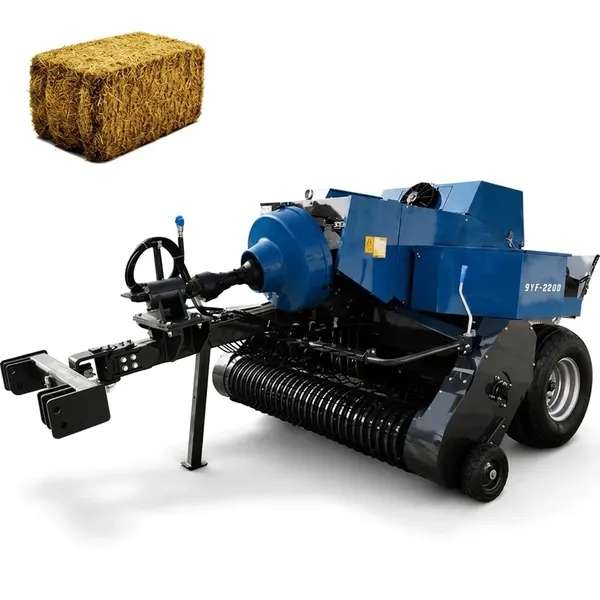
9YF-2200 square baler suitable for Southeast hay production operations where managing high humidity baling windows requires narrower windrow formation faster curing and strict afternoon timing compared to the wider baling windows available to producers in arid western states

Producers in Texas, Florida, Georgia, Alabama, Mississippi and Louisiana face consistently challenging baling conditions from June through September — dew point temperatures commonly reach 20–24°C, overnight minimum temperatures are warm (20–25°C), meaning the nighttime temperature often does not fall below the dew point and dew formation begins early in the evening and persists well into mid-morning. The following strategies are validated by producers in these conditions:

Strategy 1: Narrow Windrow Formation for Faster Core Drying
Form windrows at 50–60% of the pickup width rather than the maximum 75–80%. A narrower windrow exposes more surface area per unit volume of crop to airflow and solar radiation, allowing the core to dry faster relative to the surface. The trade-off is more passes per acre during raking — but in high-humidity conditions, faster core drying takes priority over raking efficiency. A windrow that can be baled 4 hours earlier due to narrower formation is worth the extra raking pass.
Strategy 2: Cut in Wider Swaths to Increase Curing Rate
Cut in the widest practical swath your mower allows and ted immediately — spreading the cut crop across the full cut width exposes maximum surface area to drying conditions. In humid climates, tedding is not optional — it reduces curing time by 30–50% compared to untedded windrows, which can mean the difference between 3 days and 5 days of curing in overcast or partly cloudy conditions.
Strategy 3: Strict Afternoon-Only Window Management
In Gulf Coast conditions during summer, the safe baling window is typically 13:00–17:00 — 4 hours. Do not attempt to extend this window by starting at 11:00 or continuing past 18:00 regardless of how the windrow surface feels. The morning surface moisture at 11:00 in high-humidity conditions is a poor indicator of core moisture, and evening humidity rises faster than in low-humidity regions. Accept a 4-hour window and plan field sessions to fit within it.
Strategy 4: Smaller Cutting Areas Per Session
Cut only as much area as can be baled in the available afternoon window on Day 3 or 4 of curing. Cutting more than can be baled in the available window leaves windrows that have been raked and re-wetted repeatedly — each dew cycle adds and removes moisture but the cumulative effect is nutrient loss through leaching and mechanical damage from multiple rake contacts. Smaller cutting cycles that allow all cut hay to be baled in one session reduce these losses.

Hay Preservatives: Do They Work in High Humidity?

How Preservatives Extend the Safe Moisture Threshold

Hay preservatives — typically propionic acid or buffered propionic acid blends — are applied to the windrow at the baler intake through a nozzle system. They work by inhibiting microbial activity in the bale, reducing the heating that occurs when bacteria and molds metabolise moisture and organic compounds in the hay. A correctly applied propionic acid treatment can extend the safe baling moisture threshold from approximately 17% to 20–22% for small square bales in covered storage.

This extension is valuable but not unlimited. Preservatives do not make wet hay safe indefinitely — at 25% moisture, the microbial load exceeds what practical preservative application rates can manage. The correct use of preservatives in high-humidity conditions: apply when the windrow core reads 18–21% and the weather forecast indicates rain within 24–48 hours, making waiting for lower moisture impractical. Do not use preservatives as a substitute for proper moisture management in normal weather — reserve them for genuine weather-pressure situations.

Practical Notes on Preservative Use

Application rate is critical — under-application provides false security without adequate protection. Follow the product label rate exactly for the moisture level and bale weight. Some premium horse hay buyers are cautious about treated hay — verify that your buyer category accepts preservative-treated hay before using it as a routine practice. For export markets to Japan and Korea, confirm whether the specific propionic acid product is approved under the destination country regulatory requirements before applying to export lots.

Adjusting Machine Settings for Marginally Wet Hay
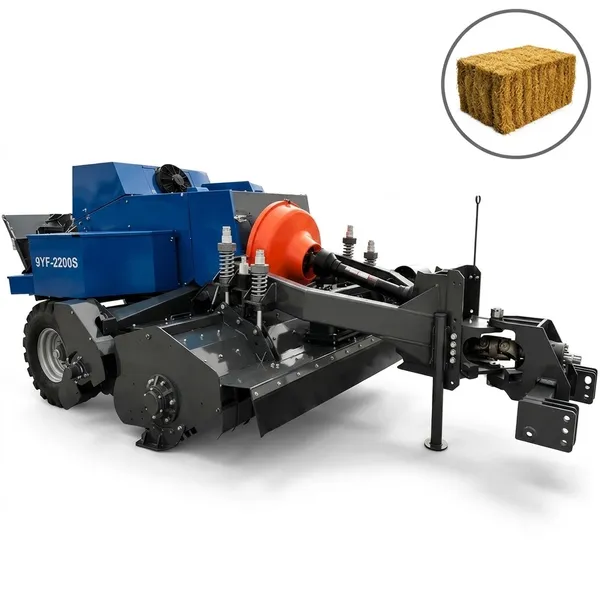
9YF-2200S square baler with shredder system — in marginally wet hay conditions the shredder on this model provides an additional benefit beyond density by breaking stem walls and accelerating moisture release from the bale interior which can reduce the peak heating temperature in the first days after baling compared to unshredded stem hay baled at the same moisture level

When baling at the upper edge of the safe moisture range — 16–18% — two baler adjustments reduce the risk of heating in storage:

Reduce bale density slightly: a less densely compressed bale has more internal air space, which allows residual moisture to escape more rapidly in the first days after baling. This reduces the peak temperature the bale reaches during the stabilisation period. The trade-off is lighter bales per unit volume — but in marginally wet conditions, a 22kg bale that cools safely is better than a 26kg bale that heats and loses quality.

Do not stack immediately: leave bales in a single layer with airflow between them for 48–72 hours after baling before stacking more than 2 layers high. Stacking insulates the interior bales from air cooling and concentrates the heat produced by the outer bales — dramatically increasing the peak temperature the inner stack reaches. Single-layer rest allows the initial moisture equalisation and peak heating to occur in conditions where the heat can dissipate to the surrounding air.

Monitor the stack temperature daily for the first week: use a metal temperature probe (a steel rod or baling stake inserted into the stack for 30 seconds) to monitor heat levels. Any probe that is too hot to hold with a bare hand after 30 seconds inside the stack indicates temperatures approaching or exceeding 60°C — spread the bales immediately to prevent further temperature increase.

Moisture Testing Tools for High-Humidity Conditions
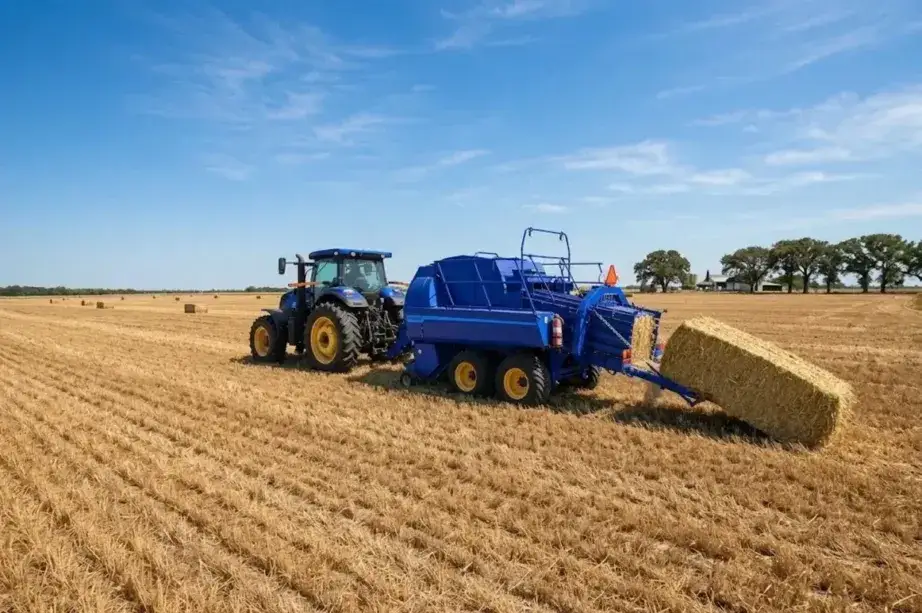
square baler in field operation with operator checking windrow conditions before baling — in high-humidity environments probe-type windrow moisture testing must be conducted from the windrow core not the surface because surface readings underestimate core moisture by up to 6 percentage points in warm humid conditions making surface feel testing an unreliable indicator of safe baling moisture

Surface feel and surface colour are unreliable moisture indicators in high-humidity conditions — the windrow surface dries faster than the core under any conditions, and in humid air, the surface can appear and feel dry while the core retains 20%+ moisture from overnight re-wetting. The only reliable moisture measurement for baling decisions is a probe-type moisture meter reading from the windrow core at 15–20cm depth.

In high-humidity regions, take a minimum of 5–8 core readings across the field width and at multiple locations along the windrow length before deciding to bale. Moisture is not uniform — low-lying areas of the field, shaded sections near tree lines, and areas where the windrow is wider from a previous merge point will consistently show higher moisture than the driest parts of the field. Use the highest reading as your go or no-go decision point, not the average. A single high-moisture zone in an otherwise ready field can produce enough out-of-condition bales to compromise a buyer relationship built over multiple seasons.

Square Baler Range for Humid Region Hay Production


agricultural gearbox and PTO shaft for square balers used in humid region hay production where reliable operation in compressed afternoon baling windows requires correct drive train specifications and maintenance

PTO shaft and gearbox specifications for all 9YF models: spécifications des boîtes de vitesses agricoles et des arbres de prise de force

In high-humidity regions where the baling window is compressed to 3–4 hours, machine reliability during that window is critical — any mechanical downtime directly costs baling time that cannot be recovered. Correct driveshaft setup prevents PTO-related downtime: PTO driveshaft and CV joint sizing guide.

Le 9YF series square balers include models with the fan dust-removal system (9YFS-2.2) that reduces ash content — relevant for humid-region hay where soil contact from low-set pickups is more common.
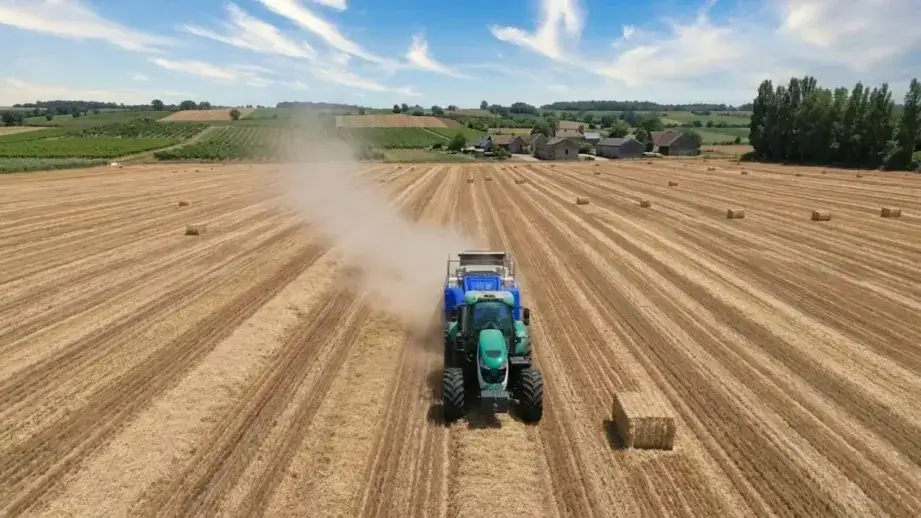
square bales in field showing correctly baled hay from a managed afternoon window — in humid regions all bales should be visually inspected at barn arrival and checked for temperature by hand on the outer surface within the first 48 hours of storage to confirm heating is within the normal stabilisation range and not progressing toward fire risk

Frequently Asked Questions — Baling Hay in High Humidity

What is the maximum relative humidity at which I can safely bale hay?+
There is no single maximum RH figure that applies universally — the safe RH depends on the temperature at which the humidity is measured, which determines how much moisture is actually in the air. At 32°C, air at 60% RH holds significantly more moisture per cubic metre than air at 20°C at the same 60% RH. For practical baling decisions: rather than using RH alone, use the combination of RH below 65% AND rising temperature AND windrow core probe below 17% as your green light. When all three conditions are met, baling is generally safe regardless of the absolute RH value. When RH is above 70% at any temperature, baling risk increases significantly and probe testing should be done more frequently during the session — every 30 minutes in humid southern conditions rather than once at session start.
My hay was 15% moisture yesterday afternoon but this morning it reads 20%. Did I do something wrong?+
No — this is entirely normal overnight re-wetting and is not a measurement error or a problem with the crop. Your hay reached baling moisture at 15:00 yesterday afternoon. Overnight, the temperature fell below the dew point, and moisture condensed on the windrow surface. By 08:00 this morning, the surface-absorbed moisture has partially migrated into the windrow core, raising the core reading. The correct response: wait. The morning moisture will decrease again as solar radiation and airflow resume. By 12:00–13:00 on a sunny day with moderate humidity, the windrow core should return to a reading close to yesterday afternoon. Test again at 12:00 and 14:00. If the reading does not return to below 17% by 14:00, the overnight re-wetting was more severe than typical — the dew point in your area was high enough that significant moisture was added to the windrow overnight. In this case, wait for another 24 hours or apply preservative if a weather deadline forces earlier baling.
How do I know if my bales from yesterday are heating in the barn?+
Three detection methods for bale heating in storage. First: thermometer probe method — push a soil thermometer or metal probe into the stack and read after 30 seconds. Above 50°C is a concern requiring monitoring. Above 60°C requires immediate action. Second: smell — a sweet, caramel-like or tobacco-like smell from a fresh bale stack is normal initial curing. A sour, vinegar-like or musty smell indicates microbial activity that is excessive. Third: touch the outer bale surface in the centre of the stack — warm to the touch on the outside after Day 3 suggests significant heating inside. A stack that cannot be hand-touched on the outside due to heat requires spreading immediately. Monitor every 24 hours for the first 7 days after baling. If peak temperature remains below 50°C and is clearly declining by Day 5, the bales are stabilising normally. If temperature continues to rise through Day 4 or 5, the moisture level was too high and the lot will have quality damage regardless of what is done now — spread the bales and maximise airflow to limit further damage.
Can I bale bermudagrass hay in Florida in July without preservative?+
Yes — but the management required is strict and the window is narrow. In central Florida in July, average dew point temperatures are 21–24°C and daytime highs reach 33–35°C. The afternoon drying window when conditions are suitable for small square baling is typically 13:30–16:30 — a 3-hour window. To bale without preservative in these conditions: rake in the morning (07:00–09:00), allowing the windrow to cure through the full day; test core moisture at 12:00 and 13:00; bale only if core reads below 17% by 13:00 and RH is below 70% at that time; stop by 17:00. Fields that have been rained on during curing, or fields in shaded or low-lying areas, may not reach 17% core moisture within this window — these lots benefit from preservative application if baling cannot be delayed. Many Florida bermudagrass producers apply preservative as a routine practice during July–August, treating it as a cost of doing business in their climate rather than an emergency measure.
Does the bale format affect heating risk — does small square bale hay heat more or less than round bale hay at the same moisture?+
Small square bales have a higher surface-area-to-volume ratio than large round bales, which means they can lose moisture more rapidly to the surrounding air after baling — which can limit heating if the bales are stored in a well-ventilated barn with airflow between bales. However, small square bales stacked tightly in a barn loft have significantly less airflow around individual bales than round bales stored in rows outdoors or in an open barn — the stacking pattern insulates inner bales from the cooling effect. In practice: round bales at 19% moisture stored outdoors with airflow often heat to a lower peak temperature than small square bales at the same moisture stacked 6 layers high in a closed barn, because the round bales are exposed on all sides while the inner square bales in a tight stack have no air contact. The safe moisture threshold for small square bales depends significantly on stacking configuration — loosely placed bales in an airy barn are safer at 17–18% than tightly stacked bales of the same moisture in a closed space.
Will hay that heated in the barn still be suitable for feeding?+
Hay that heated to 48–55°C and then stabilised without visible mold or discolouration may still be acceptable for some livestock feeding, but is likely not premium horse hay quality. The primary concern is protein availability: heat-damaged protein (often called heat-damaged protein or ADICP — acid detergent insoluble crude protein) is still present on a standard crude protein analysis but is not digestible. A hay that heated significantly may analyse at 16% crude protein but only have 11–12% digestible protein after ADICP is subtracted. To determine the extent of damage, submit a sample for forage analysis including the ADICP test — this will indicate whether the protein loss is significant. Hay that heated above 60°C, shows visible mold or has a strong musty or vinegar smell should not be fed to horses and should be evaluated by a nutritionist before feeding to any livestock. The risk of mycotoxin production in severely heated hay makes feeding decisions for high-moisture heated lots best made with professional guidance rather than visual assessment alone.
Is early morning cutting better for avoiding humidity problems during baling?+
The timing of cutting affects the curing trajectory but does not change the fundamental humidity challenge at baling time. Early morning cutting (05:00–08:00) on Day 0 puts the crop into the drying environment as early as possible on Day 1 and subsequent days — maximising the total sun hours available for curing. This can reduce the total curing time by 12–24 hours compared to afternoon cutting, particularly in sunny periods with afternoon thunderstorms (common in the Southeast). However, the moisture at which the hay arrives at the baling window on Day 3 or Day 4 is still determined by the combination of overnight re-wetting and afternoon drying during those curing days — and the nighttime re-wetting is the same regardless of when the crop was cut. Early morning cutting is worth doing in humid regions to maximise total curing time and avoid cutting during afternoon humidity spikes, but it does not eliminate the need for strict afternoon-only baling window management at harvest time.
What weather app or tool gives the most reliable dew point data for baling decisions?+
For accurate local dew point data at field level, a personal wireless weather station placed within 300–500 metres of your baling field is the most reliable single tool. Units from Davis Instruments, Ambient Weather, or AcuRite in the $80–$200 price range provide real-time dew point along with temperature and humidity. For forecast data, the National Weather Service hourly forecast at weather.gov provides dew point on a 48-hour hourly graph for any U.S. location — search your zip code and look for the hourly detailed forecast with temperature and dew point shown separately. Weather Underground (wunderground.com) allows you to find the nearest personal weather station to your location, which often provides more locally accurate readings than airport or official station data. The combination of a personal field station for real-time readings and NWS hourly forecast for planning the upcoming 24–48 hours gives you the information to make reliable baling timing decisions without relying on feel or surface observation alone.

Choose the Right Baler for Your Regional Climate

From fan-equipped models for export-grade low-ash hay to standard models for reliable afternoon baling in any region — the 9YF series covers every small square baling application. Tell us your primary crop, region and market and we will confirm the right model for your conditions.

Éditeur : Cxm