
Transporteur de balles rondes 9JYY-4.5 | Transporteur de 4 500 kg
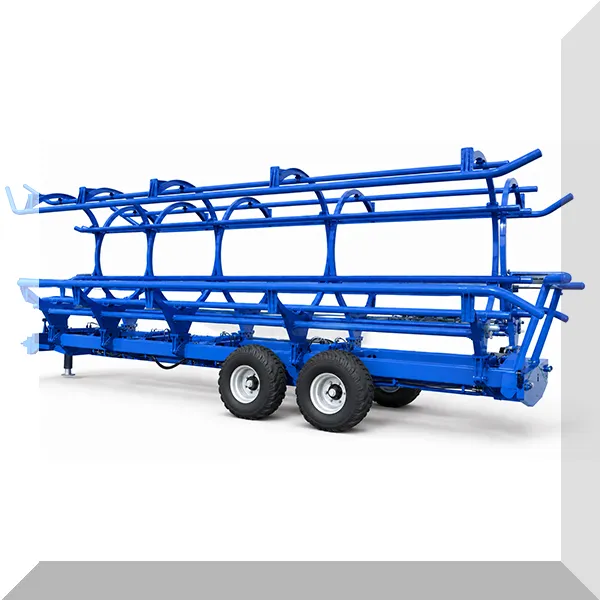
Le Transporteur de balles rondes 9JYY-4.5 Le modèle 9JYY-4.5 est le fleuron de notre gamme de remorques porte-balles à grande capacité. Il offre une charge utile de 4 500 kg sur une plateforme à deux essieux et quatre roues, équipée de deux circuits hydrauliques indépendants et d'un bras de ramassage repliable. Ce dernier se déploie jusqu'à une largeur de travail de 6 750 mm et se replie à 2 900 mm pour le transport routier. Si le 9JYY-2.5 optimise la logistique pour les exploitations de 40 à 120 hectares, le 9JYY-4.5 est conçu pour les producteurs de foin, les entreprises de pressage à façon et les élevages où le transport de 6 à 9 balles par voyage – et non de 3 à 4 – fait toute la différence entre une journée de travail et trois.
Quand la capacité devient la contrainte : l'argumentaire commercial en faveur du 9JYY-4.5
À un certain stade de l'exploitation d'un élevage commercial de foin ou de bétail, le facteur limitant la logistique des balles n'est plus le nombre de trajets, mais le temps d'utilisation du tracteur. Une exploitation de luzerne de 200 hectares (500 acres) effectuant trois coupes par an produit environ 1 500 balles annuellement. À raison de 2 500 kg par trajet (3 à 4 balles), cela représente 375 à 500 trajets par saison. À raison de 4 500 kg par trajet (6 à 9 balles), on en compte 167 à 250. Le 9JYY-4.5 ne se contente pas de réduire le nombre de trajets ; il diminue également le temps total consacré par un tracteur de plus de 68 ch à la logistique des balles, le libérant ainsi pour le labour, les semis et d'autres tâches génératrices de revenus.
Les entreprises de pressage à façon sont confrontées à une contrainte similaire, mais différente : leurs clients paient pour un travail complet incluant le pressage et le nettoyage, et chaque heure d'attente du tracteur de pressage représente une heure facturable perdue. Avec une capacité de 6 à 9 balles par passage, tractée par un tracteur dédié de 70 à 100 ch, la presse 9JYY-4.5 surpasse même les presses commerciales les plus rapides : le champ est dégagé avant que la presse ne revienne pour l'andain suivant. Cette productivité accrue permet aux entreprises de couvrir des surfaces saisonnières plus importantes de se démarquer de celles qui fonctionnent déjà à pleine capacité. Vous pouvez consulter tous les produits sur fourragebaler.com pour voir comment le 9JYY-4.5 s'intègre dans un système de récolte complet.
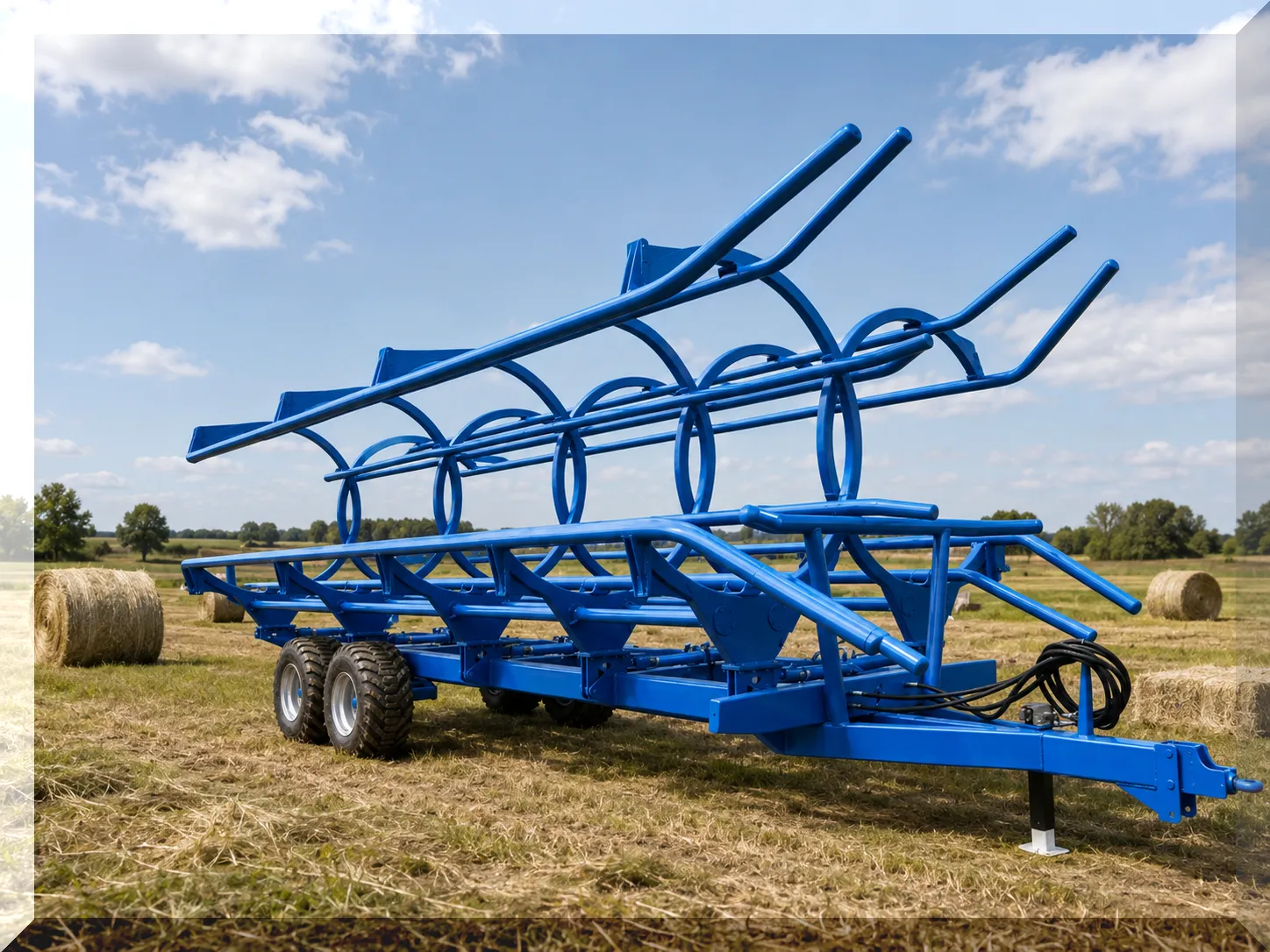
Spécifications techniques
Deux lignes de dimensions sont indiquées : les dimensions de travail (bras de levage entièrement déployés pour le chargement) et les dimensions de transport (bras repliés pour le transport routier). Avant toute première utilisation sur route, notamment sous des lignes électriques ou des ponts bas, vérifiez la hauteur libre de votre itinéraire pour une hauteur de transport de 3 300 mm (10,8 pi).
| Non. | Paramètre | Unité | Valeur |
|---|---|---|---|
| 1 | Produit | / | Chargeur et transporteur de balles rondes 9JYY-4.5 |
| 2 | Type d'attelage | / | Remorqué (barre de traction) |
| 3 | Méthode de chargement | / | Hydraulique (double circuit) |
| 4 | Charge utile maximale | kg (lb) | 4 500 (9 921 lb) |
| 5 | Puissance requise du tracteur | kW (HP) | ≥ 50 (≈ 68 HP) |
| 6 | Pression de service hydraulique | MPa | ≥ 16 (deux circuits indépendants) |
| 7 | Vitesse de transport maximale | km/h (mph) | ≤ 40 (25 mph) |
| 8 | Pneus | / | 400/60-15.5 — Essieu double, 4 roues |
| 9 | Diamètre de balle accepté | mm (po) | 1 000 à 1 400 (39,4 à 55,1 pouces) |
| 10 | Longueur de balle acceptée | mm (po) | 1 000 à 1 500 (39,4 à 59,1 pouces) |
| 11 | Dimensions utiles (L×l×H) | mm (pi) | 9400 × 6750 × 1750 (30,8 × 22,1 × 5,7 pi) |
| 12 | Dimensions de transport (L×l×H) | mm (pi) | 9400 × 2900 × 3300 (30,8 × 9,5 × 10,8 pi) |
| 13 | Poids total de la machine | kg (lb) | 3 240 (7 143 lb) |
Ingénierie des circuits hydrauliques doubles : pourquoi deux circuits indépendants sont importants
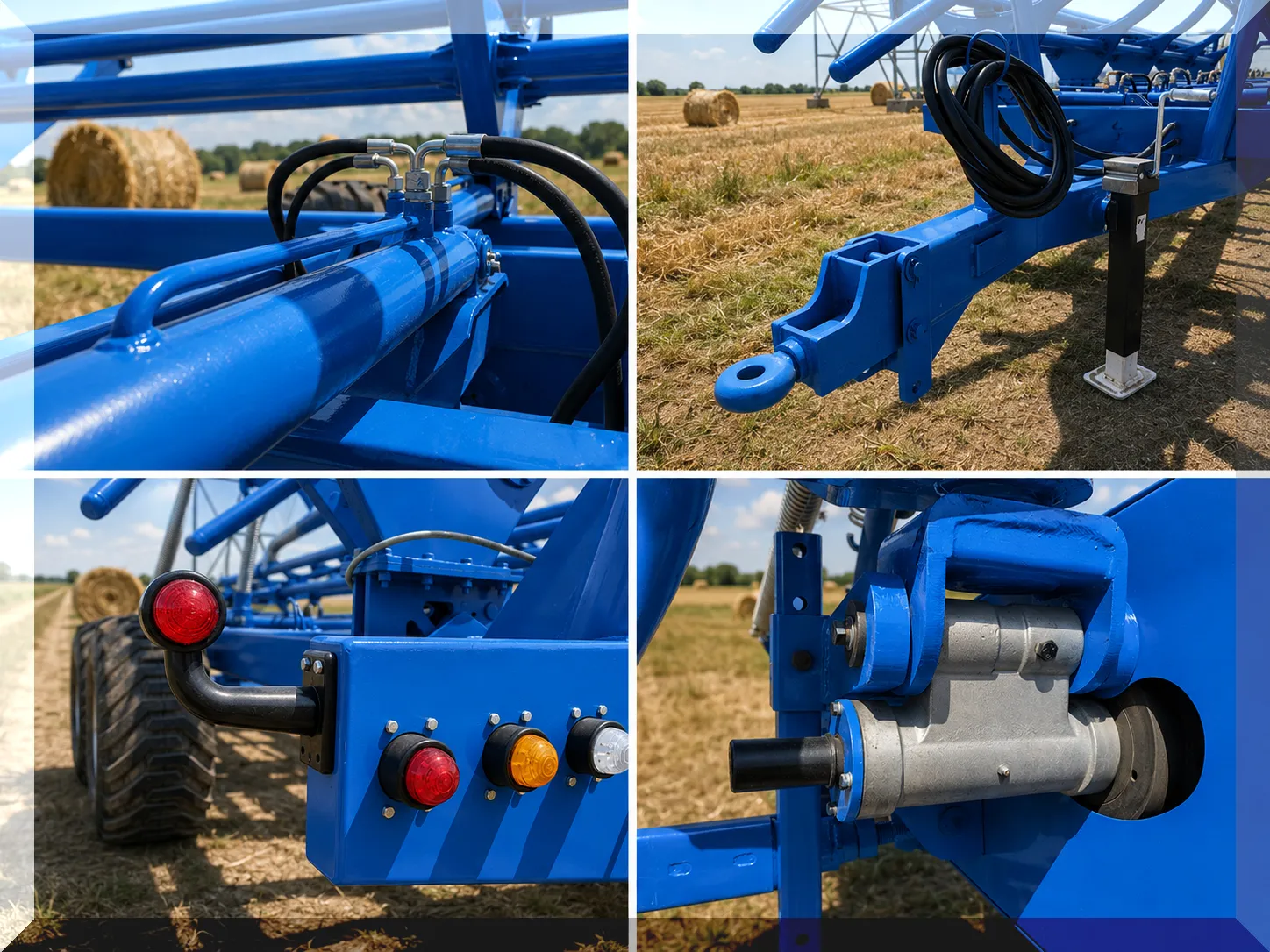
La plupart des transporteurs de balles à un seul essieu fonctionnent avec un seul vérin hydraulique relié à une commande à distance du tracteur. Le 9JYY-4.5, quant à lui, utilise deux circuits hydrauliques totalement indépendants, chacun relié à une sortie de distributeur hydraulique distincte du tracteur et commandant un côté du système de ramassage à double bras. Il ne s'agit pas d'une redondance ajoutée a posteriori ; c'est le choix de conception fondamental qui permet à la machine d'offrir une charge utile élevée, une grande capacité de manutention des balles et des temps de cycle rapides à l'échelle industrielle.
Lorsque le bras de ramassage d'un côté rencontre une résistance accrue de la balle (par exemple, une balle d'ensilage particulièrement dense ou une balle légèrement inclinée), le circuit de ce côté peut supporter une pression plus élevée sans affecter le bras opposé. Un système à circuit unique égaliserait la pression entre les deux bras, ce qui entraînerait une extension excessive du côté le plus léger ou un levage insuffisant du côté le plus lourd. L'architecture à circuit indépendant maintient chaque bras précisément à la charge requise.
Sur les parcelles ouvertes où les balles sont disposées sur deux rangs, le double circuit permet de charger simultanément une balle de chaque côté de la machine, au lieu de les charger successivement. Ceci réduit de près de moitié le temps de cycle de chargement sur les parcelles aménagées de manière appropriée – un gain de temps considérable qui se cumule sur des centaines de trajets par saison dans les grandes exploitations commerciales.
Si un circuit hydraulique subit une défaillance (fissuration de flexible ou fuite de raccord) pendant la récolte, la machine continue de fonctionner grâce au circuit restant, ramassant les balles d'un côté à un rythme réduit au lieu de s'arrêter complètement. Dans une période de récolte de 10 jours où les coûts d'arrêt se mesurent en termes de qualité de la récolte et de respect des délais contractuels, cette capacité de résilience opérationnelle présente un réel avantage économique.
Votre tracteur doit être équipé d'au moins deux distributeurs hydrauliques arrière (SCV), chacun capable de fournir une pression de service ≥ 16 MPa avec un débit hydraulique suffisant (minimum 25 à 30 l/min par circuit). Avant de commander, vérifiez le nombre de distributeurs hydrauliques de votre tracteur dans le manuel d'utilisation. La plupart des tracteurs agricoles et utilitaires de 68 à 100 ch sont équipés de 2 à 4 distributeurs hydrauliques arrière. Si votre tracteur ne possède qu'un seul distributeur hydraulique, le modèle 9JYY-2.5 à circuit unique est le choix approprié.
Compatibilité avec les balles de diamètre 1 000 à 1 400 mm : ce que votre flotte peut désormais utiliser
La géométrie du berceau du bras de ramassage du 9JYY-4.5 est conçue pour s'adapter à toute la gamme de diamètres de balles rondes (1 000 à 1 400 mm) produites par les presses à balles rondes commerciales du parc américain, des presses compactes de 40 pouces aux grandes presses commerciales de 5 pieds × 6 pouces, en passant par les presses standard de 5 pieds. Ce point est crucial pour les entrepreneurs et les acheteurs de foin qui travaillent avec de nombreuses exploitations agricoles clientes utilisant des presses de marques et de configurations différentes.
| Configuration des balles | Plage de poids typique | Balles de 4 500 kg | Type de presse à balles / culture courante |
|---|---|---|---|
| Ø 1 000 mm × L 1 000 mm | 300–450 kg | 10 à 15 balles | foin sec, paille — presses à balles compactes utilitaires |
| Ø 1 200 mm × L 1 200 mm | 450–700 kg | 6 à 10 balles | Luzerne, graminées mélangées — presses à balles standard de milieu de gamme |
| Ø 1 300 mm × L 1 300 mm | 600–900 kg | 5 à 7 balles | Luzerne commerciale, bermuda côtier — la plupart des presses à balles commerciales américaines |
| Ø 1 400 mm × L 1 500 mm | 800–1 200 kg | 3 à 5 balles | Ensilage de maïs à forte humidité, lourd, côtier — grosses presses à balles commerciales |
Quatre opérations où le 9JYY-4.5 change la donne économique
Revente et exportation de foin à longue distance
Les grands producteurs de foin du Texas, de l'Idaho et de la Californie, qui vendent leurs balles en gros aux parcs d'engraissement, aux laiteries et aux entreprises de consolidation à l'exportation, doivent empiler de 200 à 400 balles à la fois sur des aires de stockage accessibles aux camions pour le chargement des semi-remorques. Avec un rythme de 6 à 9 balles par voyage, le 9JYY-4.5 traite un champ de récolte de 300 balles et les stocke sur une aire de stockage en 35 à 50 voyages, contre plus de 100 voyages avec un tracteur chargeur. La plateforme à deux essieux maintient une vitesse de 40 km/h sur les chemins agricoles goudronnés entre le champ éloigné et l'aire de chargement, sans les secousses et le balancement que l'on observe avec les équipements de transport à un seul essieu sur les trajets à grande vitesse sur autoroute.
Logistique commerciale du foin pour les exploitations laitières — Réapprovisionnement hebdomadaire des granges
Les grandes exploitations laitières, avec 500 à plus de 1 500 têtes de bétail, consomment des volumes de foin qui nécessitent un réapprovisionnement organisé des étables une à deux fois par semaine à partir des parcs de stockage situés en périphérie des champs. Déplacer 40 à 60 balles par cycle de réapprovisionnement avec un tracteur chargeur prend une demi-journée. Le 9JYY-4.5 effectue le même travail en 6 à 8 voyages, soit moins de deux heures, avec un tracteur de 70 ch qui, autrement, resterait inutilisé en milieu de semaine entre les travaux des champs. Les exploitations laitières du Wisconsin et du Minnesota, qui cultivent plus de 120 hectares de luzerne, constatent régulièrement que le 9JYY-4.5 réduit leur temps de réapprovisionnement hebdomadaire des étables de 4 à 5 heures à moins de 2 heures.
Opérations de flotte d'entrepreneurs en pressage sur mesure
Les entreprises de pressage à façon, intervenant chaque semaine sur plusieurs exploitations clients, sont confrontées à deux contraintes d'organisation simultanées : retirer la presse de chaque champ suffisamment rapidement pour respecter l'engagement suivant, et nettoyer chaque champ avant facturation. La presse 9JYY-4.5, montée sur un tracteur distinct, nettoie les champs à une cadence supérieure même aux presses commerciales les plus rapides. Les entreprises du Nebraska, de l'Iowa et du Kansas qui ont modernisé leur équipement, passant d'un essieu simple à cette presse, constatent une réduction de 30 à 40 % du temps passé en moyenne sur les champs de leurs clients, ce qui se traduit directement par une augmentation des surfaces cultivées saisonnièrement sans ajout de matériel ni de personnel.
Distribution hivernale de balles de bétail dans les grands ranchs
Dans le Dakota du Nord, le Wyoming et le Montana, les élevages bovins de 300 à 800 têtes, répartis sur plusieurs grands pâturages et nourrissant leurs troupeaux en hiver, distribuent de 10 à 30 balles de foin par distribution, souvent sur des chemins de plusieurs kilomètres. Avec 9 balles par trajet, le 9JYY-4.5 assure la distribution de 25 balles en 3 trajets au lieu de 25 trajets avec un chargeur, réduisant ainsi le temps de travail quotidien de 3 à 4 heures à moins d'une heure dans les grands ranchs. Sa plateforme à quatre roues et double essieu lui permet d'affronter les conditions difficiles des chemins de ranch avec une stabilité inégalée par les transporteurs à un seul essieu, même à pleine charge et à vitesse élevée, sur des chemins de terre et de gravier non aménagés.
Pliage de 6 750 mm à 2 900 mm : fonctionnement du mode transport
Le principal défi pratique de conception pour une machine d'une largeur de travail déployée de 6 750 mm (22,1 pieds) réside dans son transport routier entre les champs et les sites de stockage. Les bras de ramassage du 9JYY-4.5 se replient hydrauliquement vers l'intérieur et vers le haut grâce aux commandes du distributeur hydraulique du tracteur, réduisant ainsi l'encombrement au sol à 2 900 mm (9,5 pieds) de largeur et 3 300 mm (10,8 pieds) de hauteur – respectant la largeur standard de 3 m (10 pieds) autorisée pour les outils agricoles dans la plupart des États américains, sans permis de transport exceptionnel.
- Bras de ramassage déployés sur toute la largeur de travail
- Portée latérale de 6 750 mm — approche des balles des deux côtés
- Hauteur de 1 750 mm — dégagement sous la ligne de clôture
- Les deux circuits hydrauliques sont actifs pour le chargement.
- Bras repliés vers l'intérieur et verrouillés hydrauliquement
- Largeur de transport de 2,9 m (9,5 pi) — la plupart des routes nationales sans permis
- Hauteur de 3,3 m (10,8 pi) — vérifier le dégagement sous les lignes électriques et les ponts
- Les bras se verrouillent en position de transport à l'aide d'une goupille mécanique avant utilisation sur route.
Le cycle de repliage prend environ 60 à 90 secondes depuis la cabine du tracteur une fois que l'opérateur est familiarisé avec la procédure. Insérez la goupille de verrouillage mécanique en position repliée avant le transport routier ; la pression hydraulique seule ne doit pas suffire à maintenir les bras repliés pendant le transport. L'équipe d'assistance américaine vous guidera à travers la procédure de repliage et de verrouillage lors de la confirmation de la configuration à la livraison.
9JYY-2.5 vs 9JYY-4.5 : Quel transporteur convient le mieux à votre exploitation ?
Ces deux machines résolvent le même problème fondamental — le transport de balles autochargeuses par un seul opérateur depuis la cabine du tracteur — mais elles ne sont pas interchangeables. Les critères de sélection sont simples :
| Facteur | 9JYY-2.5 | 9JYY-4.5 (Ce modèle) |
|---|---|---|
| Charge utile | 2 500 kg | 4 500 kg |
| Balles par voyage (moyenne) | 3–4 | 6–9 |
| Configuration de l'essieu | Essieu simple, 2 roues | Essieu double, 4 roues |
| Système hydraulique | Circuit unique (1 SCV) | Double indépendant (2 SCV) |
| Gamme de diamètres de balles | 1 300 mm seulement | 1 000–1 400 mm |
| puissance minimale du tracteur | ≥20 kW (≈27 CV) | ≥50 kW (≈68 CV) |
| Poids de la machine | 1 165 kg | 3 240 kg |
| Idéal pour | exploitations agricoles de 100 à 300 acres, tracteur compact | 300 à 1 000+ acres, commercial / entrepreneur |
Exigences relatives aux tracteurs de ≥ 50 kW : que signifie réellement « 68 ch minimum » ?
La puissance minimale de 50 kW ne signifie pas qu'un tracteur de 68 ch soit idéal ; elle indique plutôt que 68 ch représente la puissance minimale nécessaire pour alimenter les deux circuits hydrauliques à leur pression nominale (≥ 16 MPa) tout en maintenant la force de traction requise pour le transport en charge à 40 km/h en pente. La plage de puissance optimale se situe entre 70 et 100 ch, soit la plage de puissance des tracteurs de moyenne gamme pour cultures en rangs et des tracteurs utilitaires déjà courants dans les exploitations agricoles de foin et les parcs de presse à balles aux États-Unis.
| Cas d'utilisation | Puissance de sortie recommandée | Exemples compatibles |
|---|---|---|
| Balles légères, terrain plat, transport court | 68–75 CV | Kubota M7060, JD 5075E, NH Workmaster 75 |
| Poids variés des balles, terrain vallonné, foin commercial | 75–100 CV | JD 6105E, Case IH Farmall 90C, Massey 5711, NH T5.100 |
| Balles d'ensilage lourdes, transport en pente constante, cycle élevé | 100–130 CV | JD 6130M, Case IH Maxxum 110, NH T6.120, Kubota M108S |
Équipements requis : attelage de timon agricole standard, deux sorties de distributeur hydraulique arrière (minimum), débit hydraulique suffisant (25 à 30 l/min par circuit). Équipements non requis : prise de force, attelage avant, prise de force avant, attelage trois points. Le modèle 9JYY-4.5 utilise uniquement les distributeurs hydrauliques de timon et arrière.
Construction du système logistique complet pour le foin
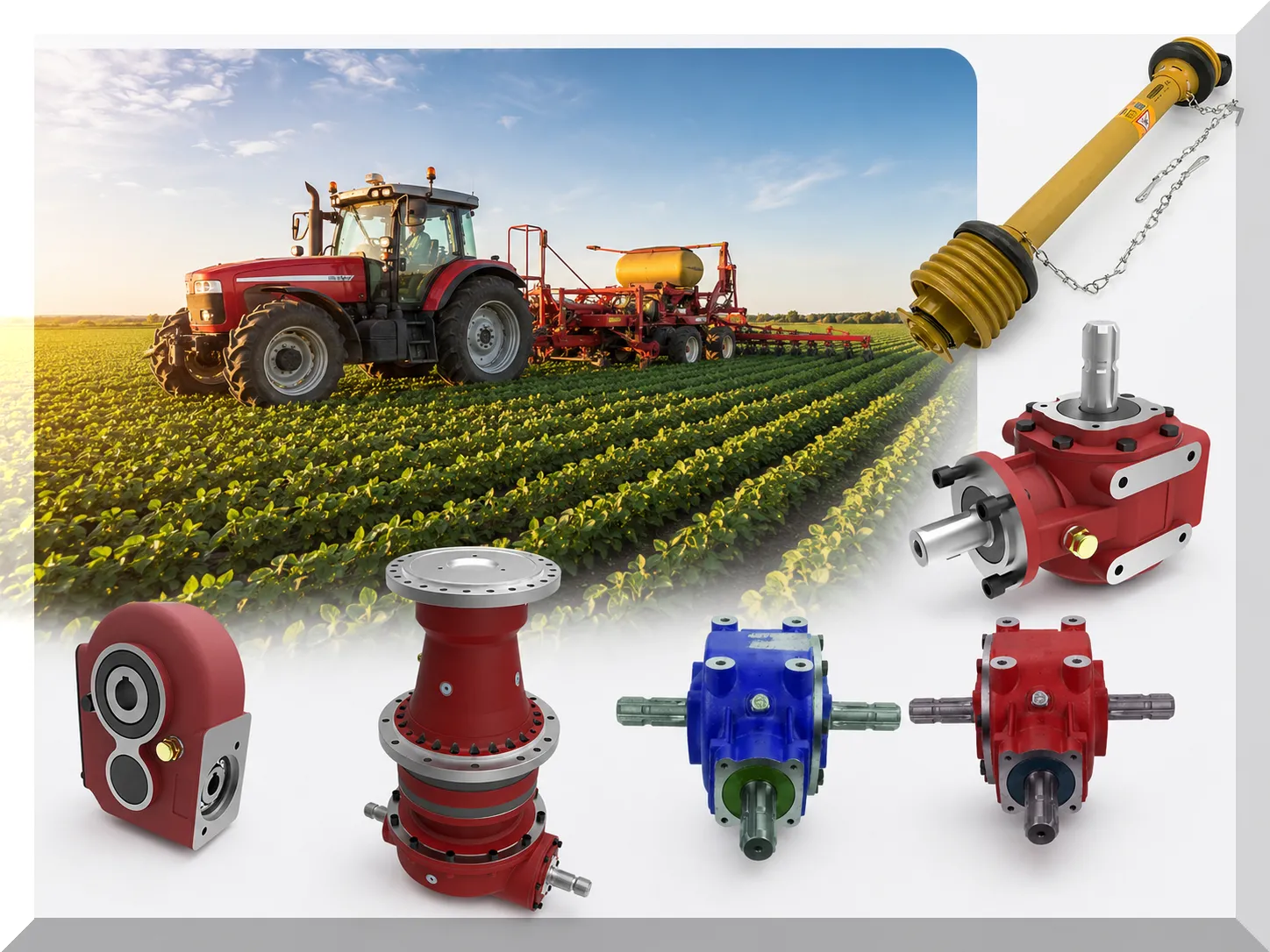
La 9JYY-4.5 intervient en fin de chaîne de récolte, après le faneur, après la presse à balles, au niveau de la logistique. L'optimisation de l'ensemble de la chaîne implique que les équipements en amont suivent la cadence du transporteur. Avec un débit de 6 à 9 balles par trajet, la 9JYY-4.5 peut nettoyer un champ plus rapidement qu'une presse à balles rondes commerciale classique ne peut déposer de balles sur la plupart des grandes exploitations. Ainsi, un seul opérateur de 9JYY-4.5, associé à une seule presse à balles, peut maintenir un champ propre sans anticiper l'opération de pressage – un flux de travail parallèle utilisé dans les grandes exploitations pour assurer le fonctionnement continu des deux équipements.
Notre gamme de presses à balles rondes Ce modèle inclut des presses allant des mini-presses de 40 CV aux presses commerciales de 1,25 m et 2,24 m produisant des balles de 1 000 à 1 400 mm de diamètre, compatibles avec le berceau 9JYY-4.5. Avant tout achat, il est primordial de vérifier que la taille des balles produites par votre presse correspond à la plage de diamètres du berceau 9JYY-4.5.
La régularité de l'andainage lors du ratissage influe directement sur l'uniformité du poids des balles ; des balles régulières simplifient la planification de la charge utile du 9JYY-4.5 et réduisent le risque de charger une balle trop lourde qui ferait dépasser la limite de 4 500 kg pour le trajet. alignement des râteaux à foin comprend des modèles pour des champs de 5 à 12 mètres de large, produisant des andains uniformes adaptés aux diamètres de balles commerciales.
La presse à balles rondes qui s'enfonce dans ces andains actionne une prise de force à couple élevé continu. Une presse correctement dimensionnée boîte de vitesses agricole robuste Dans la transmission de la presse à balles, le rotor de ramassage et l'entraînement de la chambre de la balle sont protégés des pics de couple générés lorsqu'un andain dense et uniforme se précipite dans le ramasseur à pleine vitesse commerciale au sol, ce qui permet à votre opération de pressage de fonctionner à plein régime afin que la 9JYY-4.5 ait toujours des balles à ramasser.
Pourquoi les exploitations agricoles spécialisées dans le foin choisissent foragebaler.com
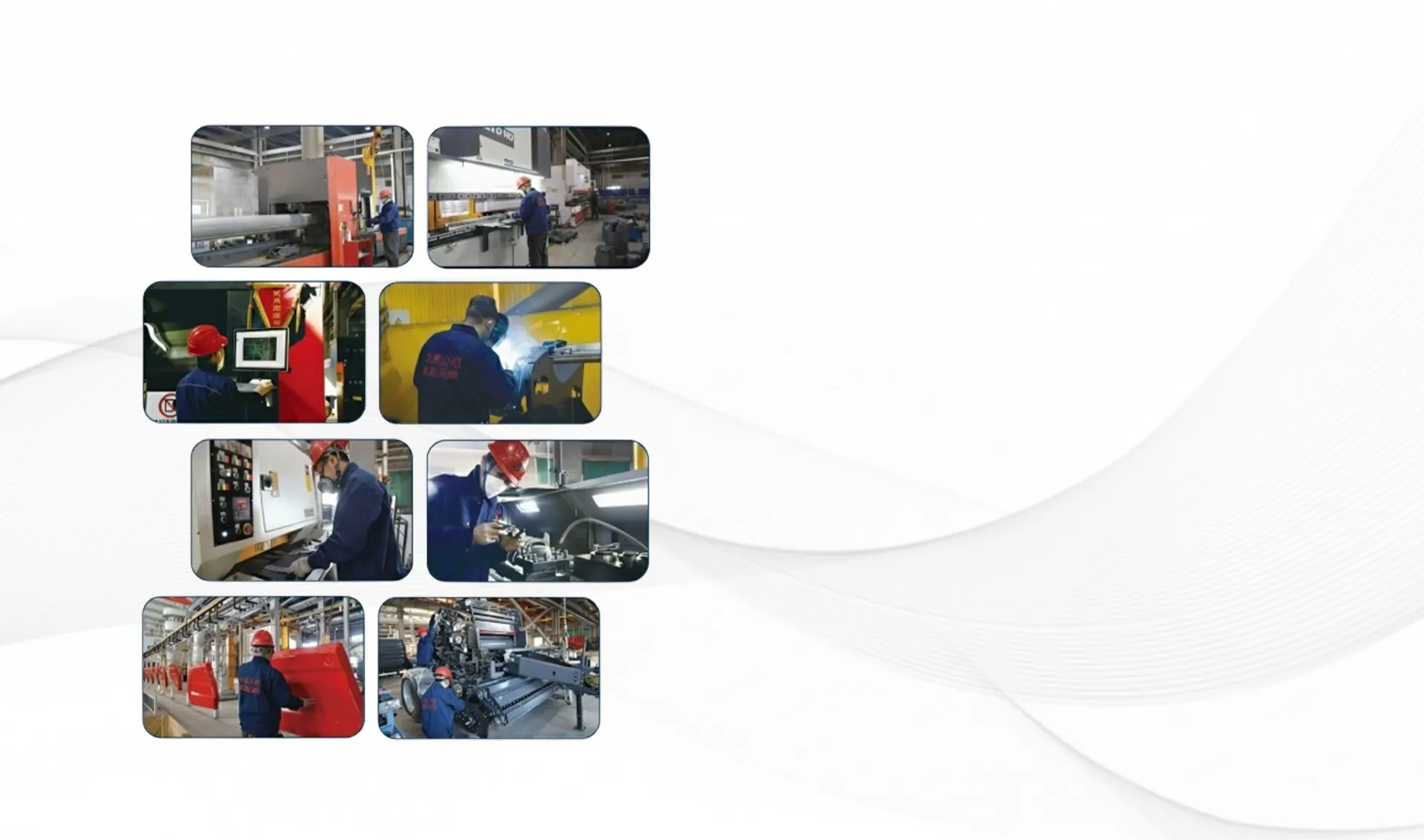
Équipe californienne, anglophone, assistance téléphonique en temps réel pendant les heures ouvrables américaines, y compris durant la haute saison du foin (septembre-octobre). Pas d'appels à l'étranger. Voir À propos de nous pour le profil de notre équipe.
Chaque unité 9JYY-4.5 est soumise à un test de pression en usine sur ses deux circuits hydrauliques avant expédition. Les rapports de test et la documentation qualité sont fournis avec chaque unité pour les dossiers d'évaluation USDA FSA et de prêt de matériel.
Les kits de joints hydrauliques pour les deux circuits, les flexibles, les chambres à air pour pneus 400/60-15.5, la quincaillerie pour barre de traction et les goupilles de verrouillage de bras de pliage sont expédiés le jour même depuis l'entrepôt californien pour les commandes passées avant 14 h, heure du Pacifique.
Le modèle 9JYY-4.5 est admissible à la déduction immédiate des frais en vertu de l'article 179. Un dossier de facturation complet est fourni à votre comptable. Prix direct usine : pas de réseau de concessionnaires, pas de majoration territoriale.
Foire aux questions
Mon tracteur ne possède qu'une seule sortie SCV. Puis-je utiliser le modèle 9JYY-4.5 ?
Non, la double transmission hydraulique nécessite deux sorties de distributeur hydraulique indépendantes. Avec un seul distributeur, aucun des bras ne peut développer simultanément la pression nécessaire au chargement à pleine capacité. Pour les tracteurs à un seul distributeur, le modèle 9JYY-2.5 à circuit unique est le choix approprié.
Combien de temps dure l'opération de pliage des bras ?
Comptez 60 à 90 secondes depuis les commandes de la cabine après quelques minutes d'entraînement. Insérez la goupille de verrouillage du bras mécanique avant le transport routier ; ne vous fiez pas uniquement à la pression hydraulique pour maintenir la position repliée. Les goupilles de verrouillage sont conçues pour résister aux charges du transport routier et sont incluses dans l'emballage standard.
Quel débit hydraulique mon tracteur nécessite-t-il ?
Débit minimal de 25 à 30 L/min par circuit (50 à 60 L/min au total) à une pression de service ≥ 16 MPa. La plupart des tracteurs de 68 à 100 ch équipés de deux distributeurs hydrauliques arrière fournissent un débit suffisant. Consultez la fiche technique du système hydraulique de votre tracteur. Si le débit est insuffisant, les temps de cycle de chargement seront plus longs, mais la machine restera fonctionnelle.
La 9JYY-4.5 peut-elle traiter des balles d'ensilage enrobées de filet ou de film plastique ?
Oui, les berceaux incurvés et lisses sont conçus pour éviter d'accrocher ou de perforer le film d'emballage. Le chargement à double circuit assure un levage fluide et contrôlé, sans à-coups susceptibles d'endommager les coutures du film. Avant le chargement, inspectez chaque balle afin de vérifier l'absence d'extrémités de fil dépassantes ou de débris pointus et ainsi éviter d'endommager le berceau ou le film.
La hauteur de transport de 3 300 mm nécessite-t-elle un permis de transport hors gabarit ?
La hauteur maximale autorisée pour les engins agricoles, selon la norme FMCSA, est de 4 115 mm (13,5 pi) sur la plupart des routes fédérales. Avec une hauteur de 3 300 mm (10,8 pi), le modèle 9JYY-4.5 respecte largement ces limites sur la plupart des routes. Toutefois, avant toute première utilisation, vérifiez le dégagement sous les lignes électriques, les ponts et les structures agricoles basses sur votre itinéraire habituel.
Le modèle 9JYY-4.5 est-il spécifiquement adapté aux balles d'ensilage de maïs ?
Oui, mais attention au poids. Les balles d'ensilage de maïs de 1 400 mm de diamètre et à forte teneur en humidité peuvent peser de 1 000 à 1 200 kg chacune, ce qui signifie un maximum de 3 à 4 balles par voyage, dans la limite de 4 500 kg. Ne chargez jamais plus de balles que la limite de poids, quelle que soit la capacité de la benne. À charge utile maximale, réduisez votre vitesse à 30 km/h sur les surfaces non pavées pour une marge de sécurité accrue au freinage.
Quel entretien nécessite le système hydraulique double ?
Inspectez les deux circuits hydrauliques (tous les flexibles, raccords et joints de tige de vérin) toutes les 50 heures de fonctionnement ou au début de chaque saison. Graissez tous les paliers de pivot de bras à l'aide des graisseurs avec de la graisse NLGI-2. Vérifiez l'état des goupilles de verrouillage du repliage des bras et remplacez toute goupille tordue ou usée avant toute utilisation sous charge. Utilisez l'huile hydraulique ISO VG 46 ou VG 68, conformément aux spécifications du manuel de votre tracteur.
Comment fonctionnent le transport et l'assemblage pour le 9JYY-4.5 ?
La livraison aux États-Unis depuis l'entrepôt californien prend de 8 à 14 jours ouvrables. Le modèle 9JYY-4.5 est partiellement démonté pour le transport. L'assemblage sur place des deux raccords hydrauliques, du mécanisme de repliage des bras et du circuit d'éclairage prend environ 2 à 3 heures à deux personnes à l'aide du guide d'assemblage illustré. L'équipe américaine vous accompagne par téléphone, gratuitement, le jour de la livraison, pour le raccordement du double circuit et le test de repliage.
Exploitants commerciaux : Rapports de six saisons
★★★★★
Nous exportons du bermuda côtier et du stargrass vers le Mexique et l'industrie de l'engraissement : de 800 à 1 000 balles par saison, réparties sur plusieurs champs distants d'un mile. La 9JYY-4.5 transporte 8 balles par trajet à vitesse routière entre les champs périphériques et notre quai de chargement. Le chargement des camions depuis les champs prend désormais trois jours au lieu de huit. Le système à double circuit a géré nos presses à balles de 1 300 et 1 400 mm de différentes saisons sans aucun réglage du berceau. Associé à un JD 6105E de 105 ch, il fonctionne sans aucune contrainte hydraulique.
★★★★★
Grande exploitation d'exportation de foin de luzerne dans la Magic Valley — 445 hectares, trois coupes, expédition vers le marché laitier du Nord-Ouest Pacifique. La moissonneuse-batteuse 9JYY-4.5 a remplacé trois systèmes à un seul essieu différents que nous avons testés au fil des ans. La stabilité des quatre roues à vitesse de route sur les routes rurales de l'Idaho est nettement supérieure : chargée, elle garde le cap sans le balancement que nous constations avec les équipements à un seul essieu. Le chargement sur deux circuits, des deux côtés, réduit considérablement le temps de cycle dans les champs ouverts où nous pouvons accéder aux balles en alternant les rangs.
★★★★★
Opération de pressage à façon sur 22 exploitations agricoles clientes dans la région des comtés de Lancaster et Chester. La presse 9JYY-4.5 m'a permis de prendre en charge quatre exploitations supplémentaires cette saison par rapport à l'année dernière, sans ajout de matériel ni d'opérateurs. Chaque intervention est désormais plus rapide : le temps moyen passé sur chaque propriété client a diminué de près de 40 %. Le cycle de pliage est rapide une fois maîtrisé, et les déplacements routiers entre les exploitations clientes voisines à 40 km/h permettent de gérer facilement les trajets dans le planning journalier.
★★★★★
Exploitation laitière de 600 vaches nourries au foin de luzerne et d'ensilage de maïs. La moissonneuse-batteuse 9JYY-4.5 traite les deux types de fourrage : la luzerne à 1 300 mm pour 7 à 8 balles par voyage et l'ensilage à 1 400 mm pour 3 à 4 balles par voyage, sans changement de berceau. Le réapprovisionnement hebdomadaire de l'étable depuis notre parc à foin est passé de 4 à 5 heures à moins de 2 heures. Le groupe électrogène New Holland T6.120 alimente les deux circuits sans problème. Je la recommande sans hésitation à toute grande exploitation laitière productrice de foin.
★★★★☆
Je travaille sur 283 hectares de foin de brome et de luzerne, avec un itinéraire personnalisé desservant une quinzaine d'exploitations clientes. La remorque 9JYY-4.5 divise par deux mon temps de débroussaillage par rapport à la remorque à un seul essieu que j'utilisais auparavant. Je lui attribue quatre étoiles car la procédure de pliage pour le transport nécessite la goupille de verrouillage mécanique et il m'a fallu deux ou trois séances pour bien la maîtriser avant de pouvoir l'utiliser sur route. Une fois le réflexe acquis, c'est rapide. Le double circuit est particulièrement utile dans les champs où les balles sont disposées sur deux rangées parallèles : le chargement simultané des deux bras est nettement plus rapide.
★★★★★
Exploitation bovine de 420 têtes (vaches et veaux) sur 1 133 hectares de pâturages naturels : nous produisons environ 850 balles rondes de fourrage par an, distribuées quotidiennement pendant l’hiver. Avant l’acquisition du 9JYY-4.5, la distribution hivernale sur trois pâturages prenait presque toute la matinée. Désormais, deux à trois allers-retours par pâturage suffisent, en moins de 90 minutes. La plateforme à quatre roues motrices assure une stabilité optimale sur nos chemins d’exploitation (gravier, ornières et sol gelé), une stabilité que le matériel à un seul essieu que nous louions auparavant ne pouvait égaler à pleine charge. Le service des pièces détachées aux États-Unis s’est montré très réactif. Une machine robuste et bien conçue.
Transportez plus de balles par voyage — Demandez un devis pour le 9JYY-4.5
Compatibilité du circuit hydraulique double vérifiée avant expédition. Prix direct usine, assistance basée aux États-Unis, documentation relative à la section 179 et guide de connexion du circuit double inclus avec chaque commande.
America Ever-Power Forage Baler Equipment INC. | 1401 21st ST STE R, Sacramento, CA 95811
Informations complémentaires
| Éditeur | Cxm |
|---|
Produits similaires
-
Moissonneuse-batteuse de haricots rouges 4DQ-5 | Batteuse traînée à 5 rangs
-
Combinaison presse-enrubanneuse 9YCM-850 | 30 à 40 balles/heure
-
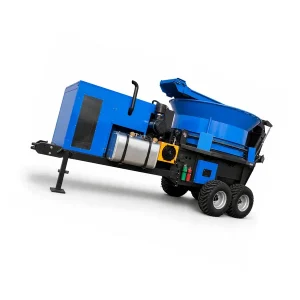
Broyeur à fourrage 9F-70 | Broyeur à marteaux à prise de force
-
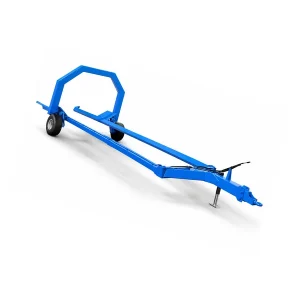
Remorque porte-balles rondes compacte 9JYY-2.5
-
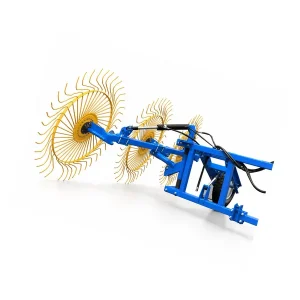
Faneuse à doigts pliable hydraulique 9FZ-2.0 | 3 roues


