ROI Analysis · 2025 · All 9YF Models
Is Buying a Hay Baler Worth It? Break-Even and ROI Analysis
The standard analysis compares your annual custom baling cost against the annual cost of machine ownership and calculates the break-even point. But this analysis misses the single most valuable benefit of baler ownership for many operations: the ability to bale when your hay is ready rather than when the custom operator is available. This guide covers both the numbers and the scheduling argument honestly.
Covers: true custom baling cost · annual ownership cost · break-even acreage · scheduling value · custom income potential · 5-year model · when to keep using custom service
The True Cost of Custom Baling — Beyond the Rate per Bale
Custom baling rates for small square bales in the U.S. range from $0.40–$0.80 per bale or $28–$60 per acre depending on region and operator, with most markets clustering around $0.50–$0.65 per bale in 2025 conditions. At first glance, custom baling appears the clear economic choice at low acreage: 1,500 bales at $0.55 per bale is $825 per year — far below any machine ownership cost.
But the per-bale rate captures only part of the true cost. Custom baling also involves: scheduling uncertainty (your bales must be baled when the operator is available, not necessarily when your moisture conditions are optimal), weather exposure loss from hay sitting in the windrow past its ideal baling window while waiting for the operator, quality reduction from any over-drying or re-wetting that occurs during the wait, and the inability to capture premium pricing windows that require baling within a very specific moisture window for horse or export market grades.
These hidden costs do not appear in any invoice but appear in your hay quality, your buyer satisfaction and ultimately your per-tonne revenue. Operations that have lost a lot of horse-grade hay to moisture problems while waiting for a custom operator — and subsequently sold the same hay at half price into livestock channels — understand the true value of baling schedule control.
Annual Cost of Owning a Square Baler
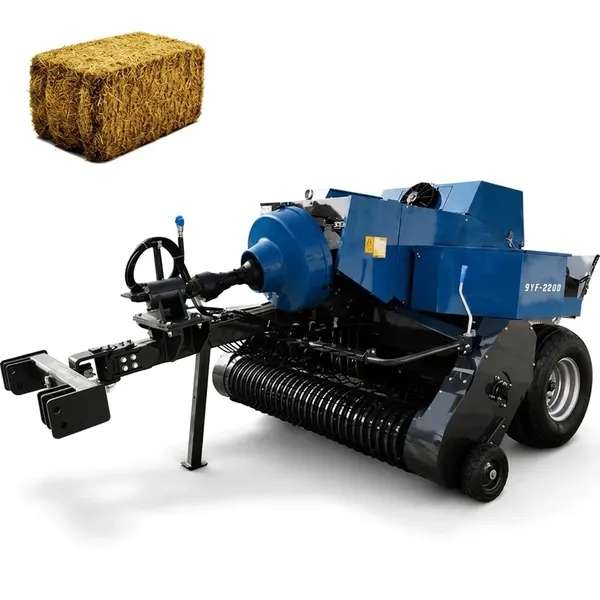
Complete Annual Ownership Cost Breakdown
| Komponen Biaya |
9YF-1700 (new $10,000) |
9YF-2200 (new $15,000) |
9YF-2200S (new $24,000) |
| Depreciation (15-yr, 20% residual) |
$533/yr |
$800/tahun |
$1,280/yr |
| Perawatan tahunan dan suku cadang |
$250–$500 |
$350–$700 |
$600–$1,200 |
| Twine (3,000 bales at $0.04/bale) |
$120 |
$120 |
$120 |
| Insurance (farm equipment rider) |
$80–$140 |
$120–$200 |
$180–$300 |
| Tractor fuel (per baler use, not tractor ownership) |
$0.08–$0.14/bale |
$0.08–$0.14/bale |
$0.12–$0.18/bale |
| Total annual cost (at 3,000 bales/yr) |
$1,350–$1,850 |
$1,750–$2,350 |
$2,750–$3,750 |
Tractor fuel for baling uses not included in the total above — add $240–$420 for 3,000 bales at the fuel cost per bale shown. Tractor ownership cost is excluded as the tractor is used for other tasks regardless of baler ownership.
Break-Even Acreage by Model
The Break-Even Calculation
Break-even occurs when the annual custom baling cost equals the annual ownership cost. Using representative figures:
9YF-1700 Break-Even
2,900–3,700
bales per year
At $0.55/bale custom rate vs $1,600 midpoint annual ownership cost. Approximately 75–90 acres at 40 bales/acre.
9YF-2200 Break-Even
3,600–4,800
bales per year
At $0.55/bale custom rate vs $2,050 midpoint annual ownership cost. Approximately 90–120 acres at 40 bales/acre.
9YF-2200S Break-Even
5,900–7,700
bales per year
At $0.55/bale custom rate vs $3,250 midpoint annual ownership cost. Approximately 150–200 acres at 40 bales/acre.
These break-even points are based on a $0.55/bale custom rate and 40 bales per acre. At higher custom rates ($0.65–$0.80/bale) the break-even moves lower — ownership becomes cost-competitive at fewer bales. At lower custom rates ($0.40–$0.50/bale) the break-even moves higher — ownership requires more bales to justify the cost.
The Scheduling Control Premium — What the Numbers Miss
The break-even analysis above treats all hay baled as equivalent in quality and revenue. But the timing of baling relative to optimal moisture conditions directly affects hay quality — and hay quality directly affects the price you receive. This is where the scheduling argument for ownership is strongest.
A hay operation selling alfalfa to horse buyers at $12 per bale versus $6 per bale (commodity cattle channel) has a $6 per bale premium that depends entirely on baling at the correct moisture on the correct day. If the custom operator is available 3 days after the optimal window and the hay has been re-wetted by overnight dew or slightly over-dried — the batch goes to cattle hay at $6, not horse hay at $12. The revenue loss from this single event for a 200-bale lot is $1,200. One such event per season equals or exceeds the full annual ownership cost difference between custom baling and the 9YF-2200.
Operations that sell into premium markets — horse hay, export, retail farm stands — where timing-sensitive quality is a real revenue driver should weight the scheduling argument heavily in their break-even analysis. The calculation changes from a pure cost comparison to a cost-plus-quality-revenue comparison where ownership frequently wins at lower acreage than the pure cost break-even would suggest.
Custom Baling Income: Accelerating Your Payback
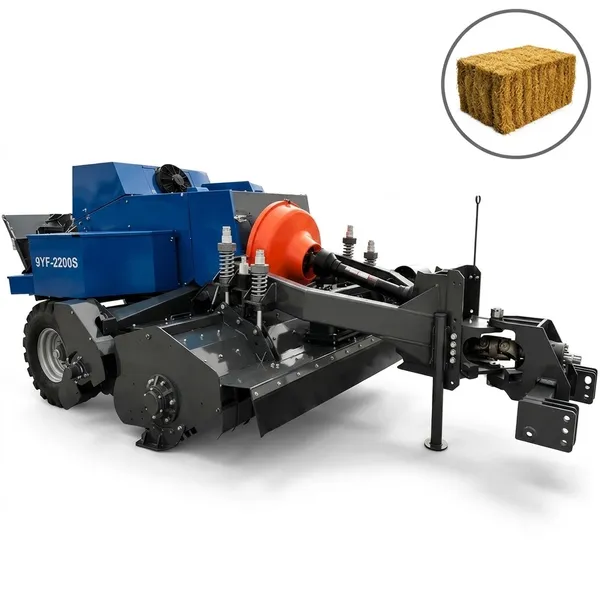
A square baler that is paid for and operated for your own hay also has capacity to generate income on neighbouring farms during the baling season. Custom baling for neighbours at the local rate — $0.50–$0.65 per bale — converts idle machine capacity into revenue that directly reduces your effective annual ownership cost.
A 9YF-2200 operating 500 custom bales per season for neighbours at $0.55 per bale generates $275 in custom income. At 2,000 custom bales, that is $1,100 — covering approximately half the annual ownership cost of the machine on own-use economics. Operations that actively build a custom baling service around their own production can reach positive cash-flow on the machine within 2–3 seasons even at sub-break-even own-use volume.
Practical limit on custom volume: your total season capacity (machine × available baling days × daily output) minus your own acreage requirement. A 9YF-2200 in a 30-day peak season at 400 bales per good day has approximately 12,000 bales of season capacity. Own use at 80 acres (3,200 bales) leaves approximately 8,800 bales of custom capacity — enough for $4,400–$5,720 in custom revenue at prevailing rates. At this scale, the machine more than pays for itself from custom income alone in the first season.
5-Year Total Cost of Ownership Model
| Scenario: 9YF-2200 at $15,000 new · 5,000 bales/year own use |
Tahun 1 |
Year 3 |
Year 5 |
| Cumulative own-use cost (ownership) |
$2,050 |
$6,150 |
$10,250 |
| Cumulative cost if using custom baling at $0.55/bale |
$2,750 |
$8,250 |
$13,750 |
| Cumulative ownership savings vs custom |
+$700 |
+$2,100 |
+$3,500 |
| Estimated machine residual value at end of year |
$12,000 |
$9,000 |
$7,500 |
| Net position vs custom (savings + residual value, less purchase) |
-$2,300 |
+$100 |
+$5,500 |
The model above uses the $2,050 midpoint annual ownership cost, $0.55/bale custom rate and 5,000 bales per year own use. At this volume, the ownership decision breaks even in year 3 on a net cash basis and produces $5,500 in net advantage versus custom baling by year 5 — before accounting for any custom income earned from neighbours or any scheduling-related quality revenue premium. The machine residual value at Year 5 represents real recoverable capital if the operation sells or upgrades the baler.
When the Math Favours Continuing with Custom Baling
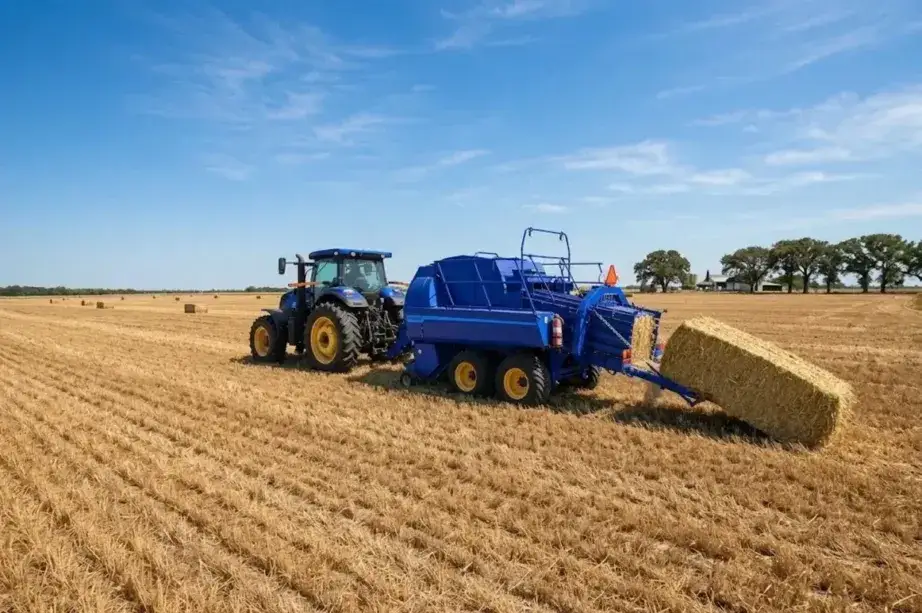
Baler ownership is not the correct answer for every operation. Custom baling makes more economic sense than ownership when:
Case 1
Annual volume below 2,000–2,500 bales with no premium market access or custom income opportunity. At this volume, ownership costs more than custom baling at any current U.S. market rate. The break-even calculation does not favour ownership unless the scheduling value is demonstrably large.
Case 2
You do not own a tractor meeting the minimum HP requirement for any 9YF model. Purchasing both a tractor upgrade and a baler together changes the economics significantly — if the tractor would not otherwise be needed or upgraded, the full tractor cost becomes part of the baler ownership calculation.
Case 3
A reliable custom operator is available at short notice and you have never experienced scheduling-related quality losses. If the custom operator bales your hay within 12–24 hours of the ideal window in every previous season, the scheduling argument for ownership is weak for your specific situation.
Case 4
Your hay is sold exclusively to commodity livestock markets where the pricing is not sensitive to the specific baling day or moisture-window precision. The scheduling premium argument does not apply when the downstream market is indifferent to within-day moisture variation.
PTO and Drive Specifications for ROI Planning
A complete machine setup — correct PTO driveshaft length, correct lubricants, pre-season knotter service — is the foundation for achieving the output volume that makes ownership economics work. Driveshaft specifications: Panduan ukuran poros penggerak PTO dan sambungan CV..
Frequently Asked Questions — Is Buying a Hay Baler Worth It
I bale 50 acres per year. Should I buy a baler?+
At 50 acres per year — approximately 2,000 bales at 40 bales per acre — the pure cost comparison favours custom baling at standard U.S. rates. Annual ownership cost for the lowest-priced 9YF-1700 is approximately $1,350–$1,850 per year. Custom baling 2,000 bales at $0.55 per bale costs $1,100 per year — less than ownership in most scenarios. However, the specific reasons to still consider ownership at 50 acres: (1) your hay market is premium horse or export where scheduling control is worth real revenue and you have experienced quality losses from custom baling delays; (2) you have neighbours who would pay for custom baling services that would push your total annual bale count well above 3,000; (3) you are a first-year buyer with growth plans that will add acreage in the next 2–3 seasons. If none of these apply and your custom operator is reliable, 50 acres per year does not economically justify a baler purchase at any model level based on own-use economics alone.
What is the minimum number of bales per year to justify buying a 9YF-2200?+
Using the ownership cost model at a $15,000 purchase price and $2,050 midpoint annual ownership cost: at $0.55 per bale custom rate, break-even occurs at approximately 3,700 bales per year. At $0.65 per bale custom rate, break-even occurs at approximately 3,150 bales per year. At $0.45 per bale custom rate, break-even occurs at approximately 4,600 bales per year. To find your specific break-even: divide your annual ownership cost by (custom rate minus twine cost per bale). For the 9YF-2200: $2,050 annual cost divided by ($0.55 minus $0.04 twine) = $2,050 divided by $0.51 = 4,020 bales per year. Below 4,020 bales per year, custom baling costs less than ownership on a pure cost basis — above this threshold, ownership is the more economical choice. Every 500 bales above the break-even adds approximately $255 of net annual benefit from ownership over custom baling, which accumulates significantly over a 5–10 year machine life.
How much should I charge per bale if I offer custom baling to neighbours?+
Custom baling rates in the U.S. for small square bales range from $0.40–$0.80 per bale depending on region, with most markets in the $0.50–$0.65 range in 2025 conditions. To set your rate: calculate your operating cost per bale (not including depreciation — that is a sunk cost on a machine you own) which includes twine ($0.04), fuel ($0.10–$0.15) and an allocated portion of maintenance ($0.05–$0.10). Total operating cost per bale is approximately $0.19–$0.29. A rate of $0.50–$0.55 per bale covers operating cost and generates a profit margin of $0.21–$0.36 per bale, or $210–$360 per 1,000 custom bales. This rate is competitive with existing custom operators in most markets. Research what custom operators in your area charge before setting your rate — pricing below the market rate is not necessary to get business, and pricing correctly allows you to be compensated fairly for your machine time and operator labour.
Does the tax deduction for farm equipment make baler ownership more economical?+
Yes — Section 179 immediate expensing and bonus depreciation under current U.S. tax law can allow a qualifying farm business to deduct the full purchase price of a new baler in the year of purchase rather than depreciating it over 15 years. For a farm in a 25% effective tax bracket, a $15,000 baler with Section 179 treatment produces a $3,750 tax reduction in year 1 — reducing the after-tax purchase cost to $11,250 and improving the first-year economics significantly. The break-even acreage calculation changes meaningfully when the effective machine cost is reduced by the tax benefit. Consult with a tax professional familiar with agricultural operations before making the purchase decision based on tax treatment — Section 179 limits, bonus depreciation percentages and eligibility rules change periodically and depend on your specific business structure and income level. As a general principle, the after-tax economics of baler ownership for a profitable farm business are meaningfully better than the pre-tax analysis suggests.
How much does scheduling control actually save in quality-sensitive hay markets?+
The scheduling value depends entirely on your specific market and how often custom baling delays have cost you quality-sensitive revenue in previous seasons. To estimate: take your most recent season where a custom baling delay forced you to bale hay outside the optimal window and calculate the actual revenue difference between what you sold and what you would have received from a premium buyer if the hay had been baled at the right time. A single 200-bale lot of alfalfa that went to cattle hay at $6/bale instead of horse hay at $12/bale due to a 2-day custom baling delay represents $1,200 in lost revenue — this single event covers most or all of the annual ownership cost advantage that the break-even analysis shows against custom baling at 3,000 bales per year. Operations where this scenario has occurred more than once in three seasons are in the group where ownership provides real economic value beyond the pure bale-count break-even calculation.
Is financing a baler purchase a good idea?+
Agricultural equipment financing through Farm Credit Services, AgDirect or local agricultural banks is widely available for baler purchases in the $8,000–$25,000 range. Financing makes ownership accessible when the upfront capital is not available but the annual savings and volume justify the investment. The key consideration: the annual loan payment must be added to the ownership cost calculation. A $12,000 loan at 7% over 5 years adds approximately $2,850 per year in loan payments during the repayment period. At $0.55 per bale custom rate, the break-even volume during the loan repayment period increases significantly — the operation needs higher volume to cover loan payments plus operating costs than a debt-free purchase. However, if the operation also generates custom baling income, the financing equation improves substantially because custom income can directly service the loan payment. For new buyers with high custom income potential and a growth trajectory, financing is often the correct approach. For operations where the total bale volume is at or near the break-even threshold and no custom income is planned, a cash purchase of a less expensive used machine may produce better economics than financing a new machine at a higher total cost.
At what bale count does the 9YF-2200S shredder model become economically justified over the 9YF-2200?+
The 9YF-2200S costs approximately $9,000 more than the 9YF-2200 in new purchase price. The annual additional ownership cost from this price difference — at the same 15-year depreciation and 20% residual value — is approximately $480 per year. This means the 9YF-2200S must generate at least $480 more value per year than the 9YF-2200 to justify the additional cost. The shredder value comes from two sources: improved bale density in thick-stemmed or mature crops (producing more revenue per acre from heavier bales), and reduced plugging frequency in hard-stalk crops (saving field time and operator labour). If your primary crop is standard grass hay or early-cut alfalfa and you rarely bale hard-stalk crops, the shredder value is modest and the 9YF-2200 is the better economic choice. If you regularly bale late-cut alfalfa, corn stover or cotton stalk where the shredder provides 15–20% density improvement, the additional revenue from heavier bales across 5,000 annual bales can easily exceed $480 per year — justifying the shredder model. Calculate the projected density improvement in kilograms per bale for your primary crop, multiply by the number of bales per season, and compare to the $480 annual cost increment to determine which model provides better value for your specific operation.
How does selling hay revenue factor into the baler ROI calculation?+
The baler itself does not grow hay — it processes it. The revenue from hay sales should be attributed to the land, the crop production inputs and the cutting and raking operations as much as to the baler. In strict accounting terms, the baler ROI is the difference between owning versus custom baling — not the total hay revenue. However, for practical decision-making, the scheduling control benefit of ownership is best understood through the lens of total hay revenue: if ownership allows you to consistently bale at optimal quality and capture an average of $1.50 per bale more than you achieved with custom baling delays — that $1.50 multiplied by 5,000 bales per season is $7,500 per year in additional hay revenue directly attributable to the ownership decision. This framing often makes the ownership argument more compelling than the pure cost comparison, particularly for operations targeting premium horse hay or export markets where quality-driven price variation is real and measurable season over season.
Get a Current Price and Payback Estimate for Your Operation
Tell us your annual bale volume, local custom rate, primary crop and target market — we will run the break-even calculation for the Model 9YF that fits your operation and give you a current price to compare against your custom baling cost.
Editor: Cxm