
Custom baling services — where an operator owns the baler and sells baling labor and equipment on a per-bale or per-acre basis to neighboring farms — are a well-established revenue model across every U.S. hay region. In areas where hay production is growing but local labor and equipment capacity has not kept pace, demand for custom baling services consistently exceeds supply during peak season. For a producer who already owns a capable round baler, the question is not whether a custom baling service is viable in 2026 — it is whether you can manage the pricing, scheduling, and equipment reliability required to run it at a profit.
Is Custom Baling a Viable Business in 2026? Market Conditions
The structural case for custom baling services remains strong entering 2026. Several market forces converge to create demand that individual farm owners consistently struggle to supply from their own equipment:
Farm consolidation has increased the average acreage per farm in most hay regions over the past decade, but has not proportionally increased equipment investment among smaller farms that lease or manage additional land. Many 300 to 600-acre hay operations own older equipment with limited capacity and use custom operators for peak cutting periods or when their own equipment is in maintenance.
Labor shortages in rural communities have changed the economics for farms that previously hired seasonal labor to run a second baler through the season. Custom baling services that replace a full-time seasonal equipment operator with a per-bale service charge have become more attractive to many operations over the past 3 to 5 years.
Equipment prices have risen significantly. At current new baler prices of $40,000 to $90,000 depending on model and specification, the fixed cost per bale for a farm running 800 bales per season from its own machine is substantial. Custom operators who spread that fixed cost over 2,000 or 3,000 bales across multiple customer farms achieve a significantly lower cost per bale than any single-farm owner at moderate volume.
Equipment Selection for a Custom Baling Operation
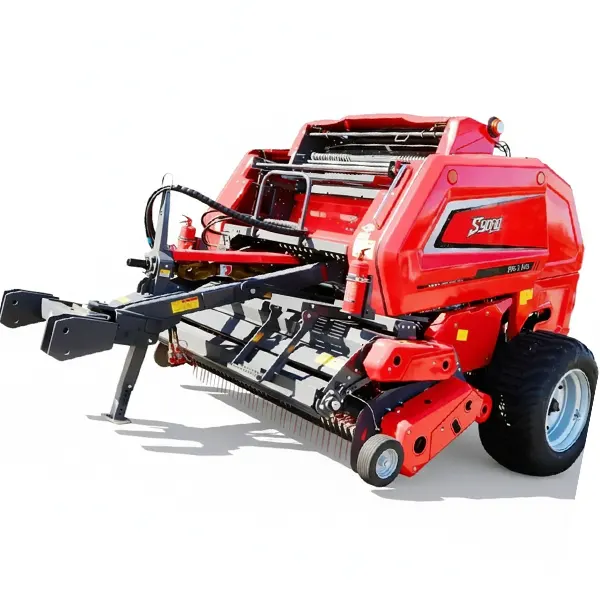
Equipment selection for a custom baling service differs from equipment selection for own-farm use in one critical respect: reliability and parts availability matter more than features. A baler breakdown on your own farm is an inconvenience. A breakdown on a customer’s field during a tight weather window is a customer relationship problem — and in a business built on reputation, customer relationship problems are existential.
The selection principles for custom baling equipment are straightforward. Choose a baler with a well-established parts supply chain: belts, pickup tines, net wrap knives, and bearings should be available from distributors within 24 to 48 hours, not weeks. Choose a baler size that matches the majority of your customer base — if most of your customers are running 100 to 250-acre operations with standard tractor HP, a mid-range commercial baler matched to 75 to 100 HP tractors serves more customers than a high-capacity specialist machine requiring 150+ HP. Choose a baler with a simple drive architecture where in-field diagnosis is practical — complex electronics that require dealer service for fault codes add unacceptable risk on a custom operation.
How to Calculate Your True Cost Per Bale
The most common mistake in custom baling pricing is setting rates based on what competitors charge rather than on what your own operation costs. If a competitor charges $10 per bale but your machine has higher depreciation, your fuel costs are higher, or you are running a newer, more expensive model, their $10 rate may be their break-even while your break-even is $13. The following framework calculates the four cost components that determine your minimum viable rate:
| Komponen Biaya | 500 bales/season | 1,000 bales/season | 2,000 bales/season | How to calculate |
|---|---|---|---|---|
| Machine depreciation | $7.00–$11.00 | $3.50–$5.50 | $1.75–$2.75 | Purchase price ÷ expected bale life (typically 15,000–25,000 bales) |
| Fuel (tractor) | $1.80–$2.50 | $1.80–$2.50 | $1.80–$2.50 | ~0.6–0.8 gallons per bale at current diesel price; varies by bale size and crop density |
| Net wrap or twine | $0.90–$1.40 | $0.90–$1.40 | $0.90–$1.40 | Net wrap: $0.90–$1.30 per bale depending on roll price and bale circumference. Twine: $0.25–$0.55 per bale. |
| Maintenance and repairs | $0.60–$1.20 | $0.60–$1.20 | $0.60–$1.20 | Historical average $0.80–$1.00 per bale for well-maintained mid-range balers; higher for older machines |
| Operator labor | $1.50–$3.00 | $1.50–$3.00 | $1.50–$3.00 | Varies by local wage rate and whether you are the operator or paying an employee; self-operated value is opportunity cost of your time |
| Total cost per bale | $11.80–$19.10 | $8.30–$13.60 | $6.55–$10.85 | This is your break-even rate. Custom rates must exceed these figures for the service to be profitable. |
Based on a new commercial round baler at $45,000 purchase price with 20,000-bale expected life, diesel at $3.80/gallon, net wrap binding, and $22/hr operator wage. Adjust inputs to your actual machine cost and local rates. These are illustrative estimates only.
The table reveals the fundamental economics of scale in custom baling: at 500 bales per season, your break-even is close to or above the market rate in many regions, leaving little margin. At 2,000 bales per season, the depreciation cost per bale drops to a level that allows competitive pricing with meaningful profitability. Most successful independent custom baling businesses in U.S. hay regions target a minimum of 1,200 to 1,500 bales per season before accepting new customers.
2026 Custom Baling Rate Benchmarks: What the Market Is Charging
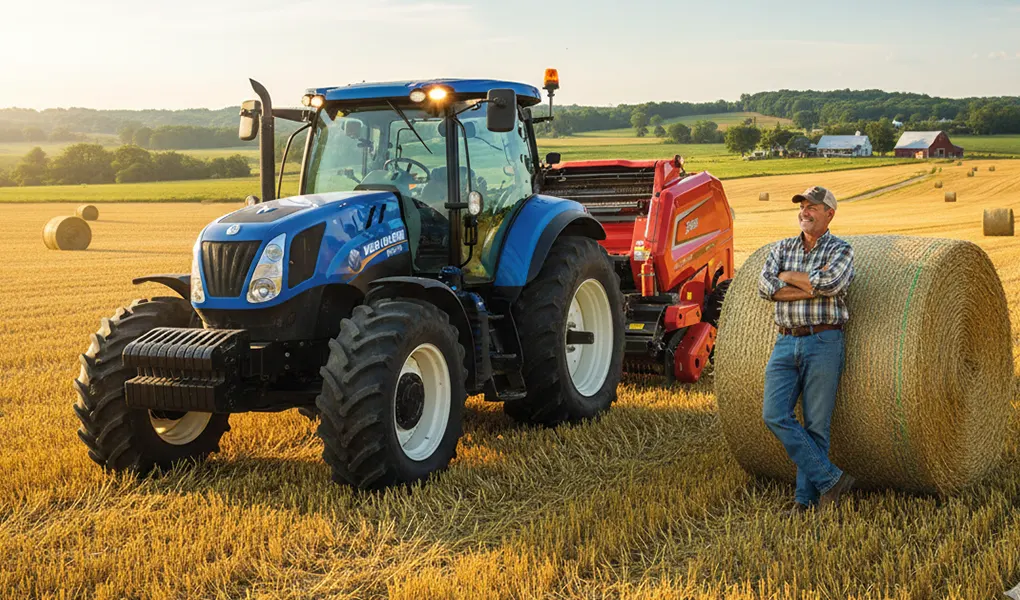
Custom baling rates in the U.S. are established through local market negotiation rather than any industry-wide standard. Rates vary significantly by region based on local equipment costs, labor markets, fuel prices, and the balance of supply and demand for custom services. The following ranges are derived from USDA Economic Research Service custom rate survey data and state extension custom rate reports for the 2024 to 2025 season as reference points:
| Wilayah | Per bale (net wrap, 4×5 bale) | Per acre (flat rate) | Catatan |
|---|---|---|---|
| Midwest (IA, MO, IL, IN) | $9–$14 | $18–$28 | Dense competition in many counties; premium for prompt scheduling during weather window |
| Midwest Atas (MN, WI, MI) | $10–$16 | $22–$32 | Higher labor costs offset by strong demand; alfalfa quality premium adds justification for higher rates |
| Great Plains (KS, NE, SD, ND) | $8–$13 | $16–$25 | Large field sizes improve operator efficiency; per-acre rates more common than per-bale in large operations |
| Mountain West (CO, WY, ID, MT) | $11–$18 | $24–$38 | Highest rates driven by rural labor shortage, higher fuel costs, and long travel distances between operations |
Rate ranges derived from state extension custom rate surveys (2024–2025). 2026 rates may be higher due to fuel and labor cost increases. Rates include operator and equipment but typically exclude net wrap material unless stated. Verify local market rates before setting your own pricing.
The critical insight from these benchmarks is that the Midwest and Great Plains per-bale rates at the lower end of the range ($8 to $9) are close to or below the break-even for a new machine at 500 bales per season. The Mountain West and Upper Midwest rates at the upper end ($15 to $18) provide genuine margin even at moderate volume. Custom operators in lower-rate markets must either run higher volume or add services — raking, tedding, or bale hauling — to achieve acceptable margins on the baling component alone.
Building a Customer Route: Scheduling and Field Logistics
The operational efficiency of a custom baling service is determined almost entirely by how well the route is planned — not by how fast the baler runs in the field. Transport time between farms, the geographic concentration of customers, and the ability to sequence jobs based on crop readiness are the variables that separate a custom operation running at $9 profit per bale from one running at $3.
A well-structured custom baling route clusters customers within a 20 to 30-mile radius from the operator’s home base, minimizing daily travel between jobs. Within a season, the most efficient operators develop an informal scheduling protocol with their regular customers: rather than committing to a fixed date for each farm weeks in advance, they work on a short-notice system where customers contact the operator 1 to 2 days before their crop will be ready, and the operator sequences jobs by geographic proximity and crop urgency. This flexibility is what allows a single operator with one baler to serve 8 to 12 farms across a season without excessive travel overhead.
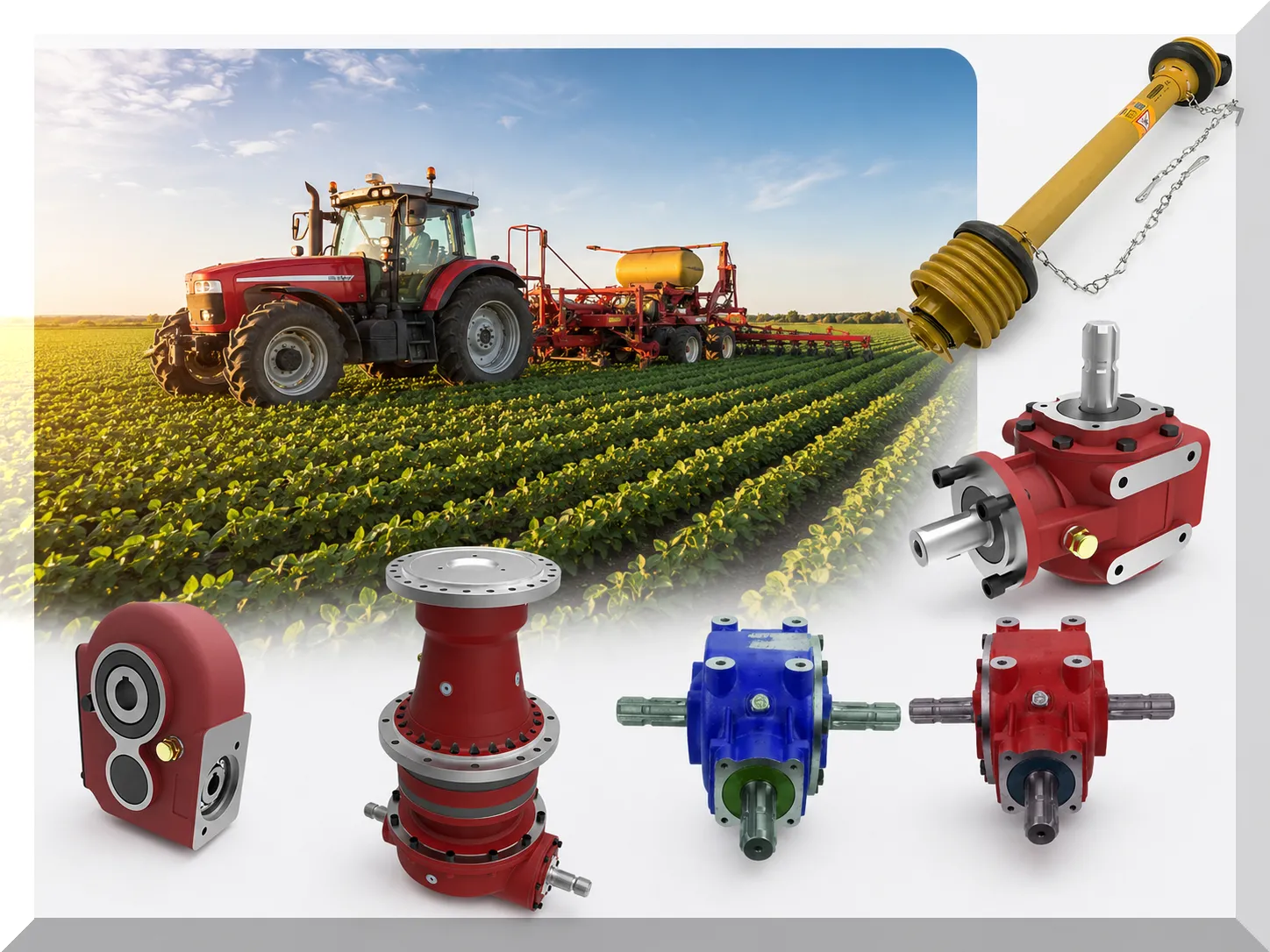
Itu Komponen poros penggerak PTO pertanian dan gearbox on the baler’s road transport configuration must accommodate the daily cycles of transport hook-up and field deployment that a multi-farm custom route demands. Pre-check the PTO shaft universals, safety shields, and drawbar hitch at each new farm visit — repeated daily connect-disconnect cycles concentrate wear at the coupling interfaces faster than sustained field operation on one property.
Insurance, Contracts, and Liability Protection
Custom baling on other people’s land creates specific liability exposures that are not covered by standard farm liability policies. Before taking a paying customer, confirm the following with your insurance agent:
Your farm liability policy covers you on your own property during your own farming operations. It typically does not cover you when you are operating as a commercial service provider on a customer’s property. A commercial general liability (CGL) policy or a farm operator liability extension is the appropriate coverage for custom baling services, and the premium for 1 to 2 million dollars in coverage is modest relative to the exposure from equipment fires, crop damage, or operator injury claims on customer property.
A written service agreement — even a simple one-page document — establishes the scope of service, the rate, the payment terms, and the liability allocation between you and the customer. The key provisions are: the customer confirms the field is clear of obstructions and suitable for baling; the operator is not responsible for crop damage attributable to field conditions outside their control (rocks, irrigation fixtures, low-hanging lines); and the payment is due within a specified period after service completion. A simple written agreement prevents the majority of disputes that arise from verbal-only arrangements.
Scaling Up: When to Add a Second Machine or an Employee
The two most common scaling decisions in a custom baling business are adding a second machine and hiring a driver for an existing machine. Each has a different financial logic.
Adding a second driver to your existing single machine essentially doubles your daily output at the cost of an operator wage ($18 to $28 per hour depending on region) minus the efficiency loss from the driver learning the route. If your machine is the throughput constraint — you are turning down jobs because you physically cannot complete them in the available weather windows — a second driver is the first scaling move. A second machine is the correct move when you have more committed acreage than one machine can complete per season, or when breakdown risk to a single machine is creating unacceptable customer service risk.
Most successful custom baling businesses that scale beyond 2,000 bales per season keep two machines rather than one for redundancy reasons alone, regardless of capacity demand. When one machine needs a repair that takes 3 to 5 days, the second machine keeps the customer commitments on schedule. Customer retention across multiple seasons is the primary value driver in a custom service business — the revenue impact of losing a 300-acre customer to a more reliable competitor significantly exceeds the cost of maintaining a second machine as backup.
For our full lineup of commercial round balers suitable for custom operations at different power classes, see jajaran mesin pengepak jerami bundar kami with specifications for each model’s daily capacity, HP requirements, and parts availability from our California warehouse.
Pertanyaan yang Sering Diajukan
Configure a Round Baler for Your Custom Operation — Direct Factory Pricing
Our U.S. team helps custom operators select the right model for their target bale volume, tractor HP, and customer base — with parts availability confirmed from our California warehouse before any order ships. Section 179 documentation included with every purchase.
Editor: Cxm


