
Penghancur Pakan Ternak 9F-70 | Mesin Penggiling Palu PTO
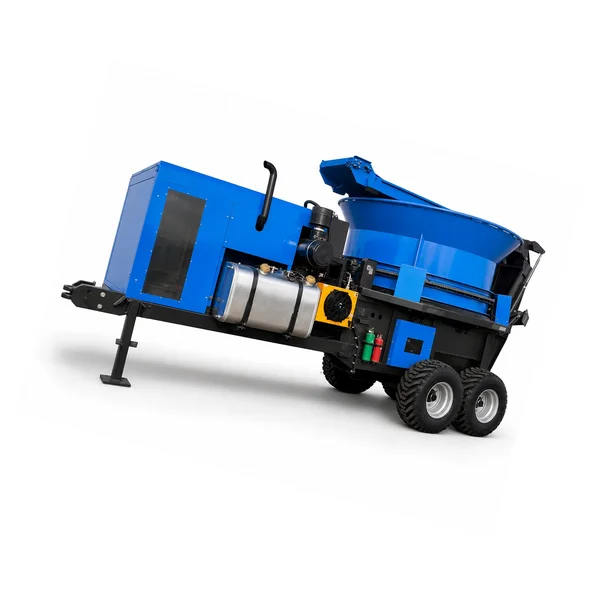
Itu 9F-70 forage feed crusher is the final link in a complete field-to-feed-bunk system. Once you have cut, raked, and baled your forage — and stored it through the winter — this PTO-driven hammer mill converts those bales into uniform short-chop particles that livestock can consume without sorting, mix directly into a TMR wagon, or incorporate into supplemented rations without adding a dedicated forage chopper to your equipment fleet. At 3 to 8 tonnes per hour on dry hay and straw, the 9F-70 processes enough forage in two to three hours of daily operation to support a 300-head beef cattle herd through the full winter-feeding season.
Where the 9F-70 Fits: Your Complete Forage-to-Feed Chain
Most livestock operations already have most of the forage chain in place — a mower, a rake, and a baler. The 9F-70 closes the last gap between stored whole bales and ready-to-feed processed forage. Without a dedicated feed crusher, that gap is filled by one of three compromises: hand-feeding whole bales (which creates sorting and wastage), purchasing a separate forage harvester (which is expensive and time-specific), or buying processed feed at retail prices (which eliminates the economic value of owning your own forage production system).
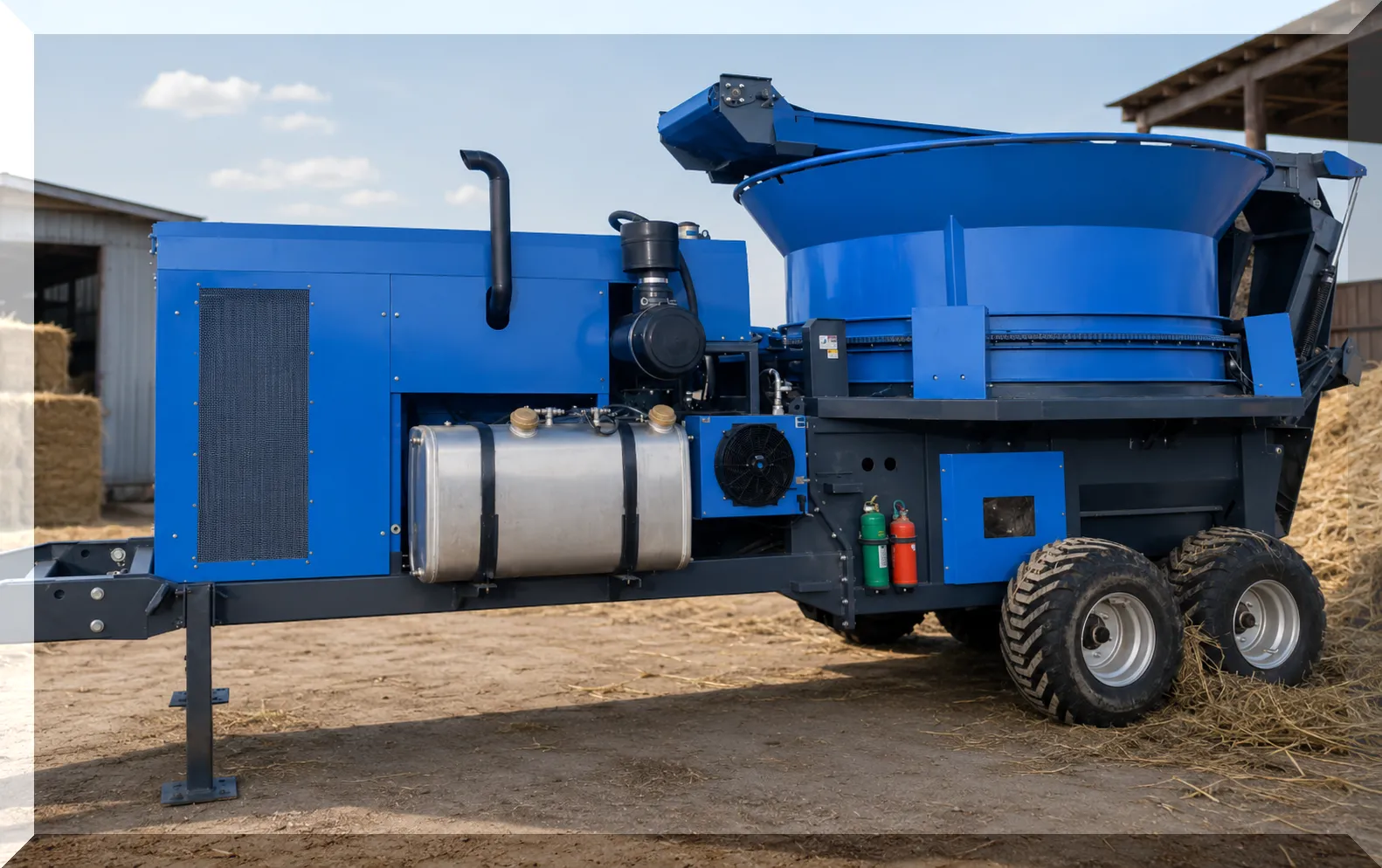
Adding a dedicated forage feed crusher like the 9F-70 to an established forage production system is the most capital-efficient way to recover value from stored bales. This full chain — from our barisan penggaruk jerami through our jajaran mesin pengepak jerami bundar to the 9F-70 feed crusher — can be sourced from one supplier, serviced from one U.S. parts warehouse, and supported by one technical team that understands how each component connects to the next.
Spesifikasi Teknis
The 9F-70 connects to the tractor's rear PTO at 540 rpm and is supported by the rear three-point hitch Category I or II. It requires no hydraulic remote outlet — operation is entirely mechanical once PTO is engaged. The U.S. team confirms tractor compatibility from your tractor model and serial number before the forage crusher ships.
| TIDAK. | Parameter | Satuan | Nilai |
|---|---|---|---|
| 1 | Model | / | Penghancur Pakan Ternak 9F-70 |
| 2 | Jenis Penggerak | / | PTO (rear), 540 rpm |
| 3 | Tenaga Traktor yang Dibutuhkan | kW (HP) | ≥ 37 (≥ 50 HP) |
| 4 | Rotor / Drum Diameter | mm (inci) | 700 (27.6 in) |
| 5 | Hammer Quantity | buah-buahan | 36 (4 rows × 9 pcs, freely swinging) |
| 6 | Hammer Material | / | 65Mn spring steel, HRC 48–52 |
| 7 | Screen Hole Diameter (selectable) | mm (inci) | 8 / 10 / 12 / 16 mm (0.31–0.63 in) |
| 8 | Feed Inlet Width | mm (inci) | 700 (27.6 in) |
| 9 | Productivity — Dry Hay / Straw | t/hr | 3–8 t/hr |
| 10 | Productivity — Corn Stalks | t/hr | 4–10 t/hr |
| 11 | Dimensi Keseluruhan (P × L × T) | mm (kaki) | 1,450 × 1,150 × 1,320 (4.8 × 3.8 × 4.3 ft) |
| 12 | Berat Mesin | kg (lb) | 520 (1,146 lb) |
| 13 | Jenis Pengait | / | Dipasang dengan 3 Titik (Belakang), Kategori I / II |
| 14 | Operator Dibutuhkan | orang-orang | 1 |
The Feeding Math: Does the 9F-70 Cover Your Herd's Daily Requirement?
Before specifying any feed crusher, the productive capacity needs to be confirmed against actual daily feed demand. The table below works backward from herd size to daily crusher run time — the number that determines whether you can fully process your herd's forage needs within a single morning's work or whether multiple passes are needed.
| Livestock Type | Head Count | Daily Forage Need (t/day) | Bales/Day (600 kg) | 9F-70 Run Time (hr/day) | Dakwaan |
|---|---|---|---|---|---|
| Dairy cows | 100 | 2.4 t | 4 | ~0.5 hr | ✔ Easy |
| Dairy cows | 300 | 7.2 t | 12 | ~1.3 hr | ✔ One pass |
| Beef cows (cow-calf) | 200 | 2.6 t | 4–5 | ~0.5 hr | ✔ Easy |
| Beef cows (cow-calf) | 500 | 6.5 t | 11 | ~1.2 hr | ✔ One pass |
| Growing steers (feedlot) | 400 | 4.0 t | 7 | ~0.7 hr | ✔ One pass |
| Sheep / goats | 800 | 1.8 t | 3 | ~0.3 hr | ✔ Easy |
Particle Size Control: Choosing the Right Screen for Your Feeding Program
The output particle size of the 9F-70 forage feed crusher is determined by which screen is installed. Screens are interchangeable — swapping takes approximately 15 minutes — and four standard hole diameters are available. The correct choice depends on the animal species, the feeding system (direct feed vs TMR mixer), and whether the processed forage will be mixed with grain or fed as a standalone roughage source.
Working Principle: How the 9F-70 Hammer Mill Processes Forage
The 9F-70 feed crusher operates on the horizontal-shaft free-swinging hammer mill principle — the same mechanical basis used in commercial grain hammer mills, scaled and respecified for the lower-density, higher-moisture-range characteristics of forage material. Understanding the three-phase processing cycle explains why the freely-swinging hammer design consistently outperforms fixed-blade choppers on variable-density forage inputs.
Phase 1 — Feed Entry and Initial Impact
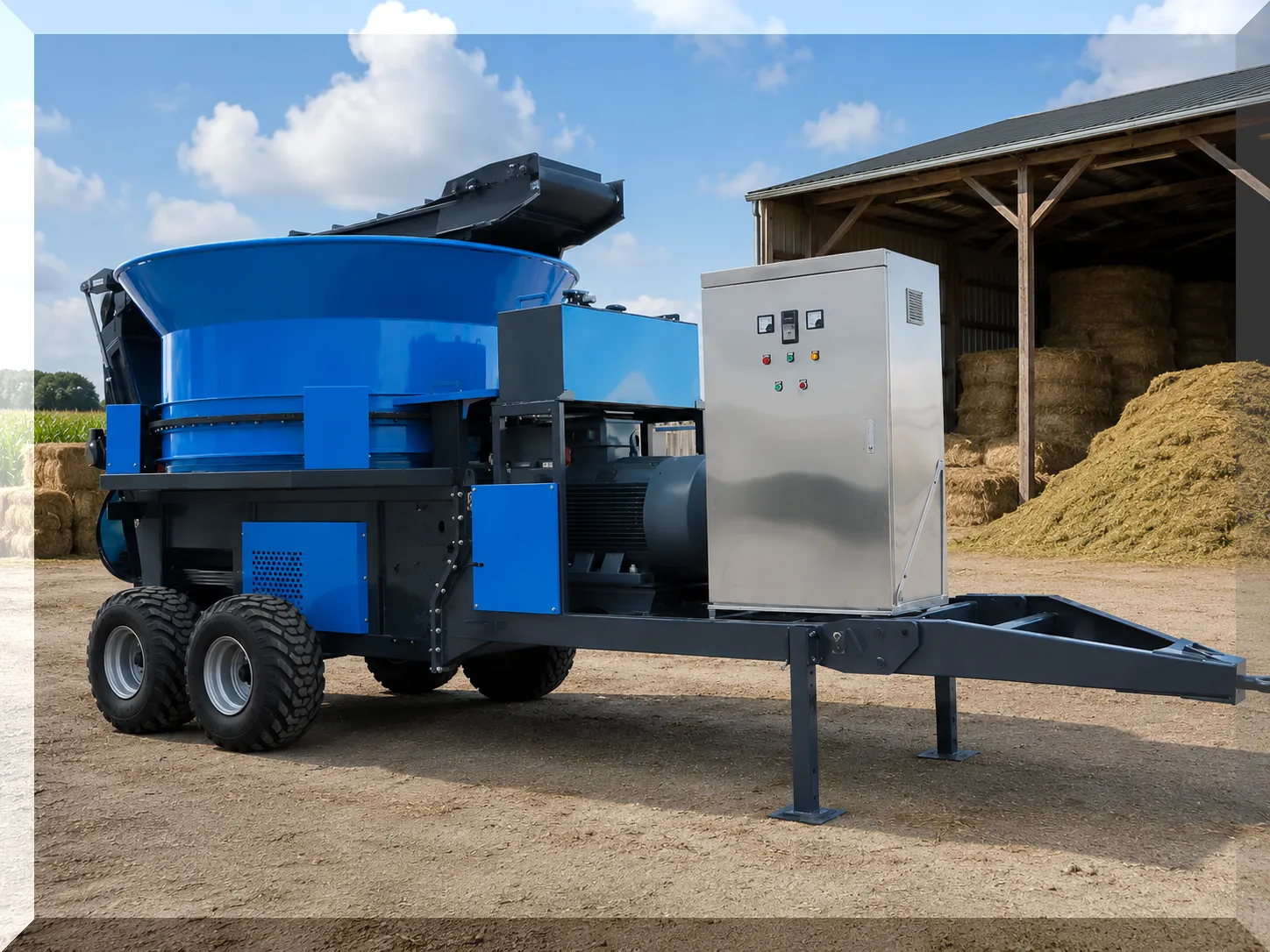
Forage material — either loose hay fed through the top inlet or bale fragments delivered by a front-loading tractor — enters the feed inlet at the top of the housing. The 700 mm rotor, spinning at PTO-driven speed, presents 36 hardened steel hammers in four staggered rows. The first hammer impact fractures the forage stem structure along its natural fiber lines rather than cutting perpendicular to the grain, which is why hammer-milled forage retains a rougher, more absorbent particle surface than disc-cut forage — a characteristic that affects both TMR mixing performance and rumen fermentation rate.
Phase 2 — Circulation and Repeated Impact
Material that does not immediately pass through the screen after the first hammer contact circulates within the housing, receiving multiple hammer impacts on each revolution. The freely-swinging mount of each hammer is mechanically significant: when a hammer strikes a dense knot or hard section in a hay stem, the swing-mount allows it to deflect backward momentarily, absorbing the overload impact without transmitting it as a shock load through the rotor shaft and into the gearbox drive circuit. Fixed-blade designs transmit all such loads directly to the drive mechanism — which is why hammer mills consistently outlast fixed-blade choppers on hard, irregular forage inputs.
Phase 3 — Screen Classification and Discharge
Only particles that have been reduced below the screen hole diameter pass through the bottom screen and exit the housing. Oversized particles remain inside and continue to receive hammer impacts. This self-classifying action guarantees that the screen diameter is also the maximum particle size in the output — there is no distribution tail of oversized particles that bypasses the screen. The classified output discharges through the bottom, typically into a ground pile, a conveyor, or directly into a mixer wagon tub.
Bale Type Compatibility: What the 9F-70 Accepts
The 9F-70 forage crusher processes any forage material that can be fed through its 700 mm inlet. The practical method for most operations is to open or slice the bale with a knife and feed sections to the inlet using a front-loader or bucket tractor. The inlet width of 700 mm accommodates sections from round bales of any diameter — the bale is positioned on the front loader, the net wrap or twine is removed, and the tractor pushes sections into the inlet at a rate that maintains steady inlet pressure without overloading the rotor.
| Bale Type | Typical Bale Weight | Processing Method | Approx. Throughput Time | Catatan |
|---|---|---|---|---|
| Round bale, dry hay (1.0 m) | 300–450 kg | Section-feed by loader | 3–6 min | Remove net wrap before processing; alfalfa and grass both work at 14–18% moisture |
| Round bale, dry hay (1.25 m) | 550–750 kg | Section-feed by loader | 5–9 min | Standard commercial bale size; most common input for this machine in U.S. operations |
| Straw bale (round or large square) | 400–600 kg | Section-feed by loader | 4–8 min | Straw is lowest-resistance material; highest throughput rates; excellent for bedding production at 8 mm screen |
| Corn stalk bale (round) | 500–700 kg | Section-feed; remove stalks pointing outward before feeding | 4–7 min | High silica content accelerates hammer tip wear; inspect and replace hammers every 60–80 bales on corn stalks |
| Loose dry hay (hopper-fed) | Continuous feed | Gravity or conveyor into top inlet | Continuous | Requires separate hopper or elevator; highest sustained throughput rate — suitable for large commercial lots |
Four Livestock Operations That Benefit Most From the 9F-70
🐄 Commercial Dairy — TMR Integration
Large dairy operations running 200 to 600 cows on a total mixed ration (TMR) program face a consistent processing challenge: whole-bale hay cannot be loaded directly into a TMR wagon, and the forage particle length after manual flaking is too variable for nutritionist-specified ration formulas. The 9F-70 feed crusher at a 12 mm screen produces a consistent short-chop hay particle that mixes uniformly with grain and protein supplements in the wagon, eliminating the sorting behavior that reduces DMI on fiber-selective dairy herds. Wisconsin and Minnesota dairy operations of 250 to 400 cows routinely process their full daily forage requirement in a single 90-minute morning session before the AM milking.
🐂 Beef Cow-Calf — Winter Feeding Efficiency
Cow-calf operations in the northern Plains and Rocky Mountain states that winter-feed on native grass and meadow hay stored in round bales face a specific logistics challenge: whole-bale feeding produces 15 to 30% forage waste from sorting and trampling, which compounds across 120 to 150 winter feeding days into a significant wasted inventory value. Processing through the 9F-70 forage crusher at an 8 to 10 mm screen reduces sorting by providing uniform particles that cattle consume without selecting, cutting winter hay waste from the typical 20–25% on whole bales to under 8% on processed forage. For a 300-cow herd feeding 4 bales per day, that waste reduction translates to 20 to 35 fewer bales needed per winter — effectively paying for the machine in two to three seasons on forage alone.
🌾 Stocker and Feedlot — Ration Roughage Supplement
Backgrounding and stocker operations in Iowa, Nebraska, and Kansas that feed high-grain growing rations require a controlled inclusion of roughage to maintain rumen health. The 9F-70 feed crusher processes stored hay at 16 mm screen to produce a short-chop particle that can be weighed and mixed with ground grain or distillers grains at the specified roughage percentage without creating feed sorting at the bunk. Consistent particle size at the ration mix-in level is critical for preventing sub-acute ruminal acidosis (SARA) on high-concentrate growing programs — and it is only achievable when the roughage source is processed to a target particle length, not flaked from whole bales.
🐑 Small Ruminant and Specialty Livestock Operations
Sheep, goat, alpaca, and horse operations that purchase or grow round bales of hay face the mismatch between commercial bale formats (produced at 500–750 kg for cattle operations) and the daily intake requirements of small ruminants. A 600 kg alfalfa bale feeds 400 ewes for one day — but a whole bale cannot be stored open without moisture intrusion and mold risk. The 9F-70 forage feed crusher processes one bale per session into a day's supply of short-chop hay that can be accurately weighed into individual feeding trays or mixed with mineral supplements, with the leftover processed forage sealed in bags for next-day use without the spoilage risk of an open whole bale.
Six Technical Advantages That Make the 9F-70 the Practical Choice
Freely-Swinging 65Mn Hammers
65Mn spring steel hammers heat-treated to HRC 48–52 are reversible — when one face wears below the critical threshold, flip the hammer to expose the unworn face and continue at full performance. Each hammer delivers approximately two full service lives before replacement.
Interchangeable Screens — 15-Minute Swap
Four hole-diameter options (8, 10, 12, 16 mm) on the same machine. Change screen for different feeding programs, animal species, or bedding production without any tooling change beyond a standard wrench. Keep all four screens in the toolbox and switch as needed for the day's ration.
No Hydraulic Requirement
The 9F-70 operates entirely from the rear PTO — no rear hydraulic remote outlets, no electrical harness beyond the PTO driveshaft. Any tractor from 50 HP upward with a working 540 rpm rear PTO can run it, including older fleet tractors without functional hydraulics or those reserved for specific non-hydraulic tasks.
Screen-Guaranteed Maximum Particle Size
Unlike disc choppers and tub grinders, the screen-classification mechanism guarantees that no particle above the screen hole diameter exits the machine. Nutritionists formulating TMR rations can specify the screen setting as a defined particle size input in ration calculations — a level of consistency that chopper-based systems cannot provide.
Low Moisture Sensitivity
The 9F-70 processes forage across the full moisture range from air-dry (12%) to moderate-moisture haylage (45%). Above 45% moisture, material tends to mat on the screen rather than pass cleanly — for higher-moisture silage processing, pair the 9F-70 with the Mesin pengepak dan pembungkus silase 9YCM-850 to preserve high-moisture material intact for separate processing at a lower moisture point.
Simple Maintenance Profile
The machine has three service points: hammer wear inspection (flip or replace), rotor shaft bearing grease (NLGI-2, every 50 hours), and PTO driveshaft lubrication. There are no belts, no chains, no hydraulic cylinders, and no electronic sensors in the core crushing mechanism. Annual service takes under two hours.
PTO Driveline at Full Continuous Load
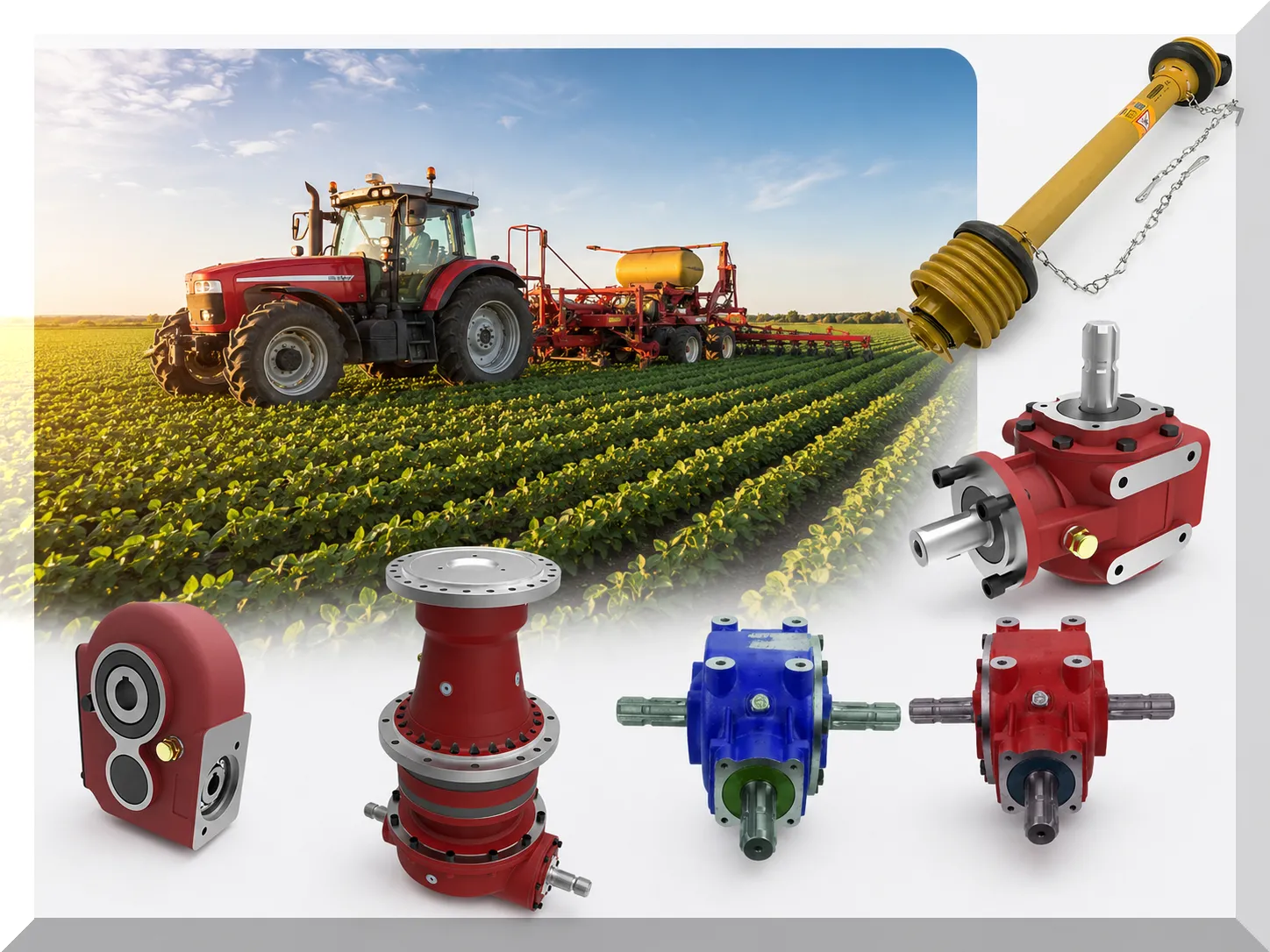
The 9F-70 forage feed crusher is a high-inertia machine — the rotor assembly at 700 mm diameter maintains significant rotational mass once up to speed, but the start-up torque demand and the torque spikes when dense forage sections enter the chamber are substantial. The internal bevel gear transfer between the PTO shaft and the rotor shaft must handle both the steady-state torque of continuous full-feed operation and the peak torque of a dense knot or hard section entering the rotor at full RPM.
A correctly specified heavy-duty forage processing gearbox for this application is rated for continuous input torque above 800 Nm with case-hardened spiral bevel gears, sealed oil-bath lubrication, and tapered roller bearings that handle the combined axial and radial loads generated by the high-inertia rotor at 540 rpm input. The overload clutch on the PTO driveshaft should be pre-set at 700–750 Nm to protect the gearbox from the rare but high-magnitude torque spikes that occur when a particularly hard material (a dried thistle clump, a soil-contaminated bale edge) passes through the rotor in a single pass.
Maintenance Schedule
The 9F-70 feed crusher has the simplest maintenance profile of any machine in our lineup. Three components require regular attention; everything else is a visual inspection at the start of each season.
| Selang | Komponen | Tindakan |
|---|---|---|
| Every 60–80 bales (hay/straw) | Hammer tips (36 pcs) | Measure tip thickness. When worn below 4 mm, flip hammer to the unworn face. Replace when both faces are below 4 mm. |
| Every 30–50 bales (corn stalks) | Hammer tips | Corn stalk silica content accelerates wear. Reduce inspection interval and replace hammers more frequently during corn stalk processing. |
| Every 50 operating hours | Rotor shaft bearings (2 pcs) | Regrease via zerk fittings with NLGI-2 multi-purpose grease. Do not over-grease — 2 to 3 full pumps per fitting. |
| Every 50 hours or seasonally | PTO driveshaft telescopic section | Apply EP-2 grease to the profile section. Check safety guard integrity — replace guard if cracked or fasteners missing. |
| Pramusim | Gearbox oil (SAE 90 GL-5) | Drain and refill. Inspect drained oil for metal particles or discoloration before refilling. |
| Pramusim | Screen condition | Inspect screen holes for deformation or enlargement — worn holes pass oversized particles. Replace screen if any hole diameter exceeds nominal by more than 2 mm. |
| Pramusim | Hammer pivot pins | Check pivot pin diameter for wear; replace if lateral play in hammer exceeds 2 mm. Hammers that are loose on the pivot do not swing freely and lose impact efficiency. |
Why U.S. Livestock Producers Choose foragebaler.com
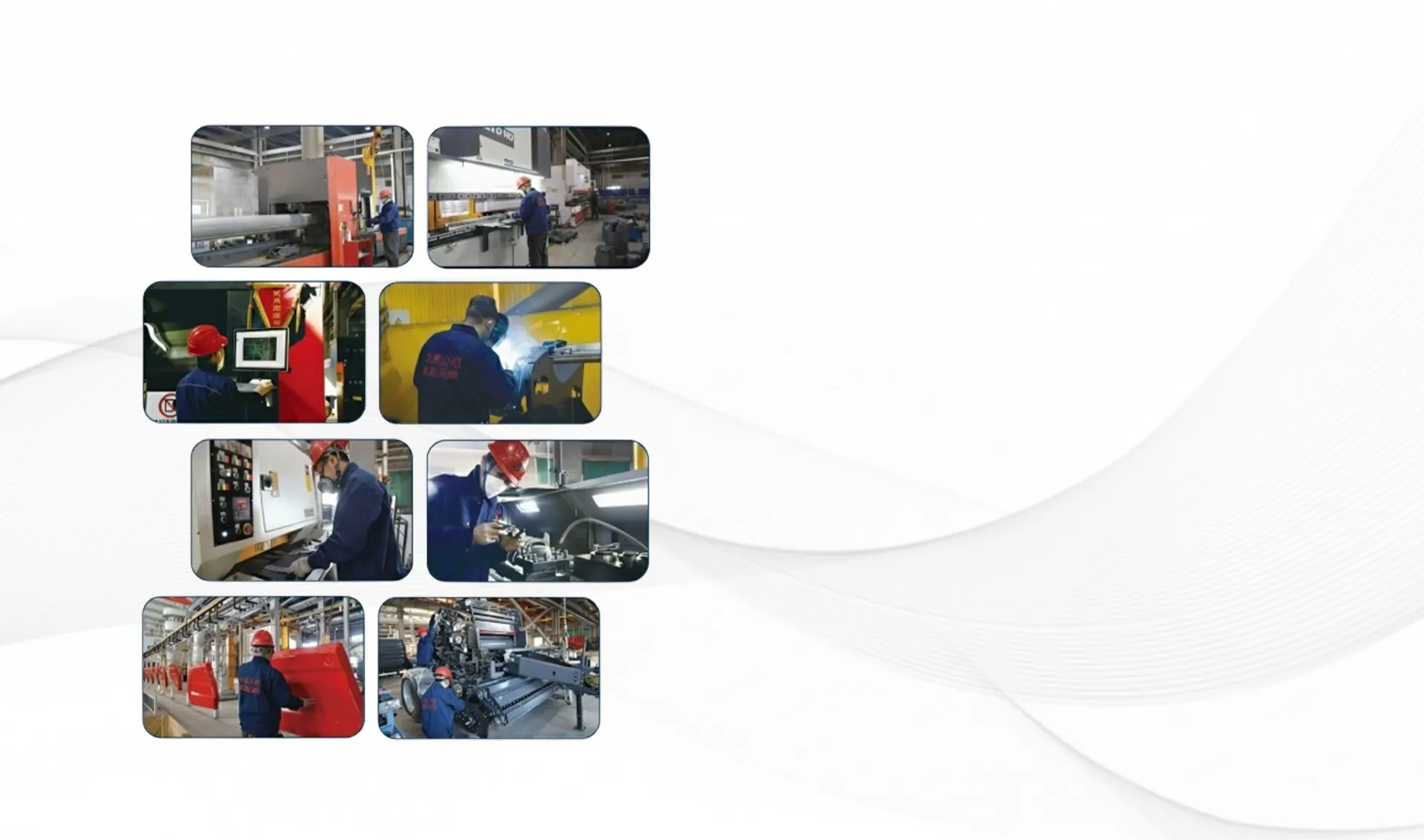
- ✔Complete System, One Supplier. The 9F-70 forage crusher is the final step in a complete forage system that begins with our mowing and raking equipment, runs through our round baler lineup, and ends at the feed bunk. Parts for every machine in the chain ship from the same California warehouse on the same order — one invoice, one freight run, one support team.
- ✔U.S. Warehouse Parts — Same-Day Dispatch. Hammer sets (36-piece full rotors), pivot pin kits, replacement screens (all four sizes), rotor shaft bearing kits, and PTO driveshaft components stocked year-round. Orders placed before 2:00 PM Pacific ship same business day.
- ✔PTO Compatibility Verified Before Shipping. The U.S. team confirms your tractor's rear PTO output (540 rpm), hitch category, and overload clutch specifications from your tractor's model and serial number before anything ships. The most common installation issue on PTO-driven hammer mills — incorrect clutch slip torque setting — is identified and resolved before the machine arrives at your farm.
- ✔Dokumentasi Mutu ISO 9001. Full quality certification package including material traceability, hammer hardness test records, and gearbox oil-fill inspection documentation available on request. Learn more at our Tentang Kami halaman.
- ✔Memenuhi syarat berdasarkan Pasal 179. The 9F-70 qualifies as qualified tangible business property under IRS Section 179. Full invoice documentation for first-year expensing provided on request. For a machine priced in the mid-range capital equipment bracket, the after-tax first-year effective cost can make a compelling improvement to the payback calculation for operations in a profitable year.
Freight and Delivery

The 9F-70 forage crusher weighs 520 kg and ships LTL freight from our California warehouse. At this weight it typically qualifies for standard pallet freight pricing rather than oversize equipment rates. Domestic transit runs 6 to 10 business days to most U.S. addresses. The machine arrives fully assembled; installation involves connecting the 3-point hitch pins, attaching the PTO driveshaft, and installing the starter screen — approximately 30 to 45 minutes for one person. The U.S. team walks through the PTO clutch setting and first-run procedure by phone on delivery day.

Pertanyaan yang Sering Diajukan
Operators Who Run the 9F-70 Daily
★★★★★
We run 340 Holstein cows on a full TMR program. Before the 9F-70 we were paying a neighbor with a tub grinder to process a week's worth of hay at a time, then storing the processed forage loosely in the barn. The quality dropped significantly after day three of storage. Now we process fresh each morning — about 80 minutes with a 65 HP Kubota M7060. The 12 mm screen output mixes uniformly in our vertical TMR mixer with no sorting issues in the bunk. Our nutritionist noted improved fiber distribution scores on the Penn State Separator starting the second month. Best equipment investment we've made in three seasons.
★★★★★
480 cows winter-fed on native grass meadow hay in the Big Horn Basin. We were seeing 22 to 25 percent hay waste on whole-bale ground feeding — trampling, spoilage, selectivity. First winter with the 9F-70 using 8 mm screen, waste dropped to under 9 percent measured by weighing unconsumed material after 24 hours. That's roughly 35 fewer bales needed across the feeding season — on a 600-bale winter inventory that's a meaningful number. The machine processed our hay with a 58 HP chore tractor we already owned. No additional investment required beyond the crusher itself.
★★★★★
We manage 620 ewes and 180 does on a mixed operation in eastern Kansas. The mismatch between commercial 600 kg round bales and what our small ruminants can consume before an open bale starts molding was a persistent problem. The 9F-70 let us process exactly what we need per day and seal the remainder in feed bags. Hay waste went from approximately 18 percent on whole-bale feeding to under 5 percent. The 12 mm screen output works well for both species — long enough for adequate rumen fiber function, short enough to reduce bunk selectivity. Four stars previously on the initial order because the delivery took 10 days — the machine itself is exactly as described.
★★★★★
370 head of stocker calves on a high-concentrate growing ration with 10 to 12 percent hay roughage inclusion. The 9F-70 at 16 mm screen produces a particle that blends completely into the ration mix without bridging in the mixer auger — our previous whole-flake hay inclusion was creating pockets in the wagon and uneven distribution across the bunk. Sub-acute ruminal acidosis incidence in the pen dropped measurably in the second group after we started using crushed hay roughage rather than whole flake. The U.S. team confirmed our John Deere 5075E was compatible before the order was placed — no surprises on delivery.
★★★★☆
40-horse boarding facility in the Sierra Nevada foothills. We use 2–3 round bales of orchard grass per day and were hand-flaking every one. The 9F-70 processes a full bale in under eight minutes at 12 mm screen, then we weigh portions for each horse's daily hay ration. Four stars because the machine requires a front loader for bale feeding — I needed to rent one the first week before a neighbor loaned us theirs permanently. Once that logistics piece was solved, the machine has been excellent. Particle consistency is noticeably more uniform than hand-flaked hay, and the horses at the bottom of the social hierarchy are eating better because there's less selective refusal of shorter stem pieces.
★★★★★
We custom-feed 500 head of contracted yearlings for three clients in northeastern New Mexico. Our corn stalk bedding production was the driver for the 9F-70 purchase — we needed to process 8 to 12 bales of stalks per week for pen bedding. The 8 mm screen produces excellent fine-textured bedding at 8 to 10 t/hr on stalks with the Massey Ferguson 6718S. We also run 12 mm for daily roughage supplementation during the same session. The dual-use on the same machine in the same day was not something I expected to work this smoothly. Hammer wear on stalks is noticeable — we replace roughly every 200 stalk-bales — but the hammer cost per ton processed is still well below what contracted processing services were charging us previously.
Close the Loop From Bale Storage to Feed Bunk
PTO compatibility confirmed from your tractor model before shipment. Same-day U.S. parts dispatch, ISO 9001 quality documentation, Section 179 invoice packages, and full system support from mowing through feeding included with every order.
America Ever-Power Forage Baler Equipment INC. | 1401 21st ST STE R, Sacramento, CA 95811
Informasi Tambahan
| Editor | Cxm |
|---|
Produk Terkait
-
Mesin Pemanen Perontok Kacang Merah 4DQ-5 | Mesin Perontok Tarik 5 Baris
-
9JYY-4.5 Pengangkut Bal Jerami Bundar | Pengangkut 4.500 kg
-
Mesin Baler-Pembungkus Silase Kombinasi 9YCM-850 | 30–40 Bal/Jam
-
Trailer Pengangkut Balok Bundar Kompak 9JYY-2.5
-
9FZ-2.0 Mesin Pengering Rumput Lipat Hidrolik dengan Roda Jari | 3 Roda


