Industry Guide · Beef Cattle Operations · Updated August 2026
Best Round Baler for Beef Cattle
Round bales are the standard hay format for beef cattle operations because they reduce labour per tonne fed, suit outdoor self-feeding systems and match the volume requirements of larger herds. The right bale size is the one your herd consumes in 3–5 days before spoilage begins on the open face. The 9YQ-870 suits herds under 15 cows; the 9YQ-1250 serves 15–40 cows; the 9YQ-1950 fits 40–100 cows; and the 9YQ-2300 is the choice for 100+ head operations. This guide covers every factor in the round baler and bale-size decision for beef cattle producers.
Covers: why round bales suit beef cattle · matching bale size to herd · consumption time calculation · net wrap for outdoor storage · feeders and waste reduction · model comparison · silage bales for beef
Quick Answer — Round Baler Size by Beef Cattle Herd
Under 15 cows → 9YQ-870
15–40 cows → 9YQ-1250
40–100 cows → 9YQ-1950
100+ cows → 9YQ-2300
The goal: each bale is fully consumed within 3–5 days of being opened. Bales that sit open for more than 5 days in winter or 3 days in wet conditions begin spoiling from the face inward — increasing hay waste cost and reducing available nutrition per tonne purchased.
Why Round Bales Are the Standard for Beef Cattle Operations
Small square bales are impractical for beef cattle at any significant scale — a 50-cow herd consuming 15kg of hay dry matter per cow per day requires 750kg of hay daily, which is approximately 37 bales per day at 20kg per bale. Handling 37 small square bales to a winter feeding area is not sustainable as a daily labour commitment across a 90–120 day winter feeding period. Round bales convert the same daily requirement into 1–2 baler passes to move and present a single large-format bale.
Beyond labour efficiency, round bales suit beef cattle for a second reason: beef cattle are not nutritionally sensitive in the way dairy cows and horses are. A lactating beef cow crude protein requirement of 10–12% is achievable with good-quality mixed grass hay or lower-grade alfalfa — the hay does not need to be boot-stage timothy or Supreme-grade alfalfa. This means round bale producers for the beef market have considerably more flexibility in cutting stage, crop variety and storage method while still meeting buyer requirements.
Matching Bale Size to Herd: The Consumption Time Calculation
The most important calculation in selecting a round baler for beef cattle is: how many days will one bale last your herd? The target consumption window is 3–5 days. Below 3 days: you are moving bales too frequently and losing the labour efficiency advantage of round bales. Above 5 days (or above 3 days in wet, mild conditions): the open bale face spoils from weathering faster than the cattle can consume it, and dry matter losses from the outer layer increase feed waste cost.
| Modello |
Diametro della balla |
Typical Bale Weight |
Days to Consume
(15 kg/cow/day) |
Optimal Herd Size |
Min PTO HP |
| 9YQ-870 |
870 mm |
100–160 kg |
7–11 days (5 cows)
3–5 days (8–10 cows) |
5–15 cows |
40 HP |
| 9YQ-1250 |
1,250 mm |
250–380 kg |
4–5 days (25 cows)
3–4 days (40 cows) |
15–40 cows |
55 HP |
| 9YQ-1950 |
1,950 mm |
400–650 kg |
4–5 days (50 cows)
3–4 days (80 cows) |
40–100 cows |
75 CV |
| 9YQ-2300 |
2,300 mm |
650–1,000 kg |
4–5 days (120 cows)
3–4 days (160 cows) |
100–200+ cows |
100 CV |
Consumption estimates at 15 kg dry matter per cow per day (typical mature beef cow winter maintenance). Bulls and growing stock have higher requirements; dry cows in good condition may consume less. Adjust calculations for your specific herd composition.
9YQ Model Guide for Beef Cattle Operations
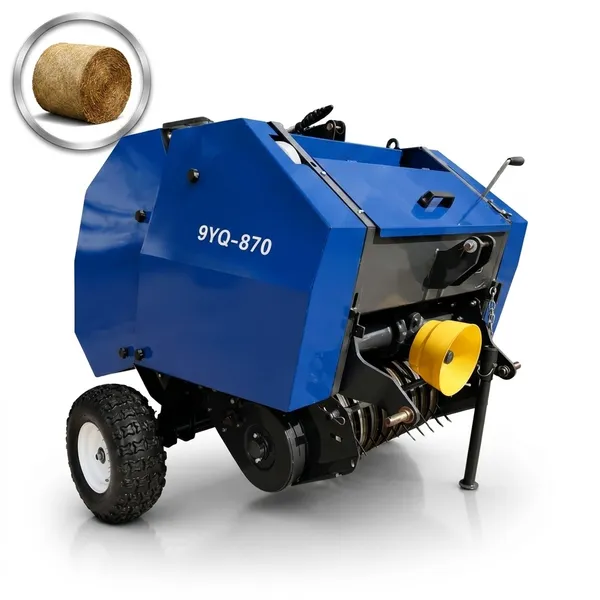
9YQ-870 — Small Cow-Calf and Stocker Operations5–15 cows · 40HP min
The 870mm bale at 100–160kg is the only round bale format that avoids excessive spoilage for small beef cattle operations. A 10-cow herd at 15kg daily consumption per cow finishes a 150kg bale in approximately 1 day — move a new bale to the feeder every day. This daily handling is labour but the bale never sits open long enough to spoil. Pairs with compact utility tractors already on small farms. Manual bale movement is possible for the smallest bales but typically requires a tractor front loader spike for practical operation.
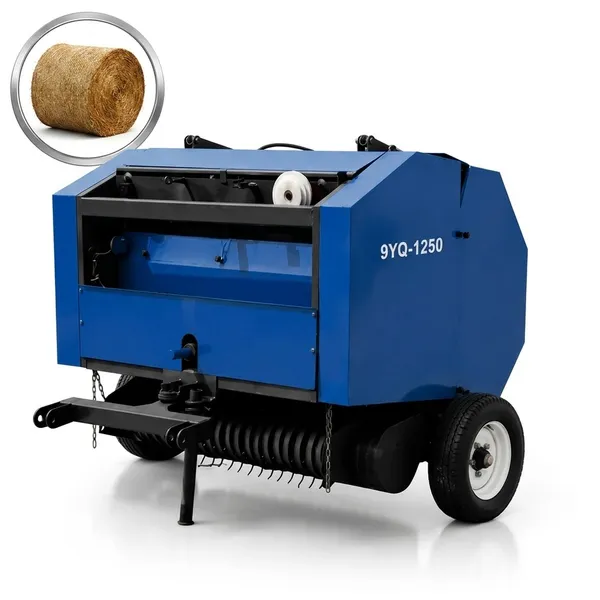
9YQ-1250 — Most Versatile Small-Medium Cattle Model15–40 cows · 55HP min
The 1,250mm bale at 250–380kg is the most widely used round bale format for US beef cattle operations in the 15–50 cow range. This bale fits standard ring feeders (most designed for 1,200–1,350mm diameter), handles with a mid-size front loader and completes in 3–4 days for a 25–30 cow herd — the ideal consumption window. Wide market availability of ring feeders, bale trailers and bale spikes at this diameter makes the 9YQ-1250 the easiest model to integrate into an existing small beef operation equipment inventory.
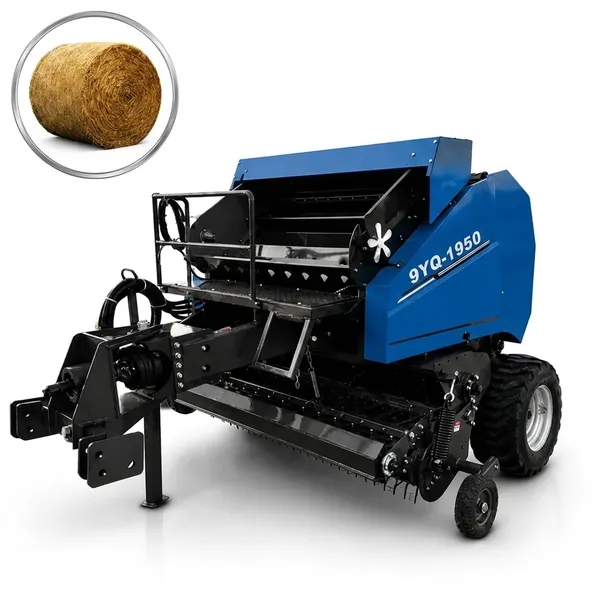
9YQ-1950 — Mid-Size Commercial Cattle Standard40–100 cows · 75HP min
The 1,950mm bale at 400–650kg is the preferred format for medium beef cattle operations and silage production. A 60-cow herd at 15kg per cow completes a 500kg bale in approximately 3.5 days — ideal. This bale size is also the most commonly specified for bermudagrass and mixed grass hay destined for the cattle market, and is the lower end of round bale sizes suitable for road transport on a standard bale trailer for producers selling hay to neighbouring cattle farms.
9YQ-2300 — Large Commercial and Feedlot Operations100+ cows · 100HP min
The 2,300mm bale at 650–1,000kg produces the lowest labour cost per tonne of any round baler format — fewer bales to move, fewer bale placements per feeding cycle. For a 150-cow herd at 15kg per cow: a 750kg bale lasts approximately 3.5 days, which is the optimal window. Requires a heavy front loader or telehandler and is not practical without dedicated bale handling equipment. Most efficient on large flat paddocks with drive-through ring feeder systems.
Net Wrap for Outdoor Storage — Why It Matters for Beef Cattle Economics
Beef cattle operations typically store round bales outdoors — the volume of bales required for a 100-head winter feeding program makes indoor storage impractical for most operations. Outdoor-stored round bales without net wrap lose 15–25% of dry matter from weathering over a 6-month storage period. At $100 per tonne and 500kg per bale, this represents $7.50–$12.50 per bale in lost feed value — more than the cost of net wrap material per bale.
Without Net Wrap — Outdoor Storage
DM loss: 15–25% over 6 months
Cause: rain penetration through twine gaps, ground contact moisture wicking, UV oxidation of outer layer
Financial loss per 500kg bale at $100/tonne: $7.50–$12.50
With Net Wrap — Outdoor Storage
DM loss: 5–10% over 6 months
Cause: only bale ends and base exposed; cylindrical surface sheds rain effectively
Financial loss per 500kg bale: $2.50–$5.00
Net wrap cost per bale: $0.90–$1.50
Net saving: $4–$9 per bale
Ring Feeders: The Second Biggest Factor in Round Bale Economics
Ring feeders (round bale feeder rings) reduce feed waste by physically restricting cattle access to a small section of the bale face at a time, preventing the nose-sorting and trampling waste that occurs when cattle have unrestricted access. The difference in waste between a cattle herd fed from a loose bale on the ground versus a ring feeder is substantial:
25–35%
Waste without ring feeder
Cattle nose-sort, trample and soil 25–35% of bale before consuming
5–15%
Waste with ring feeder
Feeder restricts access, reduces nose-sorting and keeps dropped hay off ground
$4–$10
Saving per bale (500kg, $100/t)
Ring feeder ROI typically achieved in one winter feeding season
Ring feeder diameter should be matched to the round bale diameter — most standard ring feeders are designed for 1,200–1,350mm diameter bales (matching the 9YQ-1250) or 1,800–2,000mm diameter bales (matching the 9YQ-1950). Confirm ring feeder compatibility before purchasing either the baler or the feeders.
Round Baler PTO Drive for All-Season Beef Cattle Hay Production
Beef cattle round baling often involves long daily sessions during peak summer hay production — a 300-bale day with the 9YQ-1950 at 75HP for 10 hours puts sustained load on every driveline component. CV joint failure during a peak-season session can leave hundreds of bales of cut hay in the field past its optimal baling moisture. Annual pre-season inspection of the PTO driveshaft — checking CV joint boot condition, telescoping section movement and all grease fittings — prevents the most common in-field failures. Full inspection and sizing guide: PTO driveshaft inspection guide for round baler beef cattle operations.
Frequently Asked Questions — Round Baler for Beef Cattle
Can I use the same round baler for both beef cattle hay and silage?+
Yes — all 9YQ round balers are suitable for both hay and silage (haylage) baling. For silage: bale the crop at 40–55% moisture with net wrap (one layer under the stretch film), then apply 4–6 layers of stretch film immediately after baling — on the same day — using a separate bale wrapper machine. The 9YQ produces the correctly shaped bale for a bale wrapper; the tight cylindrical shape from the fixed-chamber design ensures clean film application without air gaps. Beef cattle silage bales are valuable for winter feeding — they deliver 15–30% more digestible energy per tonne than dry hay from the same crop, making them particularly useful for thin cows, young growing stock or bulls in the breeding season where extra condition is needed.
What is the best way to feed round bales to beef cattle in winter?+
The three standard beef cattle round bale feeding methods ranked by feed waste (lowest to highest): (1) Ring feeder on a concrete pad — the concrete prevents mud and manure accumulation around the bale, reducing the soiling of dropped hay that cattle would otherwise consume. Ring feeder reduces waste to 5–10%. (2) Ring feeder on a graveled area — partial mud reduction, waste approximately 8–12%. (3) Bare ground without feeder — worst outcome: 25–35% waste, high mud contamination, potential for cattle to stand and lie in the hay, and cattle trampling the outer bale layers before consuming them. Concrete feeding pads with ring feeders have an upfront cost but pay back through reduced hay waste in 1–2 seasons for most operations. Moving the ring feeder position periodically prevents the permanent soil compaction and pathogen buildup that develops under a fixed ring feeder on bare ground.
How much hay does a 500kg beef cow need per day in winter?+
A dry, 500kg beef cow in good condition (body condition score 5–6) consumes approximately 12–15kg of hay dry matter per day during winter maintenance. This represents 2.5–3% of her body weight in dry matter daily, which is the standard figure for maintenance feeding of resting beef cows. Cows in the last trimester of pregnancy (3rd trimester) require 15–18kg per day as fetal growth increases energy demand. Lactating cows (early postpartum) require 16–20kg of hay dry matter per day if the hay is the primary ration component, dropping to 14–16kg if supplemental grain is provided. Young stock (yearlings, two-year-olds) require 8–12kg per day depending on body weight and growth target. Use these figures to calculate the correct bale size for your specific herd composition — a mixed herd of dry cows, pregnant cows and yearlings has different average requirements than a uniform herd of dry mature cows.
How long can round bales be stored outdoors for beef cattle?+
Net-wrapped round bales can be stored outdoors for 4–8 months before the dry matter losses become economically significant. At 5–10% DM loss per 6 months in typical US outdoor conditions with net wrap, a 500kg bale retains 450–475kg of usable hay after 6 months of outdoor net-wrapped storage — acceptable for beef cattle hay where the economic margin on each bale is narrower than for horse or dairy hay. Twine-wrapped bales stored outdoors should be used within 3–4 months to avoid DM losses exceeding 20%. For bales stored beyond 8 months: inspect the outer 50–100mm layer before feeding — this layer typically has the highest weathering damage and may be mold-affected even when the interior is acceptable. Cattle will reject visibly moldy hay in most cases; if consumption is poor despite apparent hunger, open the bale and check for internal mold before assuming the cattle are not hungry.
What crop produces the most round bales per acre for beef cattle?+
For total round bale yield per acre: bermudagrass in the Southeast US is the highest-yielding warm-season perennial hay crop, producing 4–8 tonnes per acre per season in irrigated conditions (3–6 tonnes rainfed), which translates to 8–16 round bales per acre at 500kg per bale per season across 4–6 cuttings. Sorghum sudangrass is the highest-yielding annual option: 5–10 tonnes per acre per season in warm climates from 2–3 cuttings, producing 10–20 round bales per acre. For the northern US: orchardgrass and mixed grass hay yield 2–4 tonnes per acre from 2–3 cuttings (4–8 bales per acre per season). Alfalfa in the Midwest yields 3–5 tonnes per acre rainfed (6–10 round bales per acre). For beef cattle where the primary goal is maximising tonnes of feed per acre at acceptable cost per tonne — not maximum crude protein — bermudagrass (Southeast) or orchardgrass/mixed (Midwest, Northeast) are the most economically efficient choices in their respective regions.
Should I buy the 9YQ-1250 or the 9YQ-1950 for a 50-cow herd?+
For a 50-cow herd: the 9YQ-1950 is the correct model. A 50-cow herd at 15kg per cow per day consumes 750kg per day. A 9YQ-1250 bale at 300kg average weight lasts only 0.4 days (under 10 hours) — you would need to move 2–3 bales per day, which negates the labour efficiency of round baling. A 9YQ-1950 bale at 500kg average lasts approximately 0.67 days — still short of the ideal 3–5 day target. To reach the 3–5 day target for a 50-cow herd: you would need to feed 2 bales simultaneously (total 1,000kg, lasting 1.3 days at 15kg/cow) or use a 9YQ-2300 bale at 800kg (lasting approximately 1 day). The realistic answer for a 50-cow herd: the 9YQ-1950 feeding 2 bales simultaneously through 2 ring feeders is the standard approach. Place 2 bales every 1–2 days rather than 1 bale every day — this is the labour compromise between bale size and consumption time for mid-size herds. Upgrade to the 9YQ-2300 when the herd consistently exceeds 80–100 cows.
Is there a tractor HP I already own that determines which 9YQ model makes sense?+
Yes — the tractor you already own is often the most practical starting constraint. A compact utility tractor at 40–50HP engine rating (approximately 34–43HP PTO) can only run the 9YQ-870. A mid-size tractor at 60–75HP engine (50–64HP PTO) works with the 9YQ-1250 comfortably and the 9YQ-1950 at minimum. A full-size utility tractor at 85–100HP engine (72–85HP PTO) is well-matched to the 9YQ-1950 and is at the minimum for the 9YQ-2300. If the most-logical bale size for your herd requires a model that exceeds your current tractor, compare the cost of a tractor upgrade versus the daily labour cost of moving more bales with the smaller model over the winter feeding season — in many cases, 10–15 years of additional bale-moving labour exceeds a tractor upgrade cost.
What hay quality should I target for beef cattle round bales?+
Dry, mature beef cows in good condition (BCS 5+) during winter maintenance can be fed hay at 8–12% crude protein and RFV 80–120 — which is achievable with mid-bloom or later-cut grass hay, straw supplements or lower-grade mixed hay. This is why beef cattle round hay costs less per tonne than horse or dairy hay: the quality specification is achievable with later-cut, higher-yield hay that is not suitable for more demanding livestock. However, late-pregnant cows (last 60 days of pregnancy) and lactating cows with calves at foot require 12–14% CP and RFV 120–150 to support calf growth and cow condition recovery. If cow body condition deteriorates noticeably during winter feeding, the hay quality is likely insufficient for the production stage — forage-test a representative sample from each batch and compare to requirements for your specific herd at each production stage. The cheapest hay per bale is not always the lowest cost per unit of production if cow condition suffers and reproductive performance declines as a result.
Which 9YQ Round Baler Matches Your Cattle Operation?
Tell us your herd size, tractor HP and hay crop and we will confirm which 9YQ round baler model produces the right bale size for your feeding system.
America Ever-Power Forage Baler Equipment INC. · 1401 21st ST STE R, Sacramento, CA 95811
Redattore: Cxm