
Mietitrice trebbiatrice per fagioli rossi 4DQ-5 | Trebbiatrice trainata a 5 file
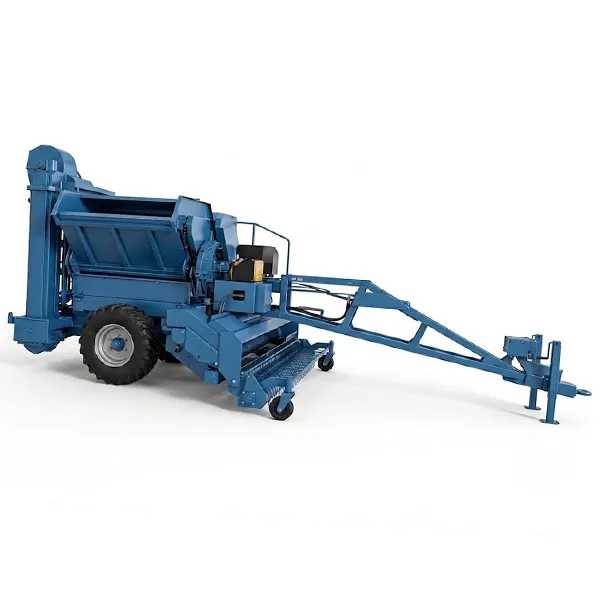
IL 4DQ-5 kidney bean threshing harvester is the commercial-scale second-stage machine in a mechanized dry-bean program: it picks up pre-pulled, field-dried kidney bean windrows and processes them through a single threshing drum to deliver clean grain into a 5.06 m³ on-board tank — all in a single tractor pass at 1.3 to 2.6 ha/h. With a 5-row, 3,200 mm working width and a 200 HP tractor requirement, the 4DQ-5 is sized for operations running 200 acres or more of kidney, navy, pinto, or black beans that need to complete the threshing stage within the weather window available after pulling.
Where the 4DQ-5 Fits: The Second Stage of Mechanical Kidney Bean Harvest
Mechanized kidney bean harvest in U.S. growing regions follows a two-stage sequence that the 4DQ-5 is designed to complete. Stage one — pulling the plant at the root, shaking soil, and laying the crop in a field windrow — is handled by the pulling machines in our serie di raccoglitrici di fagioli. Stage two — picking up the dried windrow, threshing the beans from the pod, cleaning the grain, and filling an on-board tank — is what the 4DQ-5 does. Without both stages, mechanical dry-bean harvest is incomplete; the 4DQ-5 is the machine that closes the loop.
The sequence runs like this: the pulling machine (typically the 4BYH-3.25 5-row kidney bean puller or the 4BYHD-3.9 6-row kidney bean puller) passes through the field, pulling plants and forming windrows. The windrows cure in the field for 3 to 7 days until pod moisture drops to the 12 to 18% range required for clean threshing. The 4DQ-5 then follows the same rows, picking up the dried windrow through its intake header and feeding it into the single-drum threshing chamber. Clean beans discharge into the 5.06 m³ grain tank while plant residue (pod fragments, stems, leaves) is discharged from the rear. When the tank is full, it empties via the hydraulic unloading auger into an adjacent grain cart or truck.
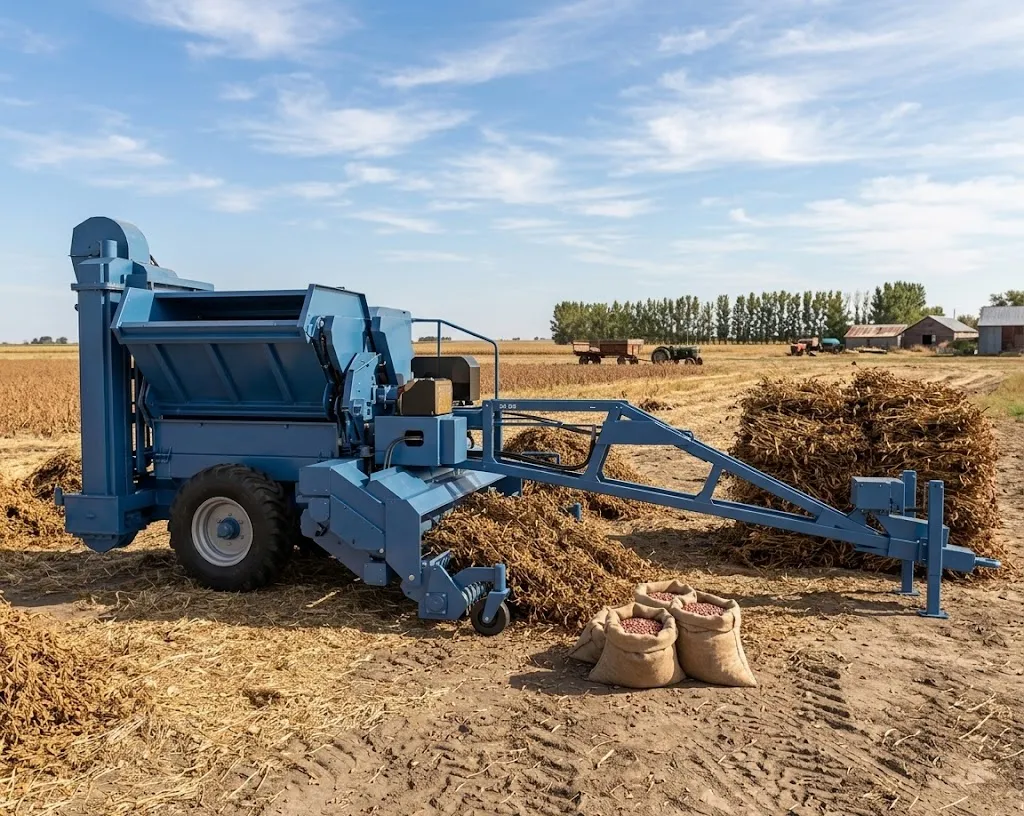
At the 4DQ-5's 3,200 mm working width, it is matched to process a windrow produced by a single pass of the 5-row puller or a combined windrow from two passes of the 4BYH-2.6 Estrattore per fagioli rossi a 4 file. Pairing the stage-one and stage-two machines at matching widths eliminates the pass-count inefficiency that comes from mismatched equipment — one of the most common sources of unnecessary field time in large-scale bean programs. Our team confirms the correct pairing at time of order.
Specifiche tecniche
All specifications per factory production data sheet for the 4DQ-5. Confirm your tractor's rated continuous PTO output, drawbar pull capacity, and available hydraulic remotes before ordering. The U.S. technical team can verify compatibility from your tractor model and spec sheet at no charge.
| NO. | Parametro | Unità | Valore |
|---|---|---|---|
| 1 | Modello | / | 4DQ-5 Trailed Single-Drum Kidney Bean Threshing Harvester |
| 2 | Connection Type | / | Side-Pull Trailed (Drawbar Hitch) |
| 3 | Larghezza di lavoro | mm (rows) | 3,200 mm — 5 rows |
| 4 | Potenza del trattore richiesta | kW / CV | ≥147 kW (200 HP) continuous PTO |
| 5 | Field Capacity | ha/h | 1.3–2.6 |
| 6 | Velocità operativa | chilometri all'ora | 4–8 |
| 7 | Velocità dell'albero cardanico | giri/min | 540–760 |
| 8 | Grain Tank Capacity | m³ | 5.06 m³ (≈3,950 kg dry kidney beans) |
| 9 | Overall Dimensions (L × W × H) | mm | 11,120 × 4,000 × 4,000 |
| 10 | Tire Specification | In | 18.4–30 (matched left and right pair) |
| 11 | Wheel Track (Tread) | mm | 2,300 |
| 12 | Peso della macchina | kg | 7,500 |
Working Principle: From Windrow Pickup to Clean Grain in a Single Pass
The 4DQ-5 threshing harvester processes kidney bean windrows in a four-stage sequence within a single continuous pass:
Stage 1 — Windrow Pickup
The intake header spans the full 3,200 mm working width. As the machine advances along the dried windrow, a reel-driven pickup mechanism lifts the tangled plant mass from the ground and feeds it into the transverse conveyor. The intake height is adjustable to accommodate different windrow thickness and field surface conditions without scalping the soil or leaving ungathered beans on the ground.
Stage 2 — Single-Drum Threshing
The crop mass feeds axially through the single threshing drum. The drum rotates at a PTO-driven 540 to 760 r/min, and the combination of drum bar impact and concave friction fractures open the dried pods and releases the beans. The single-drum design (as opposed to multi-drum systems) is chosen specifically for kidney beans because their large, fragile seed coat sustains damage from repeated mechanical impact — one well-calibrated drum pass is sufficient for dry pod material and produces lower seed coat cracking rates than sequential drum stages. Drum-to-concave clearance is field-adjustable to match pod dryness on any given day.
Stage 3 — Air-Blast and Sieve Separation
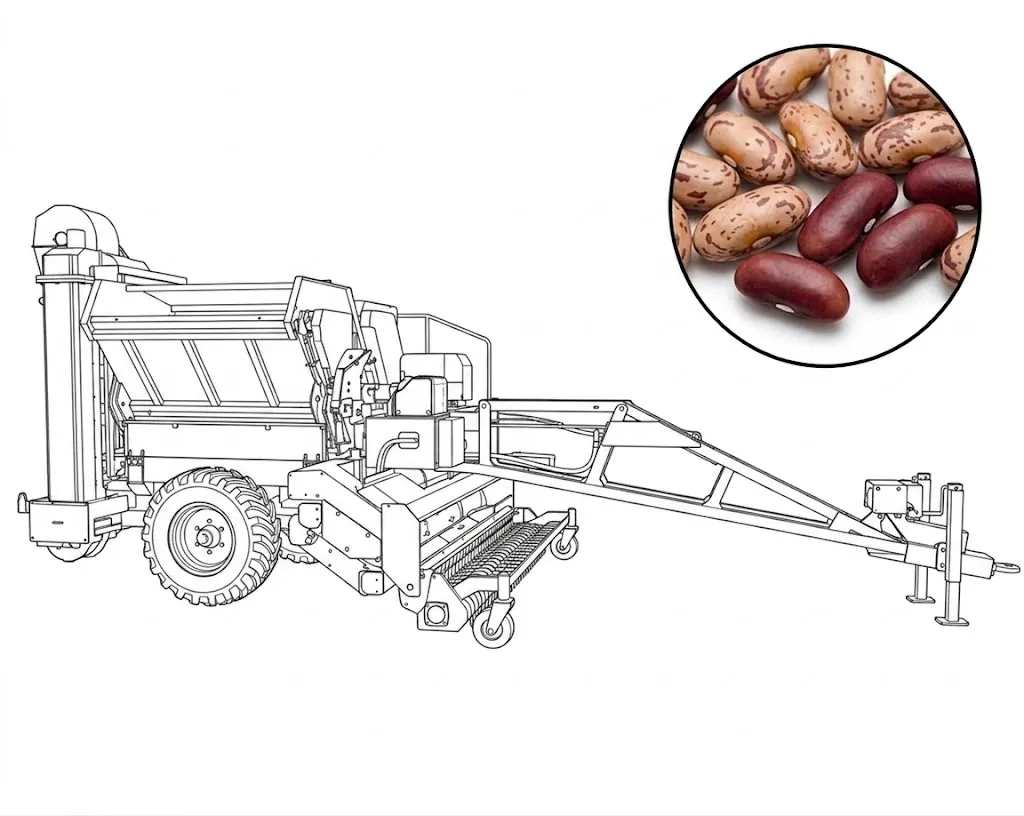
After the threshing zone, the crop mixture — beans, pod fragments, stems, and leaf debris — passes through a dual-stage cleaning system. The first stage is an air-blast fan that creates an upward air column: lighter material (pod fragments and trash) is carried up and out while beans fall through by gravity. The second stage is an oscillating sieve that separates by particle size, routing clean beans to the grain elevator and returning any un-threshed material to the drum inlet for reprocessing. This dual-stage cleaning achieves grain impurity levels below 2% on standard dry kidney bean crops at the correct threshing moisture.
Stage 4 — Grain Tank Filling and Unloading
Clean beans discharge from the cleaning shoe into a bucket elevator that lifts the grain into the 5.06 m³ on-board tank. The hydraulic unloading auger on the tank can swing to reach an adjacent grain cart, allowing on-the-go unloading during headland turns without requiring a field stop. At typical dry kidney bean bulk density of 750 to 800 kg/m³, the full tank holds approximately 3,800 to 4,050 kg — enough for 30 to 60 minutes of continuous threshing at average field yields before unloading is required.
Side-Pull Trailed Configuration: Why the 4DQ-5 Uses a Drawbar Rather Than a 3-Point Hitch
At 7,500 kg machine weight and 11,120 mm overall length, the 4DQ-5 operates well beyond the load capacity of any standard rear three-point hitch on even the largest row-crop tractors. It connects instead via a side-pull drawbar hitch — a swinging drawbar or clevis connection on the tractor's rear — that positions the machine offset to the right of the tractor's centerline.
This side-offset geometry solves a critical field problem: the tractor must travel along the edge of the windrow without its wheels running over the row ahead. In a center-draft arrangement at this machine width, the tractor's right-side drive tire would ride over the windrow the header is intended to pick up, crushing beans and mixing soil contamination into the intake stream before they reach the threshing drum. The side-pull offset positions the tractor in the clear inter-row zone — to the left of the machine's centerline — while the 3,200 mm header spans the full windrow width to the right. The result is clean intake with no pre-threshing losses from tire contact.
The 4DQ-5 PTO driveline connects from the tractor's standard rear 540 r/min PTO shaft via a universal-joint driveline that accommodates the slight lateral offset angle. An riduttore per trasmissioni agricole at the machine input distributes power to the threshing drum, cleaning fan, grain elevator, and sieve drive from the single PTO input — keeping the driveline architecture simple and reducing the number of components that require periodic inspection.
Tractor Requirements: Matching the 4DQ-5 to Your Power Unit
The 4DQ-5 operates at a power and weight class that requires careful tractor matching. Three parameters must all be confirmed before deployment:
PTO output — 147 kW (200 HP) continuous: The 200 HP figure is a continuous-duty PTO output rating at rated engine RPM, not peak engine horsepower. Many tractors rated at 200 engine HP deliver 165 to 180 HP at the PTO shaft — insufficient for sustained threshing loads in dense windrows. Confirm the tractor's certified PTO output from its specification sheet. The 4DQ-5 requires a rear 540 r/min PTO connection; 1,000 r/min PTO is not compatible.
Drawbar pull — at least 45 kN at field conditions: With the machine weight of 7,500 kg plus up to 4,000 kg of grain in the tank, the tractor must pull approximately 11,500 kg of total trailed load on late-season field conditions that may be soft. A ballasted 200 HP row-crop tractor with dual rear tires typically meets this requirement; confirm against your specific tractor's ballasted drawbar pull rating in the owner's manual or ASABE test report.
Hydraulic remotes — minimum 2 independent SCVs: The pickup header lift, grain tank unloading auger swing, and header height fine-adjustment are all hydraulically actuated. Two independent hydraulic remote couplers (SCVs) are the minimum requirement; a third is useful for header angle adjustment on uneven terrain. Standard ISO hydraulic couplings are used throughout — no custom hydraulic fittings are required.
Application Scenarios: U.S. Commercial Kidney Bean Operations
Michigan Thumb — Dark Red Kidney and Navy Bean Harvest
Michigan is the largest dry kidney bean producing state in the U.S. The Thumb region's tight late-summer harvest window — typically 2 to 4 weeks between optimal pulling conditions and the first frost — puts serious pressure on threshing capacity. At 2.6 ha/h maximum capacity and 3,200 mm working width, the 4DQ-5 can process 20 to 25 acres per operating day under good conditions, covering a 400-acre kidney bean block within a typical 18 to 22-day threshing window on large commercial operations.
Red River Valley — Navy Bean and Pinto Bean Threshing
The flat, large-field structure of the Red River Valley and the surrounding North Dakota and Minnesota growing region suits the 4DQ-5's side-pull configuration well — long straight rows reduce headland turn frequency and allow the machine to spend a higher percentage of each pass in productive threshing mode. Navy bean windrows in this region are typically thinner than kidney bean windrows, which allows operating at the upper end of the 4 to 8 km/h speed range and achieving the 2.6 ha/h capacity figure consistently.
Idaho and Wyoming — Pinto Bean and Black Bean Programs
Pinto bean programs in southern Idaho, northern Nevada, and Wyoming typically operate on irrigated ground with late-season soil conditions that are soft enough to make tractor wheel tracks in standard configurations. The 4DQ-5's 18.4-30 tires at 2,300 mm wheel track distribute the machine's weight across a wide footprint that minimizes compaction in the post-harvest field — important in these markets where the field must be prepared for winter wheat or cover crops within weeks of bean harvest.
Custom Threshing Service Operations
The 4DQ-5 is well-suited as the core machine for a custom threshing service that serves multiple farms across a regional kidney bean growing area. At a custom harvest rate of $40 to $80 per acre for threshing services in most U.S. dry-bean regions, a machine covering 25 acres per day at the low end of the capacity range generates $1,000 to $2,000 of daily service revenue during the harvest season. Custom operators who pair the 4DQ-5 with one or two 4BYH or 4BYHD pullers from our lineup offer a complete turn-key harvest service — pull, windrow, thresh, and fill grain cart — without the farm needing to own any of the harvesting equipment.
Six Design Advantages of the 4DQ-5 for Commercial Kidney Bean Programs
1. Single-pass threshing from windrow to grain tank. The 4DQ-5 eliminates the intermediate step of transferring loose threshed beans between machines. Windrow in at the header and clean grain out into the tank in a single continuous operation — no loose bean piles in the field that require secondary collection equipment.
2. Large-capacity grain tank reduces field logistics burden. The 5.06 m³ grain tank holds 3,800 to 4,050 kg of dry beans — more than most grain carts used in smaller-scale operations, and enough to complete one or more full field passes before requiring a truck or cart alongside for unloading. Operations with a dedicated grain cart on the headland can achieve near-continuous field coverage without any full field stops.
3. Adjustable concave clearance preserves food-grade seed quality. The concave-to-drum clearance is field-adjustable to match the day's pod dryness. This direct control over threshing aggressiveness is the most important lever for maintaining the seed coat integrity required for food-grade kidney bean markets. Operators who monitor and adjust concave clearance throughout the day as pods become progressively drier consistently produce lower seed coat cracking rates than fixed-clearance equipment.
4. Side-pull configuration eliminates tractor-wheel contamination of windrows. The drawbar hitch offset positions the tractor to the side of the windrow, preventing tire-induced bean losses and soil contamination in the intake zone. This is the correct configuration geometry for equipment of this width and weight class — a detail that affects every pass made throughout the harvest season.
5. ISO 9001 manufacturing with national subsidy eligibility. The 4DQ-5 is manufactured under the ISO 9001 quality management system and is listed on the national agricultural machinery purchase subsidy directory. U.S. buyers should confirm current USDA EQIP and state-level programs applicable to specialty crop harvest mechanization — our U.S. team can provide documentation to support subsidy applications.
6. Matched to the 4BYH and 4BYHD puller series in the same lineup. Ordering the pulling stage and threshing stage from the same source means width compatibility is confirmed before either machine ships, parts stocking for both machines is coordinated from the same California warehouse, and the technical team that supports your baler also supports your thresher throughout the season.
Programma di manutenzione e parti soggette a usura
Pre-season inspection and service on the 4DQ-5 takes 4 to 6 hours and covers the following areas. Completing this work before the harvest window opens prevents the mid-season breakdowns that cause bean losses from over-dried windrows sitting uncollected during a repair delay.
Threshing drum: Inspect drum tines and bar ends for wear. Worn tines reduce threshing effectiveness without giving visible external symptoms — measure tip depth against the factory specification in the operator manual and replace any tine set below the minimum profile. Check the drum shaft bearings for play (neither radial nor axial movement should be detectable by hand).
Threshing concave: Inspect all concave bars for cracks, deformation, or loose mounting hardware. A cracked or loose concave bar can cause catastrophic drum damage during the first loaded pass. This inspection takes 10 minutes and prevents the most expensive single failure mode on the machine.
Cleaning system: Check the air fan drive belt tension and condition. Inspect sieve sections for distortion or broken aperture bars that would allow bean-sized material to pass through prematurely. Check the sieve drive eccentric mechanism for lubrication and wear.
Grain elevator: Inspect chain tension and bucket mounting bolts. A loose elevator bucket creates a blockage in the tank inlet — the grain tank must be fully cleared to access this component in the field, making a harvest-season repair expensive in time and bean losses.
Hydraulic system: Check cylinder seals on the header lift, unloading auger swing, and any height-adjustment cylinders. Check hydraulic hose condition — flexing cracks at hose ends near quick couplers are the primary hose failure mode on trailed harvest equipment.
Our Sacramento California warehouse stocks the highest-frequency 4DQ-5 wear components including drum tines, concave bars, sieve sections, elevator chain and buckets, bearing kits, hydraulic seal kits, and pickup reel tine sets. Same-day dispatch on in-season orders received before 2 PM Pacific.
Customer Reviews from U.S. Kidney Bean Operations
David Schreiber, Dark Red Kidney Bean Producer, Tuscola County, Michigan (2025 season)
★★★★★
We run 380 acres of dark red kidney beans and have been using contracted custom threshing for years. The 4DQ-5 was the first machine we purchased ourselves for the threshing stage, and the first year it paid for itself compared to the custom rate we were paying. The grain tank capacity is the feature I noticed most — we only had to stop for unloading four times in a full day of threshing, compared to the continuous logistics shuffle we had with the smaller equipment the custom operator was running. Seed coat damage was within our elevator contract spec of 2% on all loads we checked. The support team answered a concave-clearance question within two hours on a Saturday morning during harvest — that was unexpected and genuinely useful.
Greg and Annette Paulson, Navy and Kidney Bean Farm, Otter Tail County, Minnesota (2025 season)
★★★★★
We transitioned from a repurposed grain combine with a pickup header to the 4DQ-5 after three seasons of higher-than-acceptable seed coat cracking from the combine's drum speed. The single-drum design at 540 r/min input with adjustable concave clearance made an immediate difference — our elevator dock sheets showed a drop from 3.1% to 1.4% split seed in the first season with the 4DQ-5. The machine arrived pre-assembled from California and was field-ready within a day of delivery. We paired it with the 4BYH-3.25 5-row puller for Stage 1, and the two machines together covered our 420 acres of beans within 9 pulling days and 13 threshing days — the most organized harvest window we have had in six years of growing beans at this scale.
Craig Olson, Custom Harvest Operator, Sargent County, North Dakota (2025 season)
★★★★★
Running a custom harvest service across four farms totaling about 900 acres of pinto and navy beans. The 4DQ-5 is my main threshing unit paired with two 4BYHD-3.9 pullers for the pulling stage. The combination works as a complete service package — I schedule pulling at Farm 1 while Farm 2 windrows from the previous week are ready to thresh. At 2.0 to 2.3 ha/h actual field rate in Red River Valley conditions, I can cover one farm's threshing block per day on the larger fields. The California warehouse had a sieve section replacement I needed mid-season at my door the next morning on overnight freight. That kind of support is what keeps a custom operation running when a part fails in the field.
Domande frequenti
Get the 4DQ-5 Configured and Priced for Your Kidney Bean Program
Tractor PTO compatibility verified, 4BYH or 4BYHD puller pairing confirmed, and California warehouse availability checked before any order ships. Section 179 documentation and direct factory pricing on every order.
Informazioni aggiuntive
| Redattore | Cxm |
|---|
Prodotti correlati
-
Trasportatore per balle rotonde 9JYY-4.5 | Trasportatore da 4.500 kg
-
Pressa-avvolgitrice combinata per insilato 9YCM-850 | 30-40 balle/ora
-
9F-70 Frantumatore per foraggio | Mulino a martelli con presa di forza
-
Rimorchio compatto per il trasporto di balle rotonde 9JYY-2.5
-
Andanatore idraulico pieghevole a ruote a dita 9FZ-2.0 | 3 ruote


