Small Farm Guide · Under 50 Acres · Updated August 2026
Hay Baler for Small Farm
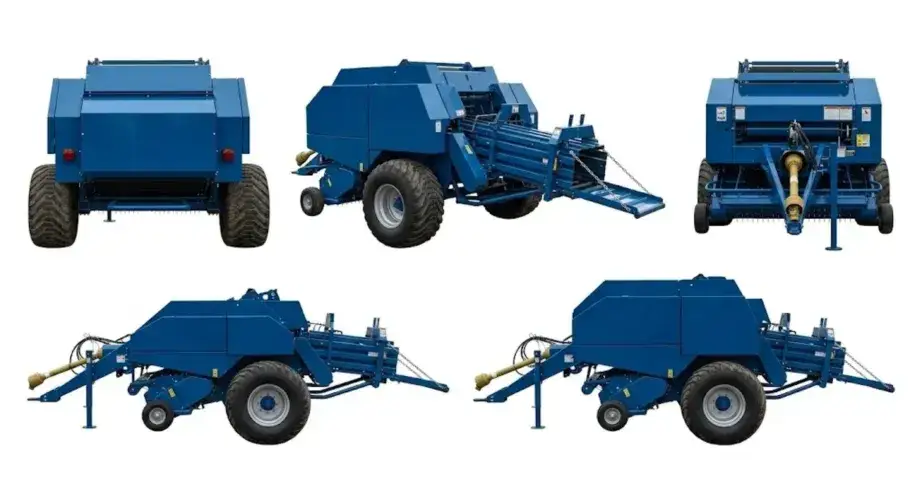
A small farm under 50 acres can justify owning a hay baler when it produces at least 800–1,200 bales per season — the volume at which the capital cost of the machine is recovered within the equipment lifespan versus paying custom baling rates. The 9YF-1700 (40HP minimum, 1,700mm pickup) is the right starting point for small farm square bale production; the 9YQ-870 suits small farms producing round bales for own-use cattle or horse feeding. Below these volume thresholds, custom baling or renting equipment is more cost-effective than owning.
Covers: what qualifies as a small farm for baling · own vs rent break-even · 9YF-1700 and 9YQ-870 model guide · compact tractor compatibility · starting a retail hay operation · first-season setup checklist
Quick Answer — Small Farm Baler Selection
Square bales, under 50 acres: 9YF-1700 (40HP min). Correct for horse hay, retail markets, and own-use livestock. Break-even at approximately 3,000–5,000 bales over 7 years on a 25-acre farm.
Round bales, own-use cattle/horses: 9YQ-870 (40HP min). Correct for small beef or horse farms where labour saving on own-use winter feeding justifies the capital investment.
Under 15 acres, under 600 bales/year: Custom baling is likely more cost-effective than owning. Compare at $2–$4 per custom bale vs your calculated ownership cost before purchasing.
What Counts as a Small Farm for Hay Baling Decisions
In the context of hay baler selection, a small farm is one that produces fewer than 1,500 bales per season from a single tractor-baler combination. This is the operating volume below which equipment utilisation is low enough that the per-bale cost of owning a baler may exceed the cost of custom baling or sharing equipment. The acreage equivalent varies by crop and region:
Grass hay: 60 bales/acre/season typical → 25 acres = 1,500 bales
Bermudagrass (SE): 80–120 bales/acre/season → 12–18 acres = 1,500 bales
Alfalfa (2 cut): 80–100 bales/acre/season → 15–18 acres = 1,500 bales
Straw: 40–60 bales/acre → 25–37 acres = 1,500 bales
Operations below these acreage thresholds — under 15 acres of hay — should complete the own-vs-rent calculation in the next section before committing to any baler purchase. Operations above 25–30 acres almost always justify ownership on a standard 7-year equipment lifespan.
Own vs Custom Baling: Break-Even Analysis
| 비용 항목 |
Own Baler (9YF-1700) |
Custom Baling |
| 장비 구매 가격 |
$7,500–$9,500 (financed or cash) |
$0 |
| Annualised equipment cost (7 yr life) |
$1,070–$1,360 per year |
$0 |
| Annual maintenance (twine, service) |
$200–$400 per year |
$0 |
| Per-bale charge (1,000 bales/season) |
$1.27–$1.76 per bale (capital + maintenance) |
$2.00–$4.00 per bale |
| Per-bale charge (600 bales/season) |
$2.12–$2.93 per bale (capital + maintenance) |
$2.00–$4.00 per bale |
| Break-even volume |
800–1,200 bales per season — above this volume, owning is consistently more economical than custom baling at standard US rates |
Additional factor: schedule independence. Custom balers work multiple farms and may not arrive at the optimal baling moisture window for your specific windrow condition. Owning your baler means baling when the crop is ready — not when the custom operator is available. For premium horse hay or dairy alfalfa where moisture timing is critical to product quality and price: the schedule independence value of owning a baler exceeds the pure cost calculation for most operations above 15 acres.
9YF-1700 Square Baler — The Small Farm Starting Point
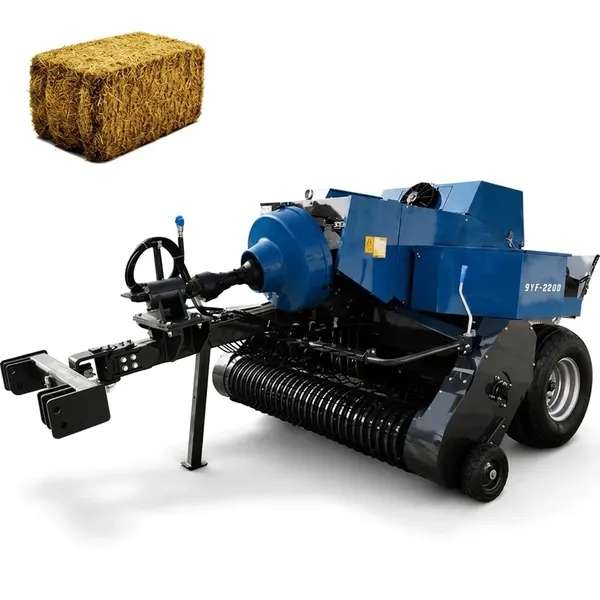
9YF-1700 Specifications
Pickup width: 1,700 mm (spring-tooth)
Min PTO HP: 40 HP
Recommended HP: 50–65 HP
Bale cross-section: 460 × 360 mm
Knotter type: D-type × 2
Ideal crop: Grass, timothy, straw
Best farm size: Under 40 acres
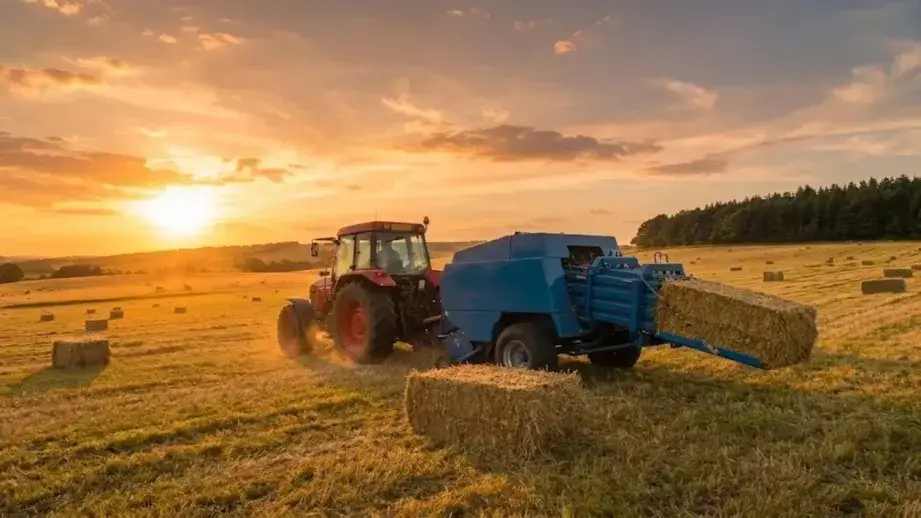
The 9YF-1700 is designed specifically for small farm operations. The 40HP minimum means it pairs with virtually any modern compact utility tractor — the most common tractor category on small farms in the US. At 1,700mm pickup width, it suits the windrow widths produced by 1.8–2.3m mowers, which are the standard equipment on small hay operations.
The spring-tooth pickup makes it the correct choice for horse hay operations — the same model that serves compact 20-acre farms also produces premium boot-stage timothy and bermudagrass bales that command the horse market premium. There is no quality difference between a premium horse hay bale from a 9YF-1700 and one from a 9YF-2200 — the bale format is identical; only the hourly throughput differs.
9YQ-870 Round Baler — When Round Bales Suit Small Farms
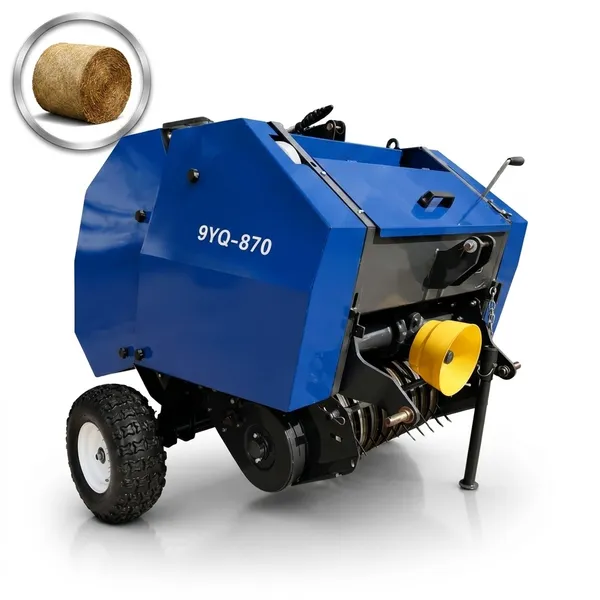
The 9YQ-870 is the correct round baler for small farms feeding their own beef cattle, dairy goats or horse herds. Its 40HP minimum pairs with the same compact tractor that runs the 9YF-1700 — one tractor serves both implements by changing implements at the field gate. The 870mm bale at 100–160kg moves with a standard front loader or ATV bale spike — no heavy loader required.
For 5–10 beef cows: one 130kg bale per 1–1.5 days. Easier than moving 6–9 small square bales per day.
For 10–20 goats: one 100kg bale lasts 5–7 days. Significant labour saving over small square bale daily handling.
For 5–8 horses (outdoor): one 150kg bale lasts 2–3 days in a slow-feed ring. Reduces stacking labour significantly.
Compact Tractor Compatibility for Small Farm Balers
Small farms typically operate compact utility tractors (CUTs) in the 35–60 engine HP range — the most common farm tractor class in the US for operations under 100 acres. Both the 9YF-1700 and 9YQ-870 are designed to be compatible with this tractor class:
| Tractor Engine HP Range |
Approx PTO HP |
Compatible Balers |
메모 |
| 35–45 HP engine |
29–38 HP PTO |
9YF-1700 · 9YQ-870 |
At minimum — reduce forward speed in thick windrows |
| 45–60 HP engine |
38–51 HP PTO |
9YF-1700 · 9YF-1900 · 9YQ-870 |
Comfortable range for 9YF-1700; 9YF-1900 at minimum |
| 60–80 HP engine |
51–68 HP PTO |
9YF-1700 · 9YF-1900 · 9YQ-870 · 9YQ-1250 |
Full small farm range. 9YQ-1250 at comfortable operating range. |
| 80–100 HP engine |
68–85 HP PTO |
All models including 9YF-2200 · 9YQ-1950 |
Suitable for a small farm that is growing — future-proof tractor investment |
Starting a Retail Hay Operation from a Small Farm — First Season Setup
1
Calculate your realistic annual bale volume. Farm acreage × expected yield per acre per season. Compare to the break-even threshold. If below 800 bales: consider custom baling for one season to establish the market before buying equipment.
2
Identify your primary market before choosing the baler. Horse hay → 9YF-1700 or 9YF-1900 spring-tooth, target weight 18–22kg. Cattle hay → 9YQ-870 or 9YQ-1250 round baler. Dairy hay → 9YF-1900 or 9YF-2200 with higher density setting.
3
Confirm tractor PTO HP meets the minimum for the chosen baler. Check the tractor specification sheet for PTO HP (not just engine HP — PTO HP is typically 80–85% of engine HP). Do not round up — operate the baler at or above the minimum specified PTO HP.
4
Obtain a moisture meter before the first baling session. A probe-type hay moisture meter ($80–$180) is the most important quality control tool for a new hay operation. Never bale without measuring core moisture — the single most common first-season mistake is baling too wet, causing mold that makes the entire first load unsaleable.
5
Source twine and calibrate bale weight before the first retail delivery. Weigh 10 bales from the first session with a digital hanging scale. Adjust the density spring if the average is outside the 18–22kg target. Consistent bale weight builds buyer confidence and repeat business from the first delivery.
PTO Drive for the Small Farm Compact Tractor — Getting the Driveshaft Right
Compact tractors have a shorter wheelbase and tighter turning radius than full-size utility tractors, which creates two specific PTO driveshaft considerations. First, the shorter tractor body places the PTO output shaft closer to the baler input — verify the driveshaft telescoping section does not bottom out (reach its minimum compressed length) when the combination makes tight turns. Second, the compact tractor hitches at a slightly different height than a full-size tractor — verify the driveshaft operating angle does not exceed the CV joint rated angle on the smallest and largest tractor 3-point hitch positions. Full selection guide: PTO driveshaft angle and length guide for compact tractor balers.
Frequently Asked Questions — Hay Baler for Small Farm
How many acres of hay do I need to justify buying a baler on a small farm?+
The general break-even threshold for owning a 9YF-1700 (the entry-level small farm square baler) versus paying custom baling rates of $2–$4 per bale is approximately 800–1,200 bales per season. For grass hay at 60 bales per acre, that equates to approximately 13–20 acres. For bermudagrass at 100 bales per acre, it is 8–12 acres. However, this calculation does not capture the value of schedule independence — owning your baler means baling at the correct moisture window rather than waiting for the custom operator. For premium horse hay, this schedule value can be worth 20–30% of the bale price. Operations as small as 8–10 acres of premium horse hay often justify the 9YF-1700 investment based on the combined effect of custom baling savings and premium quality from correct timing.
Can I rent a hay baler instead of buying for a small farm?+
Renting a hay baler is a viable option for small farms that are not yet at the break-even bale volume for ownership. Farm equipment rental is available through implement dealers, farm equipment rental companies and occasionally through agricultural cooperatives. The typical rental rate for a square baler is $80–$150 per day plus transportation. For a farm producing 600 bales per season across 3 baling days: rental at $300–$450 per season compares to an annualised ownership cost of $1,200–$1,600 for a 9YF-1700 — rental is clearly the lower-cost option at this scale. The rental option also avoids the risk of a poor first season due to weather or market conditions. Many operations rent for 1–2 seasons to establish their bale market and volume before purchasing their own equipment.
What other equipment does a small farm need besides the baler?+
A complete small farm hay operation requires: (1) a mower or mower-conditioner — the conditioner crimps stems to speed drying; (2) a wheel rake or tedder for windrow formation; (3) the baler; (4) a bale accumulator or wagon for collecting bales from the field; and (5) storage (barn or covered storage area). The minimum practical setup is mower + rake + baler — without adequate hay storage, the bale quality will suffer from weather exposure. Many small farm operators start by custom-mowing and custom-raking (paying per acre) while owning only the baler — this minimises the total equipment investment while controlling the baling step, which most directly affects bale quality and schedule.
Is a 40HP tractor big enough to run the 9YF-1700 in alfalfa?+
A 40HP engine tractor (approximately 34 HP PTO) is at the absolute minimum for the 9YF-1700 in any hay crop. For 2nd and 3rd cut alfalfa with moderate windrow density: 40HP engine is workable at a reduced forward speed — approximately 4–5 km/h rather than the 6–8 km/h possible with a 55HP tractor. For dense 1st cut alfalfa: 40HP will cause consistent PTO speed fluctuation and knotter timing problems in the thicker sections of the windrow. The practical recommendation: 40HP engine tractors should plan to bale at reduced speed and may need to stop and clear thick sections manually. A 50–60HP engine tractor (42–51 HP PTO) is more comfortable for the 9YF-1700 in all hay crops including 1st cut alfalfa at normal forward speed. For straw and light grass hay: 40HP is fully adequate.
Can a small farm start with the 9YF-1700 and upgrade to the 9YF-2200 later?+
Yes — the standard small farm growth path is 9YF-1700 → 9YF-1900 → 9YF-2200 as the operation grows in acreage and market volume. Each upgrade delivers wider pickup width (more efficient windrow capture) and higher hourly throughput, but the bale format and quality remain the same — a horse hay buyer cannot tell from the bale whether it was produced by a 9YF-1700 or a 9YF-2200. The upgrade trigger is typically one of: (1) the 9YF-1700 is causing a windrow strip problem because the mower was upgraded to a wider model; (2) daily bale targets require more throughput than the 9YF-1700 provides in the available weather window; or (3) a new tractor purchased for another reason provides sufficient HP to justify the wider model. Retain the 9YF-1700 as a backup or sell it — used 9YF-1700 units hold their value well in the small farm market.
Should I produce square bales or round bales on my small farm?+
The format decision depends on your primary market and use. Choose small square bales if: (a) you have a retail horse hay market within 30km; (b) your hay is for own-use horses or small livestock (goats, sheep) where precise daily rationing matters; or (c) you are in a region with an active local horse community where premium hay commands $12–$22 per bale and you can compete on quality. Choose round bales if: (a) you are primarily feeding your own beef cattle and want to minimise daily feeding labour; (b) your local round bale market pays competitive rates per tonne and you have enough volume for efficient delivery; or (c) you plan to produce silage bales, which require round format for practical plastic-film wrapping. Many small farms operate both formats — 9YF-1700 for the spring premium cuttings (horse and rabbit market), 9YQ-870 for the late-season lower-quality hay (own-use cattle feeding).
How long does it take to bale one acre of hay on a small farm?+
At a typical field forward speed of 5–7 km/h with the 9YF-1700 on a 1.7m working width per pass: field coverage rate is approximately 0.7–1.0 hectare per hour (1.7–2.5 acres per hour), including field turns. At 60 bales per acre of grass hay, one acre produces 60 bales, which ejects one bale approximately every 30–45 seconds at this speed — consistent with the machine specification. Practical throughput including field entry, row overlapping and occasional stoppages for twine changes: approximately 40–55 bales per hour. For a 20-acre farm at 60 bales per acre: total baling time across the season is approximately 1,200 bales ÷ 48 average bales/hour = 25 hours of baling across 3–4 sessions depending on the number of cuttings. This is a manageable time commitment for a one-person small farm operation over a full hay season.
What is the typical maintenance cost for a 9YF-1700 in the first year?+
In the first year of operation on a new 9YF-1700: maintenance costs are primarily consumables rather than repair parts. Twine cost: at 4 knots per bale × 2 strings × 1,000 bales = 8,000 knots; a standard 9,000-knot spool of polypropylene twine costs $18–$28, so approximately 2 spools = $36–$56 in twine. Grease: the machine requires greasing of all fittings (approximately 12–18 fittings) every 8–10 working hours; at 25 hours total seasonal use, this is 2–3 greasing sessions at negligible cost. Knotter timing check: inspect needles, bill hooks and twine discs at the end of the first season — no replacement expected in the first year on a correctly used machine. Total first-year maintenance cost estimate: $60–$120 including twine and grease. Annual maintenance increases to $150–$300 as knotter bill hooks and pickup tines wear at the 5–8 year mark depending on operating conditions and field cleanliness.
Ready to Choose the Right Baler for Your Small Farm?
Tell us your acreage, primary crop, tractor HP and target market and we will confirm whether the 9YF-1700 square baler 또는 9YQ-870 round baler is the right match for your small farm.
아메리카 에버파워 사료 베일러 장비 주식회사 · 1401 21번가 R호, 새크라멘토, 캘리포니아 95811
편집자: Cxm