Market Guide · US Hay Export · Updated August 2026
How to Export Hay from the USA
The US exports 3–4 million tonnes of hay annually, primarily to Japan, South Korea, UAE, China and Taiwan — making it the world leading hay exporter. Japan and Korea are the premium markets for US timothy and bermudagrass, specifying moisture below 17%, ash below 2% and bale weight 18–22kg. This guide covers the steps from farm production to container loading, including USDA APHIS phytosanitary requirements and what equipment is needed to meet export specifications consistently.
Covers: major export markets and their specifications · USDA APHIS phytosanitary certification · fumigation requirements · bale specifications for Japan and Korea · compression for container loading · finding export buyers
Export Hay Process — Five Steps
1. Produce to buyer specification (moisture, ash, weight)
2. USDA APHIS phytosanitary inspection and certificate
3. Fumigation if required (UAE, some markets)
4. Compression (if export-compressed) and container loading
5. Documentation: invoice, packing list, bill of lading, phytosanitary certificate
Major US Hay Export Markets and Their Specifications
| Pazar |
Primary Hay Types |
Moisture Spec |
Ash Spec |
Bale Weight |
| Japan (horse and dairy) |
Timothy (#1 priority), bermudagrass, orchard grass |
Below 17% |
Below 2% |
18–22 kg |
| South Korea (horse and dairy) |
Timothy, bermudagrass, alfalfa |
Below 17% |
Below 2–3% |
18–22 kg |
| UAE / Saudi Arabia (dairy and camel) |
Alfalfa (primary), bermudagrass, rhodes grass |
Below 15% |
Below 8% |
Various |
| China (growing market) |
Alfalfa (dairy expansion driving demand), timothy |
Below 15% |
Değişken |
Değişken |
| Tayvan |
Bermudagrass, timothy, alfalfa |
Below 17% |
Below 3% |
18–22 kg |
These specifications represent typical buyer requirements and may vary by specific contract. Always confirm exact specifications directly with the import buyer or their agent before production — specifications can vary between import companies within the same country and between categories of use (horse hay vs dairy feed vs camel feed).
USDA APHIS Phytosanitary Certification — Required for All Hay Exports
A phytosanitary certificate (PC) issued by the USDA Animal and Plant Health Inspection Service (APHIS) is required for hay exports to virtually all countries. The PC certifies that the hay has been inspected by a USDA official and meets the phytosanitary requirements of the importing country — confirming freedom from specified plant pests, diseases and regulated materials.
1
Contact your local USDA APHIS State Plant Health Director. APHIS operates through state offices — contact the state plant health office in the state where the hay was produced. They will assign an inspector for the export shipment.
2
Provide the lot identification and destination country. The inspector needs the bale count, field of origin, cutting date, storage location and destination country. Different countries have different phytosanitary requirements — the inspector will confirm what applies to your specific destination.
3
Schedule inspection before the shipment date. Allow 2–4 weeks before the intended container loading date for the inspection to be arranged and the certificate to be issued. Rushed inspections near shipping dates create logistical risk — build adequate lead time into the export schedule.
4
The inspector physically examines the hay lot. The USDA inspector checks the bales for visible pests, regulated weed seeds, soil contamination and compliance with the destination country requirements. The certificate is issued after inspection and must accompany the shipment — it cannot be issued retrospectively after the hay has been loaded and shipped.
Fumigation requirement: UAE, Saudi Arabia and some other markets require methyl bromide fumigation in addition to the phytosanitary certificate. Fumigation must be performed by a USDA-certified applicator — this is not a DIY procedure. Fumigation typically occurs at the port facility or at a certified fumigation location near the port. Japan and Korea generally do not require fumigation for hay from the continental US, but requirements change — confirm with your buyer or APHIS state office before production.
Equipment Requirements for Consistent Export-Specification Baling
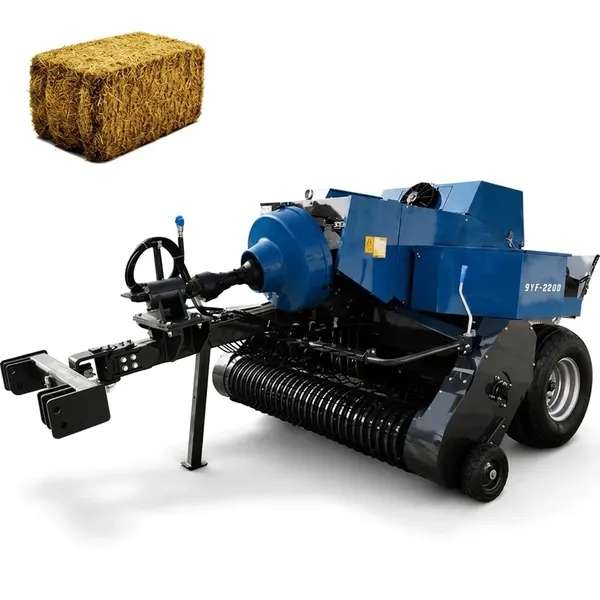
Meeting export specifications consistently — particularly the ash below 2% requirement for Japan and Korea — requires specific equipment choices and operating practices that go beyond standard domestic hay production.
For Ash Below 2% (Japan/Korea Spec)
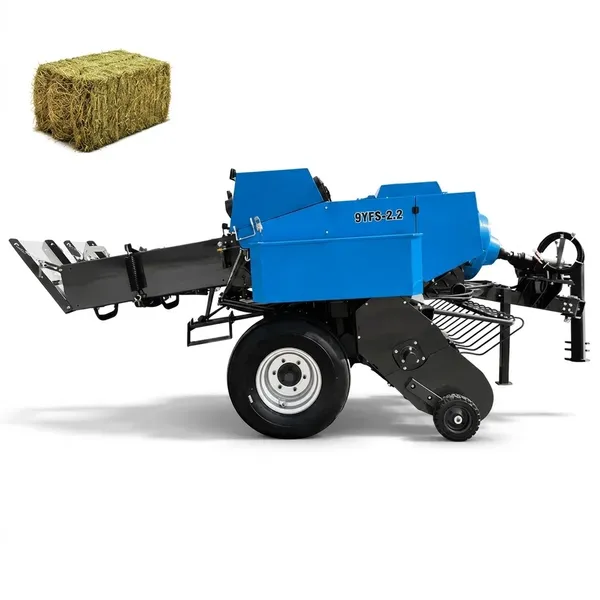
9YFS-2.2 recommended: The dual shredder plus negative-pressure fan system actively removes fine soil particles from the crop material during baling — reducing ash more effectively than any other 9YF model.
9YF-2200 acceptable: Spring-tooth pickup with careful height management (15–20mm ground clearance) can achieve 2–3% ash in good conditions.
Raking at correct moisture: Rake at 30–40% moisture to prevent soil splash from over-dried windrow contact with ground. Minimizes soil pickup in the windrow itself.
For Consistent Bale Weight (18–22kg)
Calibrate at session start: Weigh first 5 bales with a digital hanging scale. Adjust density spring or bale length if average is outside 18–22kg.
Monitor throughout session: Weight shifts as windrow density varies across the field. Spot-check every 50–100 bales.
Touchscreen advantage: The 9YF-2200S touchscreen density control records the previous session setting — useful for maintaining consistency between sessions on the same crop.
For Moisture Below 17%
Probe moisture meter: Push the probe to 15cm depth into the windrow core. Target below 16% core moisture before baling for a safety margin above the 17% specification.
Test multiple points: Measure at 10+ points across the windrow length. Do not bale if any single reading exceeds 20%.
Allow an additional curing hour: If readings are 17–19%: wait 1–2 more hours and re-measure. Export moisture failure risks are too high to rush the curing window.
Container Loading and Compression
Standard Bale Container (No Compression)
Standard 20ft container holds approximately 10–14 tonnes of uncompressed small square bales at standard density. Freight cost per tonne is the highest of the three options. Used for premium markets where compression is not permitted by the buyer (some Japan buyers specify no compression to preserve visible hay quality).
Compressed Bale Container (Most Common)
Bales are compressed 3:1 to 5:1 at a compression facility before container loading. A 20ft container holds 18–22 tonnes of 3:1 compressed small square hay. Compression reduces freight cost per tonne by 35–55% compared to uncompressed loading. Most US hay exporters use compression — it is standard practice for all high-volume markets.
Compression is typically handled by specialized export hay companies with compression machinery near major US ports (Long Beach, Portland, Seattle for Pacific exports). Most small-to-medium farms sell their hay to an export company rather than managing the compression and container logistics directly — the export company aggregates supply from multiple farms, handles compression, documentation and logistics, and pays the farm for the hay FOB (free on board) at the farm or at the compression facility.
Finding Export Hay Buyers
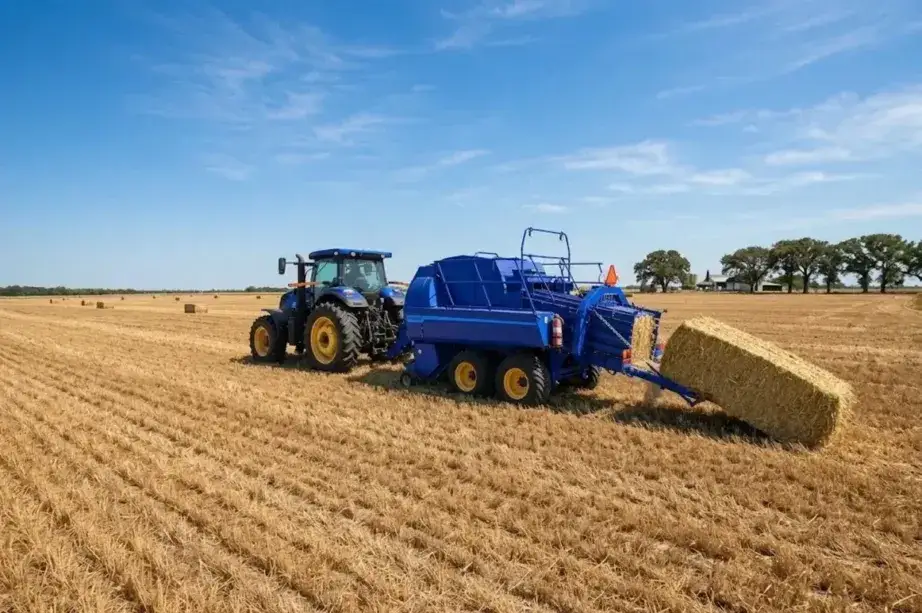
Export Hay Aggregators / BrokersThe most practical entry point for US farms new to export. Aggregators purchase hay from multiple farms, manage the USDA inspection, compression and logistics, and handle the overseas buyer relationship. The farm receives a farm-gate price that reflects the FOB export price minus the aggregator margin. Look for established Pacific Northwest aggregators in Oregon and Washington who supply the Japan/Korea timothy market.
USDA Foreign Agricultural Service (FAS)The USDA FAS publishes trade data and contacts for foreign agricultural buyers and trade associations. The Japan External Trade Organization (JETRO) and Korea Agro-Fisheries and Food Trade Corporation (aT) are government bodies that facilitate agricultural trade and can refer US producers to established Japanese and Korean importers.
Trade Shows and Industry AssociationsWorld Ag Expo (Tulare, CA) and commodity hay shows in the Pacific Northwest attract export buyers and aggregators. US hay producer associations (American Forage and Grassland Council, Western Hay Association) maintain networks of producers and buyers who actively participate in the export market.
Equipment for Meeting Export Ash Specifications
The 9YFS-2.2 fan system that produces the low-ash hay required for Japan and Korea requires a higher PTO rating than the standard 9YF-2200. The dual shredder plus fan combined add approximately 30HP above the baseline baling mechanism load — the PTO driveshaft must be rated for the full 125HP peak demand that occurs in dense windrow conditions with all systems engaged. An undersized shaft transmits above its torque rating through every session and accelerates CV joint wear significantly. Full specification guide: PTO driveshaft specification for 9YFS-2.2 export hay baler.
Frequently Asked Questions — How to Export Hay from the USA
How much does a phytosanitary certificate cost and how long does it take?+
USDA APHIS phytosanitary certificate fees vary by state and volume but are typically $50–$200 per certificate for a standard commercial hay shipment. Some states charge an hourly inspection fee ($50–$100/hour) in addition to the certificate fee, making the total cost $100–$400 per container shipment for straightforward inspections. The timeline from request to certificate issuance is 2–4 weeks under normal USDA workload conditions. Allow 4–6 weeks during peak export seasons (spring and summer hay harvest) when APHIS inspection demand is highest. A certificate is required for each individual shipment — you cannot use a single certificate for multiple container loads shipped at different times. For operations that export regularly, establishing an ongoing relationship with the state APHIS office reduces administrative friction and may improve scheduling priority.
What US hay-growing regions produce the most export-quality timothy for Japan?+
The Pacific Northwest — specifically eastern Washington state (Yakima Valley, Ellensburg, Kittitas County) and southern Idaho (Twin Falls area) — is the dominant US production zone for Japan-export timothy. These regions combine high-altitude growing conditions (cooler temperatures that produce slow, high-quality growth with elevated CP and low NDF), dry summer weather (enabling controlled curing to below 15% moisture without rain risk), and proximity to Pacific ports (Portland and Seattle) which minimizes inland freight cost to the container port. Oregon, Montana and parts of Nevada and Utah also produce export-quality timothy and bermudagrass. For bermudagrass export (primarily Korea and Japan dairy markets): the Southeast US (Georgia, Alabama, Arkansas) and Texas supply the majority, with compressed bales shipped through the Gulf ports (Houston, New Orleans) or through Panama to Pacific destinations.
Can a small farm with under 50 acres access the export hay market?+
Yes — through an aggregator or export buyer who consolidates supply from multiple farms. A single 20ft container holds 250–350 bales of uncompressed small square hay (10–14 tonnes), which a 15-acre timothy farm producing 60 bales per acre per year would need 3–4 acres to fill one container — well within a small farm capacity. The practical constraint for small farms entering export is not volume but quality consistency: export buyers and aggregators require commitment to specification (moisture, ash, weight, visual grade) across the full volume contracted. A small farm that meets specification consistently on 200–400 bales per season is a more attractive aggregator supplier than a larger farm with inconsistent quality. The USDA phytosanitary process applies to the lot regardless of size — a 200-bale lot requires the same certificate as a 5,000-bale lot. Factor the certificate cost ($100–$400) into your economics when evaluating whether to sell direct to export or through an aggregator who consolidates the documentation cost across multiple farms.
What is the typical FOB price per tonne for US timothy exported to Japan?+
US timothy FOB (free on board at US port) prices for Japan export typically range from $250–$420 per tonne for Premium and Supreme grade material, depending on the season, quality grade (boot stage vs early bloom), moisture and ash compliance, and supply-demand conditions in the export market. Prices fluctuate with exchange rates (JPY/USD), domestic US hay supply levels, and Japanese domestic hay production — drought years in Japan or the Pacific Northwest typically push export prices higher. The FOB price at the port is substantially above what the farm receives at the farm gate — deducted from the FOB price are: inland freight to the port ($20–$60/tonne depending on distance), compression ($15–$30/tonne), USDA inspection and certification ($5–$15/tonne), and aggregator margin ($20–$50/tonne). Farm gate price for export-quality timothy in eastern Washington typically ranges from $180–$320 per tonne at the farm in recent years.
Does the 9YF-2200 spring-tooth model produce hay that meets the Japan ash specification without the fan system?+
The 9YF-2200 spring-tooth can achieve below 2% ash in favorable conditions — specifically when the field has firm, dry soil surface that minimizes soil splash during raking, when pickup height is correctly set at 15–20mm clearance, and when the windrow is formed cleanly without ground contact disturbance during raking. In eastern Washington timothy fields with well-consolidated, dry soil surfaces and low soil disturbance raking: many producers achieve 1.5–2.5% ash with the standard 9YF-2200. In more challenging conditions — wet soil, surface unevenness, or fields with prior tillage exposing loose soil — the standard model may consistently produce 2.5–4% ash despite correct operating practice. The 9YFS-2.2 fan system is the reliable solution for consistently meeting the below 2% ash specification regardless of field conditions. For operations in eastern Washington and Idaho exporting to Japan: the 9YFS-2.2 is increasingly specified by export aggregators as the preferred equipment for contracted suppliers because it removes the variability of field condition from the ash result.
Are there any pesticide restrictions I need to know about for hay exported to Japan?+
Japan has strict pesticide residue limits (Maximum Residue Limits, MRLs) for imported hay and forage. These limits apply to both pesticides applied directly to the hay crop and to herbicide carryover from prior crop rotations. The Japan MRL system is comprehensive and includes compounds that are common in US hay production (certain herbicides used for weed control in rotational crops). The safe practice for export-destined hay: maintain records of all pesticide applications to the field for the past 3 years, confirm that no application has been made to the hay stand itself within 30 days of harvest, and consult with your export buyer or aggregator about specific compounds to avoid. The aggregator who purchases your hay typically has a prohibited chemicals list from their Japanese buyers — obtain and review this list before any spray application to fields designated for export production. Pesticide residue testing ($80–$150 per sample) may be required by some buyers as part of their quality assurance protocol.
What documentation is required for a complete hay export shipment?+
A complete hay export documentation set typically includes: (1) Commercial invoice — buyer and seller details, description of hay (species, cutting, grade), quantity (bale count and tonnes), price and payment terms. (2) Packing list — detailed bale count, container numbers, lot identification, weights per container. (3) Bill of lading — issued by the shipping company confirming receipt of the goods for transport; the original bill of lading is the title document for the hay. (4) USDA APHIS phytosanitary certificate — the official plant health certification issued by USDA. (5) Fumigation certificate — if fumigation was required by the importing country, the certificate from the certified applicator. (6) Certificate of origin — confirming the hay was produced in the USA (required by some importing countries for tariff preference purposes). (7) Forage quality test certificate — required by most Japan and Korea buyers; attach the lab report from the certified forage testing laboratory. Arrange all documents well before the vessel departure date — missing documents can cause costly delays at the import port.
How is payment typically structured in US hay export transactions?+
The most common payment structure for US hay exports to Japan and Korea is a letter of credit (L/C) confirmed by a US bank. The letter of credit guarantees payment from the buyer bank to the seller once the specified shipping documents (bill of lading, phytosanitary certificate, quality test, invoice and packing list) are presented and confirmed as compliant with the L/C terms. The L/C provides security to both parties: the seller knows payment is guaranteed when documents are presented; the buyer knows the hay will be shipped as specified before payment is released. Bank fees for L/C transactions: typically 0.25–0.5% of the transaction value, shared between buyer and seller. For transactions with established long-term buyer relationships: payment terms may shift to open account (payment within 30–60 days of shipping) which reduces banking fees but transfers risk to the seller. For new buyer relationships: always require a confirmed L/C for the first several transactions until the buyer reliability is established.
Producing Hay for the Japan or Korea Export Market?
Tell us your crop (timothy or bermudagrass), acreage and target ash specification and we will confirm which 9YF or 9YFS export-grade square baler meets your buyer specification consistently.
America Ever-Power Forage Baler Equipment INC. · 1401 21st ST STE R, Sacramento, CA 95811
Editör: Cxm