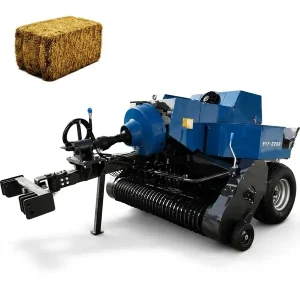
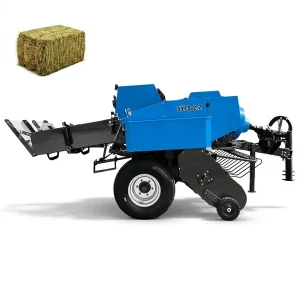
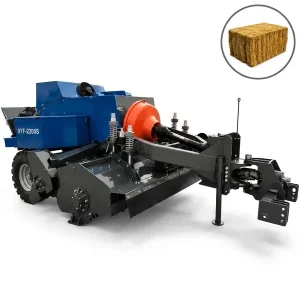
9YF-2200 Küçük Kare Balya Makinesi
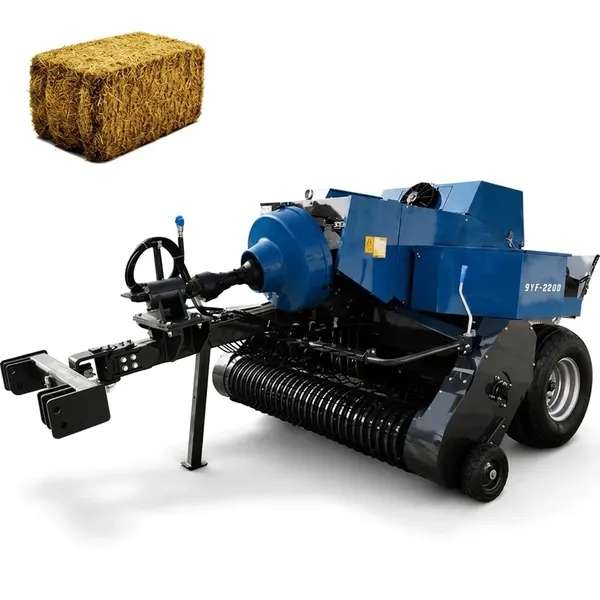
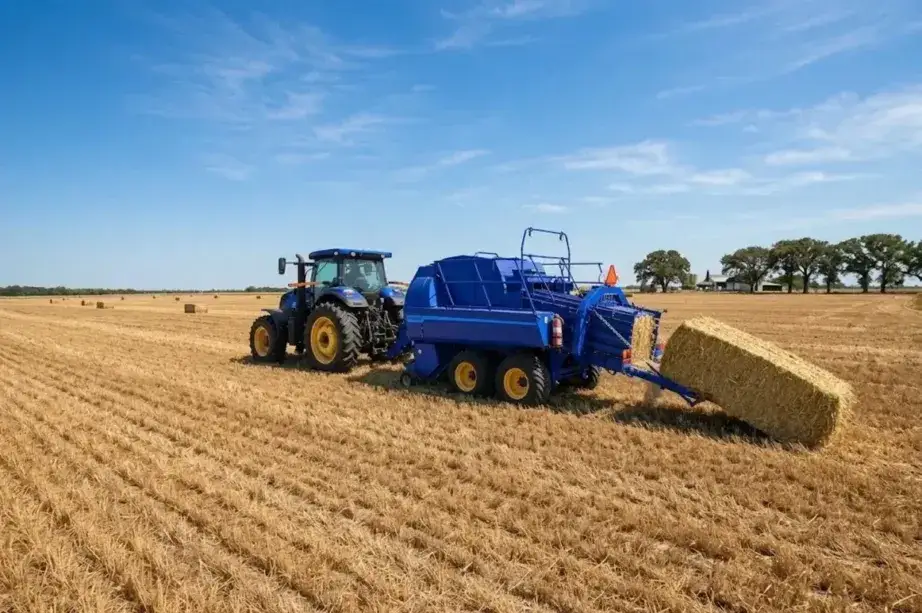
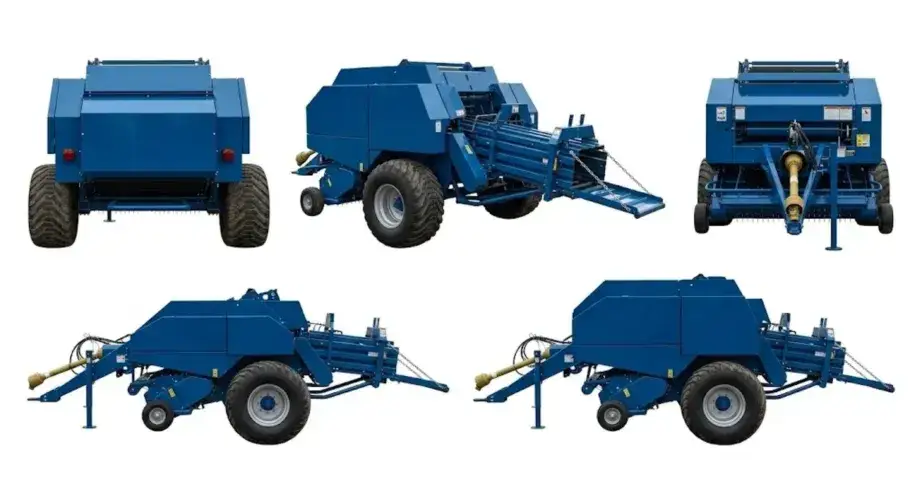
The 9YF-2200 is the entry model in the square baler lineup — a mid-mount towed baler producing 460×360 mm cross-section bales on tractors from 40 HP, with a 2,200mm pickup width and 1,950kg machine weight. No touch screen, no shredder, no complexity — just a reliable high-strength frame, D-type dual-knotter system and automatic rope binding for wheat straw, rice straw, corn stover, cotton stalks and forage grass.
- ✦ 460×360mm bale cross-section — manageable by hand or small loader
- ✦ 2,200mm pickup width — wide-field coverage in a single pass
- ✦ 40HP minimum — pairs with standard utility tractors
- ✦ 2×D-type knotters — proven reliable binding mechanism
- ✦ 1,950kg — field-ready for all standard crop residue types
9YF-2200 Small Square Baler: Reliable Daily Output from 40HP Tractors
Why Square Bales Still Make Sense
The small square bale format — typically 460×360mm cross-section and 500–800mm long from the 9YF-2200 — has advantages that round bales cannot replicate. Small square bales can be handled by a single person without equipment: they can be stacked in a shed with manual labour, loaded onto a pickup truck without a loader, and fed out to small livestock groups without wasting half a large bale. For horse operations, direct sales to backyard livestock owners, specialty hay markets, and operations where precision daily feeding matters, the small square bale remains the preferred format.
The 9YF-2200 with its 2,200mm pickup width also brings square baling efficiency to large fields — at 2.2m pickup per pass, a single tractor and operator can clear significant acreage without the repeated narrow passes that older square balers with 1.5–1.8m pickups require.
9YF-2200 At a Glance
Teknik Özellikler
| # | Öğe | Birim | Özellikler |
|---|---|---|---|
| 1 | Model Adı | — | 9YF-2200 Square Baler |
| 2 | Bağlama Yöntemi | — | Çekilebilir tip / Orta montajlı römorklu |
| 3 | Alma Genişliği | mm | 2,200 |
| 4 | Seçici Yapısı | — | Yaylı Diş Tipi |
| 5 | Besleyici Yapısı | — | Çatal Besleme Mekanizması |
| 6 | Düğümleme Tipi | — | D Tipi |
| 7 | Düğümcü Sayısı | adet | 2 |
| 8 | Balya Odası Kesiti (G×Y) | mm | 460 × 360 |
| 9 | Balyalama Yöntemi | — | Otomatik Halatlı Balya Sistemi |
| 10 | Eşleşen Güç Aralığı | kW / HP | ≥36.8 kW (≥40 HP) |
| 11 | Genel Boyutlar (Uzunluk × Genişlik × Yükseklik) | mm | 5,700 × 2,800 × 1,780 |
| 12 | Makine Ağırlığı | kilogram | 1,950 |
Crop Applications — Full Compatibility Range
Straw and Crop Residue
The 9YF-2200 is a mid-mount trailed baler suited to water and dry field operation, where flat, stone-free ground and standard combine windrows are the typical working conditions. In these conditions the machine delivers high bale density and consistent bale length from the full range of crop residues.
- ▸Buğday samanı — the primary design application; handles standard post-combine windrows at good baling rates in flat paddy and dry fields
- ▸Pirinç samanı — works well in properly raked windrows from paddy fields; best results at 15–20% straw moisture
- ▸Pamuk sapları — suitable for shredded cotton residue on flat fields with no stones or hard objects
- ▸Mısır sapı — manages properly windowed corn residue within the 40–55HP power range at reduced forward speed
Forage and Grass Hay
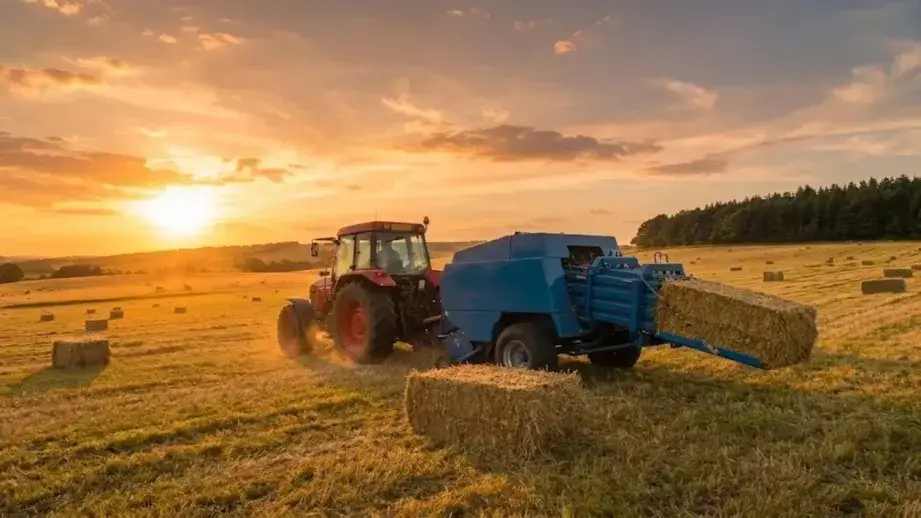
The 9YF-2200 handles dry and fresh forage grass for hay production. The 2,200mm pickup covers wide mower windrows in a single pass and the fork feeder delivers material into the compression chamber evenly. Following a first cut with a yem biçme makinesi, the 9YF-2200 can bale the same day once the windrow reaches target moisture.
- ▸Karışık ot samanı — produces small, dense bales well-suited for horse and small livestock markets that require hand-handling
- ▸Yonca samanı — handles dry alfalfa at 14–18% moisture; the rope binding is adequate for barn storage and fast feed-out operations
- ▸Various forage grasses — versatile across fescue, bermuda, orchardgrass, timothy and native grass hay in standard conditions
Key Features of the 9YF-2200
High-Strength Frame and Gear Transmission
The 9YF-2200 frame is built from welded structural steel sections dimensioned for long-season, high-cycle operation. Square balers cycle the knotting mechanism and plunger on every bale — at 80–120 bales per hour, this is a high-repetition mechanism that requires a frame rigid enough to prevent fatigue cracking at the plunger guides and tie-off points. The 9YF-2200 frame geometry distributes these loads across the full frame structure rather than concentrating stress at individual weld points.
The 9YF-2200 uses a gear-based transmission rather than belt or chain primary drive for the main plunger and knotter mechanism. Gear drive delivers higher mechanical efficiency (less power lost in the transmission), lower heat generation at sustained PTO load, and a more consistent drive speed under varying load conditions than belt drive alternatives at equivalent power input.
The dual D-type knotter system ties the bale at two points across the 460mm bale width — top and bottom of the compression chamber width. Two-knotter binding produces a bale that holds its shape and density reliably during handling and transport. The D-type knotter is a proven design widely used in commercial square baling, with well-understood maintenance requirements and widely available replacement parts through agricultural equipment dealers.
Simple, Reliable Operating System
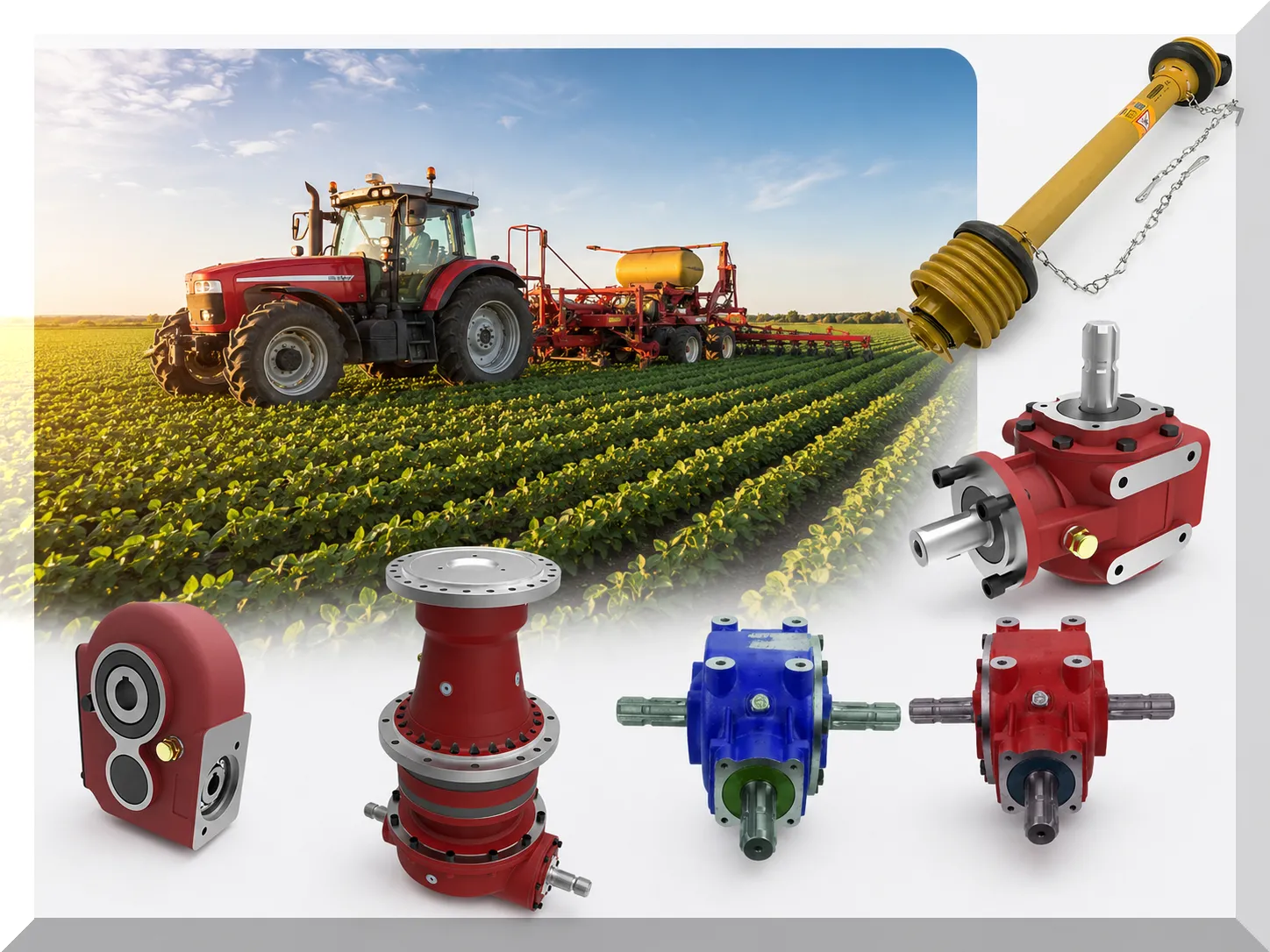
The 9YF-2200 does not have an electronic control panel, touch screen, or monitoring system. This is intentional for this model category. The baling cycle is mechanical — the plunger, knotter, and rope tensioner operate from PTO power through the gear transmission, and the operator manages forward speed and PTO engagement from the tractor cab. For operators who value mechanical simplicity — fewer components to diagnose, no software to update, no control module that can fail mid-season — the 9YF-2200 represents a clean, understandable machine that any farm mechanic familiar with square baling can maintain without specialist support. For PTO shaft specifications and driveline compatibility at this power range, agricultural gearbox component reference details the gear ratios and shaft standards applicable to this class of baler.
Small Square Bales vs Round Bales — Choosing the Right Format
When Small Square Bales Are the Better Choice
At 20–50kg per small square bale (depending on crop and moisture), these bales can be stacked in a barn by one person, loaded on a pickup without a loader, and carried by hand to individual animal feeding positions. No front-end loader required.
For 2 horses, 5 goats, or 10 sheep, opening a 400kg round bale results in significant spoilage from unconsumed feed exposed to weather. A 30–40kg small square bale provides exactly the right quantity for a small feeding cycle — no waste, no exposed leftover feed.
Small square bales sell by the bale in feed stores, farm stands, and direct-to-consumer markets where customers carry them in their car. The format that retail buyers want is almost always the small square — round bales are not a practical retail product for most end consumers.
Small square bales stack to exactly the height the barn permits — stacks of 4, 5, 6, 8, or 10 high fit the space without the fixed 1.0–1.4m diameter constraint of round bales. Low-ceiling older barns that cannot accommodate round bale storage are fully compatible with small square bale stacking.
9YF Square Baler Series Comparison
| Model | Balya Bölümü | Toplamak | Minimum Güç | Ağırlık | Standout Feature |
|---|---|---|---|---|---|
| 9YF-2200 ◀ This model | 460×360 mm | 2200 mm | 40 HP | 1.950 kg | Entry model — simple, proven, low maintenance |
| 9YF-2200S | 460×360 mm | 2200 mm | 73.5kW+ | 2.350 kg | Touch screen + single shredder for dense stalks |
| 9YFS-2.2 | 460×360 mm | 2200 mm | 73.5kW+ | 2.350 kg | Dual shredder + negative-pressure fan dust removal |
Browse the full square baler range to compare all three models side by side.
Operating Tips for the 9YF-2200
Tractor Setup and Field Conditions
The 9YF-2200 requires 36.8kW (40HP) minimum PTO. Most 45–60HP utility tractors produce 38–50HP at the PTO — the comfortable operating range for this machine across all standard crops in normal conditions. In dense corn stover or thick wet forage, a tractor toward 55–60HP PTO avoids the engine laboring. The machine is rated for paddy and dry field conditions with flat, stone-free ground — operation on stony, rough or steeply sloped ground is outside the design specification and will accelerate wear on the pickup and frame components.
Knotter and Rope Maintenance
- Before each session:Inspect both D-type knotter bills for wear and verify the knife blade cuts cleanly through the rope. A dull knife produces bales with ragged rope tails that can pull loose during handling. Check rope spool level and threading path through the knotter eye before engaging PTO.
- Rope tension:Correct rope tension holds the bale firmly without cutting into the outer crop layer. Too tight and the rope cuts through and breaks at ejection; too loose and the bale loses shape in the stack. Adjust both knotters to the same tension specification in the operator manual — mismatched tension between the two knotters produces uneven bale density across the width.
- Bale density:Set the plunger load to produce bales that are firm enough to stay rectangular during stacking but not so dense that they split the rope at the tie-off. The bale density adjustment affects bale weight per unit length — denser bales weigh more per linear metre and are more stable in stacks, but place higher cyclic load on the frame and knotter mechanism.
- End of season:Remove rope from both knotter spools and store indoors — UV and moisture degrade rope left on the machine between seasons. Lubricate all knotter pivot points. Inspect the fork feeder tines for bending and the plunger face for wear. Store with the tailgate closed if the machine design allows.
Frequently Asked Questions — 9YF-2200 Square Baler
What Customers Say About the 9YF-2200
I board 8 horses and produce my own hay on 45 acres of fescue and orchardgrass. The 9YF-2200 was the right choice — I run a 52HP tractor and the machine works well within that power range. My boarders can carry bales to individual stalls without a wheelbarrow. Every knot has held across two full baling seasons. The machine is straightforward to maintain — no electronics, no modules to worry about. I clean the knotters at the end of every session and have had zero missed knots in two seasons.
I supply a feed store with orchard grass and alfalfa bales. My customers need small square bales they can put in the back of their SUV — round bales are completely the wrong format for retail. The 9YF-2200 at 2,200mm pickup covers my fields efficiently with the 58HP tractor I already owned. The bale weight averages around 28kg in the orchardgrass, which is exactly what my retail customers want. The machine has been running for two seasons without any knotting issues or mechanical failures beyond routine maintenance.
We use the 9YF-2200 for rice straw recovery after the paddy combine. The 2,200mm pickup width means we can clear the fields quickly in the tight post-harvest window before the next water cycle. Rice straw is a challenging material for some balers — it is low density and forms a tangled mat — but this machine handles it adequately when we rake first to form a proper windrow. One thing to watch: we had a knotter miss issue early on that turned out to be the tensioner adjustment. Once we set it correctly per the manual, zero issues since. Overall a solid machine for the price point and the application.
We grow pumpkins on 80 acres and sell small square wheat straw bales as decoration every fall — about 4,000 bales per season to garden centers, farm markets, and direct customers. The 9YF-2200 produces a bale that looks good for retail: neat corners, tight knots, consistent size. Customers want to stack these in front of their store or on their porch, so presentation matters. The machine bales our wheat straw in two days at the end of the grain season, and we store the bales dry until September. Reliable, no surprises, exactly what we needed.
Get the 9YF-2200 for Your Operation
Tell us your primary crop type, tractor HP and intended use for the bales. We will verify the 9YF-2200 is the right fit and provide current pricing, lead time and delivery details.
Fiyat ve Stok Durumu Bilgilerini Alın
Ek bilgi
| Editör | Cxm |
|---|