Output and Capacity Guide · All 9YF Models · Real-World Figures
How Many Bales Per Hour Can a Square Baler Produce?
The most commonly cited baler output figures are theoretical maximums — useful for brochures but not for planning a baling day or season. This guide gives real-world output ranges for each 9YF model across different conditions, explains what actually limits daily production on most farm operations, and shows how to calculate your realistic seasonal capacity.
Covers: output by model · forward speed effects · field efficiency · daily capacity · seasonal planning · true production bottlenecks
Theoretical vs Real-World Output: Understanding the Gap
Manufacturer output figures are measured under near-ideal conditions — uniform windrow density, flat ground, ideal crop moisture, no headland turns and an experienced operator. Real-world field conditions introduce a cascade of reductions from this peak: headland turns consume 15–25% of available time, windrow density variation forces speed changes, spool changes take 3–5 minutes each, and the practical afternoon baling window is typically 4–6 hours rather than a continuous 8-hour day.
The result is that real-world output in a normal field session is typically 55–75% of the theoretical maximum. For planning purposes, always use the real-world range rather than the peak figure. A machine that can produce 120 bales per hour in ideal conditions typically produces 70–90 bales per hour in a normal afternoon session including turns, windrow variation and routine stops.
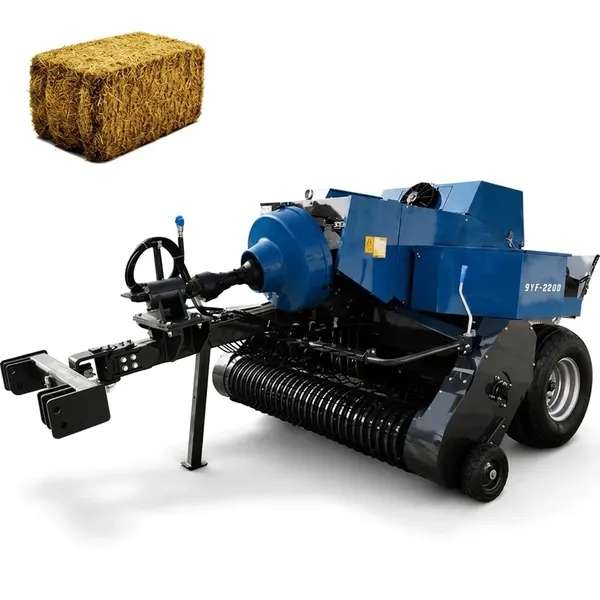
Real-World Output by Model
| 모델 |
픽업 폭 |
Light Windrow (bales/hr) |
Standard (bales/hr) |
Heavy Windrow (bales/hr) |
Good Day Total |
| 9YF-1700 |
1,700mm |
60~80세 |
50–70 |
35–55 |
250–380 |
| 9YF-1900 |
1,900mm |
70~90세 |
60~80세 |
40–60 |
290–430 |
| 9YF-2200 |
2,200mm |
85–110 |
70~95세 |
50–70 |
360–520 |
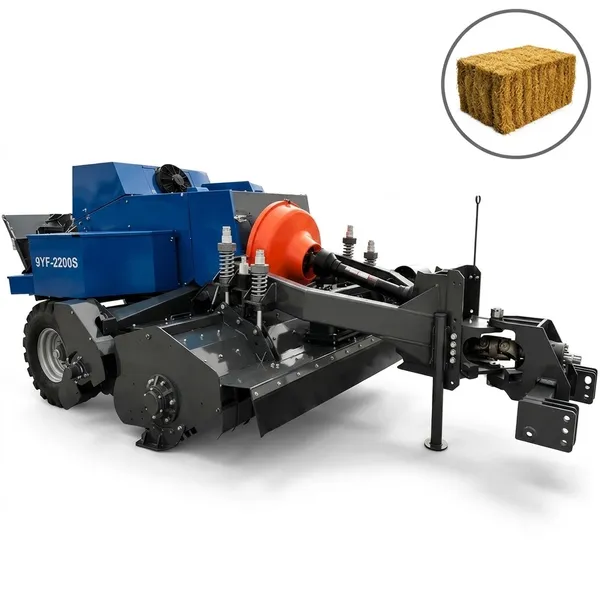
| 9YF-2200S |
2,200mm |
80–105 |
70~95세 |
55–80 |
360–520 |
| 9YFS-2.2 |
2,200mm |
80–100 |
68–90 |
55–78 |
350–500 |
Output in bales per hour based on real-world operation: 5–7 km/h forward speed, standard grass hay or alfalfa windrows, 460×360mm × 460–520mm bale length, 540rpm PTO, experienced operator. Good day total = 5 effective baling hours. Light windrow = thin, well-spread single-pass cut. Heavy windrow = merged or high-yield first-cut alfalfa.
Forward Speed and Bale Cycle Time: The Core Relationship
How Speed Determines Output Rate
Output rate is the product of how much crop the pickup collects per unit time and how quickly the bale chamber cycles through accumulation and compression. These two factors are linked: increasing forward speed increases the rate of crop delivery to the chamber, which increases the frequency of bale completion cycles up to the point where the feeder or inlet becomes saturated — at which point further speed increases cause blockages rather than higher output.
The practical operating range for forward speed on the 9YF series in standard hay is 4–8 km/h. Below 4 km/h, crop delivery rate is too low to maintain efficient bale formation and output per hour falls significantly. Above 8 km/h in standard hay and above 6 km/h in heavy alfalfa, the inlet saturation risk increases rapidly. The highest sustainable output per hour occurs at the fastest forward speed the windrow and inlet can sustain without blockage — and this varies by field section, not just by model or crop type.
The Speed-Density Trade-Off
Increasing forward speed also decreases bale density at the same spring tension setting — the chamber fills faster with less compression time per plunger stroke. An operator chasing maximum bales per hour at 8 km/h may produce lighter bales than the same operator at 6 km/h at the same tension setting. For horse hay and premium markets where bale weight consistency matters, operating at moderate speed rather than maximum speed produces better density uniformity even if the total bale count per hour is slightly lower.
Field Efficiency: What Reduces Your Actual Daily Total
Headland Turns: 15–25% Time Loss
On a typical square field with 150m rows, headland turn time at 5 km/h is approximately 25–35 seconds per row end. In a 2-hour session baling 40 rows, this is 17–23 minutes of non-productive time — 14–19% of the session.
Spool Changes: 3–5 min each
At 1,300 bales per spool, a 400-bale afternoon session requires no spool changes. At 600+ bales, plan for one spool change per side — 6–10 minutes total. Pre-threading the next spool end reduces this to 2–3 minutes per side.
Speed Reduction in Dense Sections
On a typical first-cut alfalfa field with 20% high-density sections, reducing from 6 to 4 km/h in those sections reduces average output by approximately 8% per session even if all other conditions are ideal.
Wagon Swap and Bale Collection
On small fields where bale collection is happening simultaneously, the baler may have to pause while a wagon repositions. Operations that do not have a separate collection crew or inline wagon system lose 10–20% of operating time to this constraint.
How to Calculate Your Realistic Daily and Seasonal Capacity
The Four-Step Capacity Calculation
1단계
Determine your afternoon baling window: In your region, how many hours per day can you bale at correct moisture and before dew fall? Standard afternoon window in most U.S. regions: 5–6 hours (13:00–18:00 or 14:00–19:00). In Southeast states during summer: 3–4 hours.
2단계
Apply your real-world output rate: From the table above, take the Standard column value for your model. Multiply by 0.75 to account for field efficiency losses (turns, speed variation, short stops). This gives your effective productive rate.
3단계
Multiply by baling window hours: Effective rate × baling window hours = realistic daily bale total. Example: 9YF-2200 at 70 bales/hr × 0.75 efficiency × 5 hours = 263 bales per day.
STEP 4
Multiply by your seasonal baling days: In most U.S. regions, peak hay season provides 18–28 good baling days across 2–3 cuttings. 263 bales/day × 22 days = 5,786 seasonal capacity. Compare this to your actual acreage requirement to verify the machine is correctly sized.
| 모델 |
Effective rate (×0.75) |
5-hr day |
6-hr day |
22-day season |
Acres (40 bales/ac) |
| 9YF-1700 |
45 |
225 |
270 |
4,950–5,940 |
124–149 |
| 9YF-1900 |
53 |
265 |
318 |
5,830–6,996 |
146–175 |
| 9YF-2200 |
64 |
320 |
384 |
7,040–8,448 |
176–211 |
| 9YF-2200S / 9YFS-2.2 |
64 |
320 |
384 |
7,040–8,448 |
176–211 |
What Actually Limits Output on Most Small Farm Operations
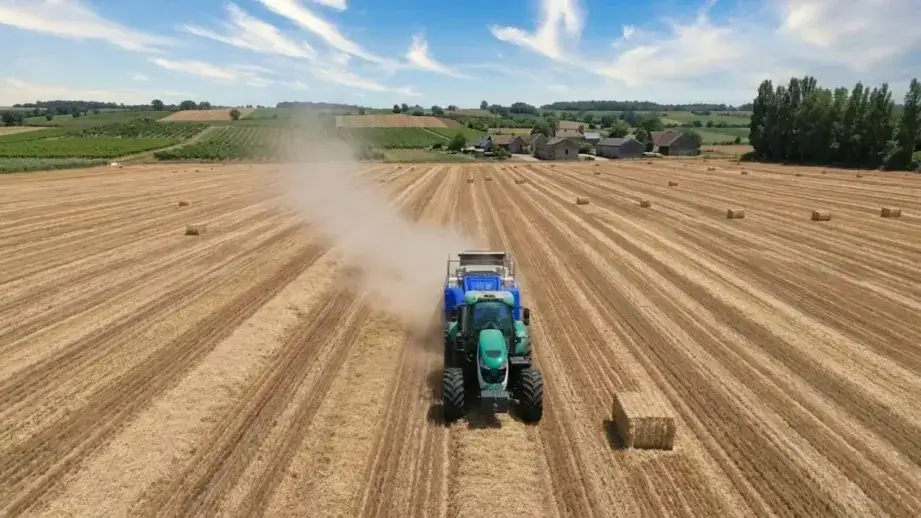
The baler mechanism itself is almost never the production bottleneck on a small farm operation. A 9YF-2200 at rated speed can produce more bales per day than most small farm hay operations need in an entire cutting. The actual limits are:
Bale Collection and Loading Labour
On operations without an inline wagon or automated bale collector, the baler must pause or slow while bales accumulate on the ground past a manageable density. One person on the baler and no collection crew can maintain maximum output only until the field becomes too congested with uncollected bales. A two-person operation — one baling, one collecting — achieves 40–80% higher daily totals than a one-person operation at the same machine speed.
Afternoon Baling Window Restriction
In humid regions, the safe baling window may be only 3–4 hours. A machine that can produce 400 bales per day in a 6-hour window can only produce 200–270 bales in a 3-hour window — the baler capability is unchanged but the window restricts total output. Choosing the correct model for your regional conditions means matching the machine output rate to your window, not to a theoretical longer day.
Field Size and Shape
Small, irregular or oddly shaped fields dramatically increase the proportion of time spent on headland turns relative to productive baling rows. A 5-acre rectangular field with 80m rows spends approximately 35% of session time on turns. The same acreage in a long narrow field with 400m rows spends only 15% on turns — producing 30% more bales in the same session time from the same machine.
Tractor HP Reserve
A tractor at or near the rated minimum HP for the baler must reduce forward speed in heavier windrow sections to maintain PTO speed. This speed reduction reduces effective output in direct proportion to how often and how much the speed must change. Operations where the tractor has 20–30% HP reserve above the baler minimum maintain more consistent forward speed and produce 10–20% more bales per hour on the same field.
Revenue Per Hour: The More Useful Productivity Metric
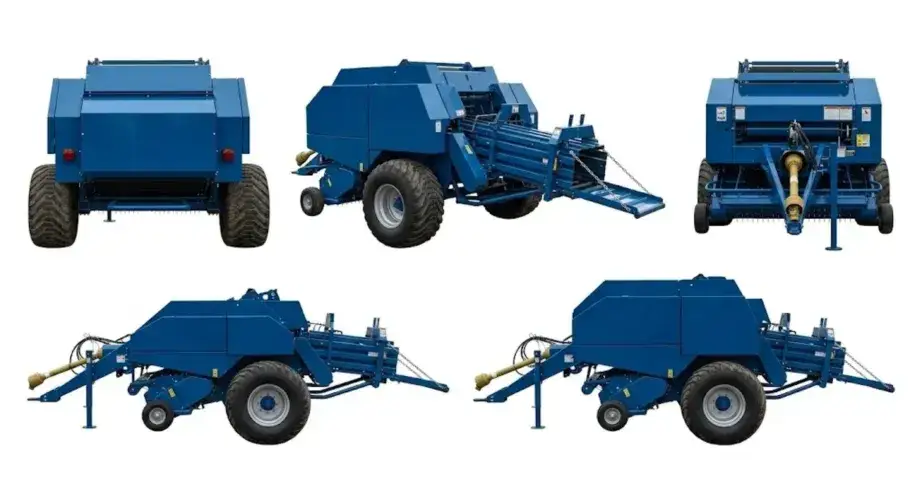
For small square baler operations selling hay at premium prices, revenue per hour is a more useful metric than bales per hour alone. A 9YF-2200 producing 70 bales per hour and selling each bale at $10 generates $700 per effective baling hour. A round baler producing the equivalent dry matter at 15 large round bales per hour sold at $60 per bale generates $900 per hour — but the square baler figure represents horse-market premium pricing that the round bale format cannot access.
The output-per-hour comparison between square and round balers must therefore be made in units of revenue per hour, not bales per hour, and must reflect the actual market each format can access. For operations selling into the equine, retail or export market — where the small square format commands 2–4 times the commodity round bale price per tonne — the revenue per hour comparison frequently favours the small square baler even at lower bales-per-hour rates, because the per-bale value compensates for the throughput difference.
PTO Speed and Output Rate Connection
Maintaining 540rpm PTO speed is essential for maximum output rate — a PTO running at 480rpm reduces the plunger cycle frequency by approximately 11%, directly reducing the maximum achievable bales per hour by the same proportion regardless of forward speed. Full driveshaft specifications: PTO 구동축 및 CV 조인트 크기 가이드.
Frequently Asked Questions — Square Baler Output Per Hour
My baler is only producing 40 bales per hour. Is something wrong?+
40 bales per hour is below the expected range for any model in the 9YF series under normal conditions. The most common causes in order of frequency: forward speed too low (below 4 km/h), producing fewer crop cycles per hour; tractor below rated PTO speed (below 480rpm), reducing plunger frequency; windrow too thin, requiring multiple passes per bale formation; significant headland turn time on a small or irregular field; or a mechanical issue reducing the feeder or plunger cycle rate. The diagnostic test: verify PTO speed first (should be at engine RPM that delivers 540rpm at the PTO shaft). Then measure the time between bale ejections by counting ejections over 60 seconds at a consistent forward speed. If ejections per minute match the expected range for the baler specification, the issue is forward speed or field efficiency rather than the machine mechanism.
Does bale length affect output per hour?+
Yes — shorter bale length settings produce more bales per hour from the same machine and windrow at the same forward speed, because each bale cycle completes more quickly when the chamber fills to a shorter length before the knotters fire. However, shorter bales also weigh less — so tonnes per hour remains approximately constant regardless of bale length setting. The revenue implication: if you are paid per bale (retail or horse hay market), shorter bales produce more revenue per hour. If you are selling by weight, bale length does not significantly affect revenue rate. For the horse market specifically, buyers generally prefer bales in the 20–28kg range — bales set too short (under 400mm) produce light bales that disappoint buyers expecting a standard weight; bales set too long (above 600mm) may be too heavy for comfortable carrying by a single person. Calibrate bale length for your target market weight, then accept the resulting bales-per-hour as the output rate that serves your market rather than a variable to maximise independently.
How does first cut alfalfa output compare to third cut for the same model?+
First cut alfalfa typically produces 15–25% fewer bales per hour than second or third cut from the same machine at the same forward speed — because the higher yield per acre (more tonnes of crop) means the windrow is denser, slowing the safe forward speed. The output in bales per hour is lower but bale weight per bale is higher, so tonnes per hour is often similar. Third cut alfalfa — thinner windrow, lighter yield, finer stems — allows higher forward speed and produces more bales per hour at lower individual bale weight. For planning purposes: budget approximately 70–75% of second/third cut output rate when calculating first cut session capacity. The same machine that produces 80 bales per hour in third cut alfalfa may only sustain 60–65 bales per hour in first cut without risking plugging.
How many acres can a 9YF-2200 bale per day?+
At 5–6 km/h with a 2,200mm pickup, the 9YF-2200 covers approximately 1.1–1.3 hectares (2.7–3.2 acres) per hour of actual baling time. In a 5-hour effective baling window: 5.5–6.5 hectares (13.5–16 acres). In a 6-hour window: 6.6–7.8 hectares (16.3–19.3 acres). With field efficiency losses (headland turns, speed variation) applied at 0.75: realistic daily field coverage is 10–14 acres in a 5-hour window and 12–17 acres in a 6-hour window. At a 2-tonne per acre yield and 24kg bale weight, 10–17 acres produces 333–567 bales — consistent with the daily total range in the model table above. These are planning figures; actual results vary significantly with field layout, windrow quality and operator experience.
Is a wider pickup always better for output?+
A wider pickup increases field coverage per pass (more hectares per hour of baling time), which increases output per hour on large, regular fields where headland time is a small proportion of total session time. On small, irregular fields where headland time is 25–35% of session time, the additional field coverage rate from a wider pickup provides less benefit because the headland time dominates the productivity limit regardless of pickup width. The 9YF-2200 with 2,200mm pickup provides approximately 23% more field coverage per hour than the 9YF-1700 with 1,700mm pickup at the same forward speed. On a 100-acre field with long rows, this translates to approximately 23% more bales per day. On a 5-acre field with short rows where 30% of time is spent on turns, the effective daily output advantage narrows to approximately 15%. For very small fields, the productivity difference between models is less significant than on large fields — which is one reason the 9YF-1700 remains appropriate for small-acreage operations even though it is slower than the wider models.
What is the maximum speed I should drive a 9YF series baler?+
The maximum safe operating speed for the 9YF series is 8–10 km/h road transport speed (PTO disengaged). During baling operation, maximum forward speed depends on the windrow density and crop type: standard grass hay in a thin to moderate windrow: 6–8 km/h is the practical upper limit before inlet saturation risk increases. First-cut alfalfa in full-yield windrows: 4–6 km/h. Straw in light windrows: up to 8 km/h. Corn stover without pre-shredding: 3–5 km/h. These are not strict limits — they are the speeds at which experienced operators report reliable operation without plugging in those conditions. An operator new to a field or a crop should begin at 4 km/h and increase speed incrementally until reaching the upper sustainable rate for those specific conditions. The correct operating speed is the fastest speed at which the inlet clears completely on each plunger stroke, the tractor maintains rated PTO speed and bale weight remains within 15% of the target — not the speed at which a specification sheet suggests the machine can travel.
How does the 9YF series compare to round balers for output per hour on the same field?+
In tonnes per hour, a round baler with equivalent pickup width processes 15–30% more crop mass per hour than a small square baler, because the round baler chamber fills continuously without the plunger stop-start cycle that temporarily limits the rate at which material can be added to the square baler chamber. In bales per hour, the comparison is reversed: a square baler produces far more individual bales per hour than a round baler because each square bale is 3–5% of the mass of a large round bale. For daily revenue: on fields that can access the
small square baler premium market at $10+ per bale, the square baler generates more revenue per hour despite lower tonne per hour throughput. On commodity hay fields selling at $50–$80 per tonne into livestock markets, the round baler advantage in tonnes per hour can produce higher revenue per hour. The correct comparison depends entirely on which market each format accesses in your location.
Will hiring a helper to collect bales significantly increase my daily output?+
Yes — significantly in most small farm operations. A solo operator baling and collecting without help must manage their forward speed to stay within the bale density the field can sustain without the collection creating a congestion problem. With a helper running a separate tractor collecting bales simultaneously, the baling tractor can maintain a more consistent forward speed without stopping to wait for bale collection. Studies of small square bale operations in the U.S. find that adding one collection person or one dedicated collection tractor increases daily bale output by 35–60% compared to solo operation on typical 20–80 acre farms. The economic calculation: if the helper costs $15–$25 per hour and the additional bales produced sell at $10 each, a 60-bale per hour output increase generates $600 of additional revenue per hour for a $15–$25 labour cost per hour — a very positive return. For operations where daily output is currently limited by collection rather than baling speed, hiring collection help is typically the most cost-effective productivity investment available.
Choose the Right Model for Your Output Requirements
Tell us your acreage, baling window and primary market — we will confirm which 9YF model provides the right output capacity for your operation without oversizing or undersizing the machine for your actual seasonal needs.
편집자: Cxm