Hay Production Tools — Moisture Measurement and Baling Decisions

건초 수분 측정기 사용 설명서: 종류, 정확도 및 선택

A $50 hay moisture probe used correctly is one of the highest-return tools in hay production. The same probe used wrong — wrong species calibration, too-short probe reading only the surface, no temperature compensation — produces readings 2–5% lower than actual moisture. This guide covers how capacitance meters work, why species calibration matters more than most producers realize, and which meter type justifies the investment at each operation scale.

See Accuracy Comparison Table

How Capacitance Probes Work — and Where the Measurement Error Enters

The vast majority of hay moisture meters used in field conditions are capacitance (dielectric) probes — instruments that measure the electrical properties of hay to infer its moisture content. The underlying principle is straightforward: water has a dielectric constant approximately 80 times higher than dry hay material. A probe that passes a small alternating electrical signal through hay and measures how that signal is altered by the material’s electrical properties can estimate moisture content from the magnitude of the dielectric effect. The accuracy of this method depends on several factors that are not visible to the user and not explained in any product manual — factors that produce the systematic errors that cause hay to arrive at the baler wetter than the meter said.

±1–3%
Accuracy range of quality capacitance probe meters when correctly calibrated, correctly used, and on the appropriate species setting — a range that is adequate for most field baling decisions but insufficient for quality documentation or insurance claims without cross-verification
2–5%
Systematic underestimate produced when an alfalfa-calibrated meter is used on orchardgrass or sorghum sudangrass hay — the most common moisture measurement error in hay operations, and the one most likely to result in baling above safe moisture
24시간
Time required for the oven-dry verification method — the reference standard that tells you if your field probe is reading accurately; a 24-hour verification performed once before each baling season prevents systematic errors from compounding across an entire production year
The physical measurement mechanism

The probe tines act as the plates of a capacitor; the hay between them acts as the dielectric material. The meter applies an AC signal and measures the resultant capacitance, which changes with moisture content. Higher moisture → higher dielectric constant → higher capacitance reading → higher moisture output. This measurement is fundamentally a bulk property of the material between the tines — meaning it reflects both surface moisture and interior moisture in proportion to how much of each exists between the tine surfaces. If the tines are only 8 inches long and the windrow core is 24 inches wide, the tines measure only the outer material and systematically underestimate core moisture.

Where the errors enter

Four sources of systematic error compound in practice: (1) Probe too short for windrow depth → reads surface, not core. (2) Wrong species calibration → converts the dielectric reading to moisture % using the wrong equation. (3) No temperature compensation → cold hay reads wetter than actual in the morning; hot hay reads drier. (4) Oxidized or dirty probe tines → changes the baseline capacitance, introducing a shift in all readings. Each error source independently produces a 1–3% bias; all four occurring simultaneously can produce readings that are 5–10% below actual moisture — which is the distance between “safe to bale” and “significant fire risk.”

Probe Meter Types and the Insertion Depth Problem That Causes Most Errors

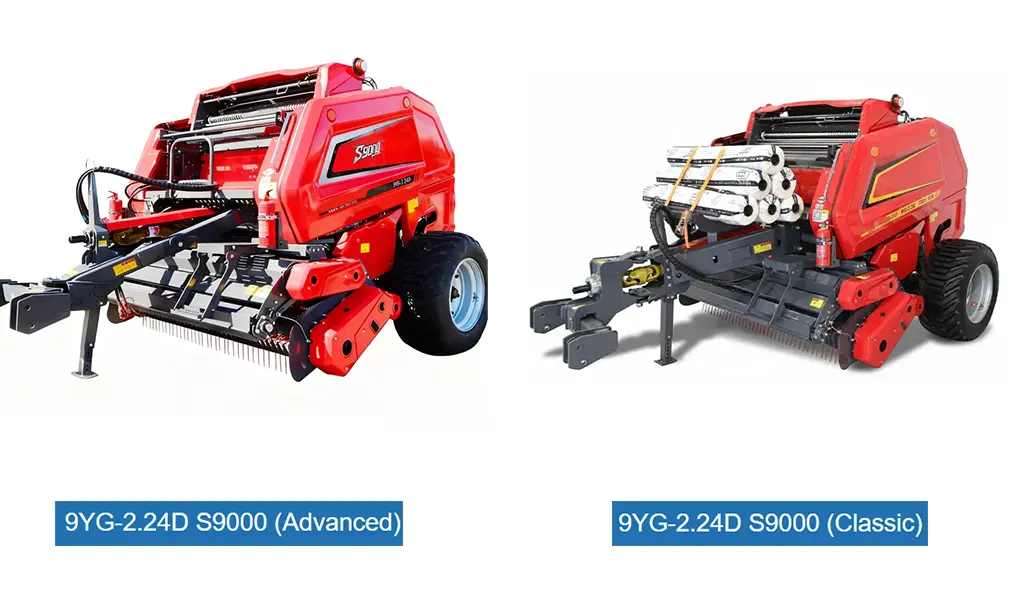
round baler comparison showing different baler configurations — moisture content at the time of baling is the primary variable that determines whether a bale will heat, mold, or maintain quality in storage; the baler's bale density setting affects how well heat can escape from the bale interior after baling, but it cannot compensate for a bale that was formed from hay that was 5 to 8 percent above the safe baling moisture threshold

The single most impactful accuracy improvement available to any hay producer using a probe meter costs nothing beyond buying a longer probe: inserting the probe deep enough to reach the windrow core rather than reading only the surface. A windrow at 40% core moisture with a dry surface at 20% will give a probe reading of approximately 25–28% if the tines only reach 6 inches into a 24-inch-wide windrow. The operator interprets “28%” as “too wet — wait another day”; when in reality a 25% surface reading on that windrow should have prompted a “27–30% core reading” interpretation.

Probe length Measurement zone Accuracy vs oven-dry Best use Key limitation
8 inches Outer 6″ of windrow ±4–8% (unreliable) Hay in storage (bale face) Systematic underestimate in windrow; do not use for baling decisions
12 inches Upper 1/3 of typical windrow ±2–5% Narrow windrows (under 18″ wide) Underestimates core moisture in full-width hay windrows; add 2% to reading as correction
18 inches Core of standard windrow ±1.5–3% Field windrow baling decisions Minimum recommended for standard windrows; insert perpendicular to windrow direction
24 inches Deep core of wide windrow ±1.5–2.5% Heavy hay windrows; triticale; sorghum Overkill for narrow windrows but the most accurate option for heavy-crop producers
Correct insertion protocol

Insert the probe from the side of the windrow, perpendicular to the windrow’s length, so the tines pass through the full width of the windrow cross-section. Do not insert from the top or along the windrow length — both insertion directions read primarily the drier outer layer. Take 5–6 readings at different windrow locations (beginning, middle, and end of the pass; different positions across the field width). Average the readings. Discard readings that are more than 3 percentage points from the others — those represent local wet spots that need additional curing time regardless of the average. The baling decision should be based on the highest reading among your sample, not the average — because baling 5 wet bales out of 100 creates 5 fire risks in the storage stack.

The moisture testing context for baling decisions

The complete moisture testing protocol — including target moisture ranges by species and market, what happens when baling is done above and below target, and how moisture relates to forage quality outcomes — is in the hay moisture and baling testing guide. The fire risk implications of baling hay above 18–20% moisture — including how core heating above 150°F triggers the spontaneous combustion sequence — are in the round baler fire prevention and safety guide.

In-Baler Moisture Sensors: Continuous Real-Time Monitoring in the Bale Chamber

In-baler moisture sensors provide a fundamentally different measurement approach from hand probes: instead of sampling the windrow before baling, they measure hay moisture continuously as the bale is forming inside the bale chamber. The capacitance plates mounted on the bale chamber rollers or walls make contact with the hay as it compresses, producing a continuous moisture reading that displays on the baler’s monitor display or ISOBUS screen. This approach eliminates the sampling error of hand probes — every bale’s moisture is measured directly during formation, not inferred from windrow samples.

What in-baler sensors do well

Continuous per-bale moisture tracking throughout the operating day; detection of high-moisture patches in the field that a windrow sampling protocol would miss; integration with baler monitoring systems that can log per-bale moisture data for quality documentation; alerting the operator when a specific bale exceeds the moisture threshold before the bale is ejected (allowing the operator to stop, wait for that area of the windrow to dry further, or mark the bale as high-moisture for separate storage). Some advanced systems also integrate with auto-wrap systems to apply additional net wrap wraps to bales that exceed a moisture threshold.

Limitations of in-baler sensors

The fundamental limitation of in-baler sensors: they cannot tell you the moisture before you start baling. A hand probe used on the windrow 30 minutes before baling tells you whether the field is ready; an in-baler sensor tells you the moisture of each bale as it’s formed, but only after the bale is already committed. For a producer operating with a clear weather window, the in-baler sensor confirms quality in real time — but does not prevent baling a field that should have waited another 4 hours. Use both: a hand probe to make the “start baling” decision; an in-baler sensor to document each bale and catch localized wet spots. Sensor accuracy: ±1.5–3% versus oven-dry reference for most commercial systems. This is the same range as a quality hand probe — the advantage is continuous coverage, not superior accuracy. For 원형 베일러 모델 available with factory-installed moisture sensing systems, see our product specifications.

Species Calibration: The Most Overlooked Accuracy Issue in Hay Moisture Measurement

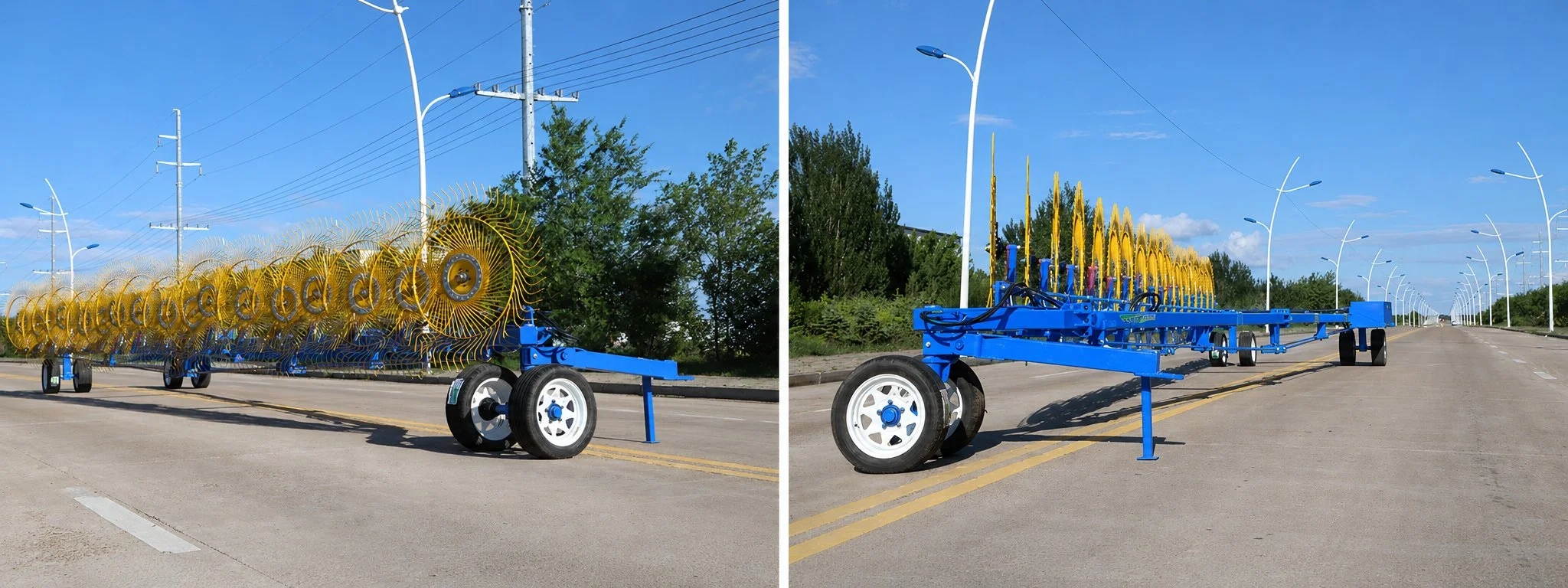
finger-wheel hay rake in field operation — the windrow formed by the rake determines the moisture gradient that the probe must penetrate to reach the core; dense, narrow windrows formed from heavy hay crops like orchardgrass and triticale have steeper moisture gradients between surface and core than wide, spread windrows from lighter crops, meaning that species-appropriate probe insertion depth and windrow width both interact with the species calibration issue to produce compounding measurement errors

Most hay moisture meter reviews and product descriptions focus on features, price, and build quality — while completely ignoring species calibration, the factor that most commonly produces systematic errors in real field use. A meter calibration is an equation that converts the measured dielectric constant into a moisture percentage. The problem: the relationship between dielectric constant and moisture percentage is different for alfalfa, orchardgrass, sorghum sudangrass, and straw because these species have different physical density, stem structure, and water distribution patterns. A single calibration equation does not apply to all species with equal accuracy.

Hay type being measured Meter calibration used Expected reading error Practical consequence
알팔파 Alfalfa (correct) ±1.5–3% (reference) Normal accuracy; alfalfa calibration is the baseline on most meters
Orchardgrass / timothy Alfalfa (wrong) Reads 1.5–2.5% LOW Orchardgrass at 20% moisture reads as 17–18%; producer thinks hay is ready to bale; hay heats in storage
수수 수단그라스 Alfalfa (wrong) Reads 3–5% LOW Sorghum at 22% moisture reads as 17–19%; significantly dangerous error for a species where high-moisture baling causes severe problems
Wheat / oat straw Alfalfa (wrong) Reads 2–4% LOW Lower consequence than hay since straw target is often 12-14%; but still creates systematic error
티모시 Grass hay (correct) ±1.5–3% Adequate accuracy when the correct grass calibration is selected; improves on orchardgrass error
Triticale / cereal rye Straw or grass (closest) ±2–4% No winter annual cereal calibration on most meters; use grass or straw setting; verify with oven-dry for first-season use
The correction factor approach for producers who measure multiple species: If your meter does not have a specific grass hay calibration, you can establish a manual correction factor through seasonal oven-dry verification. Measure 5–6 windrow samples from your grass crop with the meter on the alfalfa setting. Simultaneously collect a 150–200g sample from the same locations, weigh immediately, dry at 100–105°C for 24 hours, reweigh, and calculate actual moisture. Average the difference between meter readings and actual values — this is your species-specific correction factor. If the meter consistently reads 2.1% lower than actual on orchardgrass in your conditions, add 2.1% to all future orchardgrass readings with that meter and calibration setting.

Temperature Effects: Why Morning Readings on Cheap Meters Mislead You

Water’s dielectric constant is temperature-dependent: it decreases as temperature increases. This means that a hay windrow at 45°F in the morning will produce a higher dielectric reading than the same windrow at the same actual moisture content at 75°F in the afternoon. A meter without temperature compensation circuitry will interpret this as higher moisture in the morning than in the afternoon — when in fact the hay has not changed; only its temperature changed. The practical consequence: producers using non-temperature-compensating meters in cool morning conditions may conclude their hay is wetter than it actually is and delay baling unnecessarily, while producers using them in cold conditions (below 40°F) may see overestimates large enough to misrepresent the true moisture status.

Temperature compensation — who has it and who doesn’t

Most meters in the $120+ price range include automatic temperature compensation circuits that measure ambient or probe temperature and adjust the dielectric-to-moisture conversion accordingly. Meters in the $40–$80 range typically do not. The product specification should state whether temperature compensation is included; if it is not stated, assume it is absent. For producers baling primarily in the 60–85°F temperature range (summer conditions), the temperature error on non-compensating meters is smaller (approximately 0.5–1.0% per 10°F deviation) and less likely to cause significant decisions errors. For spring baling in the 40–65°F range — where the morning-to-afternoon temperature swing can be 25–30°F — temperature compensation is a meaningful accuracy feature.

The morning vs afternoon reading protocol

For producers with temperature-compensating meters, time of measurement is less critical. For producers with basic non-compensating meters: take readings after the windrow has equilibrated to close to air temperature — typically 2–3 hours after the sun has been on the windrow in the morning, or 1–2 hours after raking. The most critical rule: if you take a morning reading with a non-compensating meter at 55°F and it reads 22%, do not conclude the hay is too wet to bale — wait 2 hours, take a second reading at 70°F ambient, and compare. The afternoon reading is more reliable. Alternatively: add a mental deduction of approximately 0.5–1.5% from morning readings on non-compensating meters in cool spring conditions.

Meter Calibration and Maintenance: The Annual Check That Prevents Invisible Drift

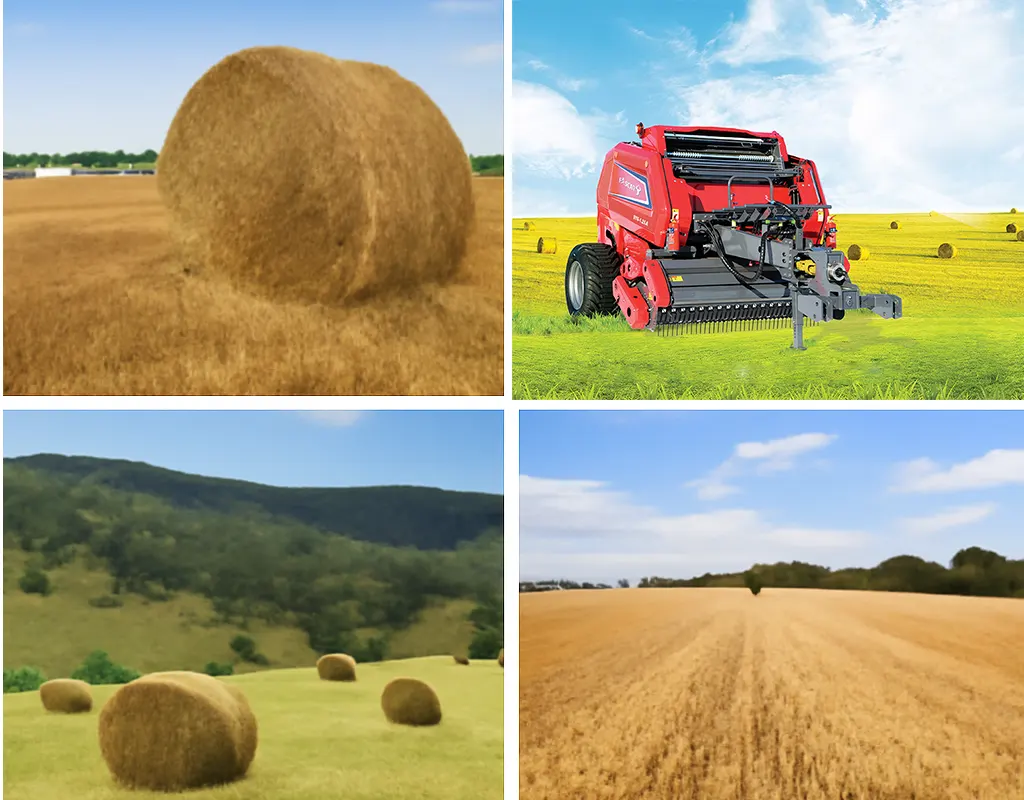
round baler operating in alfalfa hay field — the moisture measurement accuracy that determines baling decisions directly affects both hay quality outcomes and fire safety; a meter that has drifted 2 percentage points below actual moisture due to probe tine oxidation will systematically cause the operator to bale every load 2 percent wetter than intended, which over a 200-bale season means every bale enters storage at elevated moisture risk

Hay moisture meters are not set-and-forget instruments. Two specific degradation mechanisms cause meters to drift from their calibrated accuracy over time, and neither is obvious to casual inspection. A meter that was accurate when new and has developed a 2.5% systematic underestimate due to probe tine oxidation will continue to give confident, repeatable readings — the operator has no visible indication that the readings are now wrong. Only verification against a reference method reveals the problem.

Probe tine oxidation — the most common drift cause

Hay field conditions — moisture, crop acids, and abrasion — cause the stainless steel or copper probe tines to develop a thin oxide layer over one to three seasons of use. This layer has different electrical properties than clean metal, effectively adding a fixed resistance to the capacitance measurement. The result is a systematic low-bias that grows as the oxide layer thickens. Fix: lightly sand the probe tine surfaces with 400-grit wet/dry sandpaper before each baling season, removing the oxide layer. Avoid wire brushing (scratches the sensing surface) and avoid chemical cleaning agents that may leave a residue. After cleaning, verify against oven-dry as described below.

Oven-dry verification — the annual calibration check

Procedure: during the first baling session of the season, take 5 windrow readings with the meter and simultaneously collect a 150–200g hay sample from the same windrow location. Place the sample in a labeled paper bag; weigh it fresh; dry in a kitchen or laboratory oven at 100–105°C for 24 hours; reweigh the dried sample; calculate actual moisture as: (fresh weight − dry weight) ÷ fresh weight × 100. Compare to the meter’s average reading. If the meter reads consistently 2% lower than actual: add 2% to all future readings, or send the meter for factory recalibration. This check costs 24 hours and the price of electricity — it is the foundational quality control step for moisture measurement accuracy.

Battery management and storage

On budget meters without regulated power circuits, battery voltage affects the signal magnitude and can cause drift as batteries discharge. Replace batteries at the start of each baling season regardless of remaining charge — the $5 cost of fresh batteries is a trivial insurance against 2–3% measurement drift. Store the meter in a dry environment between seasons; high humidity causes oxidation of internal circuit contacts. Remove batteries before long-term storage to prevent leakage damage to the circuit board.

Selection Guide: Matching the Meter to Your Operation Scale and Market

The right moisture meter for a hobby farm making 80 small square bales per year is not the right meter for a commercial hay producer making 2,000 round bales for the dairy and horse market, and neither is right for a custom baling service that needs documentation capability. This selection framework matches meter capability to the most likely use case at each scale.

MOISTURE METER SELECTION BY OPERATION TYPE
Small farm / hobby
Under 200 bales/year
Entry-level probe ($40–$80): adequate for low-volume operations where occasional measurement errors are less consequential. Select the longest probe available in this category (ideally 12″+). Understand the species calibration limitation — use a correction factor for grass hay. Verify annually with oven-dry. Primary value: tells you whether hay is grossly ready or not; does not replace judgment in marginal conditions.
Commercial hay producer
200–1,500 bales/year
Mid-range probe with species calibration and temperature compensation ($120–$250): the most important tool purchase for any operation producing for market sale. Minimum features required: 18-inch probe, species calibration settings (alfalfa + grass hay minimum), temperature compensation, battery indicator, and averaging mode (takes 3 readings automatically and displays the average). Products in this range from Delmhorst, Agreto, and similar instrument manufacturers have 15–20 year service lives when maintained.
Premium / quality-focused
1,500+ bales/year or dairy/horse market
Mid-range probe + in-baler sensor ($600–$2,000 for retrofit): operations selling to dairy buyers or horse markets where forage analysis documentation is routine should document moisture at baling alongside the forage test. The combination of a quality hand probe for pre-baling field decisions and an in-baler sensor for per-bale logging provides the documentation standard that premium market buyers increasingly expect. In-baler retrofit sensor compatibility with baler gearbox and electronics specifications is in 농업용 변속기 및 PTO 구동계 부품 사양.
Custom baling service
Variable clients, documentation needs
Professional handheld with data logging ($200–$400): custom balers who produce for clients requiring documentation benefit from meters that can log and export readings by field and date. Several models in this range connect to smartphone apps that generate per-job moisture reports for client records. The data logging function is more important than additional accuracy, as the data forms the basis for quality warranties and dispute resolution.

Using Moisture Data to Systematically Improve Your Hay Operation

A moisture meter used only to make individual baling decisions is an underutilized tool. The moisture readings from a full season of hay production, logged and analyzed, reveal systematic patterns about your specific operation — how fast specific fields dry in different wind and temperature conditions, which cutting times produce the most consistently dry windrows, whether your baling moisture is systematically higher than intended. This information is more valuable than any single reading.

Drying rate prediction from sequential readings

Take readings from the same windrow location every 2–4 hours from cutting through the first 30 hours of field drying. Plot or log these readings against time. Most hay crops under consistent weather conditions follow a relatively predictable drying curve — the rate slows as moisture drops from 40% to 20%, then slows further below 20%. After 2–3 cuttings with consistent sequential measurement, you can estimate with reasonable confidence when a field will reach baling moisture based on the early readings and current weather conditions — producing a better baling schedule than either the “3-day rule” or a single measurement the morning of potential baling. The hay workflow management framework that integrates moisture monitoring is in the 건초 생산 워크플로 최적화 가이드.

Moisture documentation for insurance and quality

Hay bale fire insurance claims frequently require documentation of baling moisture to assess whether the fire resulted from high-moisture baling (preventable cause) or from external ignition (covered loss). Producers who maintain a field-by-field baling moisture log — date, field, cutting number, average probe reading, number of readings taken, and any readings above 18% — have defensible documentation that supports both fire prevention claims (“I was baling at 14–16%”) and loss claims. For premium market sales, a documented baling moisture below 14% is increasingly requested by Japanese export buyers and dairy nutrition consultants as a requirement for quality assurance programs.

Identifying equipment problems through moisture data

If your in-baler sensor or post-baling probe readings consistently show hay baled at 18–22% despite windrow readings of 14–16%, the problem is not your windrow moisture measurement — it is hay re-absorbing moisture between raking and baling, which indicates either: (a) you are baling in high-humidity early morning conditions before dew has evaporated from the windrow surface; (b) the windrow is being rained on at night and drying incompletely; or (c) your windrow is too dense and the core is much wetter than the probe reading suggested. Moisture data that consistently shows this pattern tells you to adjust timing or windrow management, not to recalibrate the meter.

Hay Moisture Meter FAQs

How accurate are hay moisture meters, really?+
Quality hay moisture meters used correctly — appropriate probe length, correct species calibration, temperature-compensated, properly maintained, and averaged across 5–6 readings — typically achieve ±1.5–3% accuracy versus the oven-dry reference standard. For baling decisions, this accuracy is adequate: the difference between 15% and 17% moisture in the bale is not a quality crisis; the difference between 15% and 22% is. The meter reliably distinguishes “clearly safe to bale,” “marginal,” and “clearly too wet” — which is exactly what the baling decision requires. Where moisture meters fall short: laboratory-grade accuracy for quality documentation, export compliance moisture certification, and insurance documentation. For these applications, the oven-dry reference method (performed at a commercial forage lab) is the correct measurement standard. A meter reading of 14.2% presented as a guarantee of baling moisture below the export specification threshold is not defensible; a commercial lab moisture analysis on a sample from the same lot is. Use the field probe for operational decisions; use the lab for documentation and warranty claims.
Why do I get different readings depending on where I insert the probe in the same windrow?+
Reading variation within the same windrow is real and normal — it reflects genuine moisture variation within the hay, not meter error. A windrow has higher moisture in the core (least air-exposed zone) than at the surface; higher moisture in shaded low spots than in exposed high areas; higher moisture at field edges than in the middle (wind exposure effect); and higher moisture in dense areas from heavy crop versus thin areas. Reading variation of 3–5 percentage points between locations within the same windrow is typical in a windrow that is partially cured. Reading variation of more than 8 percentage points suggests the windrow has not cured uniformly and needs additional time — even if the lowest readings suggest the hay is ready. The rule for interpreting variable readings: the highest reading you encounter in a standard 5–6 location sampling protocol determines the baling decision, not the average. If even one location reads 22% in a protocol where all others read 14–16%, that location will produce a wet bale. Mark that field area to bale last or re-rake before completing the field.
What is the best moisture meter for someone making 200–400 bales per year?+
For a commercial hay producer making 200–400 round bales per year, the investment that produces the highest return is a mid-range probe in the $120–$200 range with these features: minimum 18-inch probe (preferably 24-inch for grass and cereal hay); species calibration settings with at least alfalfa and grass hay presets; automatic temperature compensation; and an averaging mode or easy multiple-reading capability. In this size operation, a systematic moisture error of 2–3% will cost several thousand dollars per season in either over-dried hay (quality and weight loss) or bales that heat and lose value in storage. The meter pays for itself completely in the first season — the $150 investment versus a single avoided $200-quality-loss bale (or $500 fire-related damage from 10 over-wet bales in a stack) makes the economics straightforward. After establishing a baseline season with the hand probe, consider whether the operation volume and market justifies an in-baler sensor addition for continuous monitoring; at 300+ bales/year for a quality market, the sensor upgrade is economically sensible.
Can I use a hay moisture meter to check baleage before wrapping?+
A standard hay moisture meter can be used on baleage (high-moisture silage) material but has important limitations at the moisture range involved. Most hay probe meters are designed and calibrated for 10–30% moisture range; baleage material at 40–65% moisture is outside the designed measurement range of most instruments. At these high moisture levels, the relationship between dielectric constant and moisture content changes significantly, and the accuracy of most hay probes deteriorates to ±5–10% or worse. Two options for measuring baleage moisture: a dedicated high-moisture forage meter (some instruments cover 10–90% moisture range); or a commercial forage lab analysis (the most accurate and the method recommended when making feeding or fermentation quality decisions). For the field decision of whether material is in the acceptable baleage moisture range (40–65%), a simple squeeze test is often more reliable than an out-of-range hay probe: material at 40–50% moisture will release drops of water when squeezed firmly in your hand; material above 65% will produce a stream of liquid; material below 35% will not release any free moisture. If the squeeze test suggests the material is in the correct range, a lab moisture analysis on a sample before the bale is sealed provides the documentation needed for precise silage management decisions.
How do I know if my meter is giving accurate readings?+
The only definitive verification method is comparison to the oven-dry reference standard, as described in the calibration section above. Short of that, two indirect indicators suggest a meter may be reading inaccurately: (1) Your readings are consistently lower than you expect based on visual assessment and drying conditions. If your weather app says 80°F, low humidity, and good airflow, and after 3 days of field drying your windrow still reads 25% on the meter, either the weather data was wrong, the windrow core is genuinely that wet, or the meter is reading low. A visual check — squeezing the windrow center, feeling for residual flexibility in stems — can help distinguish. (2) You are experiencing bale heating that is inconsistent with the moisture readings at baling. If bales are heating to 140°F in storage when you baled at an indicated 14% moisture, either the readings were inaccurate or the moisture re-absorbed between measurement and baling. Performing the oven-dry verification immediately after you first notice these discrepancies is the most efficient path to diagnosing whether the meter or the process is the problem.
What causes a hay moisture meter to suddenly start reading differently than before?+
A sudden shift in a meter’s readings — readings that are obviously inconsistent with what you expect given your experience and the conditions — typically has one of four causes. First and most common: battery state change. If you are using the meter for the first time this season and batteries are from last year, a drop in battery voltage produces erratic readings on meters without regulated power circuits. Replace batteries immediately. Second: tine damage or contamination. If a tine was bent, chipped, or coated (from probe insertion into clay-heavy soil, for example), the capacitance between the tines has changed. Inspect the tines; clean and straighten if possible; verify with oven-dry. Third: circuit board moisture damage from storage in a humid environment. Internal corrosion of contacts changes the baseline measurement characteristics. Third, this is typically a progressive degradation rather than a sudden change. Fourth: the most disruptive cause — a change in how the meter is being used rather than a change in the meter itself. If someone started using a 12-inch probe in a situation previously using an 18-inch probe, or switched from inserting from the side to inserting from the top, the readings will shift — but for the correct reason (measuring a different part of the windrow). Verify that technique is consistent before attributing readings shifts to meter malfunction.
foragebaler.com certified round baler equipment with in-baler moisture sensor compatibility — baler models available with factory-installed moisture sensing systems and ISOBUS integration for per-bale moisture logging and documentation

Get In-Baler Moisture Sensor Specifications

Tell us your baler model (or target bale size and PTO horsepower if selecting a new baler), your primary hay species (alfalfa, grass, or mixed), and whether you need per-bale data logging for quality documentation. We provide in-baler moisture sensor compatibility specifications and the ISOBUS connection configuration for your baling system.

Get Moisture Sensor Specifications

편집자: Cxm