Hay Marketing Guide

How to Sell Hay: Market Channels, Pricing, and Buyer Relations

Most hay producers make production decisions carefully and marketing decisions haphazardly — accepting the first offer, selling to whoever calls first, and pricing based on what a neighbor received last season. Better marketing doesn’t require a large operation or a sales background. It requires knowing where each channel fits, what each buyer type values, and how to position your specific hay quality in the channel where it commands the highest return.

Compare Market Channels

The Hay Market Landscape: Four Channels, Four Economics

Every bale of hay you produce can flow through one of four main channels: direct-to-consumer retail, commercial hay elevator or broker, contracted delivery to a specific farm or feedlot, or export through an international hay trading company. Each channel has a different price point, a different volume requirement, a different reliability profile, and a different relationship demand. Most commercial producers use a combination of two or three channels rather than committing exclusively to one.

Direct Retail
Highest $/ton. Highest relationship demand. Best for small-volume premium quality.
Elevator / Broker
Mid price. High volume capacity. Best for commercial volume without marketing overhead.
Contract
Stable price. Committed volume. Best for operations valuing predictability over maximum price.
Export
High price potential. Very high quality spec. Pacific Coast and specific regions only.

Direct-to-Consumer Sales: The Highest-Margin Channel
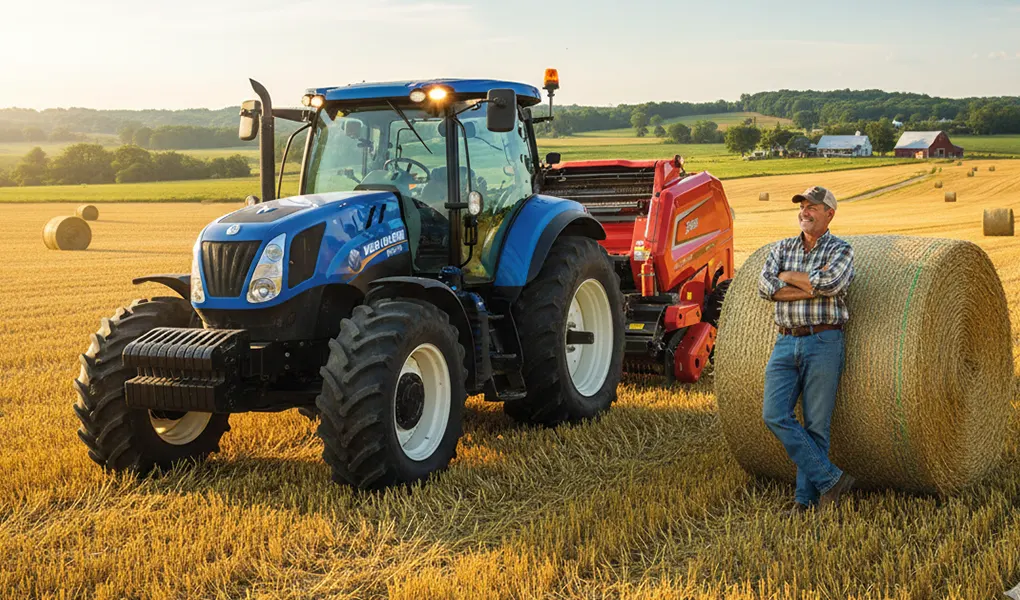
commercial hay production for direct market sale — direct-to-consumer hay sales eliminate intermediary margins and allow the producer to capture the full retail price that the end-user buyer pays, but require relationship development and consistent quality delivery

Selling hay directly to the end-user who feeds it — horse owners, small farm operators, hobby livestock keepers — eliminates every intermediary margin between production and consumption. The direct retail price for Premium alfalfa or horse-quality grass hay in most U.S. regions is 30–60% above the elevator wholesale price for the same hay. This is the channel that makes the quality investment financially rational: a hay producer who consistently achieves Supreme-grade alfalfa and sells it directly to horse owners captures the full quality premium that would be partially absorbed by elevator margins in the wholesale channel.

Who buys direct and what they want

Horse owners buying 10–50 bales at a time. Small goat, sheep, and hobby farm operators. Organic livestock producers who need documentation of management practices. Rabbit and small-animal owners who want clean, low-dust hay. All these buyers typically prioritize quality over price to a greater degree than commercial livestock operations — they want to see the hay before buying, they want consistency batch-to-batch, and they will pay a premium for a producer they trust.

Building a direct retail customer base

Direct retail customers are acquired through local visibility, not price advertising. Effective approaches: a farm sign on a well-traveled road; a listing on hay-finder websites and Facebook Marketplace; word-of-mouth from satisfied customers; contact with local boarding stables and 4-H programs; and presence at local feed stores where customers ask for referrals. One well-connected boarding stable manager who recommends your hay can generate 15–25 direct accounts. Retain direct customers through consistent quality and reliable availability.

Limitations of the direct channel

Direct retail moves hay slowly relative to elevator volume. A typical direct retail customer buys 20–50 bales per visit, 2–4 times per year. On a 2,000-bale annual production, direct retail might absorb 400–600 bales to 20–30 accounts — the remaining 1,400–1,600 bales still need a volume channel. Relying exclusively on direct retail for a commercial operation creates cash flow inconsistency and occasional storage overflow.

Hay Elevators and Brokers: Volume Without Relationship Management

A hay elevator or broker buys hay from producers and resells it to buyers — large dairies, feedlots, retail distributors, or exporters. The elevator’s value proposition to the producer is simple: they will buy your entire load, pay you quickly (typically net 30), and handle the downstream logistics and buyer relationships. The cost: they buy at wholesale (below what the end-user pays) and their margin is the difference between their purchase price and their resale price.

How elevators grade
Elevators use forage testing (ADF, NDF, RFV, moisture, ash) to assign grade — Supreme, Premium, Good, Fair. The test result determines the price offered for that truckload. Bring your own forage test from a recent baling lot to any elevator negotiation. Elevators sometimes discount the grade for loads without independent test verification, paying for Good-grade hay that tests at Premium by withholding the premium until their own test confirms it. Having your test before going to market costs $15–$25 and can be worth $10–$30/ton at the elevator scale.
Elevator requirements
Commercial elevators have minimum load sizes (typically one truck = 20–24 large square bales or 30–40 round bales). Moisture requirements are strict — most elevators require below 15% for stored hay and below 18% for immediate forwarding. Ash content above 12% is typically discounted or rejected. Foreign material (soil clods, wire, plastic fragments) causes rejection regardless of nutritional values. Know the specific elevator’s requirements before delivering.
Using multiple elevators
Develop relationships with 2–3 elevators in your region rather than using one exclusively. Different elevators have different primary buyers and different seasonal demand — one elevator may be paying a premium for dairy-spec alfalfa in February while another is paying better for horse hay in May. Maintaining multiple options allows you to direct each load to the best-paying outlet at the time of sale.

The complete guide to elevator grading standards — what each grade requires for ADF, NDF, CP, moisture, and ash values — and the price premium schedule that translates grades into dollars is in the hay market pricing and elevator grading guide.

Contract Sales: Trading Price Ceiling for Stability
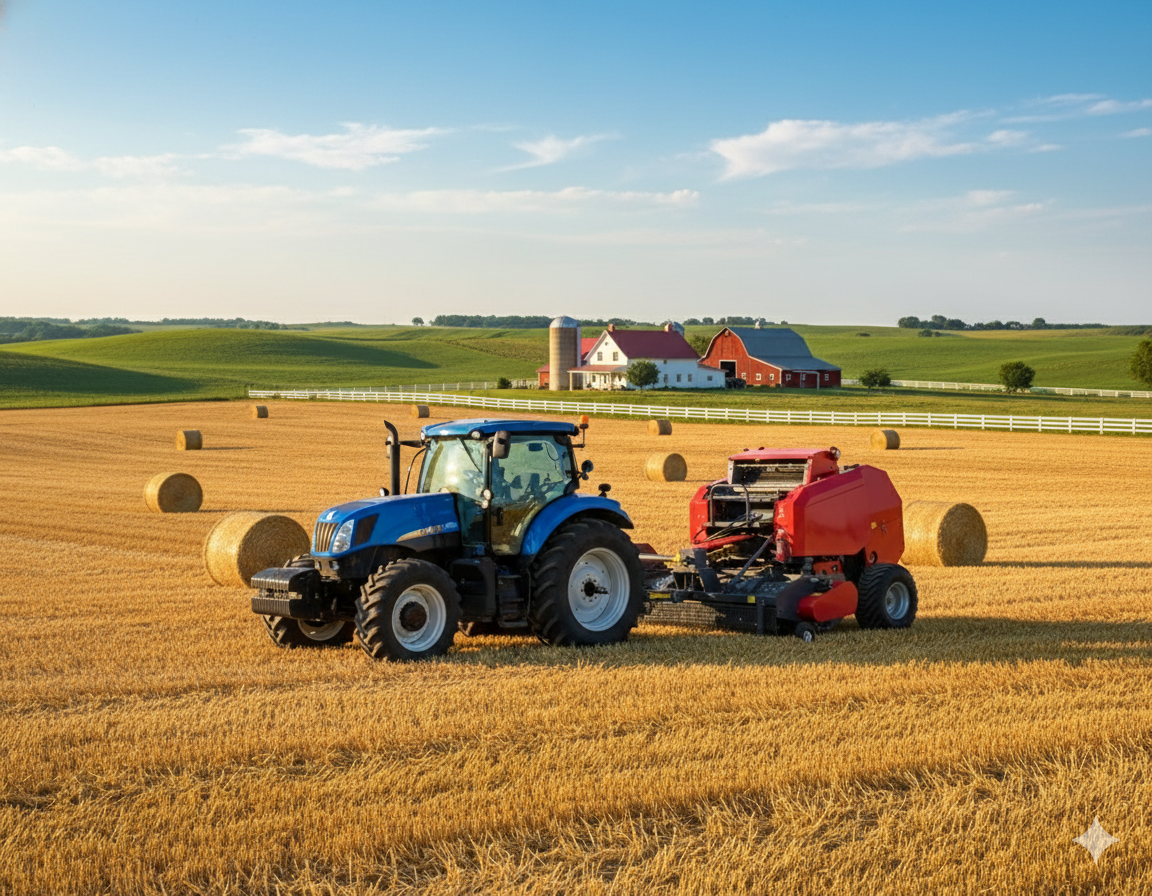
round baler producing commercial hay under contract sale arrangement — contract sales commit a specified volume at a predetermined price, eliminating market uncertainty at the cost of foregoing price upside in strong-demand periods

A contract sale commits a specific volume of hay at a specific price for a defined period — typically one cutting, one season, or one year. The dairy, feedlot, or large livestock operation that buys on contract gets price certainty for their feed budget. The producer gets guaranteed revenue regardless of whether the spot market rises or falls. The tradeoff: if the spot market rises significantly above the contract price after signing, you are committed to the contract price. If the spot market falls, the contract protects you.

Contract terms to understand before signing
  • Volume commitment: Confirm you can actually produce the committed volume in an average or below-average year. Committing more than 80% of expected production leaves no buffer for weather shortfalls.
  • Quality specification: Contract prices are conditional on meeting quality specs (RFV, moisture, ash). Know exactly what happens if a batch fails spec — substitution delivery, price adjustment, or contract default.
  • Delivery schedule: Monthly delivery contracts require consistent quality across all cuttings — first-cut and third-cut alfalfa have very different quality profiles. Negotiate flexibility in delivery timing relative to harvest windows.
  • Force majeure and crop failure: What happens if drought, hail, or equipment failure prevents delivery? A one-sided contract that holds the producer liable for Acts of God is unfair and should be renegotiated.
When contracts make sense

Contracts are most valuable when: the contracted price is at or above current spot market (never contract below spot); the buyer is a large operation that provides genuine volume certainty; your operation has predictable production with low weather risk (irrigated fields, consistent rainfall region); or you are carrying debt that requires predictable cash flow for loan service. The cash flow certainty of a contract often justifies accepting a price slightly below theoretical spot-market maximum.

Export Markets: Premium Potential and Access Requirements

U.S. alfalfa and timothy hay exports — primarily to Japan, South Korea, China, Saudi Arabia, and the UAE — command prices that can be 20–40% above domestic premium market values. These markets exist because the importing countries cannot produce sufficient high-quality hay domestically and depend on U.S. production for dairy and livestock feeding. The challenge for individual producers is that export markets require very specific quality standards, consistent volume, and phytosanitary compliance that most individual operations cannot meet alone.

How producers access export markets

Most individual producers access export markets through export-focused hay companies or regional hay cooperatives that aggregate production from multiple farms. These intermediaries handle the phytosanitary inspection, compression (export hay must meet density specs for container shipping), documentation, and buyer relationship. Individual producers typically supply to these aggregators at a premium above domestic elevator prices but below the final export price.

Export quality requirements

Japan/Korea timothy export: color grade is as important as nutritional grade — golden-yellow color, minimal bleaching, very low dust. Ash below 9%, moisture below 14%, virtually zero soil contamination. Alfalfa export to Middle East: very high RFV (180+), very low ash, Supreme-grade required consistently across the shipment. These specifications are above the average of most domestic commercial production.

Geographic access to export

Export markets are most economically accessible from the Pacific Coast (California, Oregon, Washington, Idaho) where shipping distances to Pacific ports are shortest. Inland producers can access export markets but face transportation costs that reduce the export premium advantage. Central Valley California alfalfa and Pacific Northwest timothy have the strongest direct export channel access in the U.S.

Pricing Strategy: Setting Your Price by Channel and Quality
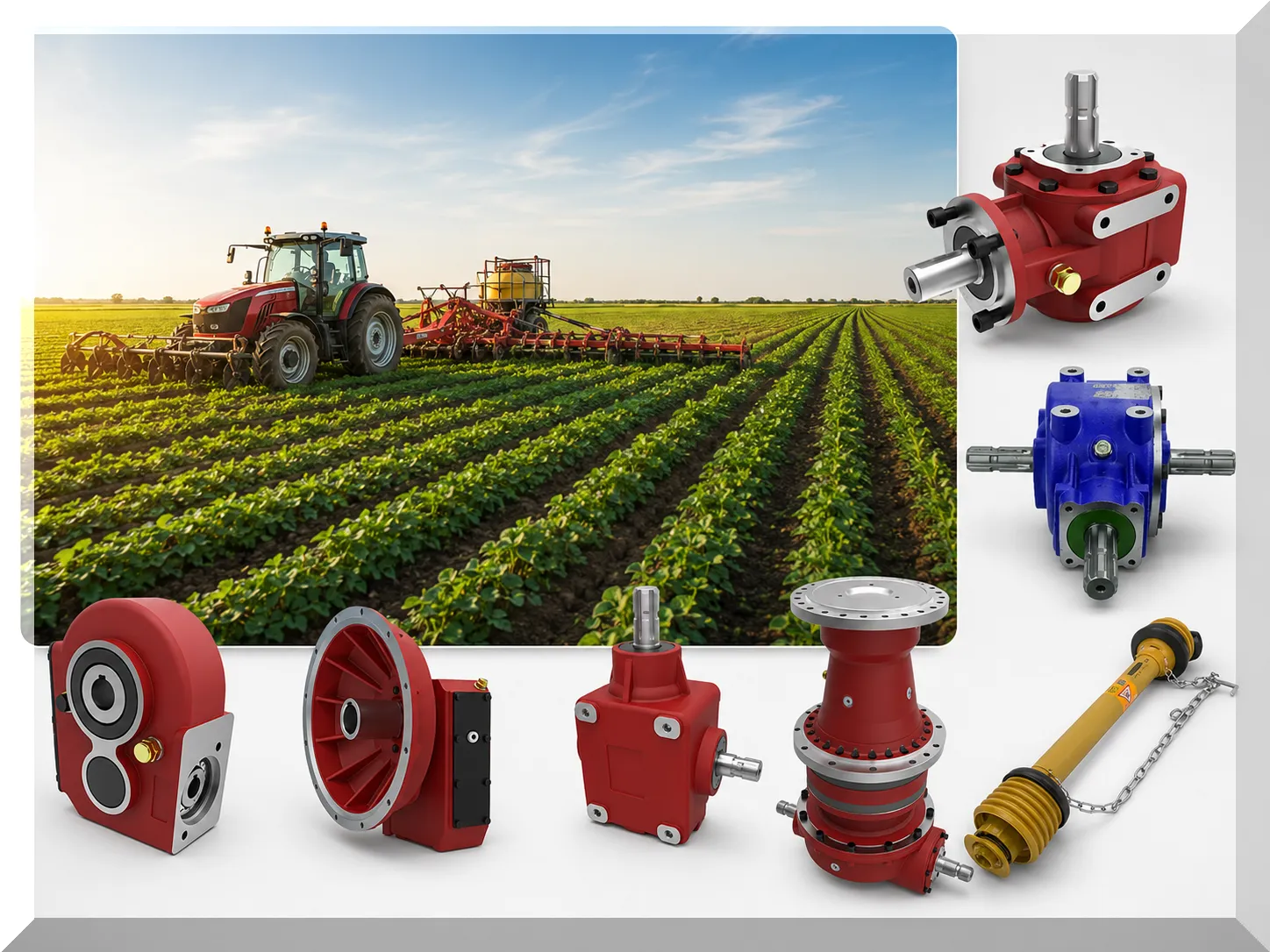
forage production equipment — hay pricing strategy is based on cost of production, quality grade, channel, and current market conditions; producers who know their cost per ton can price confidently above that threshold regardless of informal market pressure

The foundation of hay pricing is knowing your cost of production per ton — the minimum price below which selling does not cover costs. Without this number, pricing becomes a reactive process of accepting what buyers offer rather than confirming it covers costs and generates a return. Calculate cost per ton from your equipment cost, land cost (rental or opportunity cost), seed and fertilizer, and operating cost — any sale below this number generates a net loss regardless of what the market is doing.

Pricing Framework by Channel — Alfalfa Premium Grade Example
Your cost: $140/ton. Never sell below this regardless of pressure.
Elevator price: $180–$200/ton for Premium-grade. This is your floor for non-direct sales — never take less than what the elevator would pay.
Direct retail target: $220–$260/ton. This is achievable when the quality, relationship, and marketing support the premium.
Export (if accessible): $250–$320/ton potential when meeting specification requirements and working through an export aggregator.

The complete pricing guide — including the grade-to-price premium schedule, seasonal price patterns, and the negotiation approach that gets elevator-side price improvement — is in the forage analysis and hay quality testing guide. For custom baling as an additional revenue stream that uses the same equipment and builds buyer relationships simultaneously, see the custom baling service guide. The PTO and gearbox specifications that determine your equipment’s productive capacity in commercial operations are in Especificações dos componentes da caixa de engrenagens e da transmissão da tomada de força (TDF) para uso agrícola.

Building Buyer Relationships That Generate Consistent Revenue

Consistency is the primary buyer value

Buyers who feed livestock have one overriding requirement: consistency. They need to know that each load from your farm will match the last — same moisture range, same quality grade, same bale density and size. A producer who delivers variable quality (Premium one load, Good the next) forces buyers to constantly re-evaluate each load, which erodes the relationship and eventually pushes the buyer to a more consistent alternative even at a slightly higher price. Build consistency deliberately by maintaining strict cutting maturity discipline, consistent baling moisture management, and quality testing of each cutting before marketing.

Communication practices that retain buyers

Proactive communication between loads — alerting buyers when the next cutting will be available, what quality it is testing, and any production limitations — allows buyers to plan their feeding program. Buyers who cannot plan their hay supply because their producer never communicates proactively tend to develop secondary supplier relationships as backup, which eventually erodes the primary relationship. A simple call or text 2–3 weeks before expected harvest availability is enough to maintain relationship priority.

Marketing Tools and Platforms for Hay Sellers

Hay Finder Websites
Hay.com, HayMaker, and state-specific hay listing services allow producers to post available inventory with quality specs, price, and location. These are the first place many horse owners and small farm buyers search. List current inventory immediately after each cutting with the forage test result attached — buyers who see a test result alongside a listing convert to inquiries at 3–4× the rate of listings without test data.
Facebook Marketplace
Facebook Marketplace and local Facebook agricultural groups are highly effective for direct retail hay sales — particularly for horse hay in suburban/rural fringe areas where horse owner density is high. Post with photos of the actual hay (close-up of stem quality, leaf retention, color), the forage test, and a clear price. Photos of the hay itself convert at higher rates than photos of equipment or fields.
Word of mouth and referrals
The most cost-effective marketing for small-volume premium hay is the referral network from satisfied existing customers. Ask every satisfied direct buyer to refer one person who might need hay. A boarding stable that recommends you to their boarders can generate 10–20 direct accounts over 2–3 years. Build the referral network deliberately: ask for it, make it easy, and deliver quality that makes the referral credible.

Hay Marketing FAQs

Should I sell all my hay from one cutting at once, or hold some back?+
Holding inventory to sell later is a price speculation strategy — it only pays when the price you can get later is sufficiently above the current price to cover your storage cost and storage loss risk. In most U.S. hay markets, prices peak in late fall/early winter (November–February) when stored inventory is in demand, and are lowest in summer (June–August) when new crop is flowing. If you have adequate covered storage and low DM loss risk (round bales on gravel pad), holding a portion of premium summer production for fall/winter sale can return $15–$30/ton more than selling immediately. The risk: an unusually good crop year industry-wide can prevent expected seasonal price increases. Hold no more than 30–40% of production as a speculation hedge — sell the remainder immediately for cash flow and storage rotation.
What is the best way to price hay when I don’t have a forage test result yet?+
Wait for the test before setting a final price on premium hay. You can quote a “pending test” price with a confirmed price adjustment clause when the result is returned — this is common practice and accepted by most serious buyers. For livestock market hay where quality variation is less significant to the buyer, the current local market rate is an acceptable starting point. Never price premium alfalfa without a test — you are either leaving money on the table if it tests higher than you assumed, or creating a quality dispute if it tests lower. At $15–$25 per sample, every premium cutting should be tested before marketing.
How do I handle a buyer who consistently tries to renegotiate the agreed price at delivery?+
A buyer who routinely attempts price renegotiation at delivery is a low-value relationship that consumes negotiating energy without compensating for it. The appropriate response: use a written confirmation (text message is sufficient) that documents the agreed price before each delivery, referencing the forage test result that supports the price. At delivery, the written confirmation is your reference point. If a buyer disputes the agreed price at delivery without a legitimate quality-failure basis, deliver once more at the agreed price while identifying an alternative buyer. The third delivery with the same pattern ends the relationship — there are always buyers who honor their commitments. Direct retail buyers who renegotiate are worth addressing directly: “The price we discussed is based on the test result I sent you. If there’s a quality concern with what I delivered, I want to hear it specifically.” Most renegotiation attempts at delivery fold under direct, documented confrontation.
Is it worth traveling further to a better-paying elevator or buyer?+
Calculate the net price after delivery cost: (better buyer’s price) minus (incremental transportation cost per ton). Transportation for round bale hay typically runs $0.12–$0.18 per ton-mile for custom trucking. On a 50-mile further distance, the cost is $6–$9/ton above your local delivery option. If the better buyer pays more than $9/ton above local, the longer haul is worth it. On a 20-ton load, every $5/ton price difference is $100 — worth running the calculation before defaulting to the nearest buyer. Note that the calculation also must include your time value if you are delivering yourself — factor your hourly rate into the travel time component.
What is the most effective way to get my first direct hay customers?+
The fastest path to first direct customers is contact with local horse boarding facilities. Visit or call the managers of 3–5 boarding stables within 20 miles and introduce yourself — explain that you grow premium tested hay and are looking for horse-owner customers. Many stable managers informally recommend hay suppliers to their boarders; getting on that referral list opens 10–30 potential accounts in one conversation. Bring a forage test and a small bale sample to the introduction meeting. If the stable itself buys hay for its resident horses, offer a small trial load at a slight discount to demonstrate quality — once the stable is buying from you, the referral network to individual boarders follows naturally. This approach is more effective than any online listing for a producer starting a direct retail program.
How much of my production should I allocate to each channel?+
A balanced channel mix for a commercial producer (500–2,000 bales per season) typically looks like: 20–30% to established direct retail accounts (highest margin, absorbs the premium-quality cuttings); 50–60% to elevator or contracted buyers (volume clearance at market rates); 10–20% held in storage for late-season spot market or to fill unexpected demand from direct buyers. The optimal mix varies by your local market depth — if you have established horse owner accounts that absorb 50% of production at premium prices, allocate more to that channel. If your region has no strong horse market, direct retail may not be worth pursuing and elevator or contract channels should absorb most of the volume. Build toward the highest-margin channel capacity that your market and management time can support.
foragebaler.com hay equipment — quality documentation, test records, and equipment specifications that support hay marketing to premium buyers

Get Equipment and Quality Guidance for Your Target Hay Market

Tell us your primary target market (horse retail, dairy contract, export, or livestock), your annual production volume, and your current quality grade. We recommend the baler, mower-conditioner, and storage configuration that positions your hay for the highest-value channel your quality and market support.

Get Market Channel Guidance

Editor: Cxm