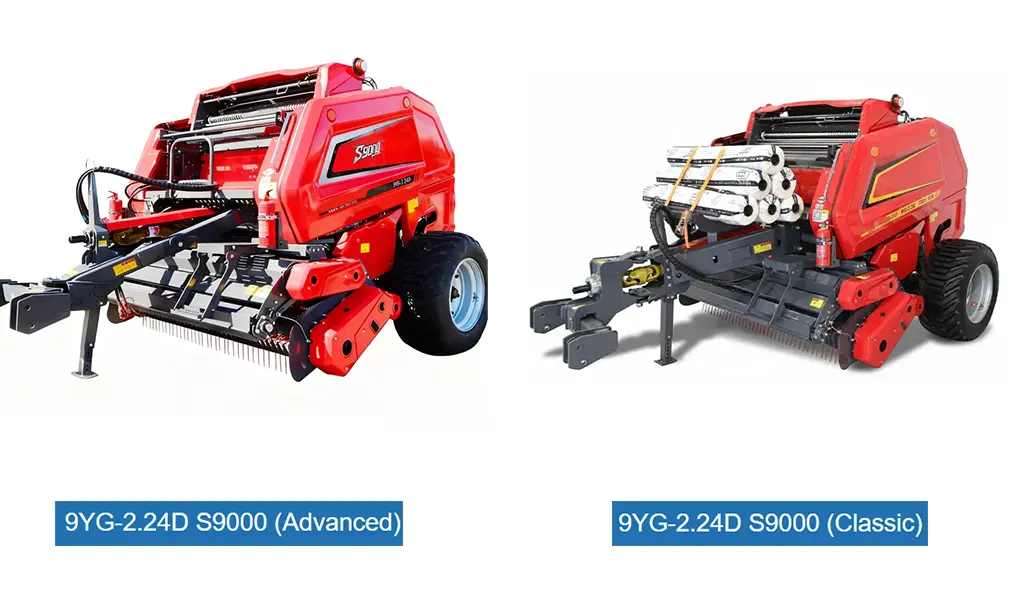
这 圆捆打捆机 investment question is asked on almost every hay operation at some point in its growth trajectory: “At what point does my own machine pay for itself?” The round baler ROI answer is almost always a specific number — a bale count per year at which ownership becomes cheaper than custom rates. But the correct answer is not just cheaper. It also accounts for the scheduling risk, quality consistency, and weather-window independence that custom dependence costs and that the invoice never shows. This guide runs the complete break-even analysis — and adds the numbers that are routinely left out.
Custom Baling vs Owning: The Break-Even Formula
每一个 圆捆打捆机 custom baling vs ownership analysis reduces to a single equation. The complexity lies in accurately estimating its components — particularly the annual ownership cost, which most producers underestimate by excluding depreciation and opportunity cost of capital.
The Break-Even Formula: Annual Bales Needed to Justify Ownership
Break-Even Bales/Year =
Annual Ownership Cost ($)
Custom Rate per Bale – Direct Operating Cost per Bale
Annual Ownership Cost includes:
▸ Machine cost ÷ useful life years
▸ Annual maintenance (belts, bearings, net wrap knife, tines)
▸ Fuel cost (tractor, 0.4–0.8 gal/hr × hrs baling)
▸ Insurance (typically $200–600/yr)
▸ Storage (opportunity cost of shed space)
Direct Operating Cost per Bale includes:
▸ Tractor fuel per bale (~$0.80–1.50)
▸ Net wrap or twine per bale (~$0.50–1.50)
▸ Proportional maintenance per bale
▸ Does NOT include depreciation
(depreciation is in Annual Ownership Cost)
| 年销量 |
Custom Cost
@ $8/bale avg |
Own: 9YG-1.25
~$26k, 15 yr life |
Own: 9YG-1.25A
~$32k, 15 yr life |
决定 |
| 100 bales/yr |
$800/年 |
~$2,900/yr |
~$3,400/yr |
Custom wins — clear |
| 200 bales/yr |
$1,600/yr |
~$2,900/yr |
~$3,400/yr |
Custom still cheaper — evaluate non-financial factors |
| 300 bales/yr |
$2,400/yr |
~$2,900/yr |
~$3,400/yr |
Approaching break-even — Section 179 tips the balance |
| 400 bales/yr |
$3,200/年 |
~$2,900/yr ✔ |
~$3,400/yr ≈ |
9YG-1.25 crosses over |
| 600 bales/yr |
$4,800/yr |
~$2,900/yr ✔ |
~$3,400/yr ✔ |
Ownership clearly wins — both models |
Annual ownership cost calculated as: machine cost ÷ 15 years + $800 maintenance + $400 fuel + $200 insurance = ~$2,900 for 9YG-1.25 / ~$3,400 for 9YG-1.25A. Does not include Section 179 tax benefit (see below). Custom rate of $8/bale is a regional average — verify your local rate.
The Hidden Costs of Custom Baling Dependence: What the Invoice Doesn’t Show
The financial break-even table above counts only the direct cost of custom baling versus ownership. It does not count the non-invoice costs that every operator using custom services accumulates — and that experienced custom-baling operations quietly absorb as “the cost of doing business.” These costs are real and, for some operations, are large enough to change the break-even calculation significantly.
The Custom Baling Cost Iceberg
👁 VISIBLE — On the Invoice
Custom rate per bale ($6–12)
⚠ HIDDEN — Not on Any Invoice
Scheduling Risk
Custom operators serve multiple clients. When your hay is dry and ready on the same day as two larger clients, you wait. Every day of waiting costs 0.5–1.5% of WSC — measurable quality loss from respiration. At $90/ton hay, one extra day costs $10–15/ton across the windrow.
Weather-Window Loss
If the custom operator cannot reach you before a rain event, the entire standing-dry windrow resets. Rain on ready hay can reduce a Grade 1 cutting to Grade 2 or damaged — a $20–40/ton quality reduction on the entire affected acreage.
Quality Variance
Your control over bale density, net wrap tension, and chamber settings is zero when custom baling. The operator adjusts settings for the day’s overall conditions — not for your specific crop moisture and feed program. Bale-to-bale weight variation of 15–25% is typical in custom programs.
Operator Time
Coordinating custom operators — calling ahead, confirming arrival, waiting on-site — typically costs 2–4 hours per cutting event in management time. At $35/hr, that is $70–140 per cutting not tracked on any equipment invoice.
What a Round Baler Actually Costs: Machine, Operating, and Per-Bale Depreciation
这 圆捆打捆机 purchase price is the most visible cost component but not always the largest when viewed over a 15-year ownership period. Annual operating costs — net wrap or twine, belt replacement, bearing kits, PTO shaft service, gearbox oil — accumulate to 2 to 4% of machine cost per year under commercial use. The following table breaks down the true all-in ownership cost for each class in our lineup.
| 模型 |
Machine Cost
(direct factory) |
Est. Annual
Operating Cost |
Depreciation/Bale
(15-yr life) |
收支平衡
Bales/Year* |
| 9YG-1.0C(紧凑型) |
$18k–22k |
$400–600/yr |
@ 150 bales/yr: $8–10 |
~200–250 bales |
| 9YG-1.25 (mid-range) |
$22k–28k |
$600–900/年 |
@ 250 bales/yr: $6–8 |
~350–400 bales |
| 9YG-1.25A (commercial) |
$28k–36k |
$900–1,200/yr |
@ 400 bales/yr: $5–7 |
~450–550 bales |
| 9YG-2.24D (flagship) |
$38k–55k |
$1,500–2,500/yr |
@ 600 bales/yr: $4–6 |
~600–750 bales |
*Break-even bales at $8/bale custom rate; includes all annual ownership costs. Annual operating costs include net wrap ($0.80–1.50/bale amortized), belt/bearing maintenance, and fuel. The PTO驱动齿轮箱 oil change and inspection (every 200 hours) contributes approximately $40–80/year to maintenance costs and should be budgeted as a recurring service item.
Section 179 First-Year Expensing: The IRS Rule That Changes the Numbers
Section 179 of the IRS tax code allows businesses — including farms operating as a business — to deduct the full cost of qualifying equipment in the year of purchase rather than depreciating it over the asset’s useful life. For a profitable hay operation purchasing a 圆捆打捆机 in a year with taxable income, this deduction substantially reduces the effective first-year investment in a round baler.
Section 179 Worked Example — 9YG-1.25A at $32,000
Without Section 179
Purchase price: $32,000
Standard depreciation (MACRS 7-yr): $4,572/yr
Tax benefit year 1 (at 24% rate): –$1,097
Effective first-year cost: $30,903
With Section 179
Purchase price: $32,000
Section 179 deduction year 1: $32,000
Tax saving year 1 (at 24% rate): –$7,680
Effective first-year cost: $24,320
Section 179 saves $6,583 in year one — moving the break-even point from approximately 450 bales/year to approximately 350 bales/year at the same custom rate. This is why operations near the break-even threshold should run the Section 179 calculation before making the custom-vs-own decision. Always consult a qualified tax professional before making equipment investment decisions based on tax deductions — individual eligibility, income requirements, and applicable limits vary.
USDA and State Programs That May Offset Equipment Costs
Several federal programs provide cost-share assistance for farm equipment that serves conservation or rural development objectives. Eligibility is not universal — it depends on your state, USDA service center priorities, and how the equipment use is framed in the application. The following programs are worth investigating before finalizing a purchase decision:
EQIP (NRCS)
The Environmental Quality Incentives Program funds practices that reduce soil erosion, improve water quality, and support grazing management. Hay-making equipment can qualify when it supports a conservation grazing or crop management plan. Cost-share rates typically 50 to 75%. Apply through your local USDA Natural Resources Conservation Service office.
FSA Farm Service Agency Loans
USDA Farm Service Agency provides below-market-rate direct and guaranteed farm operating loans that cover equipment purchases. Rates are typically 1 to 2 percentage points below commercial agricultural loan rates. Beginning farmer loan programs have additional benefits including lower down payment requirements.
State Agriculture Programs
Many U.S. states have their own beginning farmer, equipment financing, or agricultural development programs with cost-share or below-market financing. Programs in Wisconsin, Minnesota, and New York specifically target hay equipment in their dairy support programs. Contact your state’s department of agriculture for current program availability.
Program availability changes annually. USDA funding allocations, sign-up windows, and program priorities shift with Congressional appropriations and USDA administrative decisions. Contact your local USDA service center in the spring before the equipment purchase season to confirm current program availability and application deadlines.
The Break-Even Threshold: What It Looks Like for Four Operation Types
这 round baler ROI break-even threshold in the formula above is not a single number — it is different for every operation type because the custom baling rate, hay market value, and what’s at stake during quality and scheduling losses all differ. The four operation profiles below represent the most common U.S. hay production contexts:
🐄
Dairy Alfalfa Operation
Feed use, 3+ cuts, premium grade
Break-even: 100–150 bales/year
Why lower: Premium RFV hay worth $90–120/ton. Any quality variance from custom baling or weather-window loss translates to feed performance difference measurable in milk production — the hidden cost is very high relative to machine cost.
Recommended: 9YG-1.25 or 9YG-1.25A — quality control through owned equipment pays faster than the formula indicates.
🌾
Dryland Hay Resale
Commodity market, 1–2 cuts, flat pricing
Break-even: 300–450 bales/year
Why higher: Lower hay value ($40–65/ton) means scheduling and quality losses have less dollar impact. The pure financial math is less favorable than dairy programs. Section 179 and direct factory pricing both shift this threshold lower.
Recommended: 9YG-1.0C or 9YG-1.25 — match machine class to annual bale volume carefully.
🚜
Custom Contractor
Service-based revenue, multi-client
Break-even: Driven by billable days, not own acres
Framework: Machine cost ÷ billable days needed to recover investment. At $800/day custom rate and 60 billable days, a $32,000 baler pays for itself in the first season. Machine utilization is the primary variable.
Recommended: 9YG-1.25A or 9YG-2.24D — higher daily output = more billable days per season.
🐂
Cow-Calf Ranch
Own feed use, winter hay program
Break-even: 200–350 bales/year
Why this range: Hay is valued at replacement cost (what you’d pay to buy equivalent feed). Ranches with limited local custom availability often pay a premium for scheduling priority — which makes the effective custom rate higher than the posted rate.
Recommended: 9YG-1.25 — capable, affordable, and paired well with the single-tractor ranching workflow.
How Direct Factory Pricing Changes the Break-Even Math
The break-even tables above use direct factory pricing from foragebaler.com. The same machine through a dealer network would typically cost 15 to 25 percent more — a difference that directly extends the break-even timeline by 30 to 50 bales per year at the same operating assumptions.
9YG-1.25A Through Dealer
$38,000–40,000
MSRP + dealer margin (18–22%)
Break-even: ~530–580 bales/yr
Section 179 savings: $9,120–9,600
9YG-1.25A Direct from foragebaler.com
$28,000–32,000
Factory cost + U.S. logistics only
Break-even: ~430–470 bales/yr
Section 179 savings: $6,720–7,680
这 圆捆打捆机 pricing difference is not exclusive to the purchase transaction — it also affects every parts order for the life of the machine. Our direct factory pricing policy applies to replacement belts, bearing kits, net wrap knives, and PTO shaft components — typically 10 to 18 percent below dealer parts pricing on equivalent components for the same models in our 圆捆打捆机系列.
Frequently Asked Questions: Round Baler Investment Analysis
What useful life should I use for my round baler in depreciation calculations?+
对于 圆捆打捆机 financial break-even model, using 15 years is a reasonable working assumption for a mid-range baler operated at 300 to 500 bales per year and maintained to the seasonal service checklist. The IRS MACRS classification puts most farm machinery on a 5 to 7-year depreciation schedule for tax purposes, which is considerably shorter than actual mechanical useful life — this gap is what makes Section 179 immediate expensing valuable. Mechanically, well-maintained belt-chamber balers regularly exceed 20 years in commercial service; the actual physical useful life is typically longer than the accounting useful life. Use 15 years for break-even modeling and 7 years for tax calculations — or the actual depreciation schedule your accountant specifies.
Should I buy a used round baler instead of new to reduce the investment?+
A used baler can reduce the initial capital investment but changes the risk profile and maintenance cost projection substantially. A 5-year-old commercial baler at 2,000+ operating hours needs belt replacement, bearing inspection, and PTO shaft assessment before the first season of use — costs that should be modeled into the break-even calculation. The advantage of a new, direct-from-factory baler is the known starting condition, the full parts support, and the warranty period. For operations in the 200 to 400 bale per year range that are borderline on the break-even threshold, a properly priced used baler at 40 to 50% of new cost can shift the equation — but only if the actual repair cost at purchase is honestly assessed and included in the ownership cost model.
Can I increase baler utilization by doing custom work for neighbors to reach break-even faster?+
Yes — adding custom baling revenue from your 圆捆打捆机 to your own-use volume is one of the most effective ways to accelerate break-even for an operation that is borderline on the financial threshold. At $7 to $8 per bale custom revenue, each 100 bales of custom work adds $700 to $800 toward annual machine cost recovery, reducing the effective ownership cost per own-use bale. The practical constraint is scheduling: your own harvest takes priority, and custom work should be booked for periods when your own fields are either not ready or already complete. Starting with 1 to 3 neighboring operations in the first season keeps the workload manageable while generating revenue to accelerate break-even. As reputation for reliability and bale quality builds, demand typically grows — custom baling often becomes a stable revenue stream rather than a break-even accelerator within 3 to 5 seasons.
What is the resale value of a well-maintained round baler after 10–15 years?+
A well-maintained mid-range baler (equivalent to 9YG-1.25A class) after 10 years of commercial use typically retains 20 to 35% of original purchase value if belts, bearings, and PTO shaft have been kept to service schedule, the frame shows no structural repairs, and bale count is under 8,000 to 10,000 bales. Using 25% as a residual value in the break-even model reduces the effective depreciation per year by approximately 25% of machine cost ÷ life years — a meaningful improvement to the ownership cost calculation. Our factory documentation package includes production test records and serial number traceability that support resale value by providing an auditable service history — buyers of second-market equipment consistently pay premiums for machines with documented maintenance histories.
How should I think about the investment if I’m planning to expand acreage in the next 3–5 years?+
Buy a 圆捆打捆机 for the projected acreage 3 to 5 years from now, not the current acreage. A baler that is technically “too large” for today’s operation at 200 bales per year but correctly sized for your 5-year projection of 450 bales per year will operate at below-rated productivity for the first 2 to 3 seasons, then cross the break-even threshold as volume grows. Buying the smaller baler that is “just right” today means buying a second baler in 5 years — incurring two sets of purchase, transaction, and learning costs instead of one. The one exception is if financing is the binding constraint: in that case, the smaller correct-for-today machine with a clear upgrade path at year 5 is preferable to an ownership cost that generates financial stress in years 1 to 3 when volume is still building.
Can foragebaler.com provide a customized break-even analysis for my specific operation?+
Yes — our U.S. team runs operation-specific break-even calculations as part of the pre-order consultation for any buyer who provides their annual bale volume, current custom rate, crop type, and approximate tax bracket. We have run this calculation for hundreds of operations across the Great Plains, Midwest, and Northeast and can typically provide a complete own-vs-custom comparison within one business day of receiving the inputs. We do not provide tax advice — the Section 179 component of the analysis is presented as an illustrative example, and we recommend buyers confirm the tax treatment with their accountant before making the purchase decision. Contact us through the form below with your operation parameters and we will provide the analysis at no cost or obligation.
Round Baler Investment — Direct Factory Pricing
Tell Us Your Annual Bales, Custom Rate, and Tractor — We Build the Break-Even in One Day
Round baler ROI and operation-specific break-even analysis at no cost or obligation. Direct factory pricing — no dealer markup on any model in the lineup. Section 179 illustration included. Parts pricing confirmed for the full ownership period. Same-day dispatch on all replacement components from the California warehouse.
✔ Break-Even Analysis
Your numbers, not averages
✔ 工厂直销价
所有车型均不设经销商利润
✔ Section 179 Example
Illustrative tax saving shown
Request a Custom Quote
编辑:Cxm