Baler Decision Guide

Round Baler vs Large Square Baler: A Complete Comparison for Operations Ready to Scale

round baler vs square baler format decision is a market channel decision before it is an equipment decision. Get the market wrong and even the best baler produces the wrong product. This guide runs the full comparison — market fit, field productivity, capital cost, and storage — so you can decide which format fits your program.

Discuss Which Format Fits Your Program

round baler vs square baler question surfaces on every large hay operation on every large hay operation at some point — usually when the annual volume grows to the point where the current format becomes a bottleneck or when a new market opportunity requires a different bale shape. The answer is not universal. It depends on where your hay sells, how far you transport it, how you store it, and what your operation’s capital position can support. This round baler vs square baler guide works through all four factors so you can make the decision based on your program, not general advice.

Why Bale Shape Is a Market Decision Before It Is an Equipment Decision

round baler vs square baler comparison — bale format market channel selection for dairy export retail and silage

The bale format — round or large square — determines which markets are open to you. Some channels require large square bales as a condition of purchase; others use round bales exclusively. Understanding this market structure before buying a baler prevents the most expensive mistake in the baler decision process: producing the right quality hay in the wrong format for your intended buyer.

Bale Format vs Market Channel Compatibility
Market Channel Round Bale Large Square (3×3, 3×4) 笔记
Dairy farm TMR ration Large dairy TMR operations prefer square for mixer wagon loading consistency; small dairies accept round
Export hay (Japan, Korea, Middle East) Export buyers specify large square bales exclusively — container packing efficiency requires rectangular geometry
Retail bale / feed store Feed stores typically sell round bales for cattle and horse retail; large squares require mechanical handling at point of sale
Silage / wrapped haylage Round bale silage wrapping is faster and more accessible; large square silage requires tube or bunker — different infrastructure
Cow-calf ranch own-use Both work well for on-farm beef feeding; round bale lower equipment investment; large square feeds out faster with less waste
Custom baling service Custom market demand for round baler service significantly exceeds square baler service in most U.S. regions — lower capital barrier means more operators
✔ Compatible    ⚠ Partial/conditional    ✘ Not compatible. Verify your specific buyer’s format requirement before purchasing. Export buyer specifications in particular are non-negotiable.

Bale Density, Weight, and Transport Efficiency: The Geometry Difference

A standard round bale at 1.25 m diameter and 1.25 m length has a volume of approximately 1.53 m³ and weighs 200 to 700 kg depending on crop type and baler tension settings. A standard large square bale (1.2×1.3×2.4 m) has a volume of 3.74 m³ and weighs 450 to 900 kg. The density comparison between the formats is closer than the weight difference suggests — what differs significantly is how they pack into transport vehicles.

48-Foot Flatbed Trailer — Bale Count Comparison (Top-Down View)
Round Bales (1.25 m diameter)

~12 bales single layer
Voids between circles: ~21% trailer space unused
Payload: ~4,800–8,400 kg (variable bale weight)
🔴 Lower packing efficiency

Large Square Bales (1.2×2.4 m)

~8 bales single layer
Zero void space — rectangles tile perfectly
Payload: ~3,600–7,200 kg (consistent bale weight)
🟢 Maximum packing efficiency

Diagram is illustrative. Actual bale count varies with trailer length, bale size, and transport regulations. Round bales are typically stacked 2 layers high when permitted, doubling the per-load payload — but adding height compliance considerations.

Field Productivity: Where Each Format Wins and Where It Loses

round baler field productivity vs square baler — throughput cycles per hour and harvest window comparison

Round baler vs square baler field productivity comparisons often focus on bales per hour — a number that favors large square balers on high-volume grass programs, where the larger bale size produces fewer bale cycles per ton of hay. The more complete productivity comparison includes: bale cycle time, tying and wrapping time per bale, harvest weather-window flexibility, and the time from bale completion to when the field is clear for the next pass.

Round Baler — Productivity Profile
Faster bale cycle: 2–4 minutes per bale including ejection
Net wrap cycle: 30–90 seconds — minimal field stop time
Bale ejection automatic — no operator action needed
Silage wrapping: inline combo seals bale within 4 minutes of formation
Lower tons per bale cycle — more bales per ton vs large square
Individual bale handling required to load transport
Large Square Baler — Productivity Profile
Higher tons per bale cycle — fewer cycles per field pass
Consistent bale weight (tight weight tolerance)
Automatic accumulator stack — fewer individual handling events
Bale cycle: 4–8 minutes including twine/net and plunger reset
Higher minimum HP requirement (80–120+ HP typically)
Silage application impractical — requires tube-wrapping or bunker

Capital Cost and Operating Cost: 10-Year Ownership Comparison

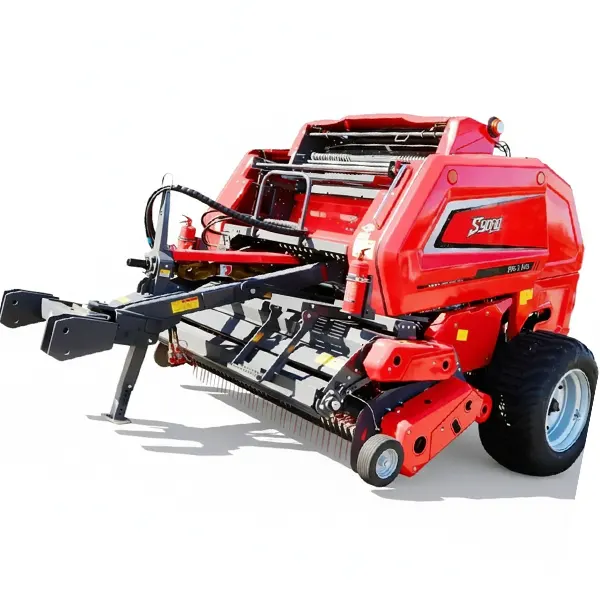
large square baler comparison on capital cost shows a significant entry point difference. A new large square baler (3×3 class) — which relies on a high-torque 农业驱动变速箱 for the plunger mechanism — starts at $60,000 to $90,000 from major OEM brands; flagship models run $100,000 to $130,000. Our round baler lineup starts at $18,000 for the 9YG-1.0C compact and reaches $38,000 to $55,000 for the commercial 9YG-2.24D.

Cost Component 圆捆打捆机
9YG-1.25A at $32k
Large Square Baler
Entry-level at $70k
Machine cost ÷ 15-year life $2,133/yr $4,667/yr
Annual maintenance $800–1,200/yr $2,000–3,500/yr
Tractor fuel per season (500 bales) $600–900/yr $1,000–1,600/yr
Binding material (net/twine) $400–650/yr $600–1,000/yr
Total annual ownership cost $3,933–5,083/yr $8,267–10,767/yr
Cost per ton at 500 bales/yr × 280 kg $28–36/ton $59–77/ton

Large square baler maintenance cost is higher due to plunger mechanism complexity, knotter system service, and higher HP tractor fuel consumption. Round baler cost-per-ton advantage narrows as annual volume increases, since large square balers produce more tons per operating hour at high volume.

Storage: Where Round Bales Win and Where Square Bales Win

round bale vs square bale outdoor storage comparison — DM loss stackability and covered storage geometry

Round baler vs square baler outdoor storage DM losses differ primarily because of geometry. A round bale’s curved surface naturally sheds precipitation; the top surface of a large square bale is flat, allowing rain to pond on the upper face and wick into the bale interior. In humid-climate outdoor storage conditions, large square bales typically show 8 to 18% DM loss compared to 6 to 14% for net-wrapped round bales on the same site. In covered storage (barn or shed), both formats perform similarly — the geometry difference disappears under a roof.

Round Bale Storage Advantages

✔ Curved surface sheds rain — lower outdoor DM loss
✔ Silage wrapping compatible — integrated baler-wrapper
✔ No equipment needed to stack outdoors — single layer, end-to-end
✔ Lower capital investment in storage infrastructure

Large Square Bale Storage Advantages

✔ Stacks 3–4 high in barn — maximum covered storage density
✔ Precise rectangular geometry enables tight covered storage packing
✔ Consistent bale weight simplifies feed budgeting and inventory
✔ Standard forklift-compatible in some facilities

Our Recommendation: When the Round Baler Format Is the Right Answer

round baler recommendation and pricing — when round baler beats large square baler for your operation

Based on the market, productivity, cost, and storage analysis above, the round baler is the correct format choice for these specific scenarios:

  • Silage and haylage programs — round baler silage with an inline wrapper delivers the fastest bale-to-sealed cycle available; large square silage requires different infrastructure entirely.
  • Operations below 600 bales per year — the cost-per-ton advantage of the round baler is clear at this volume; large square balers require higher annual throughput to justify their capital and maintenance premium.
  • Retail, feed store, and cow-calf ranch markets — these buyers use round bales and pay the same price per ton regardless of bale shape.
  • Custom baling service operations — round baler service demand far exceeds square baler demand in most U.S. regions; lower capital investment means faster break-even.
  • Outdoor storage programs — net-wrapped round bales consistently outperform large square bales in outdoor DM preservation in humid climates.

Our full round baler models and pricing page shows the complete lineup from 9YG-1.0C compact to 9YG-2.24D commercial class, with specifications to match the right model to your volume and market channel.

Frequently Asked Questions: Round Baler vs Square Baler

Can I sell round bales to a dairy that currently uses large square?+
Possibly — it depends on the specific dairy’s TMR mixer wagon configuration. Large commercial TMR mixer wagons designed for large square bales require the square format to load efficiently from the throat of the wagon. However, many mid-size dairies use vertical auger mixers or tub-style grinders that accept round bales with a cradle attachment. The question to ask the dairy: “What is your current mixer wagon model, and is it compatible with 1.25 m diameter round bales?” If they use a Patz, Supreme, or similar vertical mixer, round bales are typically compatible. If they use a Roto-Mix or Keenan horizontal ribbon mixer, they require square bales.
Is there a meaningful hay quality difference between round and large square bales?+
When both formats are baled from the same windrow at the same moisture and stored under the same conditions, there is no inherent quality difference between round and large square bales at the time of baling. Quality differences emerge in storage: round bales in outdoor conditions typically preserve DM better due to their curved rain-shedding geometry. Large square bales in covered storage achieve equivalent DM preservation. The quality difference that buyers sometimes observe between formats is almost always a storage and handling difference, not a baling difference.
What tractor HP is required for each format?+
Round balers in our lineup require 25 kW (34 HP) at the compact end (9YG-1.0C) up to 55 to 75 kW (74 to 100 HP) for the commercial 9YG-2.24D. Most new large square balers (3×3 class) specify 80 to 110 kW (108 to 148 HP) continuous PTO output — a significant tractor investment that adds to the total capital cost of the large square format if your current tractor is undersized. Factor the tractor HP requirement into the total capital comparison, not just the baler purchase price.
At what annual volume does the large square format become more cost-efficient?+
round baler vs square baler crossover point where large square cost-per-ton falls below round baler cost-per-ton depends heavily on the hay value, local custom baling rate, and tractor fuel costs — but as a general benchmark, operations producing above 1,500 round baler vs square baler equivalent bales (approximately 420 tons at 280 kg per bale) per year begin to see large square economics become competitive on pure operating cost. Below that volume, the round baler’s lower capital cost and maintenance burden almost always results in a lower cost-per-ton. Operations at 800 to 1,500 bales per year are in the transitional range where both formats can be justified — market channel usually becomes the deciding factor at this scale.
Can I run both formats if I have two market channels?+
Yes, and for operations with both a local cow-calf retail market and an export channel opportunity, running a round baler for local/silage production and contracting out large square production for export-grade hay is a common and logical split. The capital cost of maintaining two baler formats in-house is rarely justified below 800 total bales per year across both formats. A better approach: own the round baler (lower capital, more flexible use), and custom-bale the export-format hay through a neighboring operation that already has the large square infrastructure. This approach keeps your capital in the lower-risk round format while accessing the export market without the $60,000+ square baler investment.
Which format has lower maintenance complexity?+
Round balers are significantly simpler mechanically. The primary service items are belt replacement, bearing inspection, and net wrap knife maintenance — all accessible to a mechanically capable operator with standard tools. Large square balers add the knotter mechanism (the most mechanically complex component in any hay equipment category), plunger drive system, and needle timing — all of which require specialized knowledge and tools to service correctly. The knotter system in particular is a major source of both downtime and repair cost on large square balers; incorrect timing or damaged twine components cause missed ties that result in unbaled material in the field. Most round baler repairs can be completed by a general farm mechanic; most knotter repairs require either a specialized technician or significant operator training.

Discuss Which Baler Format Fits Your Program

foragebaler.com round baler vs square baler consultation — U.S. direct factory pricing for round baler lineup

Round Baler Lineup — Direct Factory Pricing

Tell Us Your Market Channel, Annual Volume, and Tractor HP — We Confirm the Right Format and Model

Round baler lineup from compact 9YG-1.0C to commercial 9YG-2.24D, all at direct factory pricing from our California warehouse. Market channel analysis and baler model matching at no cost or obligation.

✔ 5 Round Baler Models
Compact to commercial class
✔ Direct Factory Price
No dealer margin on any model
✔ Format Consultation
Market channel + volume matched

Discuss Which Format Fits Your Program

编辑:Cxm