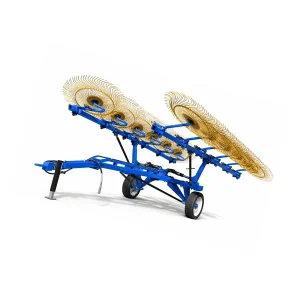
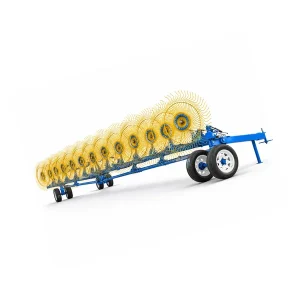
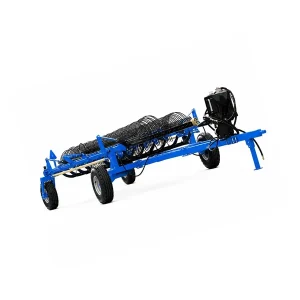
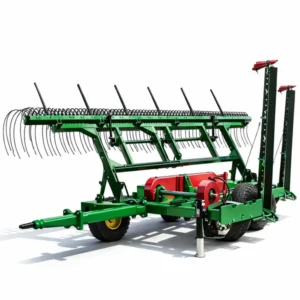
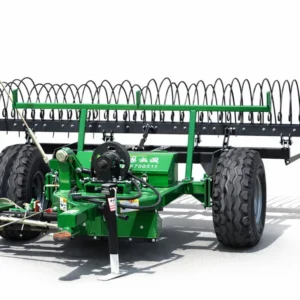
9LZY-9.0 फिंगर व्हील हे रेक | 15-व्हील वी-रेक 9 मी
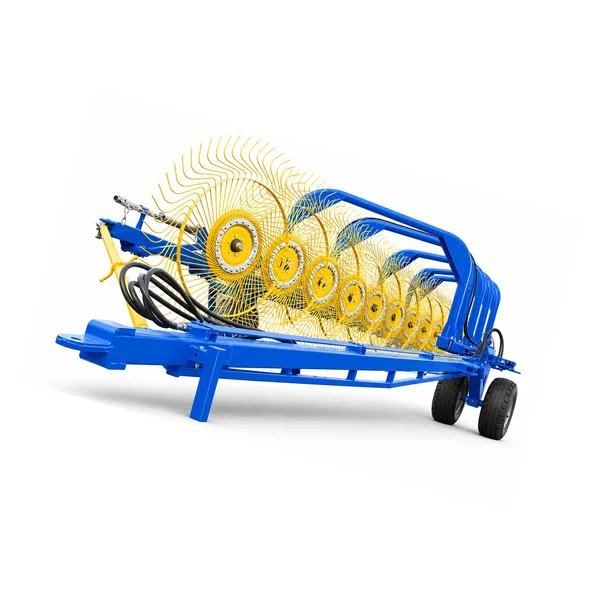
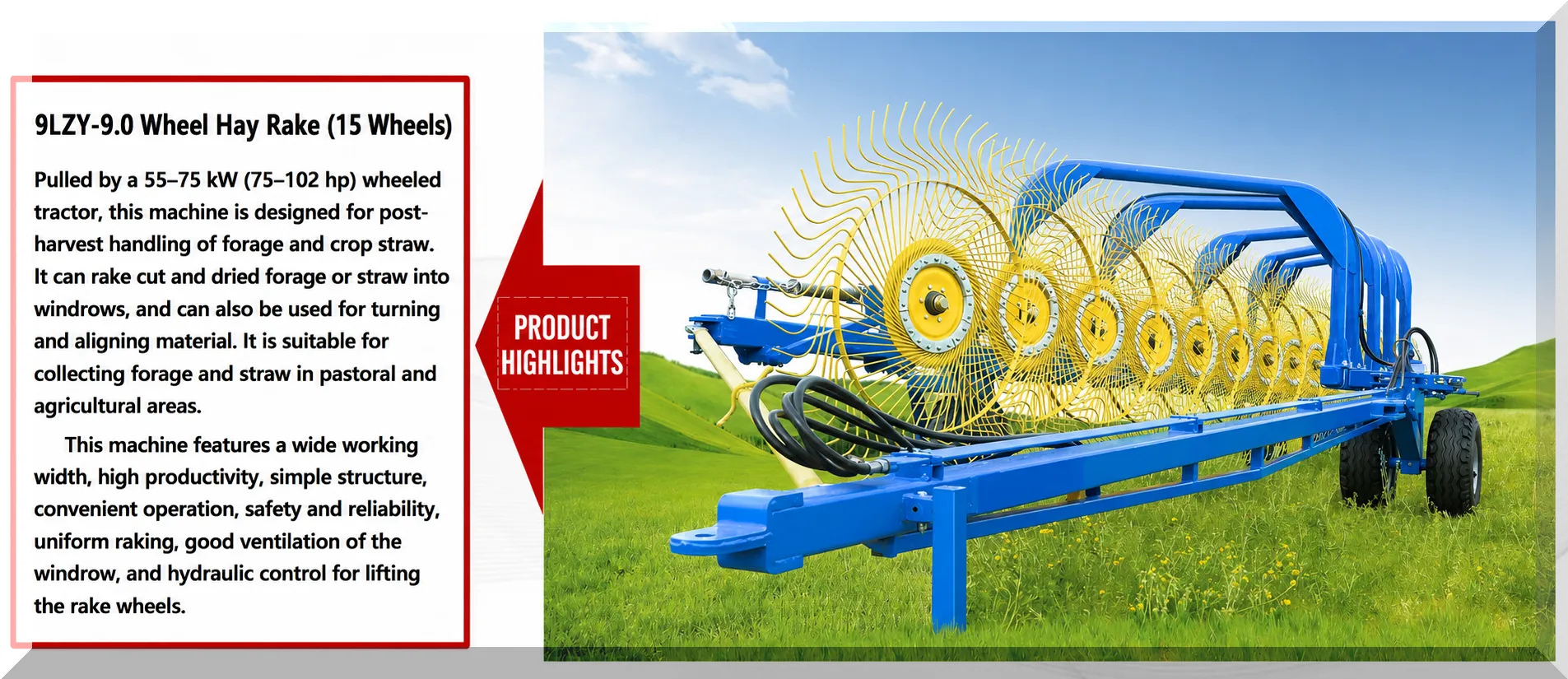
The 9LZY-9.0 finger wheel hay rake is a 15-disc towed घास का रेक that covers 9.0 meters in a single pass with 900 spring tines across 15 independently floating discs. The tractor power requirement of 50–55 kW (≈68–75 HP) and peak productivity of 7.2 to 9.0 hectares per hour place this machine at the commercial center of the rake family — the right specification for 300 to 700 hectare annual forage programs where consistent 9-meter working width is needed without the capital cost and maintenance complexity of a 17-wheel dense-coverage design. No PTO shaft. One drawbar connection. Discs driven entirely by ground contact.
Where the 9LZY-9.0 Sits in Our Finger Wheel Rake Family
Most घास का रेक buyers start the selection process at the wrong place — they look at specs first, rather than identifying which machine class the operation actually needs. The three-model comparison below starts that conversation correctly: 9 meters wide is available in two configurations (15 or 17 discs), and choosing between these उंगली पहिया घास रेक options is not about spending more for better but about matching disc density to actual field conditions.
तकनीकी निर्देश
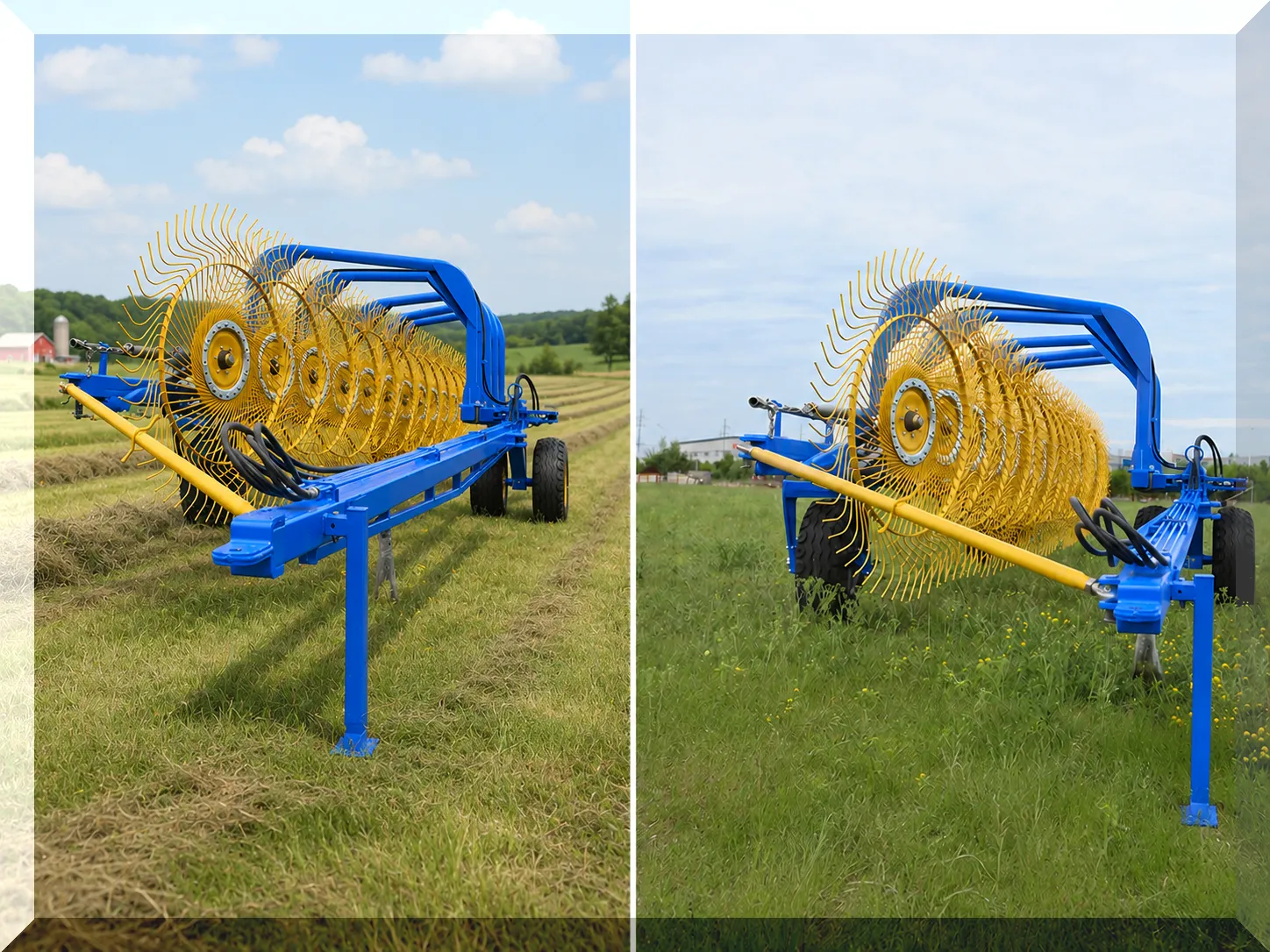
All values are factory-rated. The 9LZY-9.0 hay rake requires only a drawbar hitch and standard tractor hydraulics for lift/lower control. No PTO shaft required — all 15 discs spin from ground contact. No electrical harness beyond optional lighting.
| नहीं। | पैरामीटर | इकाई | कीमत |
|---|---|---|---|
| 1 | नमूना | / | 9LZY-9.0 |
| 2 | हिच टाइप | / | ड्रॉबार (टो किया हुआ) |
| 3 | ड्राइव प्रकार | / | ग्राउंड-ड्रिवन — पीटीओ की आवश्यकता नहीं है |
| 4 | कार्य चौड़ाई | मीटर (फीट) | 9.0 (29.5 फीट) |
| 5 | डिस्क (पहिया) मात्रा | पीसी | 15 |
| 6 | प्रति डिस्क स्प्रिंग टाइन | पीसी | 60 |
| 7 | कुल स्प्रिंग टाइन | पीसी | 900 |
| 8 | विंडरो चौड़ाई | एम (में) | 0.8–1.2 (31.5–47.2 in) |
| 9 | आवश्यक ट्रैक्टर शक्ति | किलोवाट (एचपी) | 50–55 (≈ 68–75 HP) |
| 10 | कार्य गति | किमी/घंटा (मील प्रति घंटा) | 7–12 (4.3–7.5 मील प्रति घंटा) |
| 11 | उत्पादकता | हेक्टेयर/घंटा (एकड़/घंटा) | 7.2–9.0 (17.8–22.2 ac/hr) |
| 12 | रेकिंग हानि दर | % | ≤ 2 |
| 13 | मशीन वजन | किलोग्राम (पाउंड) | 1,100 (2,425 पाउंड) |
Commercial Capacity Planning: Annual Program vs Machine Hours
Understanding how the 9LZY-9.0 finger wheel rake's productivity spec translates into your actual annual program — total machine hours per year, days per cutting, working days needed across the full season — is what converts a specification sheet into an operational decision. The table below uses a conservative 7.5 ha/hr mid-range rate (between the 7.2 minimum and 9.0 peak) to give realistic planning numbers.
| वार्षिक कार्यक्रम | Cuttings/yr | Total Raking Area/yr | Machine Hours/yr | Working Days/yr (@ 8 hr/day) |
Operator Note |
|---|---|---|---|---|---|
| 200 ha farm, alfalfa | 3 | 600 ha | 80 hr/yr | ~10 days/yr | Light utilization — single rake handles the program with time to spare; no pressure on weather windows |
| 400 ha farm, mixed grass | 3 | 1,200 ha | 160 hr/yr | ~20 days/yr | Comfortable commercial pace. One rake sufficient; second unit becomes valuable if weather risk tightens the window below 3 days/cutting |
| 500 ha farm, alfalfa + grass | 3 | 1,500 ha | 200 hr/yr | ~25 days/yr | Full commercial program — primary rake plus a backup unit is strongly recommended for weather-window-sensitive regions |
| 700 ha farm, commercial hay | 2–3 | 1,400–2,100 ha | 187–280 hr/yr | ~23–35 days/yr | Upper end of single-unit operation. Two 9LZY-9.0 units running parallel allows each cutting window to be cleared in 10–12 days rather than 20–25, substantially reducing weather risk |
V-Rake Windrow Geometry: Why the V-Configuration Produces a Better Windrow Than Side-Delivery Rakes
The 9LZY-9.0 hay rake is a V-rake — the two banks of discs are angled in a V-pattern, with the open end facing forward and the discharge point of the V centered behind the machine. Both disc banks sweep inward toward the center, depositing hay into a single, centered windrow along the machine's track. This geometry differs fundamentally from side-delivery rakes (which deposit the windrow to one side) in three ways that matter for downstream baling efficiency.
📐 Windrow Centered on Tractor Track
A centered windrow allows the baler operator to drive directly over the windrow center on every pass without steering correction for windrow offset. On a 9-meter raking swath, the baler follows the exact center track of the rake — no systematic accumulation of offset error across hundreds of passes in a large field. Side-delivery rakes require the baler operator to align with a windrow deposited approximately 2 to 4 meters to one side of the rake's center track, requiring constant minor offset adjustment.
⚖️ Symmetric Windrow Profile
Both disc banks sweep equal areas of the cut swath toward the center. The resulting windrow receives equal material from both sides, producing a symmetrical cross-section rather than the lopsided profile that side-delivery designs create when one side's material is folded over the other. Symmetric windrow profile improves bale density consistency — the baler chamber fills symmetrically across the pickup width, which produces rounder bales with more even density distribution across the bale cross-section.
🔄 Natural Merging of Adjacent Swaths
At 9 meters working width, the 9LZY-9.0 passes can be overlapped by approximately 0.5 to 1 meter on each side to naturally merge adjacent pass windrows into a double-width row. This merging produces a heavier windrow that is more efficient for commercial balers working at high volume — the baler spends less time turning and more time baling. Double-windrow formation on a 9-meter V-rake effectively doubles the load per baler pass from a standard windrow, which translates to fewer baler passes per hectare and faster total field clearance.
Disc Spacing and Forage Density: Why 600 mm Spacing Is the Right Spec for Most Operations
The 9LZY-9.0 hay rake's 15 discs across 9.0 meters of working width produce an average disc-to-disc center spacing of approximately 600 mm. This spacing is not arbitrary — it represents the design optimum for the forage density range that the large majority of commercial U.S. hay operations produce: 3 to 6 tonnes of dry matter per hectare per cutting on alfalfa, and 2 to 4 tonnes on commercial grass programs.
The 600 mm disc spacing means that each disc is responsible for a 600 mm column of cut forage as the machine passes. At typical commercial hay densities (3 to 5 t/ha dry matter), this column contains approximately 180 to 300 grams of dry crop material per meter of forward travel — a volume that the 60-tine disc handles cleanly without the tines bridging over dense mat sections or allowing material to pass between discs untouched. At forage densities above 6 to 8 t/ha (the upper end of exceptional-yield irrigated alfalfa first cuttings), the 600 mm spacing approaches its practical limit — which is precisely where the 17-disc 9LZD-9.0's 530 mm spacing provides measurable benefit.
| Crop / Condition | Typical DM Yield (t/ha/cut) | 9LZY-9.0 (15-disc) | Recommended Speed | नोट्स |
|---|---|---|---|---|
| Grass hay (mixed, dryland) | 1.5–3.5 | उत्कृष्ट | 10–12 km/h | Light crop, high ground speed, maximum daily output. Ideal 9LZY-9.0 application. |
| Alfalfa, 2nd+ cut (standard) | 3.0–5.0 | उत्कृष्ट | 9–11 km/h | Core commercial application. 600 mm spacing handles the mat cleanly without bridging. |
| Alfalfa, 1st cut (irrigated) | 5.0–7.0 | अच्छा | 8–10 किमी/घंटा | Heavy mat — reduce speed. Good performance; 9LZD-9.0 provides marginal advantage above 6.5 t/ha. |
| Dense native grass (CRP, cool-season) | 2.0–4.5 | उत्कृष्ट | 9–11 km/h | Mat is typically lower density; 9LZY-9.0 well-suited for this crop type. |
| Ryegrass / oat hay | 3.5–6.0 | अच्छा | 8–11 km/h | Tall stemmy crops; reduce speed in dense sections. Long stems can occasionally wrap on lower-speed passes — maintain 8 km/h minimum. |
| Straw / cereal residue | 2.0–4.0 | उत्कृष्ट | 10–12 km/h | Light, brittle material. High speed, low tine load, maximum productivity. Ideal application for straw windrowing. |
How It Works: Ground-Driven Finger-Disc Raking Explained
The 9LZY-9.0 finger wheel rake operates on a fully mechanical principle with no PTO connection at any point in the operating cycle. The physics of the system are straightforward but worth understanding, because they directly explain both the machine's performance characteristics and its maintenance simplicity.
Ground Contact and Free-Spinning Rotation
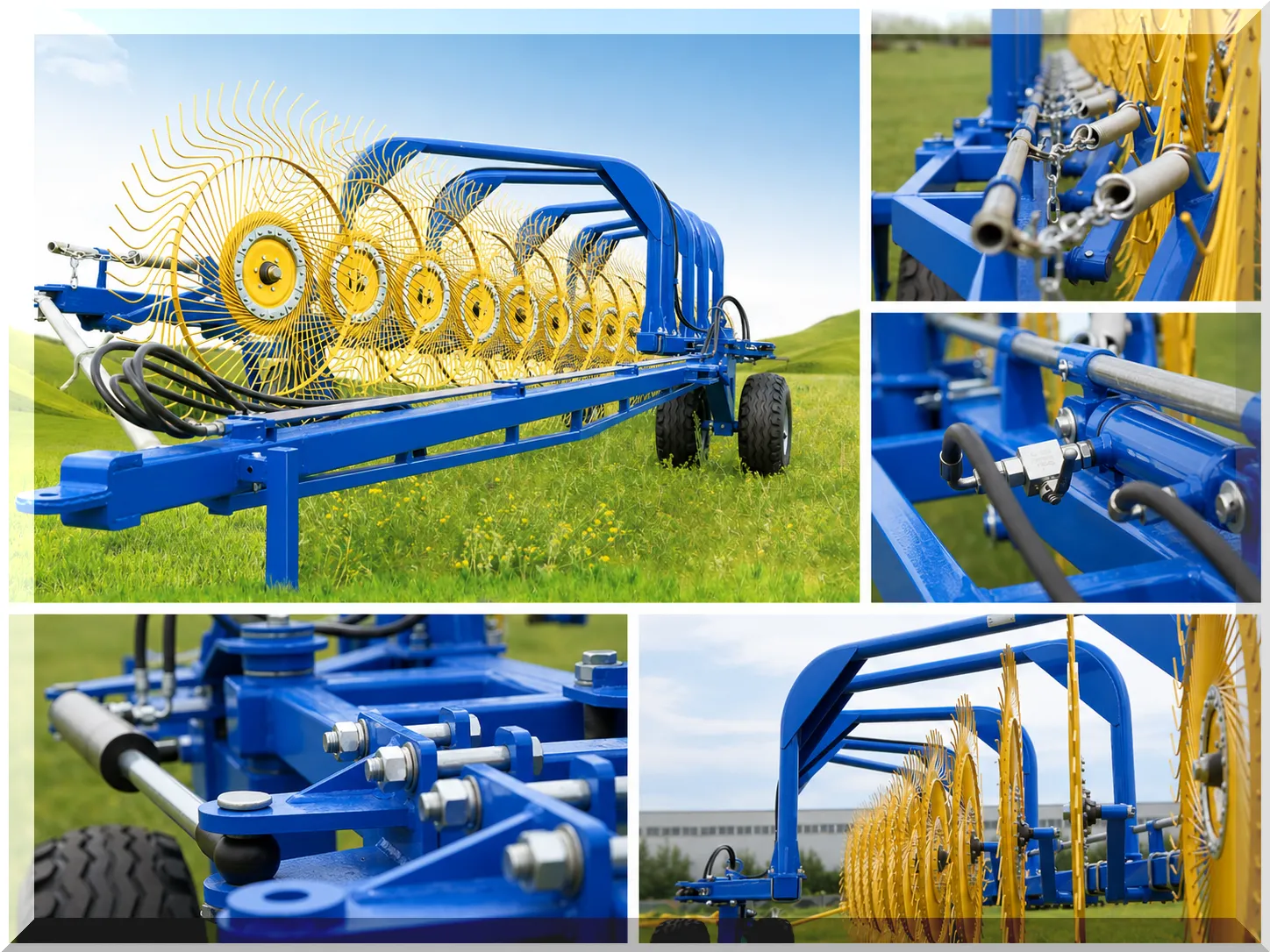
Each of the 15 discs is mounted on a free-spinning hub bearing. As the tractor moves forward, the curved spring tines on each disc contact the stubble surface and crop residue simultaneously. The friction between the tine tips and the ground/crop generates a torque reaction that causes each disc to rotate freely on its bearing. The faster the tractor moves, the faster each disc rotates — ground speed directly controls tine contact frequency at any given point in the hay mat.
This ground-speed-driven rotation means the operator controls raking intensity simply by adjusting ground speed — no mechanical adjustment to the implement is required. Light crop at 12 km/h produces rapid disc rotation with light tine pressure. Dense mat at 8 km/h produces slower disc rotation with heavier tine engagement per rotation. The spring-steel tine construction absorbs impact from ground irregularities, rocks, and hard-pan sections through elastic deflection — each tine bends under impact rather than transmitting the load rigidly to the hub bearing, which dramatically reduces bearing fatigue under commercial-scale annual operating hours.
Lateral Crop Flow and Windrow Formation
Each disc is mounted at a fixed angle (typically 15 to 20 degrees) relative to the machine's direction of travel. This angle creates a lateral velocity component in the rotating tines: as each tine lifts the forage material, it imparts a sideways motion that carries the crop toward the windrow discharge center. The magnitude of the lateral velocity depends on the disc angle and the disc rotation speed — both of which are set by the manufacturer's engineering parameters, not by operator adjustment on this machine.
On the 9LZY-9.0 V-configuration, the left bank of discs is angled to sweep material to the right-center, and the right bank sweeps to the left-center. Both streams converge at the machine's centerline, producing the single centered windrow. The windrow width (0.8 to 1.2 m) is controlled by the exact disc angle and the degree of material overlap between the two banks at the center point — parameters set during factory assembly. Field windrow width is primarily adjusted by raising or lowering the machine's working height via the tractor's drawbar hitch height setting, which changes the effective tine contact angle on the ground.
Matching Your Windrow to Your Baler's Pickup Width
The 9LZY-9.0 hay rake's 0.8 to 1.2 m windrow width output is designed to match the standard pickup header width on the राउंड बेलर लाइनअप — specifically the 1.4 m and 1.6 m wide spring-tine pickup headers used on commercial mid-range and large balers. Getting the windrow-to-baler width relationship right is one of the most directly impactful operational decisions in the hay-making chain. An undersized windrow relative to baler pickup width produces bales with low-density outer edges; an oversized windrow causes pickup bridging at the header sides.
| बेलर मॉडल | पिकअप चौड़ाई | 9LZY-9.0 Windrow Match | Windrow Adjustment | Operational Note |
|---|---|---|---|---|
| 9YG-1.0C (कॉम्पैक्ट) | ~1.2 m | ✔ Direct match | 1.0–1.1 m windrow ideal | Best windrow-baler match in the lineup for compact baler users |
| 9YG-1.25 / 1.25A | ~1.4 m | ✔ Good match | 1.0–1.2 m windrow | Slight over-width on heavy crop — merge two windrows in thin crop for maximum baler productivity |
| 9YG-2.24D commercial | ~1.6–1.8 m | ▸ Consider merging | Double-windrow merge recommended | Single 9LZY-9.0 windrow is under-width for the commercial baler — merge adjacent passes to maintain baler productivity at its rated output |
For the 9YG-2.24D commercial baler, the standard operating procedure is to run the 9LZY-9.0 at 9 m working width in a parallel pattern, then make a merging pass with the rake at half-width displacement — or run a dedicated tedder on the first day and the rake on the second day as a heavier merged windrow. The same घास काटने के उपकरण layout that produces the cut-crop pattern also determines how many rake passes are needed to build the baler-compatible windrow for each machine class.
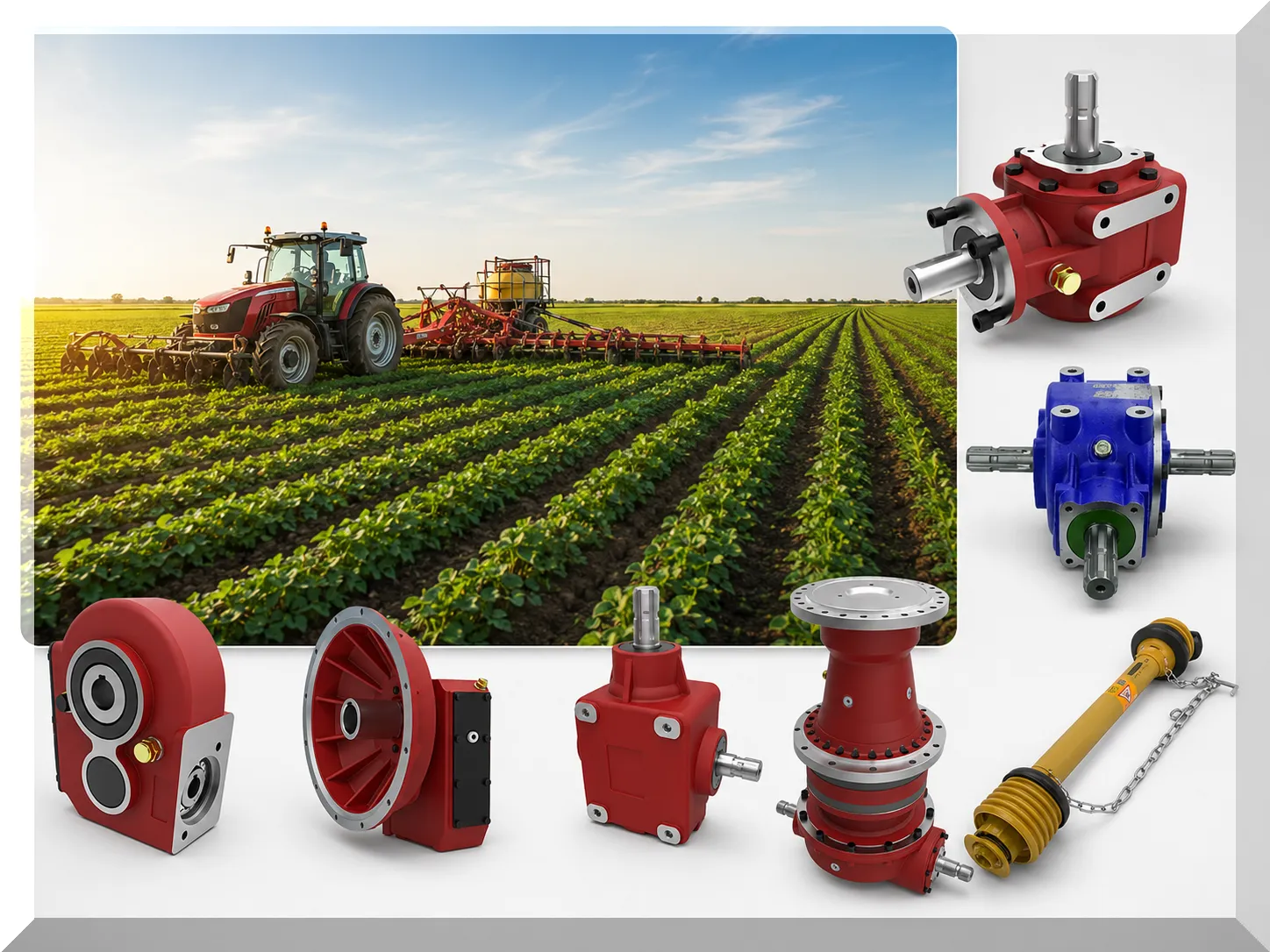
The round baler that processes the windrow downstream operates a 540 rpm PTO driveline on its pickup and bale chamber mechanism. A correctly spec'd कृषि ड्राइव गियरबॉक्स in the baler's PTO circuit handles the sustained compaction loads and pickup surge events that occur when a well-formed dense windrow from the 9LZY-9.0 enters the chamber at full ground speed.
Six Reasons Commercial Hay Producers Choose the 9LZY-9.0
No PTO — Full Tractor Flexibility
Ground-driven disc rotation on this finger wheel rake means the tractor's rear PTO shaft is entirely free throughout the raking operation. On single-tractor operations where the same machine also handles baling, mowing, and transport, this matters: hook up the rake, rake the field, unhook, attach the baler — no PTO reconfiguration at any point. The 9LZY-9.0 requires only a drawbar connection and one set of hydraulic couplers for lift/lower.
≤2% Raking Loss Rate
The घास का रेक's finger wheel disc design lifts forage from the ground surface without the aggressive dragging action of horizontal reel rakes, which scratch material off the top of the stubble and leave a higher proportion of leaf fragments on the field. The spring-tine lift mechanism is gentle on the material while maintaining contact — the ≤2% loss rate is the critical quality metric for alfalfa operations where the leaf fraction represents the highest protein and nutritional value of the bale.
0.8–1.2 m Adjustable Windrow Width
Windrow width varies by adjusting the working height via the tractor drawbar setting, not by mechanically reconfiguring the disc angles. Operators running different baler pickup widths across the season (or for different clients in custom operations) can produce baler-matched windrows without any tooling change — just raise or lower the drawbar.
15 Bearing Points vs 17 — Lower Annual Service Cost
Each disc hub requires a bearing inspection, lubrication, and eventual replacement. The 9LZY-9.0's 15-disc configuration requires fewer annual bearing service events than a 17-disc alternative at the same working width — a measurable advantage over 10 to 15 seasons of operation where bearing replacement cost and service time both accumulate. For commercial operations tracking cost-per-hectare figures, this maintenance differential is consistently cited as a practical operational advantage of the 15-disc design.
9 m Width on 68 HP Tractor
The 50–55 kW (68–75 HP) minimum power requirement for a 9-meter V-rake is lower than many competing designs in the same working width class because the ground-driven mechanism adds no power demand beyond towing. Operations where the hay tractor is a mid-range compact utility in the 70 to 80 HP class can run the 9LZY-9.0 at full rated working speed without approaching tractor drawbar limits.
Independent Disc Flotation
Each of the 15 discs is independently suspended on a flotation spring that allows it to follow ground contour changes across the full 9-meter working width. On undulating fields where the topography varies by 10 to 20 cm within a single machine width, the outer discs ride the contour without lifting and losing ground contact — maintaining the consistent tine-to-ground contact pressure that produces uniform windrow density from the first pass to the last row of the field.
Why Commercial Hay Producers Choose Us
- ✔हे सिस्टम का पूर्ण एकीकरण। The 9LZY-9.0 is part of a complete forage system available at foragebaler.com — from mowing equipment through raking to our full round baler lineup. Parts for all system components ship from the same California warehouse — one order for the whole chain.
- ✔Tractor Compatibility Check Before Ordering. Drawbar hitch load capacity, hydraulic outlet pressure, and HP rating verified from your tractor model at no charge before the 9LZY-9.0 ships. The most common installation issue — drawbar height incompatibility — is identified and resolved before delivery.
- ✔उसी दिन पुर्जों की डिलीवरी। Spring tine replacement sets (60-piece per disc, 900-piece full set), disc hub bearing kits, and hydraulic hose assemblies stocked at the California warehouse year-round. Orders placed before 2:00 PM Pacific ship same business day. Commercial operators in peak-season harvest who need tines mid-cutting receive priority fulfillment.
- ✔Section 179 Documentation. Complete invoice documentation for IRS Section 179 first-year expensing provided on request. For commercial hay operations in a profitable year, the after-tax first-year cost is substantially below the sticker price.
- ✔सीधे कारखाने से प्राप्त मूल्य। No dealer markup. Our hay rake and mowing range is sold direct-to-farm through foragebaler.com — what you pay reflects machine cost plus U.S. logistics, with nothing added between the factory and your drawbar.
Maintenance: 15 Bearing Points, 900 Tines, Nothing Else Moving
The 9LZY-9.0 hay rake has no PTO-driven components, no chains, no drive belts, and no gearbox. Every moving mechanical part consists of a disc hub bearing and a spring tine. The complete annual maintenance program involves four service categories:
🔩 Every 8 Hours (Daily Field Use)
🔧 Every 50 Hours or Per Cutting
📅 Annual Pre-Season
❄️ Winter Storage

अक्सर पूछे जाने वाले प्रश्नों
What Commercial Hay Producers Report After One Full Season
The 9LZY-9.0 replaced a 12-wheel 7-meter rake we'd outgrown. The jump to 9 meters made an immediate difference in our clearing speed — what used to take 3 days to rake between second and third cuttings now takes 2 full days at the same ground speed. The 600 mm disc spacing handles our standard-density alfalfa without any bridging issues I was concerned about from reading about 15 vs 17 wheel debates online. Two full seasons without any mechanical problems beyond routine bearing greasing.
First V-rake after running a parallel-bar side-delivery for 12 years. The learning curve for operating a V-rake vs side-delivery is real — the first two fields took adjustment time to get the windrow width right by varying drawbar height. Once dialed in, the centered windrow is noticeably easier for the baler operator to follow. Our bale density improved visibly because the symmetric windrow fills the pickup evenly. No issues with the 75 HP JD 5075E we pair it with.
Custom hay operation — we rake for about 15 different client farms, everything from irrigated alfalfa to dryland CRP grass. The 9LZY-9.0 handles all of it without configuration changes between clients. On the dense irrigated alfalfa first cuts we slow to 8 km/h and it keeps up. On the lighter CRP grass we run 12 km/h without any losses. The ≤2% loss rate is real — our clients who track their hay inventory closely have noticed consistently. No PTO to worry about on client farms with different PTO setups is a huge practical advantage.
Four stars — the machine performs exactly as described on our ryegrass and oat hay. The one adjustment I had to make was learning to stay above 8 km/h on tall ryegrass — slowing below that on heavy standing ryegrass caused occasional stem wrapping on the outer discs. Above 8 km/h, it flows cleanly. The pre-purchase check with the foragebaler.com team was helpful — they specifically mentioned the minimum speed guideline for tall-stemmed crops, which I would have otherwise discovered through trial and error in the field.
We use the 9LZY-9.0 primarily for straw windrowing after wheat and grain sorghum harvest — not traditional hay at all. At 10 to 12 km/h on dry straw, the throughput is impressive: we regularly clear 100 acres before noon in favorable conditions. Straw is light and the machine handles it without any issues. Bearing greasing at 8 hours is the only regular task — we've gone a full straw season without any tine replacements on clean, stone-free Finney County fields.
Smaller operation than the 9LZY-9.0 typically targets, but we grow high-value alfalfa for the premium horse hay market where leaf-loss percentage directly affects sales price. The ≤2% raking loss rate was the primary reason we chose this machine over a less expensive horizontal rake alternative. After two full seasons, our elevator quality scores on leaf fraction have remained consistently in the top-grade range. The 9LZY-9.0 is genuinely gentle on alfalfa leaf material in a way that was immediately apparent in the first cutting's field residue comparison versus our old rake.
The 9LZY-9.0 Commercial-Standard Finger Wheel Hay Rake for 300–700 Ha/Year Programs
Tractor compatibility (drawbar HP, hydraulic outlet, drawbar height) verified from your model before shipment. Direct factory pricing, same-day U.S. parts dispatch, Section 179 documentation, and complete system support from foragebaler.com.
अमेरिका एवर-पावर फोरेज बेलर इक्विपमेंट इंक. | 1401 21वीं स्ट्रीट, सैक्रामेंटो, कैलिफोर्निया 95811
अतिरिक्त जानकारी
| संपादक | सीएक्सएम |
|---|