Crop Guide · Northern US · Canada · Pacific Northwest
टिमोथी हे बेलिंग गाइड
Timothy is the premium horse hay of the northern and Pacific Northwest states — more than any other cool-season grass, it commands its price premium from a combination of soft seed heads at the correct cutting stage, a characteristic sweet smell, and the right moisture and color in the bale. Getting all three right requires understanding the specific behavior of timothy at different growth stages and managing the longer curing window that cool northern summers produce.
Covers: growth stages and cutting timing · moisture targets · northern curing timelines · rake settings · density by market · quality factors · equipment recommendations
Timothy Characteristics That Affect Baling Management
Timothy (Phleum pratense) is a cool-season bunchgrass that grows best in the northern US, Canada and Pacific Northwest — regions where summer daytime temperatures rarely exceed 28°C and overnight lows consistently fall below 15°C. These conditions produce the characteristic slow, steady curing timeline that distinguishes timothy baling from bermudagrass management in the Southeast.
Medium stem structure
Timothy stems are thicker than bermudagrass but finer than alfalfa — placing it in the middle range for pickup tine behavior and compression characteristics. The stems are hollow above the node, which contributes to both the faster surface drying and the slightly slower core drying than compact alfalfa stems.
Boot-stage seed head value
The closed seed head of boot-stage timothy — the characteristic cylinder shape that identifies premium horse hay — differentiates it visually and palatably from post-bloom hay. The closed head contains fructan carbohydrates that give fresh timothy its characteristic sweetness. This stage lasts only 5–10 days per cutting before the seed head emerges and begins to mature.
Overnight re-wetting in northern climates
Northern growing regions produce dew that is typically heavier and more persistent than Southeast dew — cool overnight temperatures mean morning dew often persists until 09:00–10:00. This extends the effective curing time and requires planning cuts for mid-week so the baling window falls 72–96 hours later on a weekday afternoon.
Multiple cutting potential
Northern US and Canadian timothy typically yields 2–3 cuttings per season. First cut (May–June) is the highest-yield and typically the highest-value for horse markets when cut at boot stage. Second cut (July–August) produces at boot stage again and is often softer-stemmed than first cut. A third cut in September is possible in warmer northern regions.
Growth Stage and Cutting Timing
The correct cutting stage for timothy depends entirely on your target market:
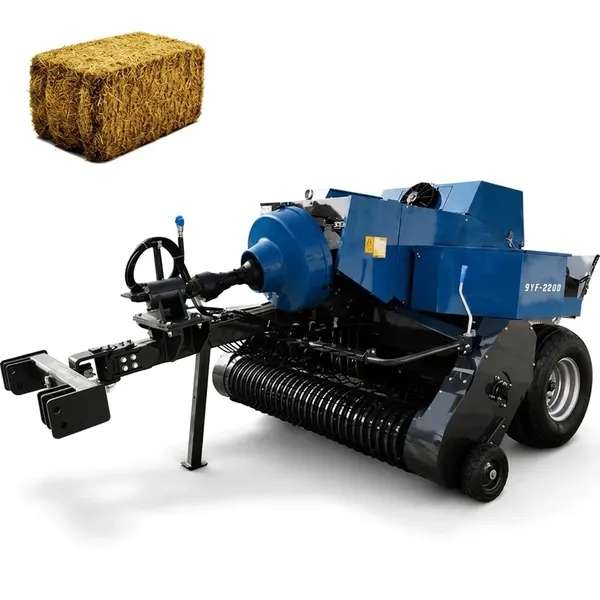
| Growth Stage |
Visual Indicator |
Best Market |
Quality Notes |
| Pre-boot |
Stem and leaves only, no head visible |
Premium rabbit / show horse |
Highest protein, lowest fiber, lowest yield. Very soft, very palatable. |
| Early boot |
Head just visible as bulge at top of sheath, not yet emerged |
प्रीमियम घोड़े का चारा |
Best balance of yield and quality. Sweet smell in the bale. Closed head appealing to horse buyers. |
| Late boot / early heading |
Seed head just emerging from sheath tip |
Standard horse hay / dairy |
Higher yield, good palatability. Beginning of quality reduction. Still commands a reasonable horse hay premium. |
| Full heading |
Seed head fully out, anthers visible |
Dairy / cattle |
Maximum yield, reduced protein. Open seed head appearance. Less palatable to horses. |
| Post-bloom |
Seed head shedding, stem hardening |
Cattle roughage |
Highest fiber, lowest protein. Not suitable for horse premium market. |
Optimal Moisture and Curing Timeline
बहुत सूखा — 13% से नीचे
Seed heads shatter at tine contact. Significant leaf and seed head loss. Bale has greenish-gray color and dusty texture. Sweetness lost. Cannot recover premium market price.
Optimal — 14–18%
Leaves pliable, seed heads intact. Green colour retained. Bale smells sweet at opening. Appropriate for horse market. 15–17% is the ideal centre of this range for premium horse hay.
Too Wet — Above 20%
Bale will heat. Color changes to tan or brown. Mold risk in damp storage. Timothy at 20–24% moisture can reach internal temperatures of 60°C+ — at this point the sweet-smelling fructans that give timothy its premium character are irreversibly destroyed.
Northern US and Canadian Curing Timeline
| Day / Time |
Activity |
Target Condition |
| Day 1 — Morning |
Cut and condition. Full-width swath. Conditioner rolls at light-to-medium setting. |
Freshly cut boot-stage stand. Conditioner crimps stems without excessive shattering. |
| Day 1 — Afternoon |
No action. Allow solar drying through the first afternoon. |
Surface moisture falling from 80% toward 50%. |
| Day 2 — Morning (07:00–09:00) |
Ted if field conditions allow — only if overnight dew was light. |
Surface moisture 40–55%. Leaves pliable, not brittle. Core still 30–40%. |
| Day 2 — Afternoon (12:00–15:00) |
Rake into windrows. Do not rake if surface moisture is below 25%. |
Surface moisture 25–40%. Seed heads still pliable. Core 20–28%. |
| Day 3 — Afternoon (13:00–17:00) |
Probe and bale if core reads 14–18%. |
Core moisture 14–18%. Stems flexible, seed head intact. Baler window open. |
| Day 4 — Afternoon (if Day 3 was too wet) |
Second opportunity. Watch for over-drying in hot periods. |
Core 13–16%. Stop baling when surface leaves begin to feel brittle. |
Rake Settings and Windrow Preparation for Timothy
Timothy stems are more robust than bermudagrass fine stems and can tolerate raking at a slightly higher surface moisture and a wider windrow width. Rake to 75–90% of the baler pickup width — wider than the bermudagrass recommendation because the coarser stems maintain windrow structure without compacting into a dense mat.
Rake timing: in cool northern conditions, rake on Day 2 afternoon when surface moisture is in the 25–40% range. At this moisture, timothy stems and leaves remain flexible enough to rake without seed head or leaf shatter. Raking too dry (below 20% surface) in timothy causes significant seed head shatter — the cylindrical heads break at the stem connection under tine impact and fall to the ground as leaf litter. Visible seed head material on the field surface after raking indicates excessive dryness at raking.
For wheel rake operation: set rake speed at 6–8 km/h maximum. Set tine height to 20–25mm clearance from field surface. Unlike bermudagrass where closer-to-ground raking is needed to capture fine-stem material, timothy stands upright after cutting and can be captured effectively at a slightly higher tine position — which reduces soil pickup and ash content in the bale.
Bale Density Targets by Market
| बाज़ार |
लक्ष्य वजन |
Quality Priority |
| Premium horse hay (equine specialty) |
18–22 किलोग्राम |
Green colour, intact seed heads, sweet smell, low dust. Boot stage only. |
| Rabbit hay (feed store / pet market) |
14–18 किलोग्राम |
Softer bales preferred. Pre-boot or early boot stage only. No mold tolerance at all. |
| Dairy (mixed timothy-legume) |
22–28 किलोग्राम |
Crude protein above 12%, low ash, consistency of weight. Heading stage acceptable. |
| Cattle roughage (late-season cuts) |
22–30 किलोग्राम |
Maximum density for handling efficiency. Post-bloom acceptable. Focus on freedom from mold. |
Quality Factors That Determine Timothy Hay Price
Green Colour Retention
The most visible quality indicator for horse buyers. Green bales command $2–$5 per bale premium over tan or yellow bales in most horse hay markets. Green colour is preserved by: correct baling moisture (14–18%); avoiding sun bleaching from extended windrow exposure; and correct storage in dark, dry conditions. A bale that was green when stored but has faded to tan on the outer face after months of light exposure is normal — the interior should remain greener, which experienced horse buyers know to check.
Seed Head Stage and Integrity
Boot-stage closed heads visible throughout the bale cross-section are the defining visual characteristic of premium horse hay. Open or shattered heads indicate either late cutting (past boot stage) or over-dry baling conditions. A simple buyer test: pull a handful of hay from the bale interior and look at the seed heads. Closed cylinder shapes = boot stage, correctly baled. Open, pollen-shed heads = post-boot, lower value. Absent heads = over-dry baling with shatter.
Sweet Smell
The characteristic sweet, slightly vanilla-like smell of fresh timothy comes from fructan carbohydrates — water-soluble sugars stored in the stem at boot stage. This smell is present when the crop is cut correctly at boot stage and baled at 15–17% moisture without heating. It is absent from over-heated bales, over-dried bales and late-cut post-bloom bales. Experienced horse buyers open a bale and smell it — premium price is confirmed before visual inspection is complete. Correct cutting stage and baling moisture are the two factors under producer control that determine whether the sweet smell is present.
Low Dust
Dusty timothy hay is a significant horse buyer rejection trigger — dust causes respiratory issues in horses stabled in barns. Dust in timothy bales comes from two sources: over-dry baling below 13% moisture (fine chaff dust from shattering); and soil contamination from tines contacting the ground during pickup. Prevention: correct baling moisture and correct pickup height. Test: shake a handful of hay vigorously over a white cloth. Minimal dust on the cloth = acceptable. Visible dust cloud on shaking = dusty bale, horse market rejection.
Equipment Recommendations for Timothy
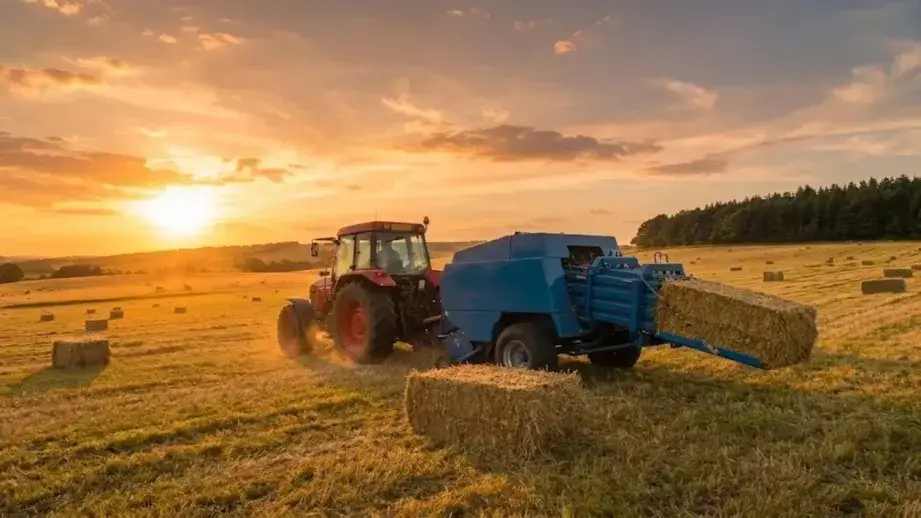
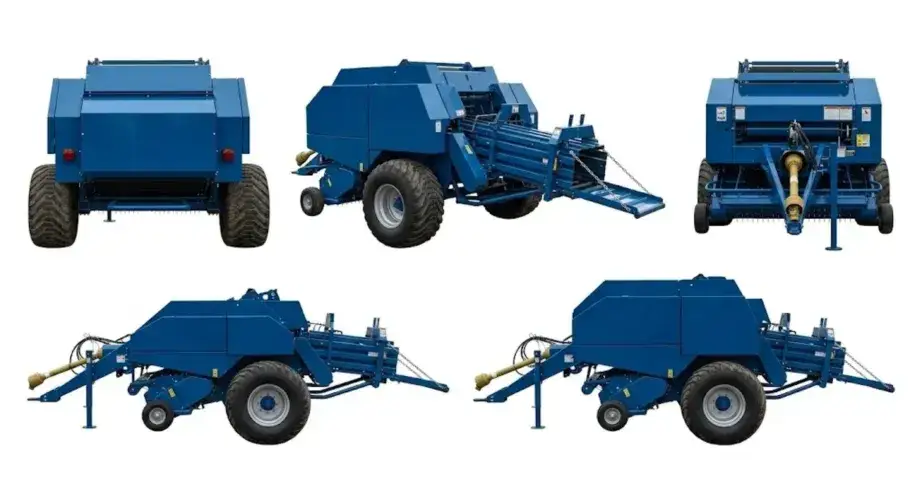
For timothy hay production targeting horse and rabbit markets: the 9YF-2200 with standard spring-tooth pickup is the correct choice. The spring-tooth tine configuration provides a gentler pickup action than the hammer-claw on shredder models — important for dry boot-stage timothy where the seed head can shatter under aggressive tine impact. The spring-tooth tine bends on contact with obstructions rather than breaking them, which also reduces the field debris ingestion risk on typical northern hay fields that may contain small stones.
The shredder models (9YF-2200S, 9YFS-2.2) are not the primary recommendation for premium timothy horse hay because the pre-shredder action can damage seed heads and produce more dust from the additional mechanical processing of dry timothy stems. These models are appropriate for timothy mixed with coarser materials (silage aftermath, cotton stalk) where the shredder benefit outweighs the seed head impact.
PTO and Drive for Northern Conditions
Northern hay operations typically have fewer total baling hours per season than southern operations, but those hours must be concentrated in narrow weather windows when conditions are right. Reliable PTO drive is critical during these windows. Full CV joint specifications: पीटीओ ड्राइवशाफ्ट और सीवी जॉइंट साइजिंग गाइड.
Frequently Asked Questions — Timothy Hay Baling
How do I know exactly when timothy is at boot stage without testing?+
Pull a stem from the stand at ground level. Run two fingers up the stem to the top. At boot stage, you will feel the seed head as a cylindrical bulge inside the top sheath, but it will not have emerged through the tip of the sheath. At this point: cut. The boot stage window in a single timothy stand is typically 5–10 days — begin monitoring the field daily once the tallest stems reach 50cm height and you can feel the bulge approaching the sheath tip. Cut when the bulge is present but not yet breaking through the top. In large fields, some areas may be 2–4 days ahead of others — start at the most advanced sections and work toward the less-advanced sections over the cutting window.
My timothy bales smell musty after 2 weeks in the barn. What caused this?+
Musty smell in timothy bales develops from microbial activity initiated when baling moisture was too high. For musty smell to develop in 2 weeks, baling moisture was likely above 18–20%. The initial heat of a timothy bale at 18–20% moisture may not be noticeable in the first few days — timothy bales can reach 45°C internal temperature without feeling hot to the touch from outside the bale. By day 14, the fungal and bacterial activity that began in the high-moisture interior has produced enough metabolites to create a detectable musty odor. Prevention requires probe moisture testing at the windrow core — not just surface feel — before baling. A wet-feeling windrow surface can mask a still-too-wet core in northern conditions where overnight dew re-wets the surface. If musty bales are already in the barn: move them to the outer stack edges where airflow can slow further deterioration. Do not stack musty bales more than 3 layers high and do not mix with premium horse hay bales in the same stack.
Can I cut timothy at heading stage to get higher yield and still sell it as horse hay?+
Late-boot to early-heading timothy can still be sold as horse hay — experienced horse buyers with cost-conscious clients will purchase it at a moderate discount to boot-stage hay. However, full-heading timothy (anthers visible, pollen shedding) is typically not accepted at horse hay premium prices by quality-conscious horse buyers. The yield advantage of cutting at heading versus boot stage is approximately 15–25% more dry matter per hectare — significant for operations where tonnage is the primary revenue driver. The value trade-off: if premium horse hay prices in your market are $15–$18 per bale for boot stage and $10–$13 per bale for heading stage, the 25% yield increase at heading stage needs to produce enough additional bales to compensate for the $5/bale price reduction. This calculation is specific to each operation and market and should be done with your actual price data before deciding on a consistent cutting-stage policy.
How many days does a 20kg timothy bale last for one horse?+
An average 500kg horse at maintenance requires approximately 8–12kg of hay per day at ad libitum feeding — or 1.8–2.5% of body weight. A 20kg bale at 85% dry matter contains 17kg of dry matter. At a typical horse daily intake of 9–10kg dry matter, one bale lasts approximately 1.5–2 days. For a 600kg performance horse at higher feeding levels, the same bale lasts 1–1.5 days. For a 400kg small breed or easy keeper at restricted feeding, a 20kg bale can last 2.5–3.5 days. These figures are useful for buyer counselling and for calculating how many bales per season a buyer should purchase. A horse owner with 3 horses typically needs 150–200 bales per season for 180 days of hay feeding — knowing this helps you plan your committed customer production volume.
What is the correct conditioner setting for timothy at boot stage?+
Boot-stage timothy should be conditioned at a lighter setting than full-heading or post-bloom timothy. A heavy roll gap that crushes stems aggressively at boot stage can also damage the still-enclosed seed heads — flattening them from the cylindrical shape that is the premium visual characteristic of boot-stage horse hay. The correct approach: set conditioner rolls at the narrowest gap that provides visible stem crimping without flattening the seed head sheath. This is typically 2–3mm wider than the setting used for post-bloom timothy or alfalfa. The crimping remains effective for drying because boot-stage stems are still young and moist — they do not require the same aggressive conditioning that older post-bloom stems need to dry at a reasonable rate. Test a handful after the first pass: stems should show obvious crimp marks when bent but the seed head sheath should remain largely cylindrical and undamaged.
Does the second cutting of timothy equal the first cutting in quality?+
Second cutting timothy at boot stage is typically softer-stemmed than first cutting because the regrowth produces finer stems from the existing root system rather than from seed. This makes second cutting often more palatable per unit weight than first cutting — horse buyers frequently prefer second-cut timothy for this reason. The seed head density in second cutting is often lower than first cutting because regrowth produces fewer headed tillers per square metre. In yield terms, second cutting is typically 20–35% less than first cutting per hectare, and in some years the summer drought stress in northern growing regions reduces second cutting yield more significantly. For quality: second cutting at boot stage equals or exceeds first cutting in palatability. For yield and total season revenue, first cutting contributes 50–60% of the season total even in areas with reliable second cutting conditions.
What is the maximum moisture for storing timothy bales in an unventilated barn?+
For unventilated (sealed) barn storage: maximum safe baling moisture is 16% for timothy bales. At 16%, a correctly baled timothy bale produces only minimal heat during initial curing in storage — typically reaching 30–35°C internal temperature before stabilising. Above 18% in an unventilated barn: heat accumulation in stacked bales is not dissipated, the bales in the interior of the stack can reach damaging temperatures, and the sweet fructan compounds break down. For ventilated barn storage (open eaves, gapped siding) or open-sided shed storage: the maximum safe moisture is 18% for stacked bales because airflow helps dissipate initial curing heat. If baling conditions force you above 18% in either storage type: apply hay preservative at the manufacturer rate, store in a single layer for 72 hours before stacking, and plan to inspect the stack temperature during the first 10 days by reaching into the interior of the stack and feeling for excessive heat (a bale interior above 55°C is too hot — spread the stack immediately).
Can I bale pure timothy or does it need to be mixed with a legume?+
Pure timothy hay is widely produced and marketed, particularly for premium horse and rabbit hay markets where the pure timothy identification is part of the product value proposition. Horse buyers who want low-protein hay specifically (for easy keepers or metabolically sensitive horses) specifically request pure timothy over grass-legume mixes. Pure timothy at boot stage runs approximately 8–12% crude protein — lower than any grass-alfalfa mix. Timothy-legume mixes are common in dairy operations where the legume contribution raises protein above the 14–16% target for high-producing dairy. The mixed stand is also easier to establish in many northern regions where alfalfa or clover fills gaps in the timothy stand. Both pure and mixed stands are practical — the choice should be driven by your target market and local growing conditions rather than baling equipment considerations. Both can be baled with the same equipment and settings.
Get the Right Baler for Your Timothy Operation
The 9YF-2200 with spring-tooth pickup is the standard recommendation for timothy horse hay production. Contact us to discuss your target bale weight, cutting schedule and storage conditions.
संपादक: सीएक्सएम