Seleziona una pagina
Dairy Forage Production Guide

Fieno di erba medica per bovini da latte: specifiche di qualità e integrazione con la razione totale miscelata (TMR).

The dairy market pays $30–$80 per ton more for alfalfa that meets its nutritional specifications than the same tonnage of equivalent-grade horse or beef hay. That premium is not awarded automatically — it requires hitting a specific combination of RFQ, ADICP, NDF digestibility, and moisture values that most operations produce inconsistently without deliberate production management. This guide defines every specification, explains why each one matters to the dairy nutritionist, and walks through the harvest and baling decisions that make consistent dairy-grade alfalfa achievable.

Dairy Alfalfa Specifications

Why Dairy Alfalfa Is a Separate Market Category — Not Just Better Hay

Dairy nutrition is precision nutrition. A dairy cow producing 80+ lbs of milk per day is a high-performance ruminant whose ration must deliver precise energy density, protein quantity, protein quality, and fiber digestibility within narrow limits. Feed that fails any of these parameters directly reduces milk production, milk fat, or cow health — consequences the dairy operator measures in real-time through milk meter data and monthly milk quality reports. This tight feedback loop makes dairy operators among the most demanding hay buyers in the market, and it is exactly what drives the premium pricing structure.

+$40–$80/ton
Typical dairy premium above commodity cattle hay for hay meeting dairy nutritional specifications
RFQ 160+
Minimum Relative Forage Quality most dairy nutritionists specify for milking cow rations
<7% ADICP
Maximum heat-damaged protein fraction acceptable in dairy alfalfa — above this level, milk protein yield suffers measurably
<14% moisture
Maximum storage moisture for dairy-quality alfalfa hay — above this level storage heating begins degrading protein quality

The Dairy Alfalfa Specification Grid: What Every Number Means for Milk
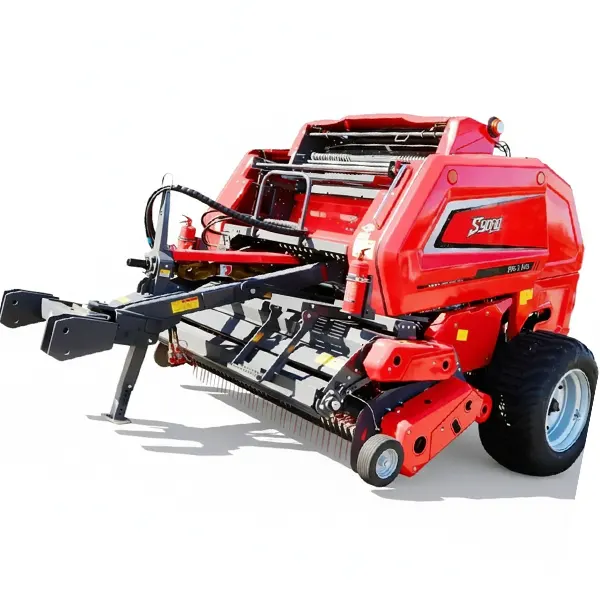
commercial round baler producing alfalfa hay for dairy market — dairy-spec alfalfa requires hitting a precise combination of RFQ, ADICP, NDFD, and moisture specifications on every lot; inconsistency between lots forces the dairy nutritionist to re-formulate the TMR ration, creating administrative burden that makes inconsistent suppliers less desirable even at competitive prices

Specifica Minimum (milking cows) Target (high-production) Why it matters for milk
RFQ (Relative Forage Quality) 150 165–185+ Higher RFQ = higher dry matter intake and energy density; 10 RFQ points = ~0.5 lb milk/cow/day
ADF (Acid Detergent Fiber) <32% <28% Lower ADF = higher energy digestibility. ADF above 35% reduces NEL significantly below dairy requirements
NDF (Neutral Detergent Fiber) <42% <38% NDF regulates rumen fill — high NDF limits dry matter intake. Must be balanced against the dairy cow’s minimum effective fiber requirement (~28% NDF from forages)
NDFD (30-hr NDF digestibility) >48% >52% How digestible the fiber is — more important than NDF level alone. RFQ incorporates NDFD; RFV does not. This is why dairy buyers prefer RFQ over RFV
CP (Crude Protein) >18% 20–24% High CP alfalfa reduces supplemental protein cost in the TMR. Every percent of CP in the hay offsets $0.05–$0.10/lb of protein supplement cost
ADICP (Heat-damaged protein, % of CP) <10% <7% The fraction of crude protein bound to cell wall by heat — nutritionally unavailable to the cow even though it appears on CP analysis. High ADICP hay “tests well” but performs poorly in the cow
RFQ vs RFV: Most hay markets use RFV (Relative Feed Value). Dairy nutritionists prefer RFQ because it incorporates NDFD — fiber digestibility — which RFV ignores entirely. A hay lot with RFV 180 but poor NDFD (45%) looks excellent on an RFV-only test but underperforms in the dairy cow’s rumen. Always request the full forage analysis including NDFD when selling to dairy buyers.

Heat Damage (ADICP): Why Storage and Baling Decisions Destroy Protein Value

ADICP (Acid Detergent Insoluble Crude Protein) is the fraction of crude protein that has been chemically bound to cell wall material through the Maillard reaction — the same browning reaction that creates a crust on bread. In hay, it is triggered by biological heating in the bale during storage. Once the Maillard reaction has occurred, the protein is permanently unavailable to rumen microorganisms regardless of how good the total CP appears on analysis.

Heat damage mechanism
When hay is baled above 18% moisture, microbial activity generates heat as organisms consume soluble carbohydrates. As bale temperature rises above 130°F, the Maillard reaction begins. Above 150°F sustained for 24+ hours, ADICP typically rises above 10–12% of total CP. At 170°F, significant protein damage occurs that is visible as brown/caramel coloration of the hay.
The hidden problem
Mild heat damage (130–145°F for short periods) does not change the hay’s appearance — it still looks green and tests well on CP. Only the ADICP value on a Cornell acid detergent fractionation test reveals the protein damage. Hay shipped to a dairy that looks and tests as Premium grade but has 14% ADICP will disappoint the dairy nutritionist at feedout. Request ADICP on every dairy-market lot.
Prevenzione
The three controllable factors: (1) bale at or below 16–17% moisture — this is the most effective single control; (2) maximize bale density — denser bales limit the oxygen supply that drives aerobic heating; (3) store in covered, well-ventilated conditions on a gravel pad — ground moisture and trapped heat compound the temperature rise. All three work together; any single control is insufficient for consistent results.

Cutting Stage and Timing for Maximum RFQ Achievement
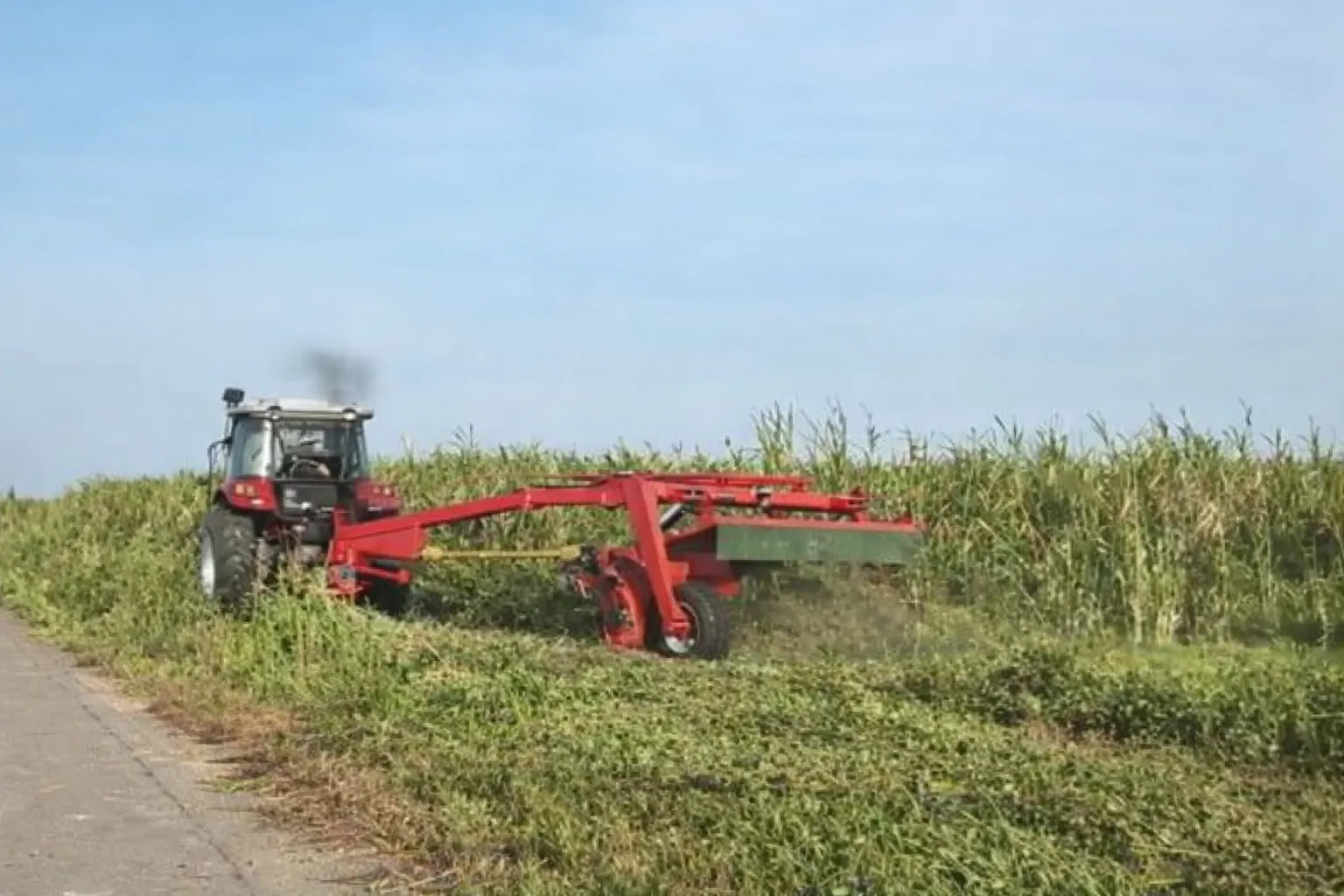
mower-conditioner cutting alfalfa at optimal stage — cutting alfalfa at 10% bloom rather than 25-30% bloom produces 15-25 RFQ points higher hay, which is the difference between commodity hay and dairy-specification hay; boot stage to early bloom represents the highest quality window in alfalfa's growth cycle

Cutting maturity is the single largest determinant of alfalfa hay quality — larger than conditioning equipment, drying management, or baling technique combined. Research from multiple state extension programs consistently documents that each day of delay in cutting past the optimal window (10% bloom) costs approximately 2–4 RFQ points. Moving from 10% to 40% bloom (a delay of 7–10 days in typical summer conditions) costs 15–25 RFQ points — the difference between dairy-spec and cattle-grade hay on the same field.

The 10% bloom target: what to look for

Walk the field and count stems in a representative 10-square-foot area. Count the total stems and the stems showing at least one open purple/blue flower. When 10% of stems show an open bloom, it is time to cut. This field assessment takes 5–10 minutes and should replace calendar-based cutting schedules entirely for dairy market production. The daily quality monitoring investment — 10 minutes per field per day during the growth period — is worth $30–$80 per ton on the resulting hay price.

Morning vs afternoon cutting for NDFD

Afternoon cutting (1–4 PM) produces alfalfa with higher water-soluble carbohydrate (WSC) content because photosynthesis has been running all day. Higher WSC correlates with slightly better 30-hour NDFD and lower NDF percentage. The effect is measurable but modest — 1–3 NDFD points typically. The more significant timing consideration is weather window management: morning cuts allow more drying time on the first day, reducing rain-contact risk. Weigh both factors before committing to a specific daily cutting time.

The full alfalfa cutting frequency system — including the root carbohydrate recovery cycle, fall dormancy cutoff rules, and the 3-cut vs 4-cut vs 5-cut economics — is in the Guida alla frequenza di taglio e alla durata di crescita delle piante di erba medica. The mowing and conditioning settings that preserve leaf retention and maximize drying rate at each cutting are in the Guida alla qualità per la falciatura e la manutenzione. The mower-conditioner gearbox and PTO driveline specifications are in Specifiche dei componenti del cambio agricolo e della presa di forza.

How TMR Nutritionists Evaluate an Alfalfa Hay Lot

Understanding how the dairy nutritionist evaluates your hay lot — what they look for, what makes them accept or reject, and what makes them pay the premium — is the most valuable perspective a hay producer can develop for accessing the dairy market consistently. The nutritionist is building a ration for cows that produces a specific amount of milk at a specific composition every day. Any ingredient that varies from what was formulated creates either a production response or a cost variance that they are accountable for explaining.

Step 1: Chemical analysis review

The nutritionist reviews the forage test report for RFQ, ADF, NDF, NDFD, CP, ADICP, moisture, and ash. Any value outside acceptable range disqualifies the lot regardless of visual appearance. A clean-looking hay lot with 14% ADICP will be rejected or heavily discounted. A slightly yellow lot with RFQ 175 and ADICP 5% will be purchased.

Step 2: Sensory evaluation

Color (bright green indicates early cutting and minimal carotene oxidation), aroma (sweet-green smell vs caramel/burned smell that signals ADICP), leaf retention (leafy hay has higher CP and NDFD), dustiness (excessive dust indicates mold spore load or over-drying), and moisture feel (pull a handful and feel for cool clamminess that indicates moisture above 14%).

Step 3: Consistency assessment

An often-underrated factor: how consistent is this producer’s hay lot-to-lot? A nutritionist who has incorporated a producer’s alfalfa as a fixed ingredient at 8 lbs/cow/day needs that hay to test within ±10 RFQ points of the value used in the ration formulation. Producers who deliver consistent quality command better relationships and better prices than those who are premium one lot and marginal the next.

Bale Density and Storage: The Upstream Quality Protection System

commercial hay production facility — dairy-specification alfalfa requires maximum bale density to limit oxygen availability that drives heating, combined with covered storage on a gravel pad to eliminate moisture infiltration; the baling and storage decisions made in the field determine whether the hay's chemical quality at cutting is preserved to the feedbunk

The quality you achieve at cutting is the ceiling — baling and storage can only preserve or reduce it, not improve it. For dairy-specification alfalfa, baling density and storage conditions are critical because even a 5°F increase in peak bale temperature during storage incrementally advances the Maillard reaction that creates ADICP. The production goal is to get the hay from the field to the feedbunk with the minimum possible ADICP accumulation above its baseline level at cutting.

Baling density target for dairy hay

Set the baler to maximum density for all dairy-spec alfalfa. Higher density (12–14 lbs/cu ft) limits inter-particle air space that supplies oxygen to aerobic microorganisms. Research shows that density above 12 lbs/cu ft at 14–16% moisture produces significantly lower peak bale temperatures than density below 10 lbs/cu ft at the same moisture level. For dairy hay, every tenth of a percentage point saved in ADICP is worth $3–$8/ton in the premium market.

Storage requirements for dairy-spec

Covered storage is standard, not optional, for dairy-quality alfalfa. Ground contact moisture infiltrates the outer bale layer and raises local moisture above the 14% threshold even when core moisture is correct. A concrete pad or gravel pad under net-wrapped bales in covered storage produces the lowest ADICP accumulation rates during storage. Round bales stored outdoors on bare ground can accumulate 3–5% additional ADICP above covered storage levels over a 6-month period — that is the difference between ADICP 5% and ADICP 10% from identical hay at baling.

How bale density affects feeding efficiency, storage DM losses, and bale shape stability through the storage period is in the Guida alla densità delle balle rotonde e alla qualità del foraggio.

Dairy Alfalfa Pricing: How to Command and Sustain the Premium

Dairy Alfalfa Price Premium Structure — Midwest/Western U.S. Reference
Commodity cattle hay (RFV 130–150):
Base market price: $130–$160/ton. No premium, high competition, price-taker market.
Dairy-grade alfalfa (RFQ 155–170, ADICP <8%):
$180–$220/ton. Entry-level dairy premium. Requires documented forage test.
Premium dairy alfalfa (RFQ 170+, ADICP <6%):
$230–$280/ton. Consistent premium buyers will contract for annual supply. Highest-margin hay market accessible without export logistics.

Prices vary significantly by region, season, and drought conditions. These ranges are illustrative; confirm current regional market rates through USDA AMS hay price reports or local hay market contacts before pricing a specific lot.

Marketing to dairy nutritionists — what works
  • Send the forage test report before price discussion — lead with data, not appearance
  • Offer consistent lot quality (±10 RFQ points between deliveries)
  • Provide ADICP on every test (most producers don’t — it differentiates you immediately)
  • Offer delivery documentation with baling date and cutting number
What damages dairy market relationships
  • Variable quality between loads (the nutritionist’s biggest pain point)
  • Delivering without a forage test, expecting the buyer to do testing
  • Moisture above 14% on delivered hay
  • Price renegotiation at delivery without a legitimate quality basis

Dairy Alfalfa Production FAQs
Can I sell alfalfa to a dairy if I don’t have NDFD or ADICP on my forage test?+
Yes — but you will be priced as commodity hay regardless of how good your hay looks or what the basic RFV test shows. A dairy nutritionist will not pay a premium for hay that lacks the ADICP and NDFD values they need to safely incorporate it into the TMR formulation. Without ADICP, they don’t know the usable protein level; without NDFD, they can’t calculate the energy contribution. The standard 3-parameter test (ADF, NDF, CP) costs $15–$18; the comprehensive dairy test adding NDFD and ADICP costs $22–$28. The additional $8–$10 per sample can add $30–$60/ton to your selling price on every qualifying lot — the investment ratio is approximately 300–600:1.
My alfalfa tests at CP 21% but the dairy says my protein value is low. What is happening?+
This is almost certainly an ADICP problem. Crude protein analysis measures total nitrogen-containing compounds — including the heat-damaged protein fraction that is chemically bound to cell wall and biologically unavailable. If your hay has 21% CP but 12% of that CP is ADICP, the biologically available protein is approximately 21% × (1 − 0.12) = 18.5% — a significant reduction from the number on the basic test. The dairy nutritionist’s ration software accounts for ADICP when calculating the usable protein contribution; your hay may appear lower in protein value than its CP number suggests specifically because the ADICP correction is reducing the effective protein figure. Request the Cornell fractionation panel on your next test lot to see your actual ADICP level.
Is alfalfa hay or alfalfa haylage better for dairy TMR?+
Both have legitimate roles in dairy TMR, and most large dairy operations use both. Alfalfa haylage (bale silage or bunker silage) provides higher moisture that improves palatability, allows harvesting at boot stage moisture without full drying (reducing leaf loss and ADICP risk from over-drying or heating), and ferments to a stable pH that preserves nutritional quality reliably. Alfalfa dry hay is preferred for operations with limited silage infrastructure, provides fiber physical form that differs from haylage, and has better year-long storage flexibility. The two products are priced and marketed differently — dry hay is a commodity with spot market pricing; alfalfa haylage is typically contracted at the farm level between the producer and a specific dairy. For hay producers without a wrapper, dry hay is the only practical option; for those with a wrapper, offering both to the same dairy buyer can be a competitive advantage.
What alfalfa varieties consistently produce the highest RFQ for dairy markets?+
Variety selection has a real but secondary effect on RFQ — cutting stage and management have a larger effect than variety. That said, varieties with high 30-hour NDFD (HiQ, High-Energy, or fiber-digestibility-rated varieties from major seed companies) produce consistently higher NDFD values than standard varieties at equivalent cutting stages. The premium-digestibility varieties typically command $5–$15/unit more in seed cost but produce measurably better forage quality for dairy markets — the investment is generally justified for dedicated dairy-market producers. Consult your state university’s variety trial data for RFQ and NDFD comparisons in your region; national averages may not reflect your local environment’s effect on individual variety performance.
How do I find dairy farm buyers for my alfalfa in my region?+
The most effective access channels for dairy hay sales: (1) Contact dairy farm nutritionists directly — consulting nutritionists who manage multiple dairy rations in a region are the most efficient market access point because they can introduce you to multiple dairy clients simultaneously. Find nutritionists through local dairy associations, cooperative extension dairy educator contacts, or feed company representatives. (2) Hay elevators and brokers with dairy market specialization — not all hay elevators have dairy market connections; specifically ask whether they supply local dairies and what volumes. (3) State and regional dairy associations often maintain producer directories — showing up at dairy meetings and introducing yourself as a hay supplier is an underused direct marketing approach. Begin these conversations 6–12 months before you have your first certified dairy-quality lot available.
Does rain-damaged alfalfa automatically disqualify from the dairy market?+
A single light rain event (under 0.3 inches) on hay that had reached 25–30% moisture (still relatively wet) causes moderate quality loss — RFQ drops 5–12 points and soluble carbohydrate content decreases. This hay may still test at RFQ 155–165 after re-drying — marginally within the dairy range. A moderate rain (0.5–1.0 inches) on hay at 20% moisture causes more significant leaching and RFQ drops of 15–25 points — this hay typically falls below dairy market specification and should be directed to cattle or livestock hay channels. Any rain contact that produces visible mold after re-drying disqualifies the hay from dairy markets entirely — mold spore counts are a health concern for high-producing dairy cows. Always test a rained-on lot after re-drying before marketing it as dairy quality, regardless of visual assessment.
foragebaler.com commercial round baler with quality documentation — complete equipment specifications and baling density standards for dairy-specification alfalfa production

Get Baler Configuration Guidance for Dairy-Grade Alfalfa Production

Tell us your alfalfa acreage, current typical RFQ range, primary cutting number (1st, 2nd, 3rd), and storage method. We confirm the baler density settings and storage recommendations that minimize ADICP accumulation and protect your dairy-market quality on every lot.

Get Dairy Alfalfa Production Guidance

Redattore: Cxm