Troubleshooting Guide · All 9YF Models · Settings and Mechanical Causes
Square Baler Loose Bales: Density Troubleshooting Guide
Loose or inconsistent bales cost you in storage efficiency, buyer satisfaction and revenue per tonne. A bale that falls apart during handling or weighs 15kg instead of 24kg represents direct lost income on every tonne baled. Every density problem has a specific cause — settings, mechanical wear or operating conditions — and each has a clear fix.
Covers: settings vs mechanical diagnosis · chamber wear · plunger tension · PTO speed · crop moisture · star wheel · calibration protocol
First: Two Critical Distinctions Before Any Diagnosis
Loose at Exit vs Loose After Storage
A bale that is loose when it exits the baler has a machine or settings problem. A bale that appears firm at exit but loosens in storage has a moisture problem — the bale was baled too wet and the moisture evaporated during storage, reducing the apparent volume and allowing the compressed material to relax. These are fundamentally different problems requiring different fixes. Weigh bales immediately at exit and again after 48 hours — if weight reduces by more than 5%, moisture is the dominant factor.
Consistently Loose vs Intermittently Loose
A machine that produces uniformly light bales across the entire field has a settings or mechanical fault. A machine that produces variable density — some bales heavy, some light from the same windrow — has either an uneven windrow feed (field condition) or a star wheel/trip mechanism fault (mechanical). Weigh 10 consecutive bales: if the variation exceeds 15% of the average, the machine has a uniformity problem distinct from an overall density problem.
Settings Check: Always Start Here Before Opening the Machine
The Density Adjustment Mechanism
The primary density control on all 9YF series models is the plunger compression spring or hydraulic tension adjustment. This controls the resistance the bale must overcome to exit the chamber. A higher tension setting forces more material into each bale length before the door opens enough to allow ejection. Before attributing loose bales to mechanical wear, confirm the density setting is correct and has not been inadvertently changed.
Check the density setting by: confirming the adjustment bolt or hydraulic valve position matches the setting you used for previous satisfactory bales; then running 5 bales and weighing them. If bale weight is consistently below target by more than 15%, increase the tension by one increment and retest. If you do not know the previous setting, start from the minimum and increase in steps — never start from maximum and reduce, as an over-tight setting risks plunger overload.
Bale Length Setting and Its Effect on Weight
Bale length is controlled by the star wheel or metering mechanism that triggers the knotters. A longer bale at the same density setting contains more material and weighs more. If you changed bale length setting between the last satisfactory session and the current one, weight will have changed proportionally. Restore the previous length setting before diagnosing density as the problem. As a reference: reducing bale length by 100mm at the same density setting typically reduces bale weight by approximately 12–18% depending on crop type.
The 8 Mechanical and Operational Causes of Loose Bales
1
Chamber Wear Strips Worn — Lateral Gap in the Compression Zone
Symptom: bales come out undersized and easily squeezed; loose on all four sides uniformly
Causa ultima
The bale chamber walls are lined with replaceable wear strips that maintain the correct internal dimensions. As these strips wear, the effective chamber cross-section increases — the same density setting now produces a bale with more physical size but less material per unit volume, which exits looser and lighter than before. Wear strip wear is progressive and gradual, which is why operators often do not notice the problem until bale weight has fallen by 10–15%.
Fix Procedure
Measure the chamber internal width and height at three points along the chamber length and compare to the specification in the operator manual. If any measurement exceeds the maximum worn dimension, replace the wear strips. This is a standard pre-season maintenance item — check wear strips annually and replace as a set when any one strip is at the wear limit. After replacement, run 10 calibration bales and adjust the density setting to achieve the target bale weight, as the new strips reduce the effective chamber size and require a lower tension setting to achieve the same output weight.
2
Plunger Compression Spring Fatigue or Hydraulic Pressure Loss
Symptom: bale density reduced uniformly; no improvement when adjusting the density control bolt
Causa ultima
The chamber door resistance is generated by either a mechanical spring system or a hydraulic cylinder depending on model. Springs lose their rated load over time from metal fatigue — a spring that correctly resisted 300kg door force when new may only resist 200kg after 8–10 seasons of compression cycling. A hydraulic system loses pressure resistance from seal wear or fluid contamination. In both cases, the density adjustment mechanism is still functioning correctly but the maximum achievable resistance has decreased below the original specification.
Fix Procedure
Test spring load by measuring the spring free length and comparing to the specification. A spring that has shortened by more than 5% of its original free length has lost significant load capacity and should be replaced. For hydraulic systems, check the system pressure at the cylinder inlet with a pressure gauge at maximum density setting and compare to the specification. If below specification, check for seal leaks and fluid condition before replacing cylinders. Replace springs or cylinder seals as indicated — this is a precision component and using a spring of incorrect rating is not acceptable.
3
PTO Speed Below 540rpm — Reduced Plunger Kinetic Energy
Symptom: bale density inconsistent and lower in heavier windrow sections; better in lighter sections
Causa ultima
Bale density in a square baler is partly determined by the kinetic energy of the plunger at peak compression — a plunger at 540rpm strikes the accumulated crop with significantly more impact energy than one at 480rpm. Below-rated PTO speed reduces the compression force actually delivered per stroke. An underpowered tractor that cannot maintain 540rpm PTO under the combined plunger, feeder and pickup load produces consistently lighter bales than the same machine at rated speed, regardless of the spring or hydraulic tension setting.
Fix Procedure
Monitor PTO speed via tractor engine RPM — at what engine speed does the PTO reach 540rpm on your tractor? Run at that engine speed or above throughout the session. If the tractor cannot maintain rated PTO speed during peak compression loads, reduce forward speed until the engine recovers to rated speed, or reduce the density setting to lower the plunger load per stroke. If PTO speed is consistently below 530rpm at any practical forward speed, the tractor may be undersized for the baler or the windrow density — consider the correct HP match for each 9YF model in the product specifications.
4
Uneven Windrow Feed — Variable Material Per Plunger Stroke
Symptom: wide variation in bale weight from the same field; heavy and light bales alternate irregularly
Causa ultima
Each plunger stroke compresses a fixed volume of chamber space. The amount of crop compressed on each stroke depends on how much material the feeder delivers to the inlet between strokes — which depends on the windrow density at that point. A non-uniform windrow — one that was raked unevenly, received extra material from a nearby windrow overlap, or has variable crop yield across the field — delivers variable material volumes to the inlet and therefore produces variable bale weights even when the machine settings are constant.
Fix Procedure
Improve windrow uniformity in the raking pass: maintain consistent tractor speed when raking, avoid merging windrows unless you also reduce forward baling speed for that section, and do not rake over areas where windrows have already been disturbed by previous passes. A windrow width variability of less than 20% across the field will produce bale weight variation of less than 15% from the same machine settings. If the field inherently has high yield variation, consider raking twice in crossing directions to average out the density before baling.
5
Worn Pickup Reducing Crop Recovery Rate
Symptom: visible crop left on the ground behind the pickup; lighter bales despite unchanged density setting
Causa ultima
Pickup tines that are bent, broken or worn below their effective working length recover less crop from the windrow per pass than a full-complement, correctly profiled pickup. A spring-tooth pickup with 15% of tines bent or missing delivers approximately 85% of the material rate of a fully-functional pickup — producing bales that are consistently 10–15% lighter than expected at the same density setting and forward speed, even when the machine is otherwise in good condition.
Fix Procedure
Walk the machine after the previous session and inspect each tine. Bent spring tines can be straightened once but should be replaced if bent a second time — repeated bending indicates the tine is fatigued. Missing tines create gaps that leave a stripe of uncollected crop across the windrow width. Replace all missing, bent or shortened tines as a set — replacing individual tines of different ages creates an uneven pickup face that delivers non-uniform material rates. Tine replacement is inexpensive and is the correct action whenever visible crop is being left on the ground.
6
Crop Moisture Too High — Apparent Density Loss in Storage
Symptom: bales firm at exit, loose after 2–5 days in storage; weight reduction greater than 5% between exit and storage
Causa ultima
High-moisture hay compresses very effectively at baling — the water in the stems acts as a lubricant that allows stems to slide past each other into a tight pack. The bale exits firm and apparently well-compressed. As the moisture evaporates in storage, the stems return toward their original dimensions and the bale loses the lubrication effect — the apparent volume increases and the bale feels loose, sometimes falling apart at the ends. This is not a machine fault; it is a crop condition problem.
Fix Procedure
Measure windrow core moisture with a probe meter before baling. For small square bales in covered storage, bale at 14–17% moisture maximum — above this range, the post-baling relaxation effect becomes significant. If weather forced baling at higher moisture, store bales in a single layer with airflow for 48–72 hours before stacking — this allows partial moisture equalisation before the stack creates insulating pressure. Do not stack high-moisture bales immediately after baling; the combined heat and pressure accelerates loosening and creates fire risk above 70°C internal temperature.
7
Star Wheel or Trip Mechanism Worn — Inconsistent Bale Length
Symptom: wide variation in bale length from same settings; some bales noticeably shorter or longer than others
Causa ultima
The star wheel measures bale length by contact with the forming bale surface and triggers the knotters when the set length is reached. A worn star wheel with flattened contact points may slip on smooth or polished bale surfaces rather than rotating with the bale movement — it under-counts the bale length and triggers the knotters late, producing bales longer than the set length. Conversely, a worn trip arm that triggers too easily produces shorter bales. Both result in inconsistent bale weight even when windrow density and machine settings are constant.
Fix Procedure
Measure 10 consecutive bales with a tape measure. If bale length variation exceeds 50mm (approximately 10% of standard 460mm cross-section bale length), the star wheel and trip mechanism need inspection. Check the star wheel tine tips for wear and flattening — worn tips should be replaced. Check the trip arm spring for fatigue and the cam latch for wear. Lubricate the star wheel bearing as specified in the operator manual — a stiff bearing causes the wheel to slip rather than rotate, mimicking the same symptom as worn tine tips. This is a service item included in the annual pre-season checklist.
8
Late-Cut Thick-Stemmed Crop — Inherent Density Reduction
Symptom: second or third cut from same field produces lighter bales than first cut at same settings
Causa ultima
As alfalfa and grass crops mature through the season, stem diameter increases and cell wall lignification increases. Mature stems have higher bending stiffness than young stems and do not compress into the same tight packing as first-cut material. A chamber that compresses first-cut alfalfa to 24kg per 460mm bale may only compress third-cut alfalfa to 18–20kg at the same spring setting because the mature stems spring back more aggressively against the plunger. This is a crop property, not a machine fault.
Fix Procedure
Increase the density tension setting when switching to later cuttings or more mature material. Run 10 calibration bales after each cutting start, weigh them, and adjust the tension to achieve the target weight for that crop stage. For operations where consistent bale weight is critical across all cuts, the 9YF-2200S with its integrated shredder provides a measurable density advantage with mature stems — the shredder breaks cell walls before compression, allowing late-cut material to pack more uniformly than unshredded long stems. This is the primary agronomic argument for the shredder model in multi-cut alfalfa operations.

10-Bale Density Calibration Protocol
10-Bale Density Calibration Protocol
Run the calibration protocol at the start of every baling session and any time you change crop type, density setting or bale length. Never assume the previous session settings are correct for today without verification.
FASE 1
Set the tractor at rated PTO speed. Run 3 lead-in bales without weighing — these represent the first material into a new session and may be slightly lighter as the chamber loads from empty.
FASE 2
Weigh 10 consecutive bales immediately at the baler exit. Use a digital platform scale for accuracy — bathroom scales are not sufficiently precise or stable for bale weighing.
FASE 3
Calculate: average weight, minimum weight and maximum weight. If average is below target — increase tension by one increment. If variation (max minus min) exceeds 20% of average — investigate windrow uniformity or star wheel condition.
FASE 4
After any density adjustment, weigh 5 more bales to confirm the change achieved the target. Never make two density changes in sequence without an intermediate weighing check.
TARGET
A well-calibrated 9YF series baler in consistent crop produces bale weight variation of less than 10% from the session average. A 24kg target bale should produce a range of 22–26kg across the 10-bale sample. Greater variation than this indicates a windrow uniformity or machine condition problem.
PTO and Drive Reference for Density Optimisation
Frequently Asked Questions — Square Baler Loose Bales
My bales were a good weight last season and now they are 15–20% lighter with identical settings. What happened over winter?+
A density reduction that appears at the start of a new season on a machine that was performing correctly the previous season most commonly has one of three causes. First: the spring has fatigued over one more winter and crossed the threshold where its load capacity is noticeably below the original specification — springs lose load-carrying capacity incrementally and the loss becomes visible when it crosses a threshold. Second: wear strip clearance has accumulated enough additional wear over the new season to produce a chamber that is measurably wider than last season. Third: a chain stretched over storage from temperature cycling and its tension is now low enough to affect the plunger timing and compression effectiveness. Before making any density setting adjustments, do a pre-season inspection: check spring free length, measure chamber internal width, and check chain tension. These three checks identify the most common post-winter density reduction causes within 30 minutes.
The first 10 bales of a session are light and then the bales return to normal weight. Why?+
The first bales of a session loading a previously empty chamber are lighter than subsequent bales because the empty chamber has no back-pressure from accumulated bale material. As the first bale begins to form and is pushed against the previous bale from the last session (or against the chamber end on a fresh start), the compression load increases and subsequent bales achieve full density. This is normal mechanical behaviour and the first 3–5 bales of a new session should be expected to be lighter. The fix is to include a session lead-in in your production management: the first 3–5 bales go to a separate pile for lower-value use (livestock rather than horse or retail market) rather than mixed with the full-density production bales. If the light-bale phenomenon persists beyond the first 5 bales, it indicates a spring or chamber condition problem rather than normal lead-in behaviour.
I maxed out the density setting and bales are still too light. What is left to check?+
When the density setting is at maximum and bale weight is still below target, the problem is in one of the components that generates the actual compression force rather than in the setting mechanism that adjusts it. Check in this order: spring free length and load (compare to specification), chamber internal dimensions (wear strip condition), and PTO speed under load (confirm 530–540rpm during compression). If all three are within specification, the crop itself may be the limiting factor — very dry, over-cured hay with moisture below 12% has very low packing density in the small square format because the dry stems spring back against the plunger even at maximum setting. In this case, the only remedies are: wait for morning humidity to slightly increase crop pliability before baling (10–15% moisture is more cooperative than 8–9% over-dry hay), or accept that the crop in its current condition has a physical density limit the machine cannot exceed with current settings.
How much should a correctly packed small square hay bale weigh?+
Target bale weight depends on the market, crop and application. For the horse and equine retail market: 18–28kg is the most widely accepted range, with 22–26kg being the typical preferred weight for boarding stable buyers who carry bales by rope. Lighter bales (under 18kg) are impractical for retail sale as the handling advantage is lost while the reduced revenue per bale increases cost. Heavier bales (above 30kg) are too heavy for many adults to carry without assistance, which limits your buyer pool. For livestock (beef, dairy): higher density is economically beneficial — 28–38kg maximises dry matter per barn space. For export markets: verify the buyer specification — Japanese and Korean buyers typically specify 18–24kg for dairy and horse hay. For straw (mulch, garden, decorative): 14–22kg is typical as straw bales are often carried directly by end users. Always establish your target bale weight based on buyer requirements before calibrating the machine — density is a product specification, not an arbitrary machine setting.
Why are my bales a different weight in the morning compared to afternoon from the same field?+
Morning vs afternoon bale weight differences from the same field are almost always moisture-driven. Morning windrow material has a higher surface moisture from overnight dew — even if core moisture is within range, the additional surface moisture adds weight to each bale. A morning bale of 25kg at 17% moisture may be compared to an afternoon bale of 22kg at 14% moisture from the same field — the weight difference reflects the moisture difference, not a machine problem. As the morning dew burns off and the windrow core moisture continues to decrease through the afternoon, bale weight at the same density setting will decrease proportionally. This is expected and normal. If you need consistent bale weight through the day, bale only during the afternoon window when moisture has stabilised, and accept that all bales baled before moisture equilibration will show morning vs afternoon variation.
Does running too fast cause loose bales?+
Yes — running too fast causes loose bales through two distinct mechanisms. First, if the forward speed exceeds the feeder capacity, material builds up at the inlet and is partially pushed through rather than completely cleared on each stroke — this reduces the material delivered to the chamber per usable stroke and produces lighter bales despite the same density setting. Second, if high forward speed causes PTO speed reduction (the tractor is at the limit of its PTO capacity), the plunger compression energy per stroke is reduced as discussed in Cause 3. The correct forward speed for your windrow density is the speed at which the inlet clears completely on each stroke while the tractor maintains rated PTO speed. Operating within this range produces the most consistent bale weight of any single speed setting adjustment.
Can I tighten the bale chamber manually with additional hardware to improve density?+
Adding non-standard hardware — spacers, additional springs or external clamps — to the bale chamber to increase resistance beyond the manufacturer specification is not recommended and can cause serious damage. The plunger, connecting rod and crankshaft are designed to withstand the peak loads produced at maximum rated spring tension. If additional resistance is added beyond specification, the structural components may experience loads that exceed their design fatigue limit — this can result in crankshaft fracture, connecting rod bending or plunger face deformation, all of which require expensive repairs. If the maximum density setting is not achieving target bale weight, the correct actions are: replace worn springs with new items of the correct specification, replace worn chamber strips to restore the correct internal dimension, or change the crop condition — the machine is designed to operate within its rated load range, and exceeding this through non-standard modification is a machine damage risk rather than a density solution.
Does the 9YF-2200S shredder model produce denser bales than the 9YF-2200?+
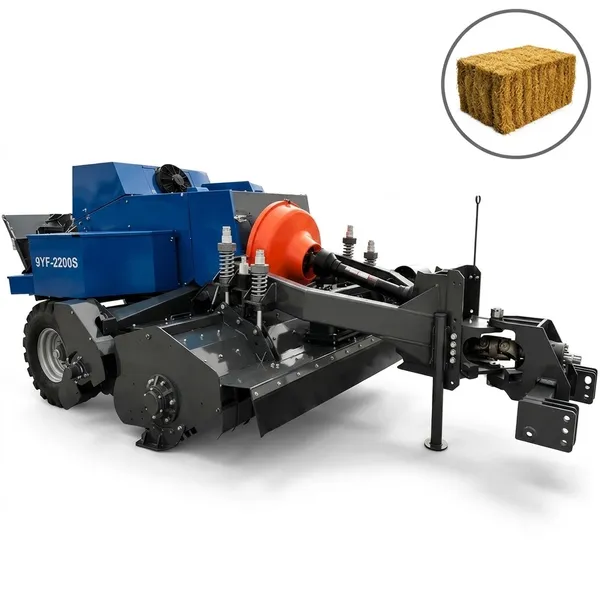
Yes — in most crop types, the 9YF-2200S produces higher average bale density than the 9YF-2200 at the same tension setting. The shredder mechanism breaks stems into shorter sections (50–150mm versus 300–600mm for uncut material) before they enter the bale chamber. Shorter stem segments pack more uniformly — they fill the chamber cross-section with less bridging and fewer large voids than long, rigid stems. The result is more dry matter per unit volume at the same tension setting, equivalent to a denser bale at the same physical dimensions. In standard grass hay and well-cured alfalfa, the density advantage is moderate — approximately 8–12% higher bale weight at the same tension setting compared to the non-shredder model. In late-cut alfalfa, corn stover and sorghum stalk, where long stems bridge significantly, the density advantage can exceed 20%. View the full
9YF shredder and standard model range for model-by-model specifications.
Get More Tonnes
Get More Tonnes Per Acre From the Right Baler Setup
From the 9YF-2200 for standard hay to the 9YF-2200S for maximum density in hard-stalk crops — the Serie 9YF is available in the configuration that matches your target bale weight and crop type. Contact us to confirm the right model.
Redattore: Cxm