Specialty Crop Baling Guide

Straw Baling Guide: Wheat, Barley, and Oat Straw Moisture Targets, Baler Settings, and Market Applications

Straw is the most forgiving baling crop for moisture — but the most unforgiving for density uniformity. Getting the baler settings right for each straw type determines whether you produce tight, stable bales that command bedding premiums or loose, soft bales that shed material in transit and lose value before they reach the end user.

Get Straw Baling Equipment Info

U.S. straw production from small grain harvest runs 30 to 50 million tons annually, with wheat straw dominating in the Central Plains, barley straw concentrated in the Pacific Northwest and Mountain West, and oat straw produced across the upper Midwest and Northern Plains. For grain farmers, straw baling converts a post-harvest residue into a marketable commodity — but only if the baling operation is managed correctly. Straw behaves very differently from hay in the baler: it is stiffer, lower-density, and much more sensitive to over-compression than forage crops, and each crop species has different physical properties that affect how the bale forms and how the market values the final product.

Wheat, Barley, and Oat Straw: Physical Properties and Baling Specs

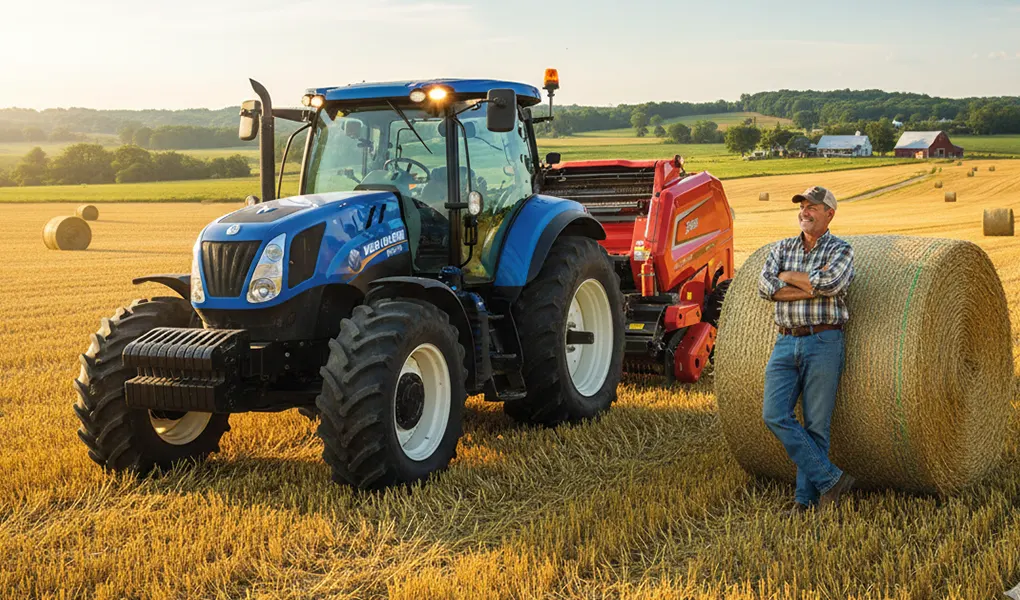
round baler for straw baling — wheat barley and oat straw require specific moisture and density settings for stable bale formation
수확고 Max baling
moisture
Stem
stiffness
Typical bale
density (4×5)
Net wrap vs
twine
Primary market
Wheat straw 18% (safe)
15% preferred
High — hollow stem resists compression 450–650 lbs Twine acceptable;
net wrap for transit
Livestock bedding, mushroom substrate, biomass fuel, erosion control
Barley straw 18% (safe)
14% preferred
Medium — finer stem; compresses more than wheat 500–700 lbs Net wrap preferred for shape retention Livestock bedding (horse premium), export markets, brewing byproduct uses
Oat straw 20% (higher tolerance)
16% preferred
Low — soft, fibrous stem; easiest to compress 550–750 lbs Net wrap strongly preferred Livestock feed supplement (higher digestibility than wheat), premium bedding, thatching

Baler Settings Specific to Straw

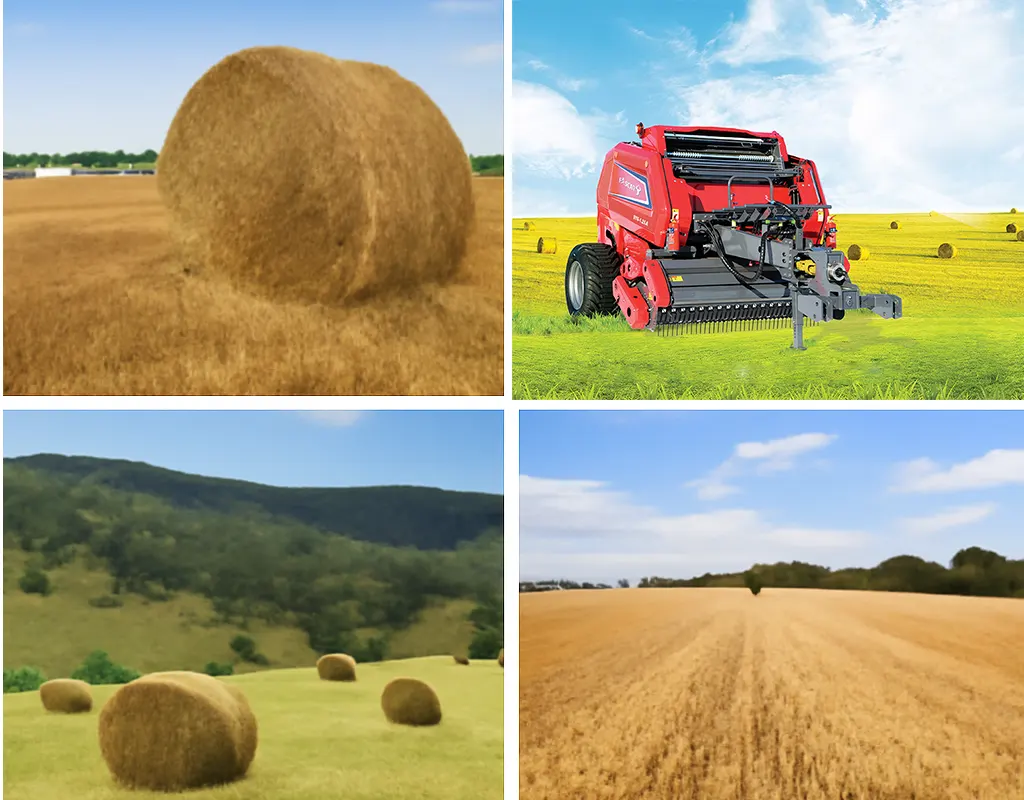
round baler straw baling operation — density settings and pickup height for wheat and barley straw windrow

Straw requires different baler settings than hay in three key areas. First, pickup height: straw windrows from combine swath boards sit higher off the ground than hay windrows from a mower, so pickup height can be set 1 to 2 inches higher than the hay setting without losing material. This reduces soil and chaff contamination of the bale — critical for mushroom substrate and export markets that test ash content. Second, chamber density: wheat straw’s stiff hollow stem creates a springback effect — the bale compresses under the belt load but expands slightly when the belt pressure is released at ejection. Set the density 10 to 15% higher than the final target weight to compensate for this springback. Oat straw, by contrast, compresses easily and stays compressed; set density at the lower end of the target range to avoid over-dense bales that exceed load limits. Third, baling speed: straw can typically be baled 15 to 25% faster than alfalfa at the same windrow density — the lower moisture and lighter material allows faster pickup without the quality-loss concerns that limit hay baling speed.

For straw stored outdoors between harvest and sale, the moisture limit at baling is more important than for covered hay storage because straw’s hollow stem structure wicks ambient moisture more readily than solid hay stems. Our round bale storage guide covers outdoor straw placement and moisture management to prevent quality loss between baling and sale. For the net wrap specification that determines how well the straw bale holds its shape through handling and transit — critical for bales shipped long distances — our net wrap selection guide covers the UV class, denier, and overlap settings that protect straw bale integrity. The agricultural gearbox and PTO driveline components on the round baler experience lower average torque during straw baling than hay baling — the lower density and drier condition of straw makes the baler’s mechanical components work somewhat less hard per bale — but the higher baling speed used in straw production can offset this advantage in total annual component stress.

round baler straw and hay field application — straw baling produces bedding and biomass fuel bales alongside hay production

자주 묻는 질문

Can straw be baled immediately after grain harvest or does it need to dry?+
Straw from small grain harvest is typically cut and left in a swath by the combine’s straw spreader or windrow attachment while the grain is threshed. In most U.S. small grain production regions, the straw is already at 12 to 16% moisture at harvest time — well within the safe baling range — and can be baled the same day or the following day after the combine runs. The exception is humid harvest conditions (Pacific Northwest barley harvest in wet years, spring wheat in the upper Midwest with morning dew) where straw moisture may be 20 to 25% immediately after cutting. In those conditions, 1 to 3 days of field drying before baling is needed. Unlike hay, which requires careful management to avoid quality-loss from over-drying, straw can be left in the field for several days without significant quality penalty — the primary risk from leaving straw exposed is rain rewetting and potential bleaching from UV exposure, neither of which significantly affects bedding value.
What makes barley straw worth more than wheat straw for horse bedding?+
Barley straw commands a premium over wheat straw in horse bedding markets for three reasons: barley straw has finer, softer stems that are more comfortable for horses to lie on and less likely to cause abrasions on thin-skinned breeds; it absorbs moisture more readily than wheat straw’s waxy hollow stem, making stall cleaning easier; and it has lower dustiness than wheat straw in most production regions, which matters for horses with respiratory conditions. The premium varies by region but is typically $15 to $40 per ton above wheat straw at the bedding market level in the Pacific Northwest and Northern Plains where both crops are grown. For the export market (barley straw exports to Japan and Korea for equine bedding), the premium is even larger, making barley straw from irrigated Pacific Northwest production one of the higher-value straw commodities available to U.S. grain producers.
What are the ash content requirements for biomass fuel straw?+
Biomass fuel buyers (power plants, industrial boilers, pellet mills) typically require straw with ash content below 6 to 8% on a dry matter basis — wheat straw averages 5 to 6% ash in clean bales from well-managed fields, rising to 10%+ in bales with significant soil contamination from low pickup height or wet-field baling. Soil contamination is the single largest cause of straw biomass rejection or dock at energy facilities, because silica in soil ash causes slagging and fouling in combustion equipment. Baling height management (pickup set 2 to 3 inches above ground), dry field conditions at baling, and avoiding over-windrow passes that accumulate soil in the windrow are the primary tools for keeping ash content within biomass specification. Some biomass buyers also specify nitrogen content below 0.5% (straw is typically 0.3 to 0.5%), chloride below 0.2% (relevant for coastal regions with salt-drift deposition), and moisture below 15% at delivery.
Does straw wear out baler pickup tines faster than hay?+
Straw is generally less abrasive on tines than hay, but the higher operating speed and the presence of soil contamination in straw windrows can affect tine wear differently than hay. At the same soil contamination level, straw baling at 7 to 9 mph creates more tine-to-soil contact events per hour than hay baling at 5 to 6 mph — accelerating tine wear in fields where soil contamination is present. Sandy soil straw (common in light-textured Great Plains wheat fields) is significantly more abrasive on tines than clay soil straw or hay from well-established stands. The net effect is that tine replacement intervals for straw operations are similar to hay operations at moderate speeds and soil contamination levels, but can be shorter in high-speed straw baling on sandy soils. Inspect tines after every 200 to 300 straw bales in sandy conditions.
What is straw used for in mushroom production?+
Wheat straw is the primary substrate for oyster mushroom (Pleurotus ostreatus) cultivation — the most widely produced specialty mushroom in the U.S. and globally. The straw provides both the structural support and the carbon nutrient source that the oyster mushroom mycelium colonizes before fruiting. Mushroom substrate buyers require wheat straw with ash content below 7% (soil contamination control), moisture below 15% at delivery, no visible mold or heating damage, and no pesticide residue from fungicide applications within 60 days of harvest. Some buyers also specify non-GMO wheat or organically produced straw, commands a premium of $20 to $60 per ton above conventional. Round bale format is increasingly preferred by commercial mushroom operations because the bale can be placed directly into a steam pasteurization tent without re-handling, reducing labor cost at the substrate preparation stage.
How does straw baling affect soil health if I remove all the residue?+
Removing all straw residue from a field reduces the organic matter returned to the soil from that crop — the same carbon that would decompose into humus if left on the field is instead removed as a marketable commodity. Research on continuous straw removal (every year on the same field) shows a slow decline in soil organic matter over 5 to 10 year periods in soils that are not receiving significant organic amendments from other sources (manure, cover crops, compost). The practical management approach for grain farmers who want to bale straw without soil quality consequences is to alternate straw removal with incorporation years — bale straw in years where the straw market justifies the removal cost, and incorporate in years with low straw prices. Many operations also apply fall cover crop seed behind the baler to establish a root system that partially compensates for the organic matter removed with the straw.
foragebaler.com round baler for straw baling — wheat barley and oat straw baling with adjustable density and net wrap

Get a Round Baler Configured for Your Straw Crop and Target Market

Density settings, pickup height, and net wrap configuration for wheat, barley, or oat straw confirmed before your baler ships from Sacramento, CA. Our team matches baler specs to your target market — bedding, biomass, or export.

Get Straw Baling Equipment Info

편집자: Cxm