
The Five Weather Variables That Control Drying Rate
Hay drying is a physical process — water in the cut crop evaporates at a rate determined by the vapor pressure difference between the crop surface and the surrounding air. Five measurable weather variables determine how fast that evaporation occurs. Understanding which variables matter most allows you to use a weather forecast as a drying rate prediction rather than just a rain-risk assessment.
| Condition combination | Expected drying rate | Cutting decision |
|---|---|---|
| Full sun, 80–90°F, RH 30–45%, wind 8–15 mph | Excellent — 28→18% in 18–24 hrs | Cut immediately — optimal window |
| Partly cloudy, 75°F, RH 50–60%, wind 5–8 mph | Moderate — 28→18% in 36–48 hrs | Cut if ≥3 clear days follow; skip if rain in 48 hrs |
| Overcast, 68°F, RH 65–75%, wind 3–5 mph | Poor — may not reach 18% in 72 hrs | Delay cutting; risk of rained-on crop |
| Any condition with rain forecast in 36 hrs | Unacceptable — rain risk | Do not cut. Wait for a 48-hr rain-free window minimum. |
How to Read a 10-Day Forecast for Hay Cutting Decisions
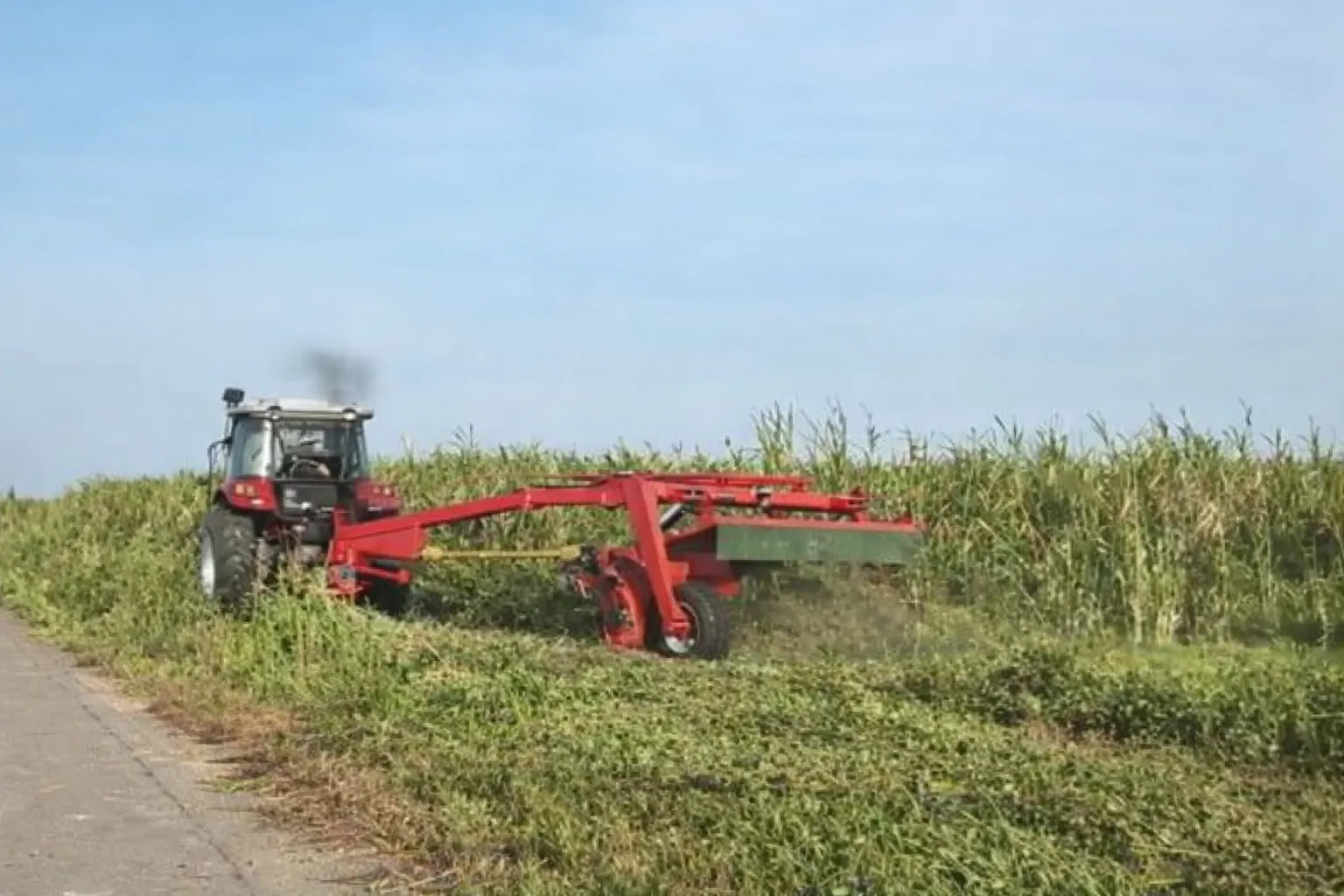
A weather forecast for hay cutting is not just a rain probability check — it is a multi-variable curing period evaluation. The question is not “will it rain on the day I cut?” but “will the 48–72 hour period after cutting provide enough drying potential to bring this crop to baling moisture before the next rain event?”
Identify your required drying window. First-cut alfalfa needs 48–72 hours to reach baling moisture in good conditions; lighter second or third cuttings need 24–48 hours. Identify the hours needed from cut to baling based on your crop, stand density, and conditioning equipment.
Check rain probability for the full drying window. Any day with precipitation probability above 30% within your required drying window is a risk. The exact threshold depends on your risk tolerance and crop value — for Premium export alfalfa, 20% precipitation probability may be the threshold. For livestock hay, 40% may be acceptable.
Check daytime RH and temperature for each day of the window. If forecast daytime RH is consistently above 65% even without rain, drying will be slow. Two overcast 70°F days with 65% RH will not dry alfalfa to baling moisture reliably even without a rain event. Insufficient drying potential is a quality risk even without direct rain.
Check overnight dew point for each night in the window. Overnight dew point above 60°F causes significant moisture reabsorption in partially dried hay — the crop that was at 22% moisture at 7 PM may be at 28% by 7 AM the next morning. High overnight dew point extends the required drying window by 8–12 effective hours per night.
Confirm the post-window weather. What follows your planned baling window matters. If baling conditions look good but rain is forecast 12 hours after your planned baling time, any delays in baling leave the crop exposed. Build a buffer between planned baling time and the next rain risk.
Dew Point and Overnight Reabsorption: The Variable Forecasters Often Miss
Dew point temperature is the temperature at which the air becomes fully saturated — when air cools to the dew point, moisture condenses on surfaces. When the overnight air temperature drops to the dew point, hay in the field absorbs moisture from the air through the same vapor pressure gradient that drives daytime drying, but in reverse. A crop that dried to 16% moisture by sunset can absorb enough atmospheric moisture overnight to return to 22–26% by early morning.
Overnight dew points below 50°F produce minimal moisture reabsorption. The crop may gain 1–3% moisture overnight from slight condensation but dries back rapidly in the first 1–2 hours of the next morning. In arid western climates where summer dew points are consistently 30–45°F, hay can sometimes be baled in the early morning after an overnight drying period without significant reabsorption concern.
In humid midwestern and eastern regions where summer dew points are consistently 60–70°F, overnight reabsorption is a major yield and quality factor. Hay that dried to 18% by 5 PM can return to 28–32% by 7 AM the next morning. This means the effective drying window is only the daylight hours — and baling must occur before dusk on the day the crop reaches baling moisture, not the following morning. Plan baling schedules around this constraint in high-dew-point climates.
Regional Hay Drying Patterns: How Climate Zone Changes the Strategy
The Best Weather Data Sources for Field-Level Hay Decisions
National Weather Service forecasts are adequate for 3-day planning but have spatial resolution of 2–5 miles — a thunderstorm that misses your field shows up in the forecast because it hit a station 4 miles away. For hay cutting, field-level accuracy matters more than for most agricultural decisions. The sources that provide the best field-level accuracy are ranked here by specificity and agricultural relevance.
Services such as DTN/Progressive Farmer, AgWeather, and Climate Corporation offer field-specific forecasts with hourly RH, temperature, wind, and precipitation probability. Many include a “hay drying index” or equivalent composite metric that translates the raw variables into a single drying potential score. These services are subscription-based but typically cost $100–$300/year — justified for operations where a single rained-on cutting represents $2,000+ in quality losses.
NOAA’s National Digital Forecast Database provides hourly forecasts for any GPS coordinate in the U.S. at no cost through api.weather.gov. The API provides temperature, RH, dew point, wind speed, precipitation probability, and sky cover for each hour, 7 days forward. A simple spreadsheet that inputs your field coordinates and pulls this data provides better field-level forecasting than any app for the drying period analysis described in this guide.
A simple on-farm weather station ($200–$600) recording temperature, RH, dew point, and wind gives the actual conditions at your field rather than forecast conditions. Historical on-farm records are the most valuable tool for calibrating forecast-to-actual differences specific to your location — learning your microclimate’s systematic biases from the regional forecast makes every subsequent cutting decision more accurate.
Rain Event Response: When a Rain Hits the Cut Crop

A rain event during the curing period is one of the most common and costly problems in hay production. The response depends on the amount of rain, the crop’s moisture level when the rain hit, and the quality of the post-rain weather window. Not all rain events produce the same damage — a 0.2-inch shower on hay at 35% moisture is very different from 1.5 inches of rain on hay that had dried to 18%.
On hay above 35% moisture: minimal additional damage — the crop was already wet and the rain adds limited total water. On hay at 15–25%: more damaging, as the rain rewets dried stems that had lost their waxy cuticle protection. Response: wait for surface dew to dry (typically 2–4 hours after rain stops), then ted if crop is above 30% moisture. Bale when moisture probe confirms target range.
Significant protein and soluble carbohydrate leaching occurs from rain contact on hay below 40% moisture. Quality loss is real and measurable on a forage test — expect 5–15 RFV point reduction on leached hay. After rain stops, allow at least 6 hours before entering the field to allow surface water to drain. Ted the windrow to accelerate re-drying. Test moisture before baling — rained-on hay often has non-uniform moisture with dry surface and wet core. If a second rain is forecast within 24 hours, consider baling at slightly elevated moisture with hay preservative to prevent further leaching.
Heavy rain on curing hay causes major quality loss — leaching, physical damage to the mat structure, potential mold initiation at the windrow base, and a significant RFV reduction that drops Premium-grade hay to Good or below. Reassess market destination after a heavy rain event — hay that was intended for horse or export premium markets may need to be redirected to livestock feed markets at a lower price point. A forage test after re-drying provides the actual quality data needed for accurate market decisions.
The mowing and conditioning equipment settings that maximize drying rate and reduce the required window length — reducing weather risk exposure for every cutting — are in the guia de qualidade para corte e condicionamento de grama. The quality management decisions throughout the harvest workflow that determine final hay grade are in the guia de como melhorar a qualidade do feno. The mower-conditioner PTO and gearbox specifications that determine conditioning intensity are in Especificações dos componentes da caixa de engrenagens e da transmissão da tomada de força (TDF) para uso agrícola.
Cutting Timing Within the Day: Morning vs Afternoon Cuts
Cutting in the morning maximizes the drying time available on the first day. A crop cut at 9 AM has 8–9 hours of peak-sun drying before late afternoon humidity begins rising. The disadvantage: morning dew may still be present on the crop at cutting time, adding initial moisture load. Wait until dew evaporates from the crop surface (typically 8:30–9:30 AM in summer) before cutting to avoid mechanical dew-spread during mowing. A morning cut requires a corresponding morning rake and afternoon bale — the full workflow must fit within the single day’s drying window in high-dew-point climates.
Afternoon cuts allow dew evaporation before cutting but provide less same-day drying time. The advantage is that the mowed crop has the highest sugar content in the afternoon (photosynthesis has been running all day), which can support more efficient fermentation for silage applications. For dry hay production in humid climates, afternoon cuts produce less same-day progress than morning cuts. In arid western climates where overnight moisture reabsorption is low, afternoon cuts are viable since the crop dries adequately the following day without significant overnight setback.
Hay Drying Weather FAQs
Get Conditioning Equipment That Shortens Your Drying Window
Tell us your crop type, climate zone, and current drying time from cut to bale. We recommend the mower-conditioner configuration that reduces your required drying window and minimizes weather-exposure risk at each cutting.
Editor: Cxm


