Tractor Compatibility · 9YF Series · Power Guide
Küçük Kare Balya Makinesi İçin Traktör Beygir Gücü: Kapsamlı Kılavuz
Five models, five different power requirements. From the 9YF-1700 that pairs with 40HP compact tractors to the 9YF-2200S and 9YFS-2.2 that need 99HP minimum at the PTO — this guide gives you the correct pairing for your tractor and crops so the machine runs reliably all season without damaging either the baler or the drivetrain.
Why PTO HP Is What Actually Matters — Not Engine HP
The 10–15% Gap That Causes Pairing Mistakes
Every baler power specification is a PTO (Power Take-Off) output requirement — not engine output. A 65HP engine tractor typically delivers 55–60HP at the PTO shaft. A 75HP engine tractor delivers 63–68HP at the PTO. This 10–15% difference between engine output and PTO output is consistent across tractor manufacturers and power classes, and it is the most common source of pairing mistakes when buying a square baler.
When a 9YF model specification lists a minimum power — say 36.8kW (50HP) — that is the minimum PTO output, not engine output. A 55HP engine tractor producing 47HP at the PTO is below the 50HP PTO minimum for the 9YF-1900 and 9YF-2200, even though 55HP engine output sounds comfortably above 50HP. Always use PTO horsepower for baler pairing. Tractor sales materials and operator manuals list PTO HP separately from engine HP — use that number.
How PTO Load Changes in the Field
Square baler PTO demand is not constant across a field session. Average PTO load in standard hay or straw at moderate forward speed is typically 60–75% of the machine rated minimum. Peak load occurs at the knotter engagement point — when the plunger reaches maximum compression and the knotters fire simultaneously. In dense windrow sections or thick late-season alfalfa, peak load can reach 100–110% of the minimum for 1–2 seconds per bale cycle. A tractor running at 90% of the minimum has no reserve for these peaks, which either stalls the PTO momentarily (producing a missed knot) or causes the engine speed to lug down, which reduces gearbox speed and disrupts the drive chain timing for the next cycle. Adequate reserve — a tractor producing at least 110% of the minimum at the PTO under normal operating conditions — eliminates these peak-load effects.
9YF-1700: HP Requirements for the 1,700mm Compact Model
Specifications and Compatible Tractors
O 9YF-1700 has a rated power range of 29.5–73.5kW (approximately 40–99HP PTO). The 40HP PTO minimum is the lowest entry point in the 9YF series and the only model in the lineup that genuinely pairs with compact utility tractors in the 45–55HP engine class. A compact tractor producing 38–45HP at the PTO connects to the 9YF-1700 with adequate reserve for standard hay and straw in light-to-medium windrow conditions.
9YF-1700 Tractor Pairing Reference
Minimum (40HP PTO): 45–50HP engine compact utility tractors — adequate for light-density hay and straw in clean windrows at reduced forward speed. No power reserve for heavy sections.
Comfortable (50–60HP PTO): 55–70HP engine utility tractors — reliable operation across standard hay, straw and moderate forage windrows. Adequate reserve for windrow density variation.
Oversized (70HP+ PTO): The machine handles the power without damage but the lightweight machine at 1,750kg may have reduced ground tracking stability behind a much larger tractor on uneven terrain.
9YF-1900: HP Requirements for the 1,900mm Mid-Range Model
The 9YF-1900 is rated 36.8–73.5kW (approximately 50–99HP PTO). The 50HP PTO minimum aligns with the output of a 60–65HP engine tractor — the most common working tractor on farms in the 100–300 acre size class in the U.S. market. At 1,900mm pickup width, the machine covers somewhat denser windrows per pass than the 1700, which slightly increases the average PTO draw in heavy hay. A 55HP PTO tractor at the minimum is technically compatible but has less reserve for peak loads in dense alfalfa or thick straw windrows than a 65–70HP PTO tractor in the same conditions.
The comfortable everyday pairing for the 9YF-1900 is a tractor producing 60–80HP at the PTO — approximately 70–90HP engine output. This gives adequate reserve across all standard crops and windrow densities without overloading either the tractor or the machine.
9YF-2200: HP Requirements for the Standard Full-Width Model
The 9YF-2200 minimum is 36.8kW (50HP PTO) — the same minimum as the 9YF-1900 despite the 300mm wider pickup. The reason: the 9YF-2200 uses the same spring-tooth pickup and standard compression chamber as the 1900, and a 300mm wider pickup in standard crop conditions does not substantially change the PTO demand per bale cycle. What does change is the per-hour material throughput — the 2200 processes more material per forward metre at the same speed, which means windrow density variation across a field has a larger effect on load variation than on the 1900.
In practical terms: a 60HP PTO tractor that manages the 9YF-1900 comfortably in standard hay may occasionally labour in dense corn stover windrows on the 9YF-2200 because the wider pickup collects a heavier charge per plunger cycle. For operators planning to bale mixed crops including heavier materials, sizing up by 10–15HP PTO for the 9YF-2200 versus the 9YF-1900 provides more reliable all-condition performance.
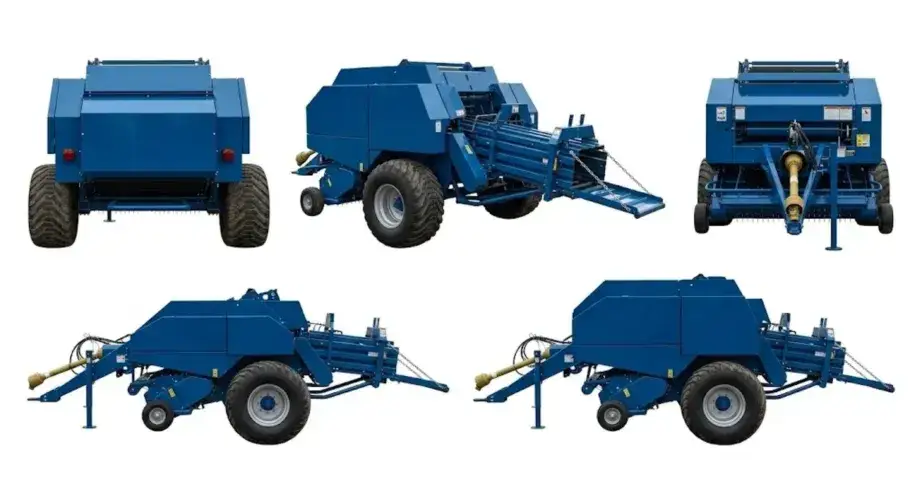
9YF-2200S and 9YFS-2.2: Why Shredder Models Require 99HP Minimum
The Shredder Load Is Not Small
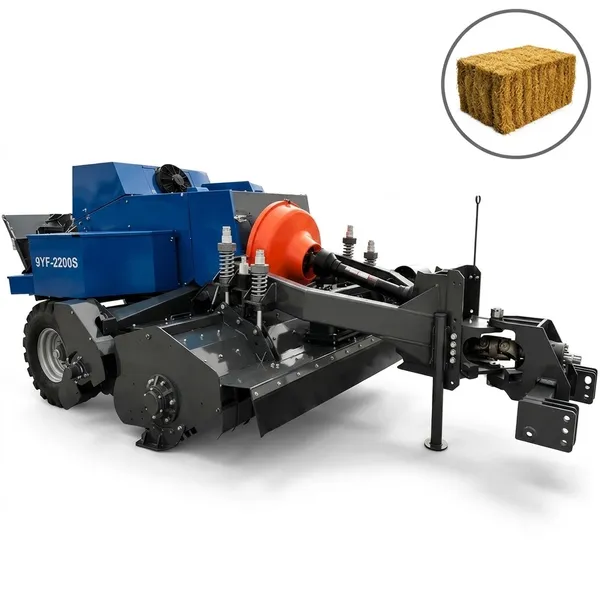
The 9YF-2200S single-stage shredder and 9YFS-2.2 dual-stage shredder both operate between the feeder and the compression chamber, continuously breaking hard stalks as material flows through the machine. In corn stover at full drydown or mature sorghum, the shredding stage can draw 20–35HP PTO on its own — before the plunger, knotters and pickup add their load. This is why the minimum jumps from 50HP to 99HP between the non-shredder 9YF-2200 and the shredder-equipped 9YF-2200S: the machine fundamentally requires more power at the PTO to operate all its systems simultaneously.
The 9YFS-2.2 adds a second shredder stage and a negative-pressure fan, both of which draw additional PTO load above the single-shredder model. In dense corn stover at full shredder engagement, the 9YFS-2.2 can approach 90–100HP PTO draw on the combined mechanism before the plunger stroke. For this reason, 115–130HP PTO is the comfortable operating range for the 9YFS-2.2 in hard-stalk conditions — not 99HP, which is the minimum for light conditions only.
Shredder Model Tractor Pairing
| Crop Condition |
9YF-2200S |
9YFS-2.2 |
| Light hay and straw (minimum) |
99HP PTO |
99HP PTO |
| Standard mixed conditions |
105–115HP PTO |
110–120HP PTO |
| Dense corn stover or sorghum |
110–125HP PTO |
120–140HP PTO |
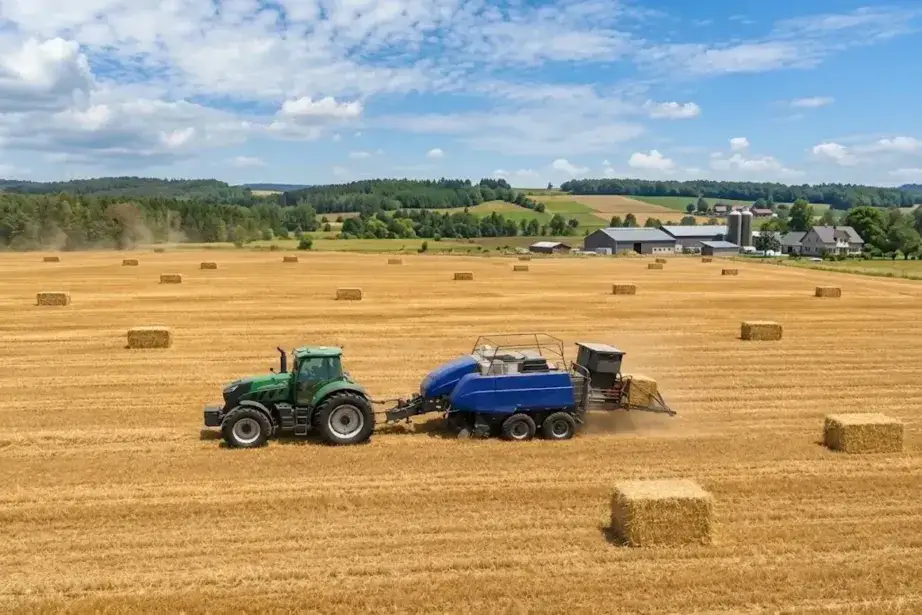
Real-World Pairing Examples by Tractor Class
Typical engine: 45–50HP compact utility. Compatible model: 9YF-1700 only. In light grass hay and clean wheat straw at 2–3 km/h forward speed, this pairing works reliably. In dense alfalfa or thick windrows, reduce forward speed until the engine does not labour. This power class has no reserve — manage forward speed actively rather than running at maximum speed in heavy sections.
Typical engine: 62–68HP utility. Compatible models: 9YF-1700 (comfortable), 9YF-1900 (within range), 9YF-2200 (adequate, reduced speed in heavy crops). This is the most common pairing class for small farm operations. Standard grass hay and wheat straw work well across all three non-shredder models at this PTO output.
Typical engine: 85–95HP row crop or utility. Compatible models: 9YF-1700/1900/2200 (all comfortable), 9YF-2200S and 9YFS-2.2 (below minimum — not recommended). Excellent pairing for all three spring-tooth standard-compression models. Not adequate for shredder models — the 99HP minimum for shredder models is a real minimum, not a marketing figure.
Typical engine: 120–130HP row crop or mid-range tractor.
Compatible models: All 9YF models including 9YF-2200S and 9YFS-2.2 in standard to moderate crop conditions. Comfortable operation in corn stover and sorghum with the shredder models. 10HP above the shredder minimum provides adequate reserve for peak load events.
The Cost of Running a Square Baler Below Rated Power
Immediate Field Effects
When a tractor PTO output falls below the baler rated minimum, the first symptoms appear at the knotter stage. The plunger needs consistent PTO speed to maintain correct knotter timing — if the tractor lugs down at the peak compression point, the knotter fires late and misses the twine, producing a missed knot even with all mechanical components in perfect condition. Operators who see intermittent missed knots in heavy windrow sections but clean tying in lighter sections are typically experiencing a power-deficiency symptom rather than a mechanical knotter problem.
Long-Term Equipment Damage
Sustained operation below rated power places the tractor drivetrain under continuous thermal stress. The transmission and PTO gearbox generate excess heat when operating at 95–100% of capacity continuously — well above the 70–80% sustained load that gear lubricants and seals are designed for in normal duty cycles. Over a season of regular baling below the power minimum, this manifests as premature seal failure, gear-face pitting and final-drive bearing wear in the tractor. On the baler side, the same peak-load stress that causes missed knots also places shock loads on the gearbox input shaft and plunger crank — components that are rated for normal cyclic loading at the specified power range, not for the irregular shock loading that occurs when the PTO speed drops and recovers on every bale cycle.
PTO Shaft, Coupling and Gearbox Specifications
Three Critical Checks Before First Connection
- PTO shaft length:With the baler hitched at working depth and the tractor at maximum turning angle, the telescoping shaft must not bottom out (fully compressed) or over-extend beyond 2/3 of its travel range. A shaft that bottoms out transmits shock loads into the baler gearbox input bearing; a shaft at full extension has minimal overlap at the telescoping joint and can separate during field turns.
- CV joint angle:At maximum tractor turn, the universal or CV joint angle should not exceed the manufacturer-specified maximum (typically 25–35 degrees). Exceeding the rated joint angle produces vibration that transmits through the driveline and into the baler gearbox — causing premature wear on the input shaft splines and bearings.
- Slip clutch and shear bolt:The overload protection device (slip clutch or shear bolt in the PTO shaft) must be rated for the baler gearbox input torque specification. A clutch set too high provides no protection; a shear bolt rated too low triggers on every heavy bale cycle and requires constant replacement in dense windrows.
PTO Driveline Specification Resources
Frequently Asked Questions — Tractor HP for a Small Square Baler
Can my 50HP tractor run a 9YF-2200 square baler?+
A 50HP engine tractor typically produces 42–46HP at the PTO shaft. The 9YF-2200 minimum rated power is 36.8kW (50HP PTO). If your 50HP engine tractor produces below 50HP at the PTO — which is likely — it is technically below the minimum for this model. In light grass hay and thin straw windrows at low forward speed, the machine may function adequately. In normal to dense windrows, corn stover or thick alfalfa, the power deficiency will produce missed knots, engine laboring and acceleration of gearbox wear. The 9YF-1700 (40HP PTO minimum) is the correct model for a 50HP engine tractor. If you specifically need the 2,200mm pickup width, the realistic minimum is a 60–65HP engine tractor producing 52–57HP at the PTO.
What happens if I run a 9YF-2200S on a 85HP tractor?+
The 9YF-2200S minimum is 73.5kW (99HP PTO). An 85HP engine tractor typically produces 72–78HP at the PTO — just at or slightly below the 99HP minimum. In light hay and straw without the shredder engaged, the machine may run adequately. With the shredder engaged in corn stover or sorghum — the primary application for the 9YF-2200S — the combined shredder, plunger and pickup load will exceed the tractor PTO capacity during heavy windrow sections. The practical symptoms: frequent PTO speed drops, missed knots in dense sections, engine overheating in sustained operation, and accelerated wear on both the tractor PTO gearbox and the baler gearbox input components. The 9YF-2200S is designed for 100HP+ engine tractors (producing 87–95HP+ at the PTO) with meaningful power reserve above the minimum.
Why do square balers need more HP than round balers of the same pickup width?+
Square balers do not inherently require more power than round balers at equivalent pickup widths. Variable-chamber round balers (the most common round baler design) actually have higher average PTO demand than fixed-chamber models because of the belt or roller slip load during bale growth. The key difference is peak load: in a square baler, the peak PTO draw occurs at every plunger compression stroke — approximately once per 2–4 seconds at normal operating speed. Each peak is sharp and brief. In a round baler, peak load occurs during net wrap and ejection cycles — less frequently but for longer durations. Both machine types require adequate tractor power reserve for their peak load events. The perception that square balers need more power typically comes from comparing a small square baler (which must tie every 2–4 seconds) to a large round baler (which ties every 60–180 seconds), rather than comparing equivalent machines.
Can I use a 540E (Economy) PTO with a square baler?+
The 9YF series operates at standard 540rpm PTO speed. The 540E (Economy) PTO mode available on some tractors drives the PTO shaft at 540rpm but at a lower engine speed than standard 540 — typically 1,700–1,800 rpm engine speed rather than the standard 2,200 rpm. Whether 540E works with a square baler depends on the specific tractor — some 540E modes deliver the rated PTO torque at the lower engine speed (acceptable), while others de-rate PTO torque proportionally with the engine speed reduction (not acceptable for a baler). Check your tractor manual for the PTO torque output in 540E mode at the engine speed it engages. If the torque output matches the standard 540 torque at full PTO engagement, 540E is usable and reduces fuel consumption. If the torque is reduced, use standard 540 mode for baling.
My tractor has enough HP but misses knots in heavy windrows — is this a power problem?+
Intermittent missed knots specifically in heavy windrow sections — but not in lighter sections of the same field — can be a power symptom even on tractors nominally above the minimum. The reason: the rated minimum is tested at a specific PTO speed under continuous load. In field conditions, a tractor at 100% of rated PTO output in a heavy windrow section with the engine management system protecting against overload can briefly reduce PTO torque during the plunger peak load — even if the tractor has adequate average output. Two diagnostic steps: check whether missed knots correlate with noticeable engine RPM changes (detectable by ear or RPM gauge) during the bale cycle. If so, the problem is power. If the engine RPM stays stable and missed knots still occur in heavy sections, the problem is mechanical — knotter bill wear, tension setting or cam timing — because the power supply is consistent but the mechanism is not.
Does a heavier baler need more tractor HP than a lighter one?+
Machine weight and PTO power requirement are related but not the same. A heavier baler requires more drawbar pull (affecting ground traction and fuel consumption), places higher load on the tractor three-point hitch or drawbar, and requires larger tyres on the tractor for stable field tracking. But PTO HP demand is driven by the mechanism — the plunger compression force, the knotter engagement loads and (for shredder models) the shredder motor load. A 9YF-2200 at 1,950kg and a 9YF-1900 at 1,850kg have nearly the same PTO minimum (both 50HP) despite the weight difference, because their mechanisms are similar. The 9YF-2200S at 2,350kg requires 99HP — not because it is heavier but because the shredder adds a major power-consuming mechanism that the lighter models do not have.
How do I check my tractor actual PTO HP rather than the nameplate engine HP?+
The most reliable method is to find the OECD test report for your specific tractor model — these standardized tests measure PTO horsepower under controlled conditions and are published by tractor manufacturers for most current and recent models. The report will list maximum PTO power and rated engine speed PTO power separately. If the test report is not available, use the general estimate of 85–88% of rated engine HP as the PTO output estimate for most modern utility tractors. Older tractors with more mechanical transmission loss may be at 80–85% of engine output at the PTO. If your tractor has any hydraulic-assist or electronic features that draw significant power off the engine (front loaders on their highest duty cycle, etc.), deduct those loads from the available PTO output as well — the engine can only deliver its rated output once across all accessory and PTO loads simultaneously.
If I have a 120HP tractor, which 9YF square baler should I buy?+
A 120HP engine tractor produces approximately 102–108HP at the PTO — comfortably above the 99HP minimum for the 9YF-2200S and 9YFS-2.2 shredder models. With this power class, all five 9YF models are compatible. The choice is determined by what you need the machine to do, not by power availability: the 9YF-2200 (spring-tooth, no shredder) is the right choice if your crops are standard clean-windrow hay and straw and you want simplicity and lower machine cost. The 9YF-2200S (single shredder, touch screen) is right if you regularly bale corn stover, sorghum or cotton stalks where the shredder density improvement is measurable. The 9YFS-2.2 (dual shredder, fan) is right if premium bale cleanliness for the horse market, dairy or export is the priority. At 120HP, all three models run with comfortable power reserve — the decision is entirely about what processing capability the crops and markets require.
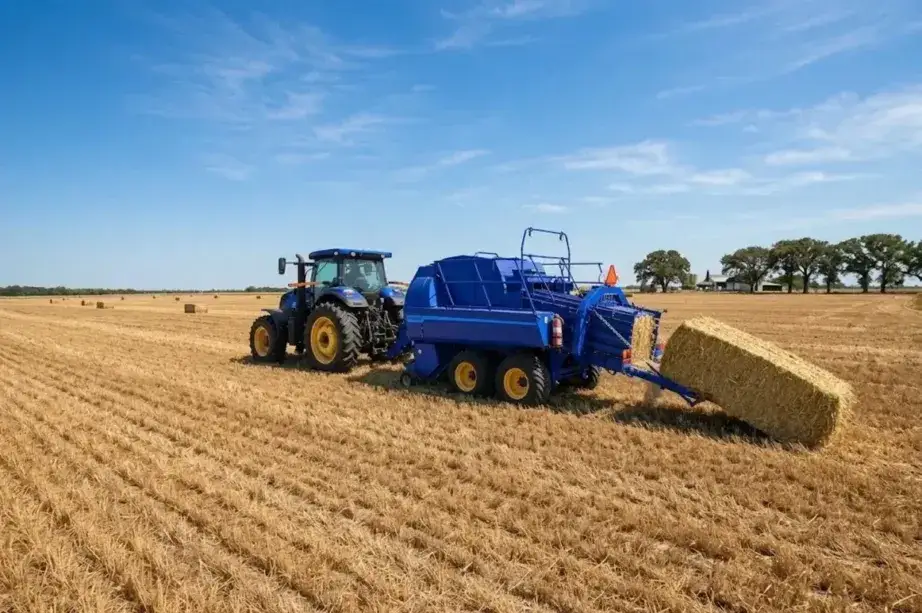
Find the Right Baler for Your Tractor and Operation
Tell us your tractor PTO output and your primary crop — we will confirm the compatible 9YF models and recommend the best fit for your operation and budget.
America Ever-Power Forage Baler Equipment INC. · 1401 21st ST STE R, Sacramento, CA 95811
Editör:Cxm