Troubleshooting Guide · Safety Protocol Included · All 9YF Models
Hay Baler Keeps Plugging: Causes, Safe Clearing and Prevention
A blocked square baler costs you time, crop loss and machine stress — and clearing it incorrectly is one of the most serious injury risks in farm machinery operation. This guide covers every cause of repeated plugging, the only safe procedure for clearing a blocked baler, and the machine and field adjustments that prevent the next blockage before it happens.
Covers: blockage location types · safe unplugging protocol · forward speed · windrow management · feeder condition · hard-stalk crops
SAFETY FIRST — Read Before Attempting to Clear Any Blockage
A baler drive train stores significant rotational energy even after the tractor PTO is disengaged. Never reach into any part of the feed system, pickup, feeder or chamber until: (1) the tractor PTO is completely disengaged, (2) the tractor engine is at idle or off, (3) all rotating components have come to a complete stop — allow at least 30–60 seconds after PTO disengagement. The plunger, knife, and feeder tines continue to move under stored inertia after the power source is removed. Baler entanglement injuries are severe and frequently fatal. This wait time is not optional.
Not all blockages are the same problem. The location of the block determines the root cause and the correct fix. Clearing the blockage without identifying its location teaches you nothing and guarantees repeat failures.
Follow these steps in order. Skipping any step is unsafe. A blocked baler under PTO load contains compressed stored energy in the crop material that can release suddenly when the blockage is disturbed.
STEP 1
Engage the tractor brake, disengage PTO completely. Move the PTO lever to the full-off position — not neutral. For tractors with an electric PTO switch, confirm the indicator light is off.
STEP 2
Wait a minimum of 60 seconds with the tractor at idle or engine off. The flywheel, plunger linkage and feeder continue to move under stored inertia after the PTO disengages. This waiting period is non-negotiable.
STEP 3
Confirm all motion has stopped by visual observation. Approach the machine only after confirming complete rest. Do not rely on sound alone.
STEP 4
Use a hay hook or wooden implement — not hands — to begin loosening the blockage from the accessible side. Reach in only as far as your tool requires; keep your body outside the feed zone.
STEP 5
For chamber blockages: back the tractor to move the machine rearward slightly — this reduces compression on the blocked material. Then remove material from the inlet access point. Do not engage PTO with material still in the chamber.
STEP 6
Before re-engaging PTO: identify why the block occurred before restarting. Restarting without addressing the cause guarantees an immediate second blockage, often more severe than the first.
Forward Speed
Start at 60–70% of your intended operating speed. Increase gradually only when inlet flow is confirmed stable across varied windrow sections. In known dense sections, reduce before entering — not in reaction to a block.
Larghezza dell'andana
Windrow width should not exceed 75% of the pickup width. A narrower windrow that the pickup can straddle without edge loading significantly reduces plug risk in high-yield crops.
Pickup Height
Set tine clearance to 30–50mm above ground. Walk the field before starting and note any high ridges or ruts that require temporary height adjustment to avoid ground contact in those areas.
Umidità delle colture
Bale only when windrow core moisture is below 20%. Wet crop has three times the blockage risk of properly cured crop at the same forward speed due to slug formation and adhesion to feeder surfaces.
Feeder Condition
Inspect fork tines before the session. Replace any tines that are bent more than 15mm from their original line or worn shorter than 85% of new length. Check for accumulated wrapping from the previous session.
Velocità presa di forza
Maintain rated PTO speed (540rpm) throughout the session. Below-rated PTO speed reduces the plunger compression rate and allows material to accumulate between strokes in the inlet zone.
My baler plugged on the second bale of the day before anything else could have worn out. Why?+
A plug on the very first or second bale is almost always a field or crop condition problem rather than a machine problem. The most common first-bale causes: the windrow at the starting point was especially dense from the previous day rake pass, a lodged or bunched section of crop from the previous windrow accumulated at the start of the next row, or the first section of the field had higher moisture than the tested sections used to make the go-baling decision. It can also indicate that crop left in the machine from the previous session created a partial restriction that the first new charge pushed into a full block. Before starting each session, clear any residual material from the inlet and visually confirm the throat is clear. Then start the first 50 metres of the field at 70% of your intended operating speed.
How do I clear a plug from the bale chamber without reversing the tractor?+
After disengaging the PTO and waiting for complete stop (Step 1–3 above), access the chamber through the inlet opening from the side or rear depending on your machine configuration. Use a hay hook — never hands — to pull material from the chamber toward the inlet opening. Work from the outside inward, removing material in sections rather than trying to pull the entire block out at once. For a severely compacted chamber block, backing the tractor by 1–2 metres reduces the mechanical compression on the block and makes manual removal substantially easier. After clearing, look into the chamber from the inlet to confirm it is completely empty before re-engaging PTO. A partially cleared chamber that is not visible from the inlet can produce a second immediate block on restart.
Will the shredder model prevent plugging in straw baling?+
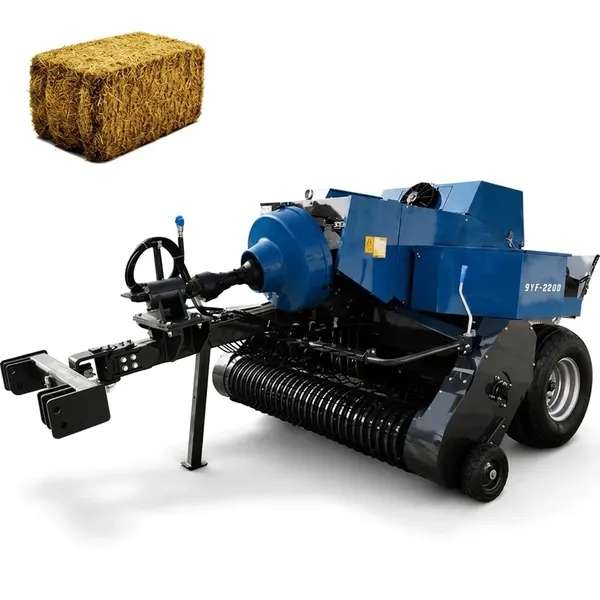
The 9YF-2200S shredder significantly reduces plugging risk in straw and stalk crops compared to spring-tooth standard models, but does not eliminate it entirely. The shredder pre-chops stems to approximately 50–150mm before they enter the bale chamber, removing the bridging risk from full-length stems. In wheat and barley straw — which is relatively low in plug risk to begin with — the shredder provides modest plugging benefit and its primary value is bale density improvement. In corn stover, sorghum and cotton stalk — where bridging is the dominant plug mechanism — the shredder provides a substantial reduction in plugging frequency and often makes baling these crops practical without pre-shredding. For standard hay baling, the shredder provides density and uniformity benefits that are separate from plug reduction — the primary anti-plug advantage of the shredder is most relevant in hard-stalk crop applications.
After clearing a plug, should I restart at full speed or reduce speed?+
Always restart at 50–60% of your operating speed after clearing a plug, regardless of the apparent cause. The windrow section immediately after the plug location is the most likely place for a second plug — either because the same dense windrow section continues, or because some loosened material from the clearing process has partially re-entered the inlet. Drive the next 50–100 metres at reduced speed while monitoring the inlet for any sign of material buildup. Only return to full operating speed once you have confirmed the windrow ahead is normal density and the machine is processing material cleanly. If a second plug occurs in the same area, exit the field section and re-examine the windrow density — persistent plugging in a specific field area points to windrow raking geometry rather than machine condition.
My baler only plugs in the headland turns. What is different there?+
Headland plugging has a very specific cause in most cases: the operator does not reduce forward speed early enough before the turn, and the machine enters the headland windrow — which is typically more dense at the row ends where previous passes have deposited additional material — at full operating speed. The headland windrow at many row-crop field ends receives accumulated material from the field raking passes and is consistently denser than the main field windrows. The fix is a procedure change: begin reducing forward speed 10–15 metres before the turn, not at the windrow itself. Reduce to 50% speed for the headland section and accelerate back to operating speed after the turn is complete and the machine is established in the next main-field windrow. If the headland section requires multiple tighter windrows due to short field ends, raking the headland last and baling it at reduced speed as a separate pass eliminates the awkward turn-and-accelerate sequence.
Can a plugged baler cause lasting damage to the machine?+
Yes — a single severe blockage can cause several types of damage. Shear bolts (on models equipped) are designed to fail at a set load threshold to protect the mechanism — these must be replaced with the correct rated replacement, not a higher-strength substitute. The plunger face can be deformed if compressed against a solid material slug with insufficient PTO reserve to complete the stroke. Feeder tines can be bent if the fork attempts to push material that is locked by the plunger on the opposite side. The timing chain can skip a link if the loading exceeds the chain tension at the critical moment. After any severe block that required significant force to clear, inspect the feeder tines, shear bolt status, timing marks and plunger face before the next baling session. A machine that produces a missed knot or erratic bale length after a severe block likely has a shifted timing chain that requires re-timing before further operation.
What forward speed should I use for first-cut alfalfa?+
First-cut alfalfa is the highest-density crop most small square balers encounter in a season — the combination of thick stems, high moisture content at baling and wide windrow from a full cutting makes it the most plug-prone of common hay crops. Recommended starting speed for first-cut alfalfa with a standard spring-tooth 9YF model: 4–6 km/h in a windrow formed from a single mower pass in a well-yielding stand. Adjust upward or downward based on observed inlet loading. In a particularly heavy first-cut stand — above 3 tonnes per acre — reduce speed further and consider splitting the windrow into two passes during raking rather than baling a merged row. With the 9YF-2200S shredder model in first-cut alfalfa, the same windrow can typically be processed at 5–8 km/h because the shredder reduces the stem length that creates slug formation in the inlet, allowing higher throughput without plugging.
How do I know if my baler plugged because of the machine or the field conditions?+
The diagnostic test is to reduce forward speed by 30% and continue baling in the same field. If the plugging stops or becomes much less frequent at the reduced speed — field conditions (windrow density, crop moisture, windrow width) are the dominant cause. If the baler plugs at the same rate regardless of forward speed — machine condition is the primary issue. Specifically check feeder tine condition, pickup height and timing if reducing speed makes no difference. A machine-cause plug occurs at the same rate across windrow densities and forward speeds because the restriction is mechanical (bent tines, reduced throat clearance, timing fault) rather than volume-driven. This field test is the most reliable single diagnostic for distinguishing cause category when the blockage location and apparent machine condition do not clearly indicate one cause over another.
From the 9YF-1700 for standard hay to the 9YF-2200S shredder model for hard-stalk crops — the 9YF series is matched to crop type and tractor HP. Tell us your primary crop and we will confirm the right model for plug-free operation.
America Ever-Power Forage Baler Equipment INC. · 1401 21st ST STE R, Sacramento, CA 95811