Business Guide · Hay Economics · Updated August 2026
Hay Baling Cost Per Bale
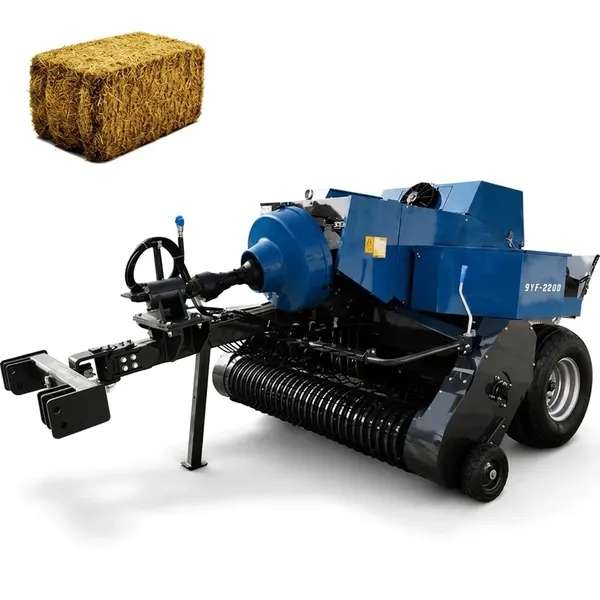
Knowing your true cost per bale — not just the custom baling rate — is the foundation of a profitable hay operation. The total cost to bale a small square bale when owning a 9YF baler at 1,000 bales per season ranges from $2.20 to $4.00 per bale, covering equipment depreciation, fuel, twine, maintenance and labor. At the same volume, custom baling costs $2.50–$4.00 per bale — meaning ownership advantage depends almost entirely on scale and market. This guide breaks down every cost component so you can calculate your own number.
Covers: complete cost breakdown per bale · own vs custom comparison · round vs square cost per tonne · revenue per bale by market · break-even volume · how to reduce cost per bale
Cost Summary — Small Square Bale, 1,000 Bales per Season
Equipment (9YF-1700, 7yr): $1.00–$1.50/bale
Fuel (tractor share): $0.70–$1.30/bale
ツワイン: $0.15–$0.25/bale
Maintenance: $0.20–$0.40/bale
Labor: $0.25–$0.50/bale
Total: $2.30–$3.95/bale
Complete Cost Breakdown — Small Square Bale (9YF-1700, Own Equipment)
| コスト構成要素 |
Basis for Calculation |
Low Estimate |
High Estimate |
| Baler depreciation |
9YF-1700 at $8,500 purchase / 7 year life / 1,000 bales/year = $1.21/bale |
$0.90 |
$1.60 |
| Tractor fuel (baling share) |
50HP tractor at 3.5L/hr diesel × $1.20/L / 50 bales/hr |
$0.70 |
$1.30 |
| 紐 |
Standard polypropylene twine at $0.18–$0.22 per bale (2 strings) |
$0.15 |
$0.28 |
| Annual maintenance |
Knotter wear, tine replacement, grease, annual service at $250–$400/year / 1,000 bales |
$0.20 |
$0.45 |
| Tractor depreciation (baling share) |
50HP tractor at $28,000, 15 year life, 20% allocated to baling: $373/yr / 1,000 bales |
$0.25 |
$0.60 |
| 労働 |
Operator time at $15–$20/hour / 50 bales per hour |
$0.25 |
$0.55 |
| Total — Own Equipment (1,000 bales/yr) |
All components combined at 1,000 bale annual volume |
$2.45 |
$4.78 |
Excludes hay production costs (land, seed, fertilizer, lime, mowing, raking) — these apply equally to own and custom baling and cancel out in the own vs custom comparison. Fuel prices vary regionally; fuel cost estimates above are based on US farm diesel at $1.10–$1.35 per liter (2025–2026 range).
Own Baler vs Custom Baling — At What Volume Does Owning Win?
| 年間生産量 |
Own Cost/Bale (9YF-1700) |
Custom Rate/Bale |
Annual Saving (owning) |
評決 |
| 年間500ベール |
$4.00–$6.20 |
$2.50–$4.00 |
–$250 to –$1,100 |
Custom baling cheaper |
| 800 bales/year |
$3.10–$4.80 |
$2.50–$4.00 |
–$480 to +$720 |
Break-even zone — schedule independence may justify ownership |
| 1,000–1,500 bales/year |
$2.45–$3.80 |
$2.50–$4.00 |
$0 to +$3,000 |
Owning ahead — breakeven clearly passed |
| 2,000+ bales/year |
$2.00–$2.80 |
$2.50–$4.00 |
+$1,400 to +$4,000 |
Ownership strongly justified; consider upgrading to 9YF-1900 or 9YF-2200 for throughput |
The schedule independence value not in this table: Custom balers serve multiple farms and may not be available at the optimal moisture window for your specific windrow. For premium horse hay or dairy alfalfa where the baling moisture window is 3–5 hours: losing that window costs the price premium, not just the custom baling rate. This schedule value alone can justify ownership at volumes as low as 600–800 bales for operations targeting premium markets where $2–$5 per bale of quality premium is at stake.
Round Bale Cost Per Bale and Per Tonne
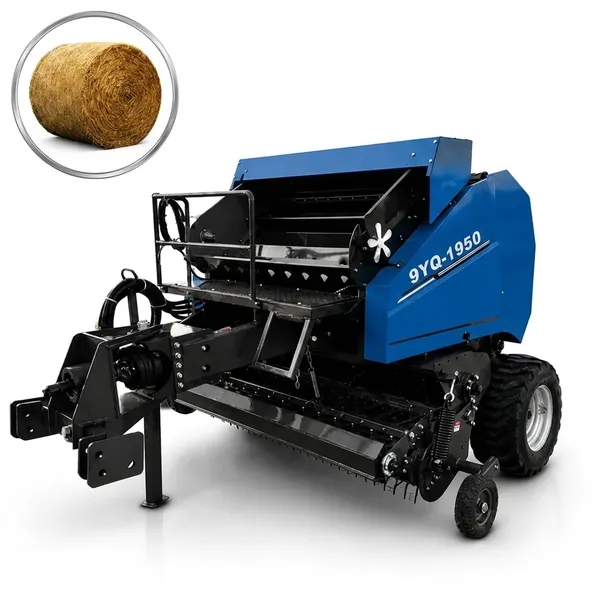
Round baling has a higher per-bale cost than small square baling but a lower cost per tonne of hay, because each round bale contains 10–25 times more hay than a small square bale. The relevant economic comparison for cattle operations is cost per tonne, not cost per bale.
| ベーラーモデル |
標準的なベール重量 |
Cost/Bale (own equipment) |
Cost/Tonne DM |
| 9YF-1700 (small square) |
20 kg |
$2.50–$3.80 |
$125–$190/tonne |
| 9YQ-870 (small round) |
130 kg |
$12–$20 |
$92–$154/tonne |
| 9YQ-1250 (medium round) |
300 kg |
$22–$38 |
$73–$127/tonne |
| 9YQ-1950 (large round) |
500 kg |
$35–$60 |
$70–$120/tonne |
Round baling delivers a lower cost per tonne for beef cattle operations where the format is appropriate. The small square bale cost premium per tonne is recovered through the price premium in horse, dairy and export markets — not through lower production cost.
Revenue Per Bale by Market — and What Margin Looks Like
| 市場 |
Revenue/Bale (20kg square) |
Baling Cost/Bale |
Gross Margin/Bale |
| Premium horse hay (boot-stage timothy) |
$15–$22 |
$2.50–$4.00 |
$11–$19.50 |
| Premium bermudagrass (Japan/Korea export) |
$12–$18 |
$2.50–$4.50 |
$7.50–$15.50 |
| Dairy alfalfa (Supreme grade) |
$9–$15 |
$3.00–$5.00 |
$4–$12 |
| Dairy/cattle hay (Grade 1–2) |
$5–$9 |
$2.50–$4.00 |
$1–$6.50 |
| Commodity cattle hay (own use) |
$3–$6 |
$2.50–$4.00 |
$0–$3.50 |
The market choice is the most powerful lever on profitability. The difference between selling boot-stage timothy to a horse market at $18/bale versus the same hay as commodity cattle hay at $5/bale is $13 per bale — at 1,000 bales per season, that is $13,000 in additional revenue from the same production cost. The equipment investment (9YF series spring-tooth baler for seed head preservation) is a prerequisite for capturing that premium, but the premium is available in most US regions with a horse hay market within reasonable delivery distance.
How to Reduce Cost Per Bale
Increase bales per hourEvery extra bale per hour at the same operating cost reduces the fixed costs per bale. Correct windrow width (matched to pickup), correct forward speed, and maintained PTO at 540rpm are the three levers. Going from 40 to 50 bales/hour reduces depreciation and tractor cost per bale by 20%.
Increase annual volumeThe fixed cost components (equipment depreciation, tractor depreciation) are spread over more bales as volume increases. Going from 1,000 to 1,500 bales/year with the same equipment reduces the depreciation component from $1.21 to $0.81 per bale — a $400 saving per season with no additional investment.
Reduce field passesA mower-conditioner that cuts and conditions in one pass saves one separate conditioner pass. A tedder-rake combination saves a separate tedding pass. Each eliminated field pass reduces fuel cost per bale by $0.10–$0.25 and reduces weather exposure time for the cut crop.
Maintain equipment on schedulePreventing a knotter failure mid-session (from overdue maintenance) saves the cost of a service call and the lost baling time in a weather window — worth $200–$500 per event avoided. Annual pre-season maintenance on the knotter, pickup and shear bolt is the highest-ROI preventive cost in hay baling.
PTO Drive Efficiency and Baling Cost Per Bale
A worn CV joint that causes PTO speed fluctuation directly increases cost per bale — the fluctuating PTO speed causes variable bale density (requiring reduced forward speed to avoid shear bolt breakage) and knotter timing problems (requiring more stoppages per session). A $60 CV joint replacement that restores stable 540rpm PTO recovers 5–10 bales per hour of throughput — at $3.50 per bale market price and $0.35 operator time cost per bale, that is a direct financial return of $3.15 per extra bale. Full maintenance cost-benefit guide: PTO driveshaft maintenance ROI guide for hay baling operations.
Frequently Asked Questions — Hay Baling Cost Per Bale
What is the typical custom baling rate per square bale in the US?+
Custom baling rates for small square bales vary significantly by region, season demand and local equipment availability. Across the US, the typical range is $2.00–$4.00 per bale for standard spring-tooth square baling of grass or alfalfa hay. Premium markets with high summer demand (Pacific Northwest, horse hay regions) may see rates of $3.50–$5.00 per bale during peak season when custom operator demand exceeds supply. The lowest rates ($1.80–$2.50) typically apply in large hay-producing regions with abundant custom capacity and lower land costs (parts of Kansas, Nebraska and the Great Plains). Round bale custom rates: $8–$18 per bale for a 300–500kg round bale, with net wrap typically charged separately ($0.90–$1.50 per roll). Always confirm whether the custom rate includes fuel, twine/net and field clearing of the bales — many quotes include only the baler operator time and not the associated consumables.
How does the 9YF-2200 cost per bale compare to the 9YF-1700?+
At the same annual bale volume (1,000 bales per year), the 9YF-2200 costs more per bale than the 9YF-1700 because of its higher purchase price — approximately $13,000–$16,000 versus $7,500–$9,500 for the 9YF-1700. The 9YF-2200 depreciation component is approximately $1.85–$2.28 per bale at 1,000 bales versus $1.07–$1.36 for the 9YF-1700. However, the 9YF-2200 delivers higher throughput (more bales per hour from the wider 2,200mm pickup versus 1,700mm) — at 2,000+ bales per year, the depreciation cost per bale converges significantly. The 9YF-2200 makes economic sense over the 9YF-1700 when: the pickup width advantage eliminates yield loss from windrow strips (producing more bales per acre), the higher throughput captures more baling windows during a season, or the operation grows to above 1,500 bales per season where the wider model provides meaningful hourly throughput advantage.
How do I calculate break-even bale count for a new baler purchase?+
Use this formula: Break-even bales = (Baler purchase price) ÷ (Custom rate per bale − Variable cost per bale of owning). Variable cost of owning = fuel per bale + twine per bale + maintenance per bale (exclude depreciation — that is what you are solving for). Example: 9YF-1700 at $8,500 purchase price. Custom rate: $3.00/bale. Variable cost of owning (fuel + twine + maintenance + labor): $1.40/bale. Break-even = $8,500 ÷ ($3.00 − $1.40) = $8,500 ÷ $1.60 = 5,313 bales total. At 1,000 bales per year, the baler pays for itself in 5.3 years — well within the 7–10 year useful life. At 1,500 bales per year: 3.5 years. At 500 bales per year: 10.6 years — marginal but still within the equipment life. The break-even shortens if you also account for the quality premium from baling at the correct moisture window (value not included in this calculation).
Does the type of twine affect my cost per bale significantly?+
Twine is a minor cost component — typically $0.15–$0.30 per bale — so switching twine types does not dramatically change the overall cost per bale. The cost difference between the least expensive polypropylene twine ($0.14/bale) and premium sisal or high-knot-strength twine ($0.28/bale) is at most $140 per 1,000 bales. The more important twine decision is reliability: cheap twine with poor knot strength causes knotter failures that stop production and waste the baling window. A knotter failure that costs 30 minutes of production at 50 bales per hour wastes 25 bales — at $3.50 market value, that is $87.50 in lost production from one failure event, many times the annual saving from cheaper twine. Use manufacturer-recommended twine specification (knot strength rating) and do not downgrade to the cheapest available option.
What is the cost per bale if I custom bale for neighbors to help pay for my equipment?+
Custom baling for neighbors (providing baling services for a fee) is one of the most effective ways to improve the economics of baler ownership. If you bale 1,000 bales for your own operation and 500 bales for neighbors at $2.80/bale: the neighbor revenue of $1,400 covers approximately 55% of the annual baler depreciation at 1,500 total bales. This effectively reduces your own-operation cost per bale from $3.50 to $1.57 (after the neighbor revenue offsets the shared depreciation). Custom baling revenue should be quoted to cover at minimum: your variable costs (fuel, twine, labor) plus a contribution to depreciation — confirm these numbers before agreeing to a custom rate so you are not baling at a loss for neighbors while supporting their operation at your equipment cost.
How much of my hay production cost is baling versus growing?+
In a typical small commercial hay operation (25 acres, 1,500 bales per season), the full hay production cost breakdown is approximately: land cost ($150–$300/acre/season) = $3,750–$7,500; mowing and conditioning ($25–$40/acre) = $625–$1,000; raking ($8–$15/acre) = $200–$375; baling (own equipment) = $3,675–$6,000 (at $2.45–$4.00/bale); fertilizer and lime ($60–$120/acre) = $1,500–$3,000; hauling and stacking ($0.30–$0.60/bale) = $450–$900; total full cost = $10,200–$18,775 for 1,500 bales = $6.80–$12.50 per bale total production cost. Baling represents 25–40% of total production cost at typical scales. This means that even halving the baling cost (by optimizing equipment use) reduces total cost per bale by only 10–15% — the larger cost reduction opportunities are in land, fertilizer and mowing efficiency, not just baling optimization.
How does rising diesel price affect my cost per bale?+
Fuel is the most variable component of baling cost, ranging from $0.60 to $1.60 per bale depending on diesel price and tractor efficiency. A $0.20/liter increase in diesel prices (from $1.10 to $1.30/liter) increases fuel cost per bale by approximately $0.14 (at 3.5 liters per hour, 50 bales per hour). At 1,000 bales per season: a $0.20/liter fuel price increase adds $140 to the annual baling fuel cost — a meaningful but not critical change in overall profitability. The more significant fuel price effect is on transport cost, which is not captured in the baling cost above — at $0.20/liter higher fuel, a 50km delivery of 200 bales increases the delivery cost by approximately $12–$15 per load. For operations selling hay at a premium market far from the farm: fuel price increases erode the premium more quickly than they increase baling cost.
Is net wrap on round bales worth the additional cost?+
For round bales stored outdoors, net wrap is almost always worth the additional $0.90–$1.50 per bale cost. The dry matter loss prevention in net-wrapped versus twine-wrapped bales stored outdoors for 6 months is 10–20 percentage points — on a 500kg bale at $100 per tonne hay value, that is $5–$10 of saved hay value per bale. Net wrap cost $1.20 per bale, saving $5–$10: a return on investment of 4–8 times the cost. For bales sold within 4 weeks of baling or stored indoors: the net wrap benefit is minimal and twine is acceptable. For any bale stored outdoors for more than 4–6 weeks: the financial case for net wrap is clear and the economics favor it regardless of the hay market or livestock type being served.
Want to Calculate Your Own Cost Per Bale?
Tell us your bale volume, market and tractor HP and we will help you calculate whether a 9YF square baler または 9YQ round baler delivers the lowest cost per bale for your specific operation.
アメリカ・エバーパワー・フォレージ・ベーラー・イクイップメント社 · 1401 21st ST STE R, Sacramento, CA 95811
編集者: Cxm