
9YQ-870 Mini Round Baler
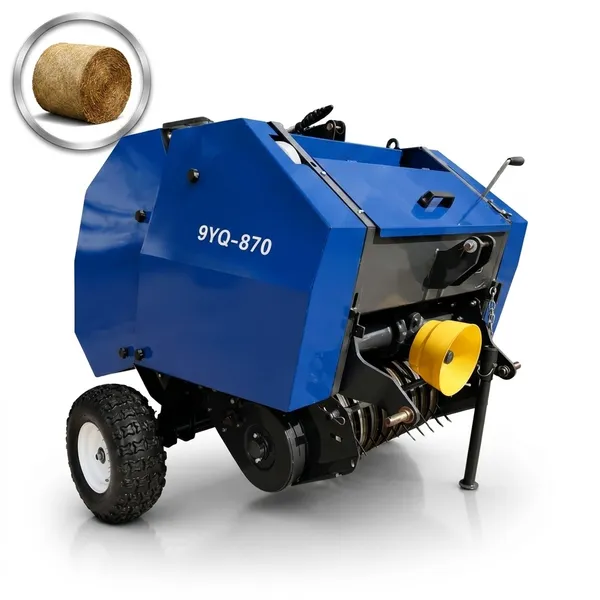
The lightest and most compact model in the 9YQ round baler lineup — the 9YQ-870 produces Φ630×700mm rope-wrapped bales on tractors from just 25HP, with a machine weight of only 440kg. Built for small farms, hobby operations, orchards, and any application where field access is tight and bale size needs to stay manageable for hand or loader handling.
- ✦ Works with tractors from 25HP — no large tractor required
- ✦ 440kg machine weight — light enough for compact tractors and narrow gateways
- ✦ Φ630×700mm bales — sized for hand handling and small storage spaces
- ✦ Spring-tooth pickup at 800mm — suits narrow windrows from small mowers
- ✦ Rope wrapping — simple, reliable, low-cost binding system
9YQ-870 Mini Round Baler: Compact Performance for Smaller Operations
Built for the Scale Most Balers Overlook
The majority of round balers on the market are engineered for 100HP and above, producing bales that require a front-end loader to move and a barn with wide doors to store. For small and hobby farms — properties under 100 acres, operations with a single 35–50HP compact tractor, or fields where a full-size baler simply does not fit — the 9YQ-870 provides a practical entry point into round bale production without requiring an equipment upgrade the operation does not otherwise need.
The 9YQ-870 produces bales of Φ630mm diameter × 700mm wide. At typical hay density, this is a bale weight of roughly 40–90kg depending on crop moisture and density — heavy enough to hold together well in storage, light enough that two people can roll and position a bale without mechanical assistance. For small livestock operations, this bale size aligns well with daily or weekly feed-out needs, reducing the number of partial bales and the associated storage and spoilage issues that come from opening a large bale for a small number of animals.
9YQ-870 At a Glance
Technical Specifications
| # | Item | Unit | Specification |
|---|---|---|---|
| 1 | Model Name | — | 9YQ-870 Round Baler |
| 2 | Hitching Method | — | Towed-type / Trailed |
| 3 | Pickup Width | mm | 800 |
| 4 | Picker Structure | — | Spring Tooth Type |
| 5 | Feeder Structure | — | Directly fed by spring tooth |
| 6 | Operating Speed | km/h | 2–5 |
| 7 | Bale Chamber Type | — | Roll Drum Type (Fixed) |
| 8 | Width of Compressing Room | mm | 700 |
| 9 | Diameter of Compression | mm | Φ630 |
| 10 | Bale Size (Diameter × Width) | mm | Φ630 × 700 |
| 11 | Bundling Method | — | Rope Wrapping |
| 12 | Matching Power Range | HP | 25–50 |
| 13 | PTO Speed | rpm | 540 |
| 14 | Overall Dimensions (L×W×H) | mm | 1,300 × 1,300 × 1,350 |
| 15 | Tire Size | — | 18×6.50-8-4PR |
| 16 | Machine Weight | kg | 440 |
Crop Applications — What the 9YQ-870 Handles
Small-Scale Hay and Straw Operations
The 9YQ-870 handles the same range of crops as the larger models in the lineup — the difference is field scale and tractor size, not crop type. It works through wheat straw, rice straw, corn stover, and forage grass windrows formed by small mowers or compact conditioning units.
- ▸Wheat and rice straw — forms clean, tight bales from typical post-combine windrows at 2–4 km/h
- ▸Corn stover — the 800mm pickup handles windrows formed from small-farm combine headers
- ▸Grass and mixed forage hay — well-suited to small paddock production with compact equipment
- ▸Cotton stalks and crop residue — the spring-tooth system handles varied-density crop material reliably
Orchards, Vineyards, and Specialty Applications
The 9YQ-870 overall dimensions of 1,300×1,300×1,350mm make it compatible with row spacings and gateway widths that exclude full-size balers. This opens several applications that larger equipment simply cannot reach:
- ▸Orchard understory grass — bale grass clippings from orchard mowing operations where row access is narrow
- ▸Cover crop termination baling — bale cereal rye, oats, or vetch in narrow strip-cropped or inter-row cover crop systems
- ▸Small paddock cleanup — clear cut grass from paddocks, laneways, or roadsides with a compact tractor and no field access constraints
Key Features of the 9YQ-870
Lightweight and Maneuverable Design
At 440kg, the 9YQ-870 is the lightest tow-behind round baler in the lineup. A 35HP compact tractor can pull and operate this machine without overloading the rear axle — and transporting between fields on a standard trailer is straightforward without the logistics required for 1,000–3,000kg commercial balers.
The 1,300mm wide and 1,300mm long machine footprint allows operation in field conditions that full-size balers cannot access — including orchard rows, narrow laneways, gated paddocks with standard 12-foot gates, and fields with tight headlands where large machine turns are not possible.
The bearing and drivetrain components are sealed against dust, moisture and UV exposure — designed for outdoor storage and field use without requiring the enclosed shed protection that non-sealed industrial components need. Maintenance requirements are proportional to the machine scale.
Direct Spring-Tooth Feeding System
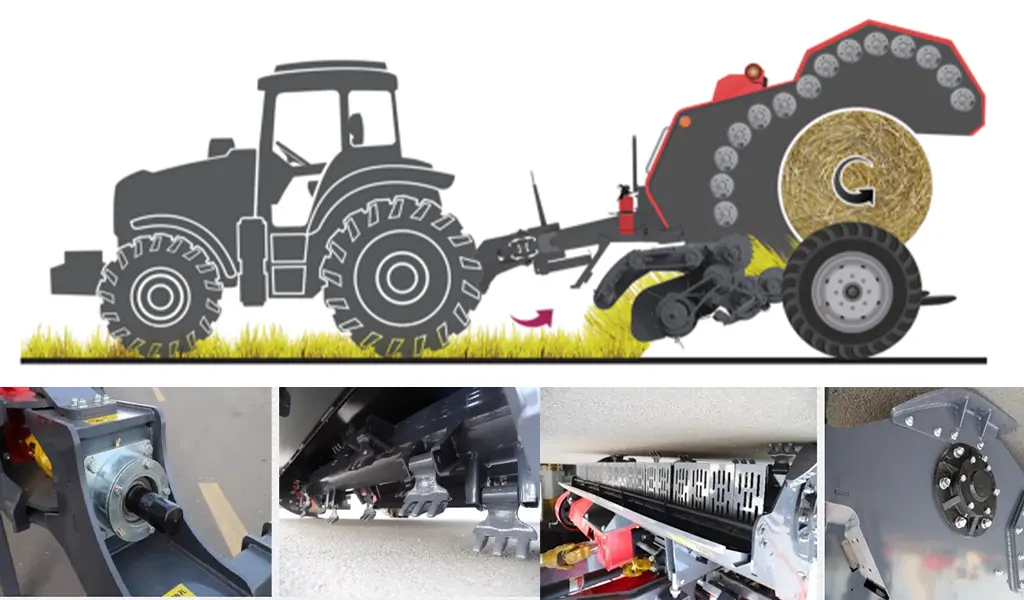
The 9YQ-870 uses a direct spring-tooth feeding arrangement — the pickup tines both gather the windrow from the ground and deliver material into the compression chamber without a separate transfer mechanism. This is a mechanically simple and robust approach that suits small-scale operation: fewer components to inspect and maintain, no secondary feeder to clear when blockages occur, and a straightforward relationship between PTO input and material throughput that operators can learn quickly.
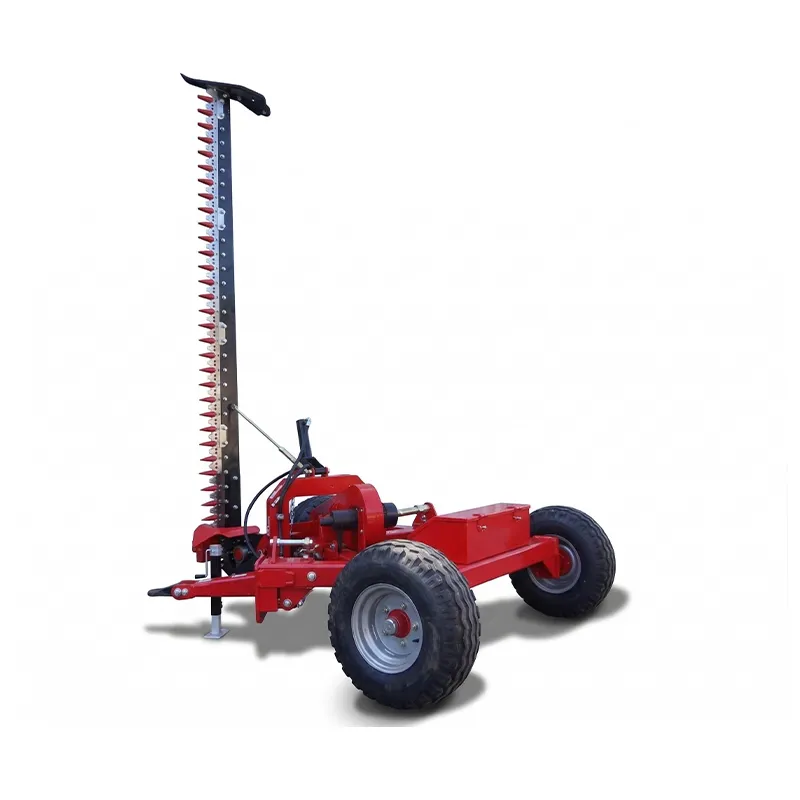
The 800mm pickup width is sized to match windrows formed by compact disc or sickle-bar mowers in the 1–2m cutting width class. For producers using a wider mower, pairing it with a mower-rake and then merging two narrow windrows into one before baling is a common practice that keeps the windrow within the pickup width.
Rope Wrapping — Simple and Cost-Effective Binding
The 9YQ-870 binds bales with rope (twine) wrapping rather than net wrap. Rope is the lower-cost consumable option per bale — typical rope cost per bale is significantly less than net wrap at equivalent bale sizes — and for small-scale operations where bales go directly into a barn and are fed out quickly, rope binding provides adequate bale integrity without the higher material cost of net. For outdoor storage beyond 2–3 months, particularly in wet climates, producers who need longer weather protection can transfer the bale into a net wrap sleeve after ejection, or transition to the 9YQ-1250 or larger models that support net wrap options.

Choosing the Right Round Baler Size — Where the 9YQ-870 Fits
When a Φ630mm Bale Is the Practical Choice
The bale size from the 9YQ-870 — Φ630×700mm — is not a limitation. For the right operation, it is the correct size. A 40–90kg bale can be rolled by two people, loaded with a small hydraulic lift, or moved by a compact tractor without a heavy-duty front-end loader. For small livestock operations (a dozen beef cattle, 20–30 sheep, a few horses), this bale size aligns with feed-out periods of 3–7 days, avoiding the spoilage and partial-bale waste that comes from opening a 500kg bale for a small number of animals and then exposing the remainder to weather.
A Φ630mm bale also stores efficiently in low-ceiling barns and standard shipping containers that cannot accommodate 1,200–1,500mm diameter bales.
9YQ Series Size Comparison — Find the Right Model
| Model | Bale Size | Min. Tractor | Weight | Wrapping | Best Fit |
|---|---|---|---|---|---|
| 9YQ-870 ◀ This model | Φ630×700mm | 25HP | 440kg | Rope | Small farms, orchards, hobby operations, compact tractors |
| 9YQ-1250 | Φ800×1,250mm | 54HP | 1,000kg | Rope | Medium farms, 50–200 acre operations |
| 9YQ-1950 | Φ1,000×1,250mm | 80HP | 2,385kg | Net wrap | Large commercial, high-volume operations |
| 9YQ-2300 | Φ1,000×1,250mm | 108HP | 2,500kg | Net wrap | Wide-pickup commercial, 2,300mm field coverage |
| 9YG-2.2 | Φ1,220×1,400mm | 148HP | 3,800kg | Net wrap | Fixed-chamber, max consistency, export and dealer sales |
Operating Tips for the 9YQ-870
Tractor Compatibility and PTO Setup
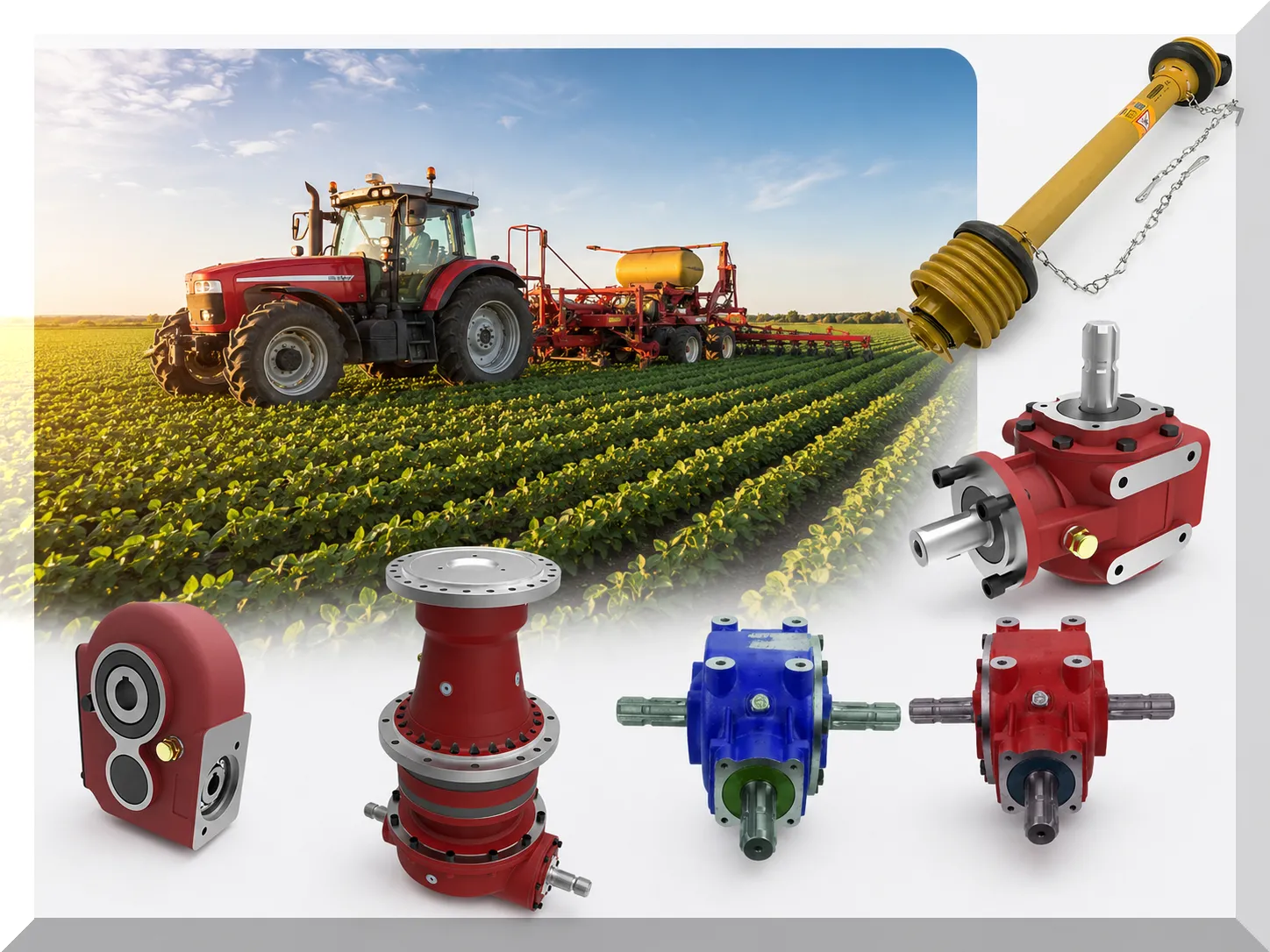
The 9YQ-870 requires a PTO output of 25–50HP at 540rpm. For PTO shaft and driveline specifications at this power class, agricultural gearbox and PTO driveline guide covers the shaft standards for this compact tractor class. Most compact utility tractors in the 30–55HP range produce 25–45HP at the PTO shaft — verify PTO HP rather than engine HP, as these can differ by 10–15% on smaller tractors. The tractor needs a standard 3-point hitch for the drawbar connection and at least one remote hydraulic outlet for the tailgate cylinder, if equipped. Check that your tractor hitch category and ball/pin hitch dimensions are compatible before coupling.
At an operating speed of 2–5 km/h, the 9YQ-870 works at a walking pace — appropriate for compact tractor operation in small fields with frequent turns. Do not try to push above 5 km/h to increase throughput; faster speeds produce under-filled bales and can cause pickup tine misfeeds on heavier windrow sections.
Windrow Management for Small Balers
- Windrow width:
Keep windrows at or below 800mm for the best pickup efficiency. Wider windrows from larger mowers should be raked narrower before baling with this machine. - Moisture target:
Bale at 15–20% moisture for dry hay. The rope wrapping on the 9YQ-870 provides less weather resistance than net wrap, so bales for outdoor storage beyond 4–6 weeks should be harvested at 14–16% moisture to reduce core heating risk. - Crop condition:
The 9YQ-870 performs best on material that has been mowed, conditioned and partially dried. Avoid baling very fresh or high-moisture material (above 25%) as this overloads the rope binding and produces bales that may not hold shape when stacked. - Rope tension:
Check rope knotter tension before the first bale of each session. Incorrect tension produces bales where the rope pulls loose on ejection or fails to cut cleanly after binding. The operator manual provides the specific tension setting for the knotter mechanism.
Frequently Asked Questions — 9YQ-870 Round Baler
What Customers Say About the 9YQ-870
I run 12 beef cows on 28 acres and my tractor is a 38HP compact utility. Every baler I looked at before this one was either too heavy for my tractor or produced bales I needed a loader to move. The 9YQ-870 changed that. I get bales around 55–70kg from my fescue hay — two people can roll them without equipment. The rope wrapping is simple and the machine has had zero downtime across two seasons. It does exactly what a small operation needs.
We use this baler in our hazelnut orchard where row spacing is around 4.5 meters. I was skeptical that any round baler would fit, but the 9YQ-870 works perfectly — we bale the cover crop rye in spring and the orchard grass clippings through summer. The compact tractor pulls it easily at 35HP and the small bales get stacked in the corner of the orchard barn without needing a loader. It has paid for itself in labor saved already.
I got this for my 6-horse operation on 18 acres of mixed grass hay. The bale size is perfect for us — I open one bale every 5 days for the horses and there is no wasted spoiled hay from a half-open large bale. The only thing I would note is that the rope can slip if the knotter is slightly out of adjustment and you are baling very dry, low-density material. Check the tension before baling light hay. Once I dialed that in, it has been reliable. The fit and finish is solid and the machine is easy to clean at the end of the day.
We grow vegetables on 15 acres and keep 8 goats and 4 sheep. The 9YQ-870 is exactly sized for what we needed — it bales our cover crop oats and vetch in spring, the annual ryegrass between beds in summer, and provides small bales our animals can use without half the bale spoiling before they finish it. I was worried it would be too slow but at our scale it fits perfectly into the operation schedule. The 440kg weight means my 35HP Kubota pulls it comfortably through our slightly hilly fields.
Get the 9YQ-870 for Your Operation
Tell us your tractor HP, primary crop type, and field access constraints. We will verify that the 9YQ-870 is the right match and provide current pricing, lead time and delivery details to your location.
Additional information
| Editor | Cxm |
|---|
Related products
-
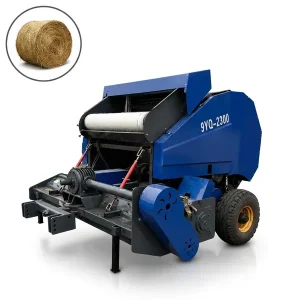
9YQ-2300 Round Baler
-
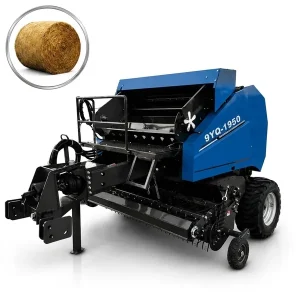
9YQ-1950 Round Baler
-
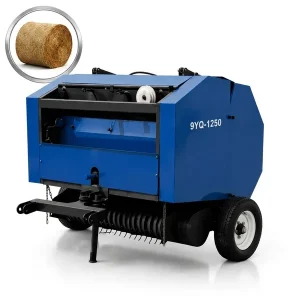
9YQ-1250 Round Baler
-
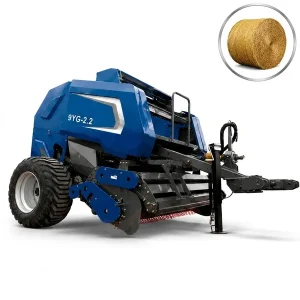
9YG-2.2 Fixed Chamber Round Baler
-
Forage Baler – 9YG-1.25 Round Baler for Hay & Silage with Automatic Net Wrap
-
Forage Baler – 9YG-2.24D Round Baler S9000 (Base) for Hay & Silage Baling
-
Forage Baler – 9YG-2.24D Round Baler S9000 Classic for Hay & Silage
-
Forage Baler – 9YG-1.0C Round Baler | Net Wrap Baler for US Farms


