Equipment Selection Guide

Fixed vs Variable Chamber Round Baler: Which Is Right for You

Fixed chamber and variable chamber balers are not better and worse versions of the same machine — they are two different designs optimized for different production priorities. Understanding which design matches your crops, your markets, and your operational style eliminates the guesswork from one of the largest equipment purchases in a hay operation. This guide compares both systems across seven decision factors that actually matter in the field.

See Full Comparison

How Fixed and Variable Chamber Systems Form a Bale

The fundamental mechanical difference between the two designs is when and how the bale chamber size is determined. In a fixed-chamber baler, the bale diameter is set by the physical geometry of the machine — the rollers or belts define a fixed-radius cylinder, and the bale grows to fill that space with a consistent diameter on every bale. In a variable-chamber baler, the bale starts small and the chamber expands as crop is added, allowing the operator to vary the finished bale diameter and density within a range.

Both designs use belts and/or rollers to rotate the accumulating crop mass. Both produce a cylindrical bale. Both are compatible with the same net wrap systems. The difference shows in how each design handles density variation, crop type transitions, and the first 30 seconds of each new bale cycle — the critical startup phase where the bale’s core formation occurs.

Design A
Fixed-Chamber Baler

How the chamber works: A set of parallel rollers and/or belts arranged in a fixed-geometry cylinder rotate around the incoming crop mass. The bale grows radially from a dense core until it fills the fixed-diameter cylinder, at which point the density gate triggers and wrapping begins.

Core formation: The very center of a fixed-chamber bale is formed under maximum belt tension from the first crop entering the chamber — producing a very dense, hard core that maintains its shape under storage and handling stresses.

Bale size: Fixed at the machine design diameter (typically 4×4, 4×5, or 5×5 ft) — same for every bale.
Design B
Variable-Chamber Baler

How the chamber works: Belts create an expandable chamber that starts small (essentially a “starter ball” of crop) and expands outward as more crop is fed in. The operator or a density sensor determines when to initiate wrapping — this can be at any diameter within the machine’s range.

Core formation: The initial crop in a variable-chamber bale is formed under progressively increasing belt tension as the bale grows. The core is typically less dense than in a fixed-chamber machine, resulting in a bale with a softer center and progressively denser outer layers.

Bale size: Adjustable — operator can produce bales from minimum to maximum diameter depending on windrow and density settings.

Seven Decision Factors: Side-by-Side Comparison

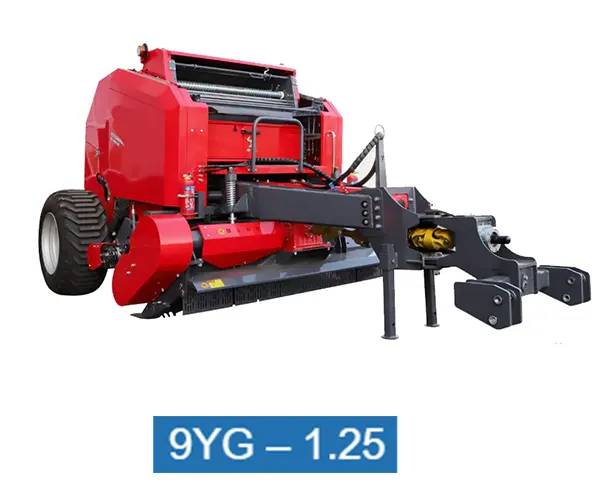
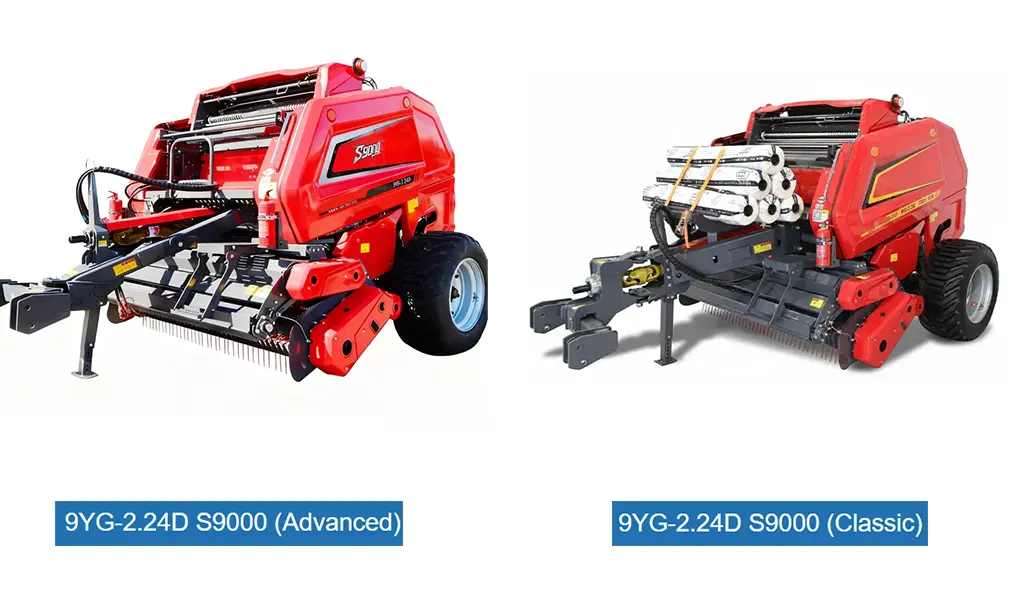
9YG-1.25A variable chamber vs 9YG-1.25 fixed chamber round baler direct comparison — the design choice determines bale consistency, density control, and crop versatility

因素
Fixed Chamber
Variable Chamber
Bale shape consistency
出色的 — every bale is the same diameter, making stacking, transport, and storage planning predictable. Uniform bales stack more stably in outdoor rows.
好的 — bale diameter varies with windrow density unless using a consistent density-sensor trigger. Slight diameter variation across a load can create unstable stacking.
Density control
Limited — density is set by the belt tension adjustment and cannot be varied mid-bale. Once set for a windrow density, the machine produces consistent density on every bale from that windrow type.
出色的 — density can be adjusted mid-bale and between bales from the cab. This allows response to windrow density variation in the same field, producing more consistent bale weights despite varying conditions.
Crop versatility
出色的 — fixed geometry handles a wider range of crop types including difficult crops (corn stover, cover crops, straw) that require a firm forming environment to compress properly from the first rotation.
好的 — performs well with standard hay crops; some models less suited to extremely coarse material that resists the “starter ball” formation in the expanding chamber startup phase.
Small windrow performance
Moderate — thin windrows take more time to fill the fixed chamber, potentially increasing crop drying time between entry and bale completion in marginal moisture conditions.
好的 — can stop bale formation at smaller diameter on thin windrows, reducing the time between windrow entry and bale completion. Particularly useful when moisture is dropping rapidly on a drying day.
Maintenance complexity
Lower — fixed geometry means fewer moving components in the chamber formation system. Belt and roller maintenance is straightforward; no expanding mechanism to service.
Higher — the expanding chamber mechanism adds moving components (pivoting belt carriers, expansion springs or cylinders) that require maintenance and occasional replacement. Fewer models to choose from at the entry price point.
Purchase price
Lower — fixed-chamber designs have been produced longer with fewer proprietary components; competitive market at all price points from entry-level to commercial. More used machine options available.
Higher — variable-chamber designs involve more complex chamber mechanics; typically commands a $2,000–$8,000 premium over equivalent fixed-chamber models from the same manufacturer. Justified when density control value is significant.
Elevator/export market
Preferred — consistent bale diameter means consistent bale weight at a given crop density; elevator buyers prefer uniform loads from known-geometry balers for handling and weight estimation.
可以接受 — variable-diameter bales are accepted at most elevators but may receive more individual weight scrutiny. Some export specifications require minimum bale diameter consistency that favors fixed-chamber production.

Which Design Is Best for Which Operation Type

round baler model comparison for different operation types — fixed chamber suits commercial elevator and export hay; variable chamber suits operations requiring density adjustment across varied windrow conditions

Choose Fixed Chamber if you…
  • Sell to hay elevators or export markets where uniform bale geometry is valued
  • Bale primarily single crop types (alfalfa, grass hay, wheat straw) with consistent windrows
  • Bale corn stover, cover crops, or other challenging crop materials
  • Want lower purchase price and simpler long-term maintenance
  • Operate at commercial scale where predictable daily output planning is important
  • Will use the baler primarily for dry hay rather than silage
  • Are buying used — fixed-chamber used machines are more available with known maintenance history
Choose Variable Chamber if you…
  • Operate in fields with high windrow density variation — hilly terrain, variable-yield fields, second-cut timing variation
  • Want to produce bales of different sizes for different customers or uses from the same machine
  • Bale primarily for on-farm livestock feeding where bale-to-bale weight consistency matters for daily feed budgeting
  • Make both dry hay and silage with the same machine and want density flexibility for each
  • Have large acreage with a wide range of stand densities across different fields
  • Value cab-adjustable density over driving consistency for different field zones

Performance in Variable Windrow Conditions: Where the Difference Is Most Visible

The performance difference between fixed and variable chamber designs is most apparent in fields with significant windrow density variation — a common condition in first-cut alfalfa, hilly terrain, or fields with partial stand failures. In a uniform 3-ton-per-acre alfalfa windrow on flat, consistent ground, both designs produce excellent, comparable results. In a field with windrow density varying from 1.5 to 4.5 tons per acre across the same cutting, the designs diverge significantly.

Thin windrow sections

Fixed chamber: the bale takes longer to fill at lower windrow density, producing a lower-density bale at the same settings — the machine fills at the same diameter regardless of how long it takes. Variable chamber: the operator can stop bale formation at a smaller diameter in thin sections, accepting a lighter but correctly-dense bale rather than a correctly-sized but under-dense bale. This difference matters primarily when elevator minimum bale weight thresholds are a concern.

Heavy windrow sections

Fixed chamber: a denser windrow fills the chamber faster at the same ground speed, producing the correct diameter bale at higher density — which is generally desirable. Variable chamber: the density sensor triggers the wrap cycle at the same density threshold regardless of windrow weight, producing consistent bale density but potentially varying bale diameter in heavy windrows. The variable chamber system’s cab adjustment allows the operator to increase the density threshold for heavy windrow sections, capturing the full weight advantage of the denser material.

Slug-loading events

Both designs experience slug-loading events (sudden large crop input) in variable windrow conditions. Fixed chamber balers typically manage slug loading more consistently because the rigid chamber geometry limits the extent to which the bale can deform under the impact — the walls (rollers or belts) push back. Variable chamber designs may show more bale deformation on the slug-loading side under high-impact events because the chamber wall at the expansion boundary is more compliant. This rarely matters for bale quality but can produce a slight oval cross-section on affected bales.

Total Cost of Ownership: Where the Price Premium Is Recovered

The purchase price premium for a variable-chamber baler over a fixed-chamber baler of equivalent production capacity is typically $2,000–$8,000 new, and $1,500–$5,000 used. Whether this premium is recovered through operational benefits depends entirely on the specific value those operational benefits have in your production system. Three scenarios determine the calculation:

Operation type Variable chamber premium justified? Reasoning
Commercial elevator hay, uniform fields Rarely Fixed-chamber consistency is preferred; variable-chamber density adjustment adds no pricing benefit at the elevator
On-farm feeding, varied fields Often yes Density control reduces lightweight bales that under-supply the daily feed ration; consistent bale weight allows accurate daily feed budgeting
Custom baling service Sometimes Customers with variable-yield fields may appreciate consistent bale weight; elevator-market customers prefer uniform diameter. Depends on customer mix.
Mixed hay/silage production Often yes Ability to increase density for silage (reducing residual air) and reduce density for dry hay (reducing HP demand) from the same machine improves both quality outcomes

For the full equipment selection framework — including the new vs. used decision and the factors specific to your operation type — the round baler buyer’s guide provides the complete framework. When comparing round baler types against the large square baler alternative, the production volume thresholds where each format makes economic sense are covered in the round baler vs. large square baler comparison. For PTO HP requirements by baler type and the gearbox specifications that determine sustained HP at maximum density setting, see agricultural gearbox and PTO driveline component specifications.

Bale Core Formation: Why the First 30 Seconds Matter for Quality

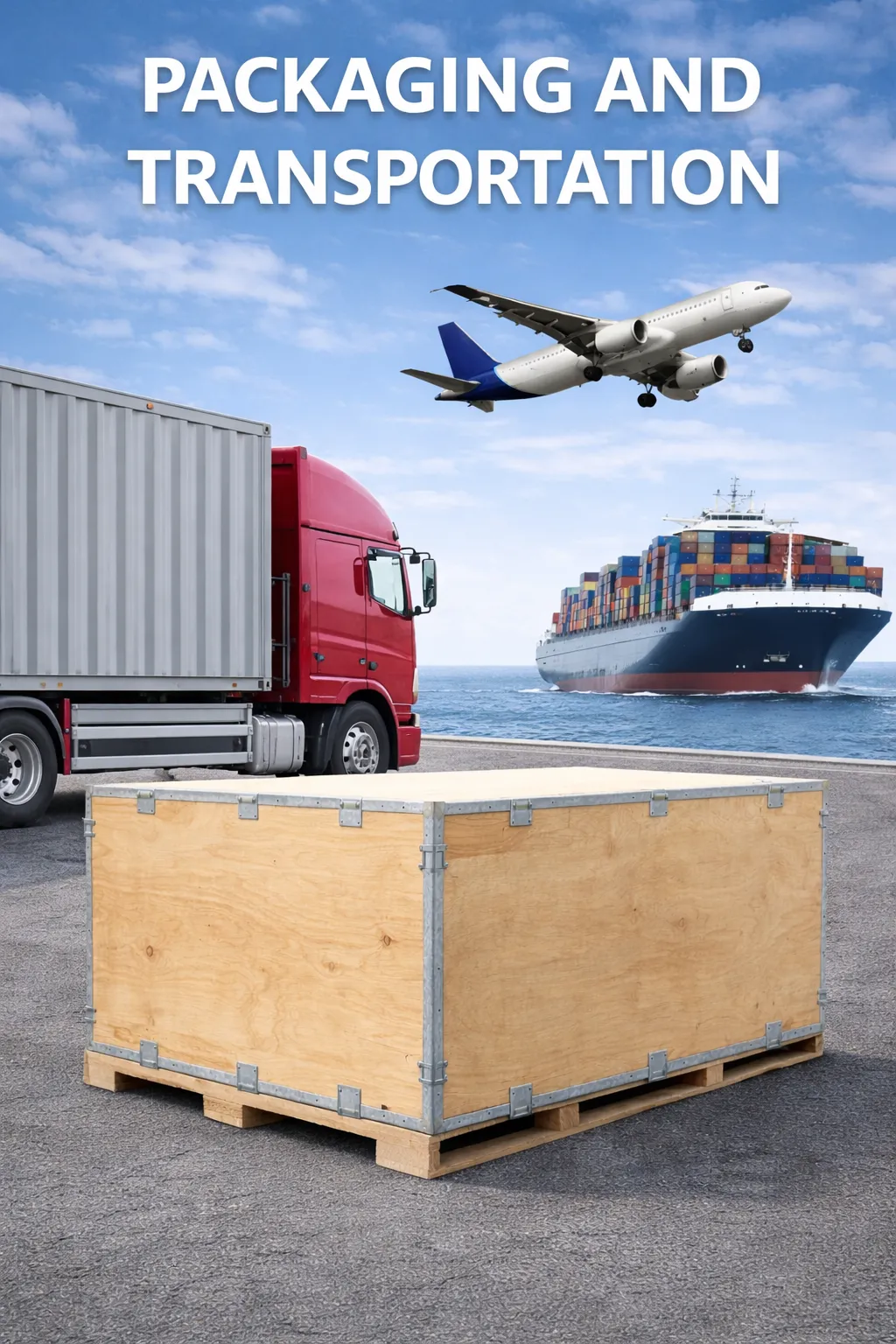
round baler equipment shipping — bale core formation quality during the first 30 seconds of chamber filling determines structural integrity throughout transport and storage

The structural integrity and density of a round bale is established in its core during the first 30 seconds of formation — a fact that has different implications for each baler type. The core forms the compression nucleus around which all subsequent crop wraps. A dense, tightly formed core produces a bale with structural integrity that survives transport and outdoor storage; a loose or poorly formed core produces a bale that sags, goes oval in storage, and loses its structural form.

Fixed-Chamber Core Formation

Crop entering a fixed-chamber baler immediately contacts the full-tension belt surface on all sides — the rollers push inward from the first crop rotation. This produces a very dense, hard core from the initial crop charge. The resulting bale has consistent density from core to outer wrap and holds its cylindrical shape under storage and transport stresses. For export markets where bale shape and integrity are inspected at port, this core density consistency is a meaningful quality attribute.

Variable-Chamber Core Formation

The first crop entering a variable-chamber baler enters an expandable space — the chamber starts wide and must fill before the belts contact the crop mass from all sides. This “starter ball” period produces a less dense core compared to fixed-chamber designs. Modern variable-chamber designs address this with a “pre-compression” feature that applies initial belt pressure during the startup phase, significantly reducing the core softness problem. Evaluate whether the specific model you are considering has effective pre-compression before dismissing variable-chamber designs on core density grounds.

Technical Specification Summary

规格 Fixed Chamber Variable Chamber
捆包直径范围 Fixed (e.g., exactly 4×5 ft) Adjustable (e.g., 36–60 inch diameter)
Density adjustment Belt tension adjustment only Density sensor + operator cab control
Core density High (immediate full-tension forming) Moderate (depends on pre-compression feature)
Bale weight consistency Varies with windrow density More consistent across windrow variation
Moving parts count Lower Higher
Corn stover / coarse crop 出色的 Good (model-dependent)
Entry price point Lower Higher

Fixed vs Variable Chamber FAQs

Do most commercial producers choose fixed or variable chamber in the U.S. market?+
In the U.S. commercial hay market, fixed-chamber balers represent a larger share of the installed base, particularly in the Mountain West and Pacific Northwest export hay regions where uniform bale geometry is valued by export buyers. Variable-chamber designs have stronger representation in the Midwest and Southeast where on-farm livestock feeding is the dominant use case and bale weight consistency for feeding management justifies the premium. In the custom baling service sector, fixed-chamber balers dominate because of lower purchase price, simpler maintenance for an owner-operator, and broader compatibility with the wide range of crops a custom baler may encounter across different customers’ fields.
Can a variable-chamber baler produce a bale as hard and dense as a fixed-chamber baler?+
At full density setting, a modern variable-chamber baler with effective pre-compression can produce a bale whose outer two-thirds is as hard as a fixed-chamber bale at equivalent settings. The difference in firmness tends to be concentrated in the inner core — the first 20–30% of the bale’s radius — where the expanding chamber design cannot achieve the same initial belt pressure as a rigid fixed geometry. For most practical applications — elevator marketing, outdoor storage, feeding — this core density difference has no measurable effect on quality or handling. The difference is most significant in export contexts where bale firmness is physically tested at the receiving port, and in high-moisture silage baling where core density affects anaerobic fermentation quality.
My current fixed-chamber baler produces inconsistent bale weights on the same field. Is this a reason to switch to variable chamber?+
Inconsistent bale weights from a fixed-chamber baler on the same field almost always indicate windrow density inconsistency — the windrow density is varying, so the same chamber fills with more crop (heavy bale) or less crop (light bale) before the density gate triggers. A variable-chamber baler would produce more consistent weights in this situation by adjusting bale diameter rather than accepting a fixed diameter with variable crop loading. However, before concluding that a chamber type switch is needed, also consider: is the rake creating inconsistent windrows? Would adjusting the rake to produce more uniform windrow density allow the fixed-chamber baler to produce more consistent weights? Improving rake consistency often solves the bale weight variation problem at lower cost than new equipment.
Does the fixed vs variable chamber choice affect net wrap consumption?+
Fixed-chamber balers produce the same bale circumference on every bale, so net wrap consumption is highly predictable — you use exactly the same length of net per bale every time for a given wrap-count setting. Variable-chamber balers produce varying circumferences (when not at maximum diameter), so net wrap consumption per bale varies with bale size. For operations that track wrap cost closely, this variability makes budgeting slightly less precise. The difference is typically small in absolute terms — a 10% variation in bale diameter produces a 10% variation in circumference and roughly 10% variation in net consumption per bale. This is not typically a significant factor in the equipment choice unless you are managing extremely tight consumables budgets across very high bale volumes.
Are replacement parts harder to find for variable-chamber balers?+
The standard wear components that both designs share — belts, tines, chains, bearings, net wrap knives — are equally available for both types. The variable-chamber-specific components (expansion arm pivot bearings, chamber expansion springs, density sensor components) are proprietary to specific manufacturers and models, and availability depends entirely on the brand and model chosen. For major manufacturers (AGCO, CNH, Deere, Krone) variable-chamber-specific parts are readily available from dealers and often from aftermarket suppliers after 5–8 years from model introduction. For smaller manufacturers or less common models, variable-chamber-specific parts may have longer lead times and limited aftermarket alternatives. This parts availability question is one reason to favor established brand lines when choosing a variable-chamber baler, and to confirm parts availability in your region before purchase.
Can I use a variable-chamber baler to make half-size bales for small herds or rotational grazing systems?+
Yes — this is one of the specific use cases where variable-chamber balers provide a meaningful practical advantage. By setting the density sensor to trigger at a smaller diameter, a variable-chamber baler can produce bales of 35–42 inch diameter rather than the full 48–60 inch maximum, creating bales that weigh 400–600 lbs rather than 900–1,200 lbs. These smaller bales are easier to handle with basic equipment (a bucket-on-the-tractor rather than a dedicated bale spear), feed out in 3–4 days rather than 7–10 days for small herds, and waste less hay per opening event. The tradeoff is slightly lower production efficiency (more bales per acre) and potentially higher net wrap cost per ton. For operations with 15–30 cow herds, small horse operations, or intensive rotational grazing programs, the small-bale capability often provides more practical value than any other variable-chamber feature.

foragebaler.com round balers — fixed chamber 9YG series and variable chamber options both available with full specification comparison before purchase

Get a Side-by-Side Model Comparison for Your Operation

Tell us your primary crop, annual bale volume, market channel (elevator / on-farm / export), and field conditions. We compare specific fixed and variable chamber models that fit your requirements — including current pricing and lead times.

Get Model Comparison

编辑:Cxm