How Fixed and Variable Chamber Systems Form a Bale
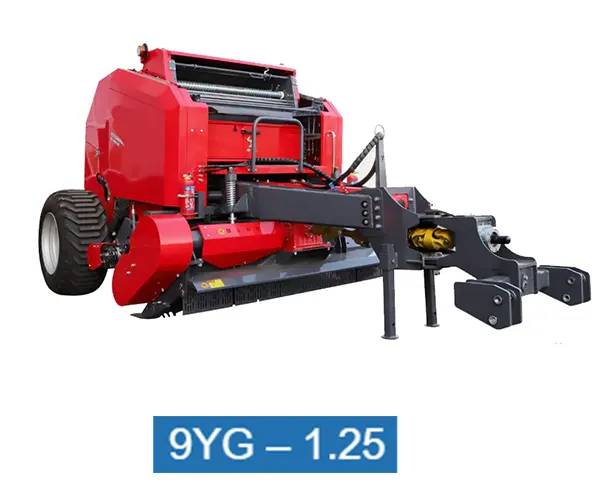
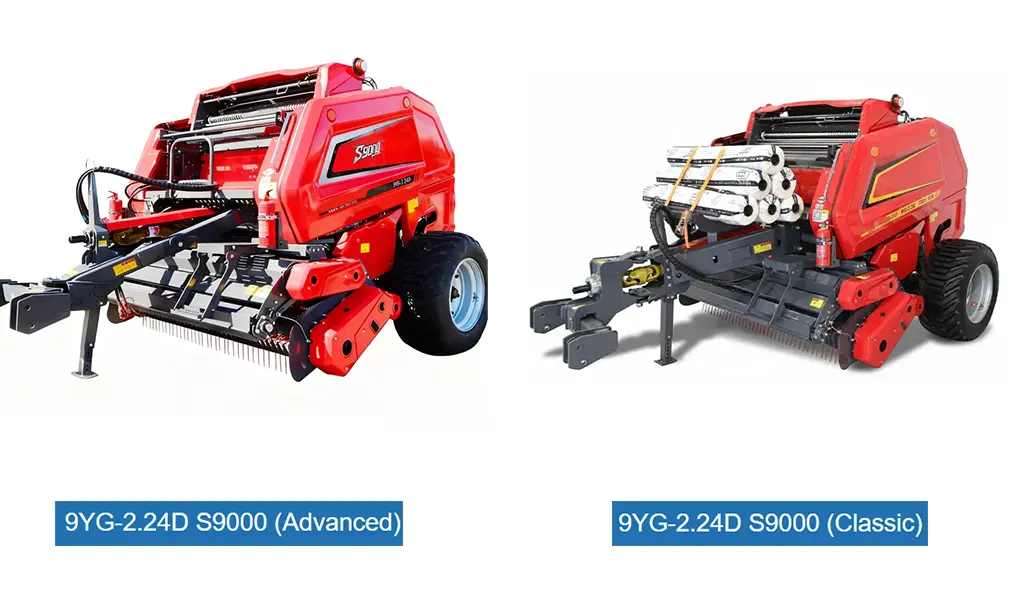
The fundamental mechanical difference between the two designs is when and how the bale chamber size is determined. In a fixed-chamber baler, the bale diameter is set by the physical geometry of the machine — the rollers or belts define a fixed-radius cylinder, and the bale grows to fill that space with a consistent diameter on every bale. In a variable-chamber baler, the bale starts small and the chamber expands as crop is added, allowing the operator to vary the finished bale diameter and density within a range.
Both designs use belts and/or rollers to rotate the accumulating crop mass. Both produce a cylindrical bale. Both are compatible with the same net wrap systems. The difference shows in how each design handles density variation, crop type transitions, and the first 30 seconds of each new bale cycle — the critical startup phase where the bale’s core formation occurs.
Seven Decision Factors: Side-by-Side Comparison

Which Design Is Best for Which Operation Type

- Sell to hay elevators or export markets where uniform bale geometry is valued
- Bale primarily single crop types (alfalfa, grass hay, wheat straw) with consistent windrows
- Bale corn stover, cover crops, or other challenging crop materials
- Want lower purchase price and simpler long-term maintenance
- Operate at commercial scale where predictable daily output planning is important
- Will use the baler primarily for dry hay rather than silage
- Are buying used — fixed-chamber used machines are more available with known maintenance history
- Operate in fields with high windrow density variation — hilly terrain, variable-yield fields, second-cut timing variation
- Want to produce bales of different sizes for different customers or uses from the same machine
- Bale primarily for on-farm livestock feeding where bale-to-bale weight consistency matters for daily feed budgeting
- Make both dry hay and silage with the same machine and want density flexibility for each
- Have large acreage with a wide range of stand densities across different fields
- Value cab-adjustable density over driving consistency for different field zones
Performance in Variable Windrow Conditions: Where the Difference Is Most Visible
The performance difference between fixed and variable chamber designs is most apparent in fields with significant windrow density variation — a common condition in first-cut alfalfa, hilly terrain, or fields with partial stand failures. In a uniform 3-ton-per-acre alfalfa windrow on flat, consistent ground, both designs produce excellent, comparable results. In a field with windrow density varying from 1.5 to 4.5 tons per acre across the same cutting, the designs diverge significantly.
Fixed chamber: the bale takes longer to fill at lower windrow density, producing a lower-density bale at the same settings — the machine fills at the same diameter regardless of how long it takes. Variable chamber: the operator can stop bale formation at a smaller diameter in thin sections, accepting a lighter but correctly-dense bale rather than a correctly-sized but under-dense bale. This difference matters primarily when elevator minimum bale weight thresholds are a concern.
Fixed chamber: a denser windrow fills the chamber faster at the same ground speed, producing the correct diameter bale at higher density — which is generally desirable. Variable chamber: the density sensor triggers the wrap cycle at the same density threshold regardless of windrow weight, producing consistent bale density but potentially varying bale diameter in heavy windrows. The variable chamber system’s cab adjustment allows the operator to increase the density threshold for heavy windrow sections, capturing the full weight advantage of the denser material.
Both designs experience slug-loading events (sudden large crop input) in variable windrow conditions. Fixed chamber balers typically manage slug loading more consistently because the rigid chamber geometry limits the extent to which the bale can deform under the impact — the walls (rollers or belts) push back. Variable chamber designs may show more bale deformation on the slug-loading side under high-impact events because the chamber wall at the expansion boundary is more compliant. This rarely matters for bale quality but can produce a slight oval cross-section on affected bales.
Total Cost of Ownership: Where the Price Premium Is Recovered
The purchase price premium for a variable-chamber baler over a fixed-chamber baler of equivalent production capacity is typically $2,000–$8,000 new, and $1,500–$5,000 used. Whether this premium is recovered through operational benefits depends entirely on the specific value those operational benefits have in your production system. Three scenarios determine the calculation:
| Operation type | Variable chamber premium justified? | Reasoning |
|---|---|---|
| Commercial elevator hay, uniform fields | Rarely | Fixed-chamber consistency is preferred; variable-chamber density adjustment adds no pricing benefit at the elevator |
| On-farm feeding, varied fields | Often yes | Density control reduces lightweight bales that under-supply the daily feed ration; consistent bale weight allows accurate daily feed budgeting |
| Custom baling service | Sometimes | Customers with variable-yield fields may appreciate consistent bale weight; elevator-market customers prefer uniform diameter. Depends on customer mix. |
| Mixed hay/silage production | Often yes | Ability to increase density for silage (reducing residual air) and reduce density for dry hay (reducing HP demand) from the same machine improves both quality outcomes |
For the full equipment selection framework — including the new vs. used decision and the factors specific to your operation type — the round baler buyer’s guide provides the complete framework. When comparing round baler types against the large square baler alternative, the production volume thresholds where each format makes economic sense are covered in the round baler vs. large square baler comparison. For PTO HP requirements by baler type and the gearbox specifications that determine sustained HP at maximum density setting, see 農業用ギアボックスおよびPTO駆動系部品の仕様.
Bale Core Formation: Why the First 30 Seconds Matter for Quality

The structural integrity and density of a round bale is established in its core during the first 30 seconds of formation — a fact that has different implications for each baler type. The core forms the compression nucleus around which all subsequent crop wraps. A dense, tightly formed core produces a bale with structural integrity that survives transport and outdoor storage; a loose or poorly formed core produces a bale that sags, goes oval in storage, and loses its structural form.
Crop entering a fixed-chamber baler immediately contacts the full-tension belt surface on all sides — the rollers push inward from the first crop rotation. This produces a very dense, hard core from the initial crop charge. The resulting bale has consistent density from core to outer wrap and holds its cylindrical shape under storage and transport stresses. For export markets where bale shape and integrity are inspected at port, this core density consistency is a meaningful quality attribute.
The first crop entering a variable-chamber baler enters an expandable space — the chamber starts wide and must fill before the belts contact the crop mass from all sides. This “starter ball” period produces a less dense core compared to fixed-chamber designs. Modern variable-chamber designs address this with a “pre-compression” feature that applies initial belt pressure during the startup phase, significantly reducing the core softness problem. Evaluate whether the specific model you are considering has effective pre-compression before dismissing variable-chamber designs on core density grounds.
Technical Specification Summary
| 仕様 | Fixed Chamber | Variable Chamber |
|---|---|---|
| ベール直径範囲 | Fixed (e.g., exactly 4×5 ft) | Adjustable (e.g., 36–60 inch diameter) |
| Density adjustment | Belt tension adjustment only | Density sensor + operator cab control |
| Core density | High (immediate full-tension forming) | Moderate (depends on pre-compression feature) |
| Bale weight consistency | Varies with windrow density | More consistent across windrow variation |
| Moving parts count | Lower | Higher |
| Corn stover / coarse crop | 素晴らしい | Good (model-dependent) |
| Entry price point | Lower | Higher |
Fixed vs Variable Chamber FAQs
Get a Side-by-Side Model Comparison for Your Operation
Tell us your primary crop, annual bale volume, market channel (elevator / on-farm / export), and field conditions. We compare specific fixed and variable chamber models that fit your requirements — including current pricing and lead times.
編集者: Cxm