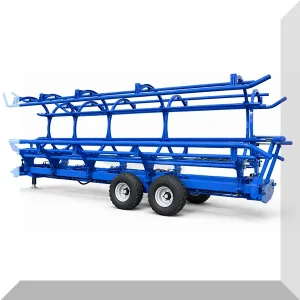
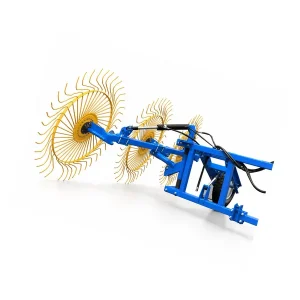
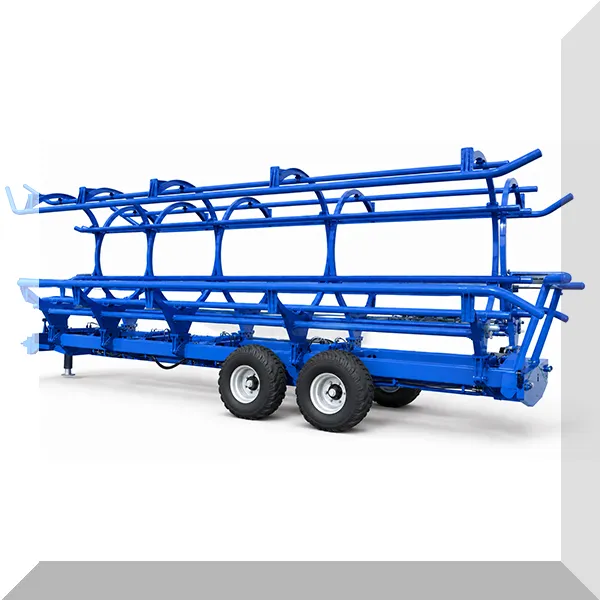
9JYY-2.5 Compact Round Bale Transporter Trailer
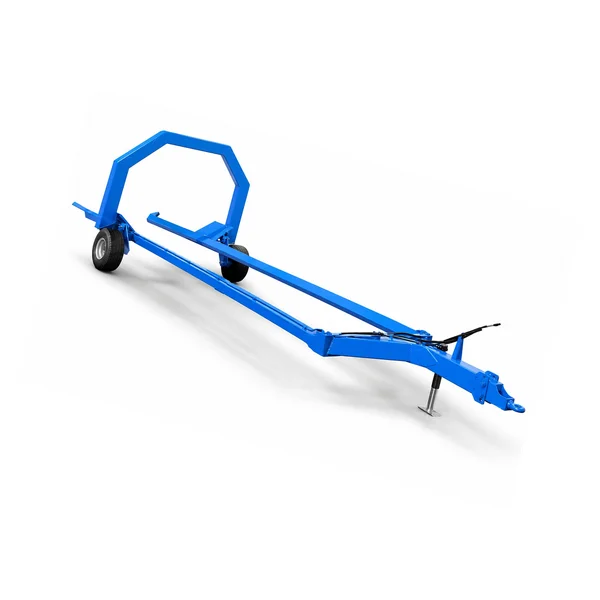
The 9JYY-2.5 compact round bale transporter is built for small-to-mid farm operations where the tractor doing the bale hauling is the same 30–65 HP utility tractor used for everything else on the property. A single hydraulic circuit, a standard drawbar hitch, and a ≥20 kW (≈27 HP) minimum tractor requirement make the 9JYY-2.5 the most accessible hydraulic self-loading bale hauler in our line — and the natural companion to the 9YG-1.0C and 9YG-1.25 compact round balers that run on those same compact tractors.
Why ≥20 kW Changes Who Can Own a Self-Loading Bale Hauler
Most self-loading bale handling equipment in the U.S. market is designed for commercial hay farms running 150 HP row-crop tractors. The hydraulic requirements, weight, and driveline complexity reflect that market — which effectively excludes the large segment of American hay producers who run 30 to 65 HP compact and utility tractors on 50 to 200 acre operations.
The 9JYY-2.5 was specified from the ground up for that smaller tractor class. At ≥20 kW (≈27 HP) minimum, a Kubota B3350, John Deere 3038E, or Massey Ferguson 1734E can power the hydraulic loading circuit fully. The single-circuit hydraulic design draws modest flow from the tractor's rear SCV — well within what any compact tractor with hydraulic remotes can supply. There are no dual-circuit complexity requirements, no air brake systems, and no electronic harness beyond the standard agricultural lighting connector.
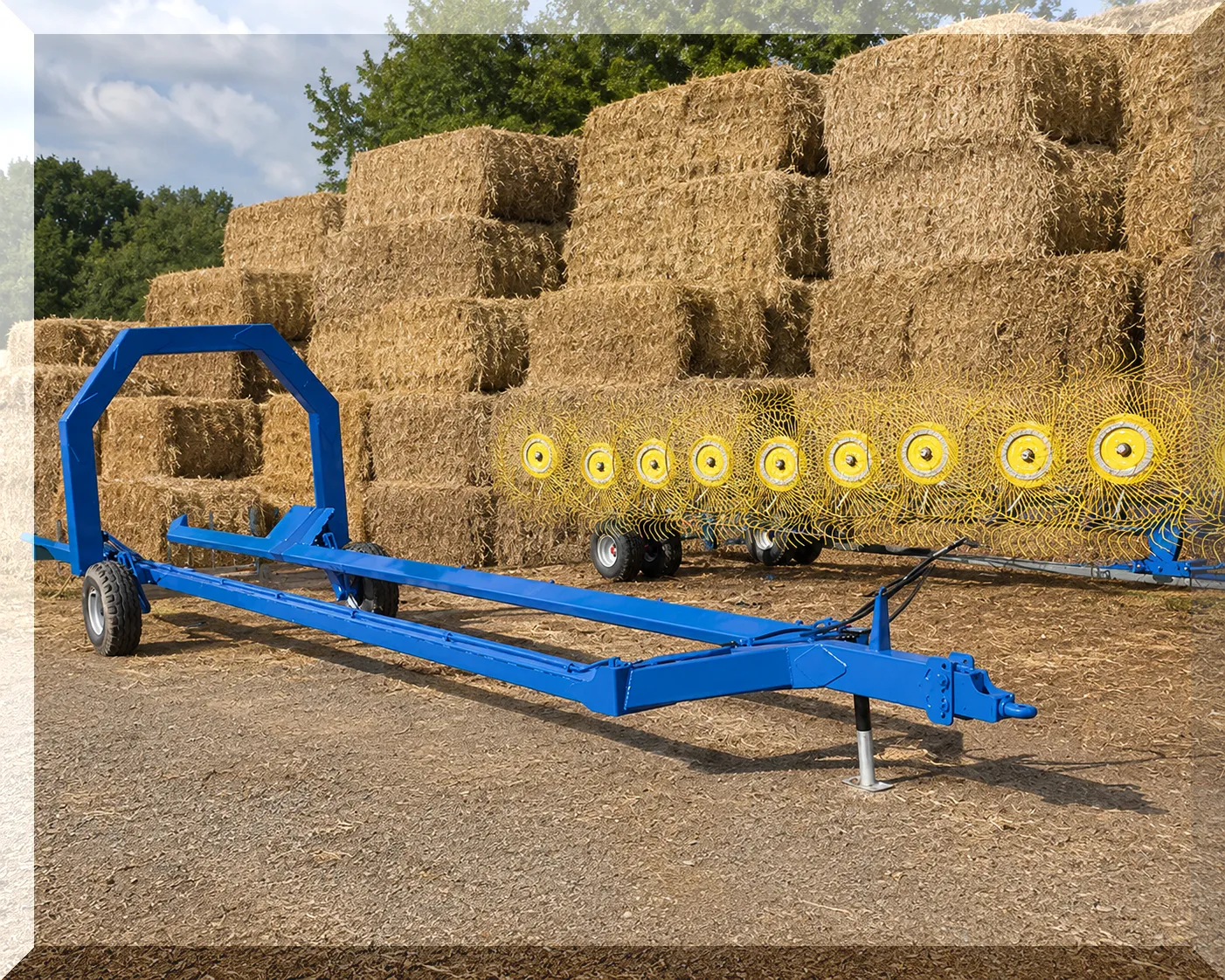
The Complete Small-Farm Bale System: Compact Baler + 9JYY-2.5 Transporter
Most compact round baler buyers focus exclusively on the baling machine, not on what happens immediately after the bale drops. On a 100-acre operation producing 180 to 250 bales per year across two or three cuttings, the bale-handling step accounts for more labor hours per season than the baling step itself — especially on farms without a dedicated front loader. The 9JYY-2.5 compact bale transporter trailer was designed to close exactly that gap, working from the same ≥27 HP tractor that runs the baler.
The following pairing guide confirms compatibility between the balers in our compact round baler lineup and the 9JYY-2.5 transporter — showing output bale size, tractor class, and the resulting hauler trip count on a 100-bale cutting:
| Baler Model | Bale Ø × L | Avg Bale Weight | Bales per 9JYY-2.5 Trip | Trips for 100 Bales | Tractor HP (shared) |
|---|---|---|---|---|---|
| 9YG-1.0C | 1.0 × 1.0 m | 300–450 kg | 5–8 | 13–20 | 40–55 HP ✓ |
| 9YG-1.25 | 1.25 × 1.25 m | 550–750 kg | 3–4 | 25–33 | 60–80 HP ✓ |
| 9YG-1.25A | 0.9–1.5 × 1.25 m | 500–850 kg | 3–5 | 20–33 | 75–100 HP ✓ |
Technical Specifications
All values reflect factory production records. The 9JYY-2.5 requires only a standard agricultural drawbar hitch and one rear SCV hydraulic outlet at ≥16 MPa. No PTO shaft, no electrical harness beyond the lighting circuit, no second SCV.
| No. | Parameter | Unit | Value |
|---|---|---|---|
| 1 | Product | / | 9JYY-2.5 Compact Round Bale Transporter Trailer |
| 2 | Hitch Type | / | Drawbar (standard agricultural) |
| 3 | Loading Method | / | Hydraulic — single-circuit |
| 4 | Maximum Payload | kg (lb) | 2,500 (5,511 lb) |
| 5 | Required Tractor Power | kW (HP) | ≥ 20 (≈ 27 HP) |
| 6 | Hydraulic Working Pressure | MPa | ≥ 16 (1 SCV outlet required) |
| 7 | Maximum Transport Speed | km/h (mph) | ≤ 40 (25 mph) |
| 8 | Tire Size | / | 10.0/80-12 (twin) |
| 9 | Compatible Bale Diameter | mm (in) | Ø 1,300 (51.2 in) nominal |
| 10 | Compatible Bale Length | mm (in) | 1,000–1,500 (39.4–59.1 in) |
| 11 | Overall Dimensions (L×W×H) | mm (ft) | 10,300 × 2,420 × 2,485 (33.8 × 7.9 × 8.2 ft) |
| 12 | Net Weight | kg (lb) | 1,165 (2,568 lb) |
Single-Circuit Hydraulic Operation: Simple Enough for Any Operator
The 9JYY-2.5's operating cycle is designed to be completable by a single operator with no prior bale-hauler experience, from the cab of a compact utility tractor. Every step is controlled from the SCV lever — no dismounting, no spotters, no second person.
Drive Alongside the Bale
Position the 7.9 ft (2,420 mm) transport bed alongside the bale. The wide bed provides clearance from either side — no precise alignment required on approach.
Open the SCV Valve
One SCV lever movement extends the pickup arm, sweeps under the bale, and lifts it onto the bed. The curved cradle conforms to the Ø 1,300 mm bale geometry — the load cycle takes under 60 seconds.
Drive to Storage
At up to 40 km/h (25 mph), the 10.0/80-12 dual tires carry the 2,500 kg payload on farm roads, gravel lanes, and paved county roads. The 7.9 ft width stays within most state agricultural implement regulations without oversize permits.
Hydraulic Unload
Reverse the SCV valve — the arm rotates outward and rolls the bale onto the storage surface precisely where needed. No bale-bounce, no repositioning, no secondary equipment.
Return for Next Load
Drive back to the field at full transit speed. The arm fully retracts into the 7.9 ft transport width. No configuration changes between load and transit — just drive.
The Small-Farm ROI: What the Numbers Look Like on 50–200 Acres
On a 100-acre mixed hay operation producing 150 to 200 bales per year, the economic case for a dedicated bale transport trailer looks different from a commercial hay farm's math. The question is not "how many bales can I move in a day" but "how much of my weekend does this save, and how quickly does the machine pay for itself from labor and storage loss reductions?"
Assumptions: $90/bale hay value, 12 min loader trip vs 18 min 9JYY-2.5 trip including load/unload. Labor rate not included — this is hay loss value alone. Adding $25/hr labor cost to the 23 hours saved adds $575/yr to the benefit calculation.
Compact Tractor Compatibility: Which Tractors Run the 9JYY-2.5
The two hard requirements are a standard drawbar hitch and one rear SCV hydraulic outlet at ≥16 MPa. Any tractor meeting these two criteria — from a 27 HP sub-compact to a 100 HP mid-range — can operate the 9JYY-2.5. The table below groups common U.S. compact and utility tractor models by HP range and notes the terrain-specific HP recommendation for loaded transit.
| HP Range | Terrain | Compatible Tractor Models (U.S.) | Verdict |
|---|---|---|---|
| 27–40 HP | Flat farm roads only | Kubota B3350, JD 3038E, Mahindra 3550, Kioti CK3510, LS MT342 | ✔ Functional |
| 40–55 HP | Moderate grades (<8%) | Kubota MX5400, JD 4052R, NH Workmaster 50, Massey MF 1754E, Mahindra 4540 | ✔ Comfortable |
| 55–75 HP | Rolling terrain, gravel roads | Kubota M7060, JD 5065E, Case IH Farmall 65C, NH T4.75, Massey MF 5710 | ✔ Optimal range |
| 75–100 HP | Any terrain incl. steep ranch roads | JD 5085E, NH Workmaster 75, Case Farmall 75C, Kubota M8560, Massey MF 5713 | ✔ Best stability |
Who Runs the 9JYY-2.5 and Why

Gate Width and Access Clearance: What Small Farm Operations Need to Know
The 9JYY-2.5's 7.9 ft (2,420 mm) transport width is the most practically important dimension for small farm operations, where barn doors, field gates, and narrow farm lane entry points can present clearance challenges that are not relevant on large open commercial operations. Check these three dimensions before your machine arrives.
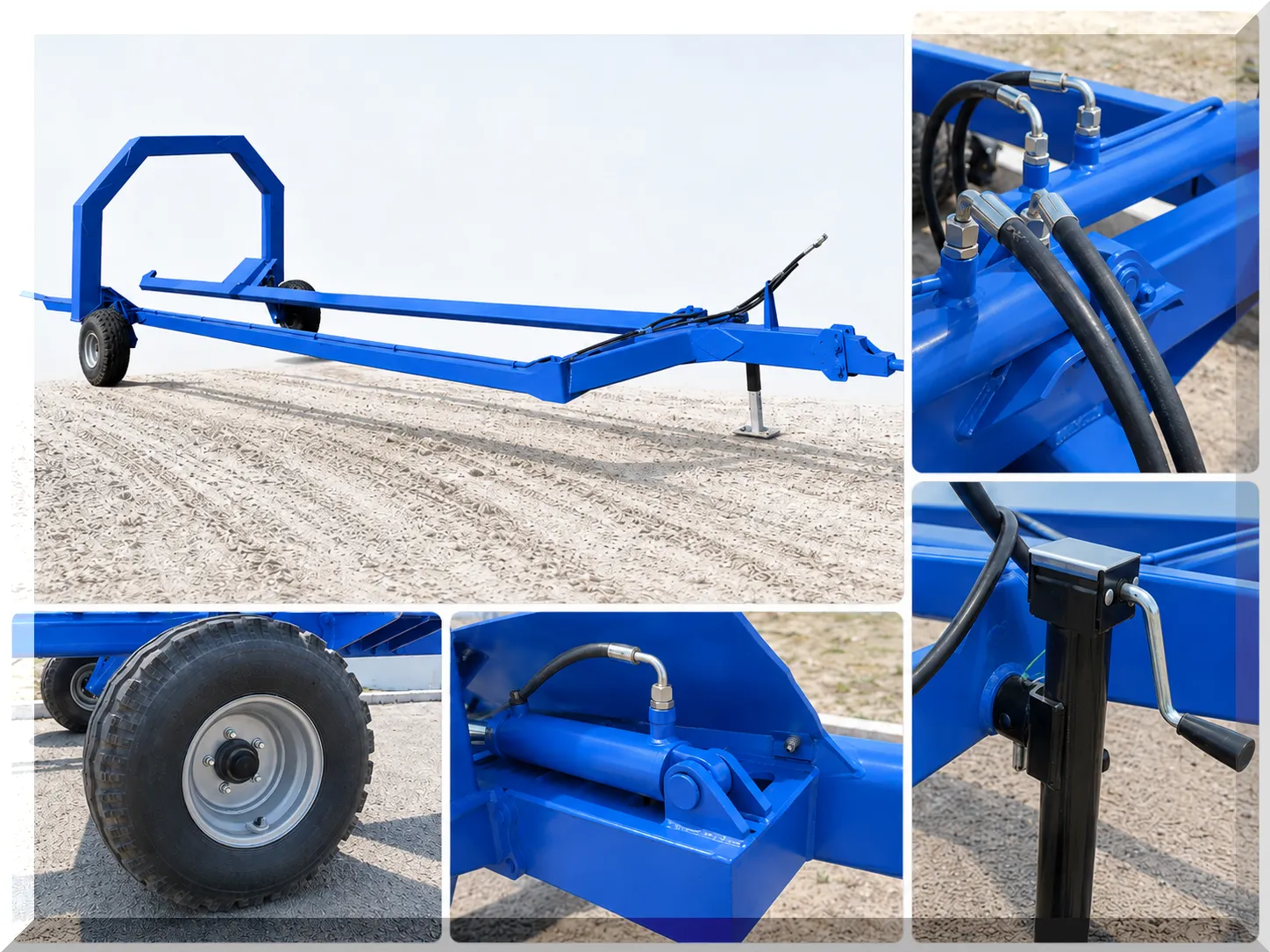
Standard U.S. farm gates are 10 to 16 ft wide. The 9JYY-2.5 at 7.9 ft clears a standard 10-ft gate with approximately 12 inches of clearance per side — workable but not generous on an angled approach. Gates narrower than 9 ft require straight-line entry. Measure your narrowest field gate before ordering.
Many small farm hay barns have 10 to 12 ft door openings. At 7.9 ft wide and 8.2 ft tall (transport configuration), the 9JYY-2.5 fits through a standard 10 ft × 10 ft barn door opening. Verify both width and height clearance at the barn door threshold and any low-clearance ceiling beams inside.
The 7.9 ft transport width falls within the 8.5 ft standard agricultural implement limit in most U.S. states without an oversize permit. On narrow gravel farm lanes with roadside ditches, the 7.9 ft width leaves 3 to 4 inches of margin from typical 8.5 ft gravel surface lanes — drive centered and reduce speed at restricted sections.
At 8.2 ft (2,485 mm) transport height, the 9JYY-2.5 clears standard NESC utility line clearance above agricultural roads (typically 14.5 ft minimum). However, on older rural properties, service line drops to buildings can be as low as 10 ft. Walk your transit route and identify any low-clearance service drops before first road use.
No PTO Needed — But What Drives the Baler That Feeds It?
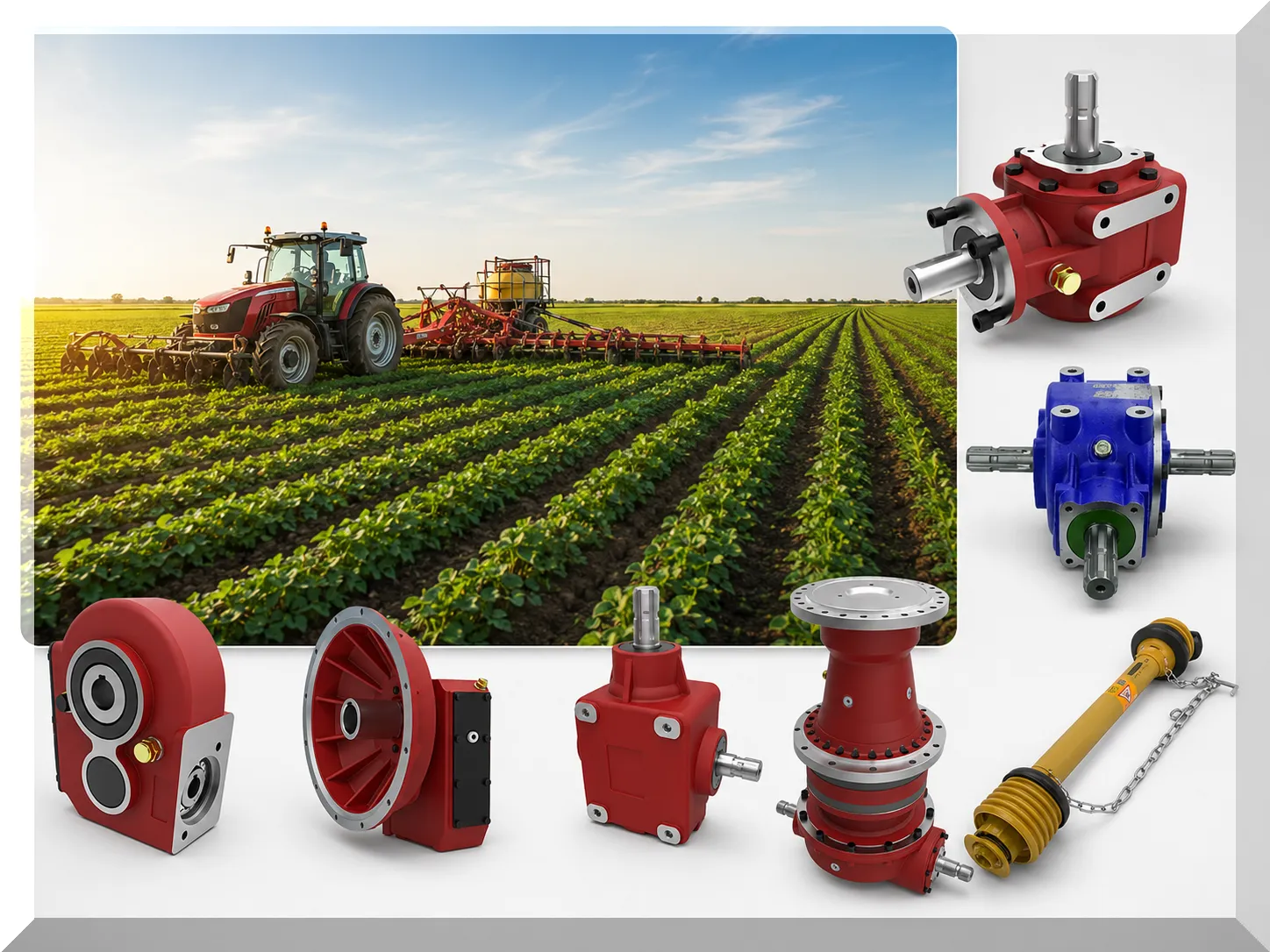
The 9JYY-2.5 itself requires no PTO shaft — it draws power entirely from the single rear hydraulic SCV. That leaves the tractor's rear PTO completely free for the compact round baler operating in a parallel workflow on the same machine. In many small farm operations, the tractor alternates between baling and transporting within the same field session — baling continues, the tractor switches to hauling, then returns to baling once the field is clear. The single-tractor workflow is the defining efficiency advantage on a small operation that cannot justify two tractor setups.
The compact round baler in that workflow runs its own PTO driveline at 540 rpm under sustained load. The transfer gearbox between the PTO stub and the bale chamber drive must handle both continuous compaction torque and instantaneous torque spikes when a dense windrow section enters the pickup at full ground speed. A correctly specified agricultural drive gearbox for the compact baler application — typically rated at 300 to 500 Nm continuous, with a 750–900 Nm overload clutch slip threshold — keeps the baler's PTO driveline protected through the full season without mid-season gearbox failures that would interrupt the paired baling-hauling workflow.
When your operation is ready to scale beyond what the 9JYY-2.5 can handle — larger acreage, heavier bales, or multi-farm custom hauling — the 9JYY-4.5 round bale loader and transporter provides the next step up: dual-axle, 4,500 kg payload, dual hydraulic circuit, and bale diameter range up to 1,400 mm — all with the same fundamental one-operator hydraulic workflow carried over from the 9JYY-2.5.
Maintenance: Simpler Than Any Other Bale Handling Equipment You Own
Single hydraulic circuit, no PTO, no chains, no belts — the 9JYY-2.5 maintenance schedule involves four service points and seasonal storage preparation. A full pre-season inspection takes under 45 minutes.
Every 50 Hours or Seasonally
Pre-Season Annual
Winter Storage
Why Small Farm Operators Choose foragebaler.com

- ✔Compact Tractor Verification Before Ordering. The U.S. team confirms your tractor's SCV count, hydraulic outlet pressure, and drawbar height from the model and year — at no charge before ordering. The most common installation issue (a single-SCV tractor or a drawbar height mismatch) is identified before the machine ships, not after.
- ✔U.S. Warehouse Parts — 2 to 5 Business Days. Hydraulic seal kits, hose assemblies, arm-pivot bearing sets, and drawbar hardware are stocked year-round at the California warehouse. Harvest-season orders placed before 2:00 PM Pacific ship same business day.
- ✔The Complete Small-Farm Forage System. Round balers, hay rake range, and the 9JYY-2.5 transporter from one supplier — one parts inventory, one phone call for support. The About Us page covers our U.S. operations and support model.
- ✔Section 179 First-Year Expensing. The 9JYY-2.5 qualifies as qualified tangible property under IRS Section 179. Full invoice documentation for first-year expensing provided with every order on request — relevant even at small-farm capital costs where the after-tax effective price makes the payback period significantly shorter.
- ✔Direct Factory Pricing. No dealer network, no territory markup. What you pay reflects machine cost plus U.S. logistics — nothing added between the factory and your farm.
Frequently Asked Questions
Seven Small Farm Operators — One Season Each
★★★★★
90 acres of orchard grass and timothy for a 22-horse boarding facility. Before the 9JYY-2.5 I was spending every Saturday after a cutting moving bales with the 45 HP tractor loader — one bale at a time, 80 or 90 trips. Now I do it in about 90 minutes with the same tractor, 3 bales a trip. Setup was about 45 minutes on delivery day. The hydraulic loading is smooth enough that I've never had a net-wrapped bale puncture in a full season of use. The compatibility check before ordering confirmed our Kubota MX5400 was a fine match.
★★★★★
120 acres of mixed alfalfa and grass, 60 beef cows, and no second tractor. The 9JYY-2.5 meant I could bale and haul in the same day instead of leaving bales in the field overnight to move the next day. My 55 HP John Deere 5055E handles it perfectly — I was skeptical a 55 HP tractor would move a full load at road speed, but it handles the loaded 40 km/h transit on flat Magic Valley roads without any strain. Hay quality improved noticeably the first season simply from getting bales off the ground faster.
★★★★★
Converted 85 acres from row crops to mixed grass hay last year. First cutting was 110 bales — I had no idea bale movement would take so long with a loader. Added the 9JYY-2.5 before the second cutting and it changed the whole operation. Third cutting went from a 2-day job to a single afternoon for the baling and clearing combined. I pair it with the 9YG-1.25 baler, both running on our 65 HP New Holland. The pre-purchase tractor check your team did was reassuring for someone buying this type of equipment for the first time.
★★★★★
130 acres of CRP native grass baled for cattle hay resale. Single tractor operation — a Massey Ferguson 5711 at 75 HP. The 9JYY-2.5 lets me clear the field the same day I bale, which has been critical for maintaining the Grade 1 pricing at the local elevator — they dock heavily for weather exposure. I've done two full seasons with no hydraulic issues and only a routine pre-season hose inspection each year. Simple machine that does exactly what it's supposed to do.
★★★★★
55 head of Angus on 100 acres of mixed grass hay in northwestern Pennsylvania with hilly terrain. I use a 62 HP Kubota M7060 and was concerned about the loaded transit on some of our steeper farm lane sections. I followed the advice to reduce speed to 28–30 km/h on the steep descents and had no stability or braking issues all season. Winter bale distribution with this machine is the biggest time saver — moving 3 bales at a time to four different pastures takes 45 minutes instead of two-plus hours.
★★★★☆
75 acres of alfalfa on a part-time basis — I have a full-time job and farm evenings and weekends. The 9JYY-2.5 means that on a Saturday cutting session, I can bale and clear in the same half-day rather than leaving bales out until Sunday and risking afternoon rain. Four stars because my 40 HP compact tractor (John Deere 3038E) is right at the floor of the spec — the machine works, but the transit speed on loaded runs is more comfortable at 30 km/h than the full 40 km/h with that tractor. Operators with 50+ HP will have more speed headroom.
★★★★★
55 acres of certified organic mixed grass cut four times per year for a 120-head dairy goat operation. Single 50 HP tractor runs everything — the 9YG-1.0C baler and the 9JYY-2.5 on the same machine. The compact baler-transporter system fits the narrow lanes and tight barn entry on our property in a way that larger commercial equipment never could. The 9JYY-2.5 arm length places bales precisely in the barn even through our 10 ft × 10 ft door opening. U.S. parts support has been excellent — a seal kit shipped and arrived in 3 days when I needed it mid-summer.
The Right Bale Hauler for Your Compact Tractor and Small Farm Budget
Compact tractor compatibility (SCV pressure, drawbar height, HP) verified from your model and year before shipment. Direct factory pricing, Section 179 invoice documentation, and U.S. support line included with every order.
America Ever-Power Forage Baler Equipment INC. | 1401 21st ST STE R, Sacramento, CA 95811
Additional information
| Editor | Cxm |
|---|