Why Bale Weight Is the Most Underused Number in Hay Marketing
Bale weight sits at the intersection of three variables that matter enormously to every party in a hay transaction: the producer’s cost per pound of dry matter delivered, the buyer’s cost per unit of nutrition purchased, and the transporter’s legal payload limit. Yet most operations do not weigh bales routinely, most sales quote per bale or per ton without weight documentation, and most pricing disagreements originate in weight assumptions that differ by 200–400 lbs per bale — a gap that compounds quickly across a truckload.
±200–400 lbs
Typical weight difference between a well-calibrated baler and the same baler running at standard settings — for a 4×5 bale, this gap represents 20–40% of total bale weight and directly affects price-per-dry-matter-ton calculations
$0.03–$0.08/lb
Value per pound of dry matter in most domestic hay markets in 2025–26, meaning a 300-lb weight difference per bale translates to $9–$24 per bale — significant on any truckload
80,000 lbs
Federal gross vehicle weight limit on U.S. interstate highways — bale weight directly determines how many bales legally fit per load and whether a shipment is overweight before it leaves the farm
The dry matter weight is what matters nutritionally. A bale that gained 200 lbs from rain exposure between baling and delivery has more weight but less nutrition per pound than the same bale delivered dry. Buyers who pay on a per-bale basis without weight documentation are paying a varying price per unit of nutrition across every load. Bale weight documentation — even a simple average from periodic weigh-ins — is the foundation of transparent, professional hay marketing.
The Physics of Round Bale Weight: Volume × Density
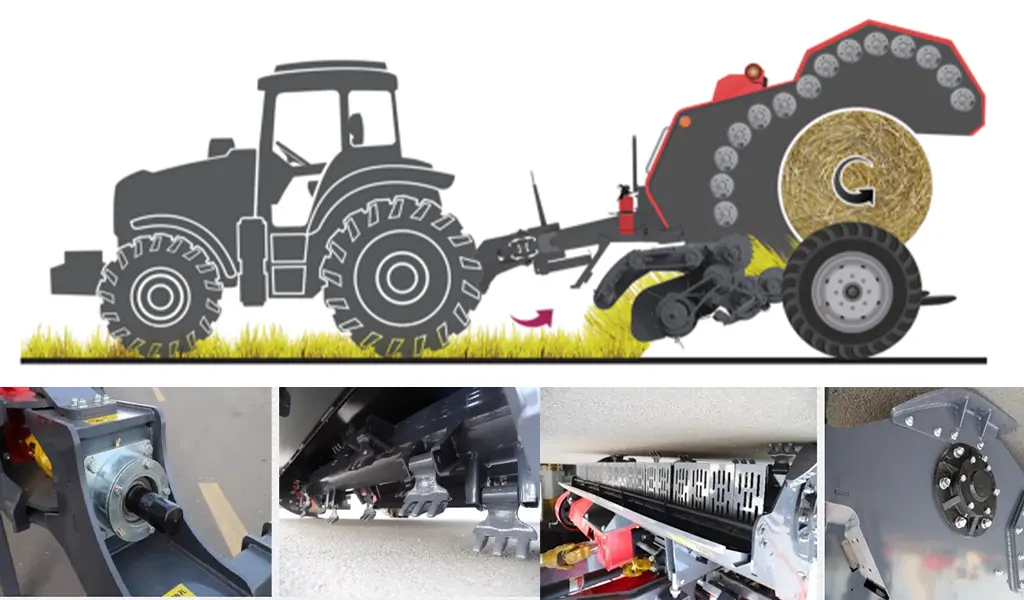
Round bale weight is a direct function of two variables: the bale’s cylindrical volume (set by the chamber diameter and width) and the bulk density at which the crop is compressed into that volume. The formula is straightforward: Weight = π × r² × width × density, where r is the bale’s radius (half the nominal diameter) and density is in pounds per cubic foot. Understanding this formula makes it possible to predict target bale weight before entering the field and to diagnose weight problems by isolating which variable has changed.
Calculated bale volume by size configuration
| Bale size |
Diameter |
Width |
Volume (cu ft) |
At 10 lbs/cu ft |
At 12 lbs/cu ft |
At 14 lbs/cu ft |
| 3×3 (small/compact) |
3 ft |
3 ft |
21.2 |
212 lbs |
254 lbs |
297 lbs |
| 4×4 |
4 ft |
4 ft |
50.3 |
503 lbs |
604 lbs |
704 lbs |
| 4×5 (most common) |
4 ft |
5 ft |
62.8 |
628 lbs |
754 lbs |
879 lbs |
| 5×5 |
5 ft |
5 ft |
98.2 |
982 lbs |
1,178 lbs |
1,375 lbs |
| 5×6 (commercial) |
5 ft |
6 ft |
117.8 |
1,178 lbs |
1,414 lbs |
1,649 lbs |
All calculations use the formula: Weight = π × (diameter÷2)² × width × density. Actual weights vary ±5–10% due to bale shape variation at chamber edges. Moisture weight included in all figures.
The 12 lbs/cu ft column represents the midpoint of the standard cattle-hay density range (11–13 lbs/cu ft). Horse-market hay producers typically target the upper range (13–14 lbs/cu ft) for bale integrity through multiple handlings; silage and high-moisture bales typically run 13–16 lbs/cu ft due to the additional weight of moisture above the normal 14–16% baling range. The relationship between density setting and feed quality is covered in the round bale density and feed quality guide.
Weight by Crop Type: Why the Same Baler Produces Different Results
Two balers set to identical density spring positions and producing nominally identical 4×5 bales will deliver significantly different weights depending on the crop being baled. These differences arise from three sources: the bulk density of the crop species at equivalent compression, the residual moisture level at baling, and the degree to which the crop’s leaf and stem structure compresses and interlocks within the bale chamber. Operators who calibrate their density expectations based on one crop and then switch crops without adjusting will consistently produce bales that are either underweight (lighter forage) or dangerously overweight for transport (high-moisture crops).
Alfalfa (high leaf content)
4×5 at 12 lbs/cu ft: ~850–950 lbs
4×5 at 14 lbs/cu ft: ~980–1,050 lbs
5×5 at 12 lbs/cu ft: ~1,150–1,300 lbs
High leaf fraction compresses densely; third-cut alfalfa with high leaf content bales heavier than first-cut for equivalent spring settings
Timothy / orchardgrass
4×5 at 11 lbs/cu ft: ~650–750 lbs
4×5 at 12 lbs/cu ft: ~750–850 lbs
5×5 at 12 lbs/cu ft: ~1,050–1,200 lbs
Stems interlock less efficiently than legume leaves; typically runs 8–12% lighter than alfalfa at equivalent density settings
Bermudagrass
4×5 at 10 lbs/cu ft: ~580–650 lbs
4×5 at 11 lbs/cu ft: ~650–720 lbs
5×5 at 11 lbs/cu ft: ~980–1,100 lbs
Fine stems create high-friction interlocking that resists compression; bermudagrass bales run consistently lighter per cu ft than cool-season species
Corn stover / straw
4×5 at 9 lbs/cu ft: ~500–570 lbs
4×5 at 10 lbs/cu ft: ~570–640 lbs
5×5 at 10 lbs/cu ft: ~900–1,000 lbs
Coarse, hollow stems trap air and resist compression; achieving high density in straw requires significantly higher spring tension than hay crops
Silage and haylage exception: High-moisture baleage (baled at 40–60% moisture for fermentation wrapping) can weigh 1,500–2,500 lbs for a 5×5 bale depending on moisture and species. The additional moisture weight is not additional nutritional value — the dry matter content per bale is equivalent to or slightly less than an equivalent dry hay bale. Always calculate nutritional value on a dry matter basis, not total wet weight.
Moisture and Its Effect on Bale Weight: The Variable That Changes Every Load
Moisture is the most significant variable affecting bale weight that is invisible to both buyer and seller at the time of transaction. A 5×5 bale of alfalfa baled at 20% moisture weighs approximately 8–12% more than the same bale of the same alfalfa baled at 14% moisture — but the higher-moisture bale contains less dry matter per pound and will lose weight during storage as that excess moisture migrates to the bale surface and evaporates.
| Bale moisture % |
Weight premium vs 14% baseline |
Dry matter % of total weight |
Market implications |
| 12% (over-dry) |
−3% |
88% |
High leaf loss risk; dusty; horse buyers reject |
| 14% (ideal) |
Baseline |
86% |
Optimal for storage, weight accuracy, and quality |
| 17% (acceptable) |
+4% |
83% |
Slightly higher weight; some heating expected; acceptable for covered storage |
| 20% (marginal) |
+9% |
80% |
Significant mold risk; buyer receives less DM per pound paid |
| 25%+ (wet) |
+16% |
75% |
Must be baleage-wrapped; major mold and heat risk as dry hay |
Practical calculation: If your standard 5×5 alfalfa bale weighs 1,200 lbs at 14% moisture and you baled a cutting at 20% moisture, those bales weigh approximately 1,310 lbs — but the buyer is receiving the same pounds of dry matter (1,032 lbs DM) in either case. The 110-lb weight premium is entirely moisture. If the buyer is paying per bale without weight or moisture adjustment, they are paying the same price for the same nutritional content. If the buyer is paying per ton of hay-as-fed, they are paying 9% more per unit of nutrition for the wet bale. Moisture testing with a probe meter is the producer’s best defense against pricing errors in either direction.
Transport Load Planning: How Bale Weight Determines What Fits on the Truck
The federal bridge formula and 80,000-lb gross vehicle weight limit are the physical ceiling on every hay load, and bale weight is the primary variable that determines how many bales legally fit. Most producers and buyers underestimate the stacking and securing constraints that interact with weight limits, leading to loads that are either inefficiently light or technically overweight — with the overweight scenario carrying fines up to $5,000 on interstate scales.
Semi flatbed load planning (48 ft trailer)
Tractor + trailer tare weight: 33,000–36,000 lbs
Net hay payload: 44,000–47,000 lbs
4×4 bales (600 lbs avg): ~73 bales max
4×5 bales (800 lbs avg): ~56 bales max
5×5 bales (1,150 lbs avg): ~40 bales max
5×6 bales (1,400 lbs avg): ~33 bales max
Physical stacking limits may reduce count further — 5×6 bales on a flatbed typically stack 2 high in two rows (4 per row × 2 rows × 2 high = 16 per “layer” depending on trailer width and height)
Farm truck and trailer (typical operation)
Pickup + gooseneck (30 ft):
GVWR: 26,000–35,000 lbs
Tare: 12,000–16,000 lbs
Payload: 10,000–19,000 lbs
4×5 bales: 12–18 bales
5×5 bales: 9–14 bales
5×6 bales: 7–11 bales
CAUTION: Overloading a farm truck is illegal on public roads regardless of how short the haul. Bale weight must be accounted for against the truck’s GVWR, not an estimate.
Weight verification before loading: The most reliable field weight check for producers without an on-farm scale is a tractor loader-mounted weight indicator or a drive-over platform scale at a local elevator or feed supply. At minimum, producers should calibrate their baler’s own weight estimate function (if equipped) against at least 10–15 randomly selected bales on a certified scale at the beginning of each season and after any density setting change. A baler weight estimate that is off by 10% compounds to a significant load-weight error when multiplied by 40 bales on a flatbed.
What Buyers in Each Market Segment Actually Expect by Weight

Bale weight preference is not uniform — it varies significantly by buyer type, their feeding equipment, their storage capacity, and their handling logistics. Producers who match their bale size and weight to the buyer’s actual operational needs capture a loyalty premium that transcends price negotiation. A dairy operation that runs an automatic round bale unroller needs consistent 1,100–1,200 lb bales; give them bales ranging from 900 to 1,400 lbs and the variable feeding rate creates nutritional inconsistency in the ration that the nutritionist has to correct.
Cattle feedlots / beef
Preferred weight: 1,000–1,600 lbs (5×5 or 5×6 bales). Feedlots use tractor-mounted hydraulic bale processors and spear handlers that are designed for heavy bales — a 4×5 bale at 750 lbs is inefficiently light per handling event. These buyers pay on a per-ton basis and are most focused on consistent density and minimal field losses. Large bales with high DM content per bale reduce handling cost per unit of nutrition fed.
Horse stables / barns
Preferred weight: 500–900 lbs (4×4 or small 4×5 bales). Horse barns frequently handle bales with minimal mechanical assistance — moving a 1,400-lb bale in a barn aisle requires equipment most horse facilities don’t have. Horse buyers value weight consistency as a ration planning tool; an operation that consistently delivers 750-lb bales lets the barn manager know that 2 bales feeds their string of 8 horses for 3 days without weighing each feeding.
Dairy operations
Preferred weight: 1,100–1,400 lbs, highly consistent (±5%). Dairy rations are formulated to specific dry matter intakes and forage proportions — bale weight variation directly affects ration accuracy. Operations using automated bale unrollers or TMR integration need weight consistency more than weight magnitude. Most dairies prefer documented average weight with standard deviation from each producer, and will pay a premium for operations that can provide certified average weights from each cutting.
Export buyers
Preferred weight: Defined by container specifications. A standard 40-ft container handles approximately 20–22 metric tons (44,000–48,400 lbs) of hay depending on bale stack efficiency. Export buyers typically specify maximum bale weight and dimensions to optimize container utilization. Most international markets prefer bale weights of 700–950 lbs (approximately 320–430 kg) — heavy enough to minimize handling count but light enough to load by hand if mechanical equipment is unavailable at the destination.
Individual/small farm
Preferred weight: Under 800 lbs strongly preferred (4×4 standard). Individual buyers purchasing hay for 1–5 animals typically have a pickup, a small tractor, or just a bucket loader. A 1,400-lb bale that requires a skid loader to move is a liability for a buyer who doesn’t own one. Small farms that need hay for a single horse or a small beef herd are best served by 4×4 bales in the 500–700 lb range — light enough to move with minimal equipment while large enough to justify a delivery cost.
The Baler Settings That Control Bale Weight Consistently
Three baler settings determine the weight of every bale produced — and two of them are frequently set once at the beginning of the season and left unchanged regardless of what crop or windrow condition changes are encountered throughout the year. Consistent bale weight requires treating density adjustment as a per-windrow decision rather than a per-season set-and-forget operation.
1
Density spring tension — the primary bale weight control. Higher spring tension = more resistance to bale expansion = denser, heavier bale. Lower spring tension = lighter bale that forms faster but weighs less and is more vulnerable to shape loss during storage and handling. For variable-chamber balers, the density spring is typically adjustable from the operator’s seat or from the tractor cab on electronic control systems. Set a target weight range for each crop and adjust spring tension until the baler consistently hits that range across windrows of similar moisture and crop stage.
2
Bale diameter setting (variable chamber only) — on variable chamber balers, the diameter at which the bale sensor triggers wrap is a second weight control. Increasing the diameter target from 4.0 ft to 4.2 ft adds approximately 10% additional volume to a 4-ft diameter bale, increasing potential bale weight by 10% at equivalent density. Many operators set the diameter once and never adjust it — but reducing diameter by 0.2 ft in light, fine-stemmed crops (bermudagrass, teff) allows faster cycle time and consistent core formation that would otherwise be loose in the center.
3
Ground speed and windrow entry — the indirect weight control that most operators underestimate. Entering a dense windrow at 6 mph when the baler can only compress the material at 4 mph results in a loose bale core surrounded by a dense outer shell — the density reading at the sensor appears acceptable but the bale’s average density is significantly lower than target. Matching entry speed to the windrow weight (tons per linear foot of windrow) is necessary for consistent bale density and therefore consistent bale weight. This is a matter of matching the tractor to the baler: the round baler to tractor matching guide covers PTO power and speed requirements that affect this balance.
The physical specification differences between round baler configurations that make one model better suited for heavy-density alfalfa than another are in our round baler models. Drive system torque specifications that govern the maximum density the baler can achieve before PTO torque becomes limiting are in agricultural gearbox and PTO driveline component specifications.
Large Square vs Round: When Bale Weight Specification Drives the Equipment Decision
The bale weight ceiling of a round baler is fixed by its chamber size — a 5×6 baler at 14 lbs/cu ft produces a maximum of approximately 1,650 lbs per bale. Large square bales (3×3×8 ft or 4×4×8 ft) can reach 1,600–2,200 lbs per bale and offer uniform stacking geometry that containers and transport vehicles handle more efficiently. When a buyer specifies bale weights above 1,800 lbs, or when stacking efficiency for container loading is critical, the round vs large square decision becomes a bale weight and logistics question rather than a quality question. The detailed comparison of these two systems is in the round baler vs large square baler comparison.
When round bale weight is sufficient
Domestic cattle, horse, and dairy markets where buyers have round bale handling equipment. Export markets accepting 700–950 lb bales. Any market where the buyer’s mechanical handling capacity is at or below 1,600 lbs. All pasture direct-feeding applications where bale weight interacts with animal waste and reachability at the feeding ring.
When large square bale weight makes more sense
Export markets with container-loading contracts specifying bale weight above 1,800 lbs. Commercial dairy operations with inline bale feeding equipment designed for square bale geometry. Operations that ship to markets where round bale handling equipment is not standard (most international destinations). High-volume commercial operations where stacking efficiency in barn storage is a cost driver.
Measuring, Recording, and Marketing Bale Weight as a Quality Differentiator
Bale weight documentation is not standard practice in most small and medium hay operations — which is exactly why it represents a competitive differentiation opportunity for producers who implement it. Buyers who regularly receive both a forage test report and a documented average bale weight with standard deviation have everything they need to calculate cost per unit of nutrition, plan transport loads, and ration feed without guesswork. These buyers pay consistently more and stay with reliable suppliers longer than buyers managing uncertainty on every load.
Method 1: Tractor loader scale
A load cell kit installed on a tractor front loader provides real-time bale weight every time a bale is moved. Cost: $600–$1,800 for aftermarket kits. Accuracy: ±2–3% depending on installation quality. Best for operations that move every bale through the loader during storage or loading — captures the full production sample without additional handling steps.
Method 2: Drive-over platform scale
A fixed platform scale installed at the farm entrance or storage area allows individual bale weights to be captured during movement. Cost: $3,000–$8,000 for commercial-grade ag scales. Best for high-volume operations where consistent documentation justifies the capital investment. Provides the most accurate individual bale weights of any field method.
Method 3: Sample weigh-in at elevator
Load 10–20 bales from a given cutting onto a truck, weigh at a commercial scale (elevator, grain facility), unload tare weight, divide by bale count. Cost: minimal — most elevators charge $5–$15 per weigh-in. Accuracy: ±5–8% as a lot average. Adequate for establishing average weights by cutting for marketing documentation and transport planning.
Marketing language that closes sales: “This cutting averaged 1,080 lbs per 5×5 bale (standard deviation ±38 lbs), confirmed by platform scale on delivery, at 13.8% moisture. Forage test attached.” This statement gives a dairy buyer or feedlot manager everything they need to calculate cost per ton of dry matter, confirm transport load count, and verify ration inputs — in two sentences. Producers who consistently provide this level of documentation occupy a different competitive tier than those who quote a price per bale without supporting data.
Round Bale Weight FAQs
How much does a typical 4×5 round bale weigh?+
A 4×5 round bale weighs between 600 and 1,100 lbs depending on crop type, moisture content at baling, and the density spring setting. Alfalfa baled at 14–16% moisture at standard cattle-hay density (11–12 lbs/cu ft) typically produces 4×5 bales of 750–900 lbs. Timothy or orchardgrass at equivalent settings runs 650–800 lbs. Bermudagrass, which is harder to compress, typically runs 580–720 lbs for a 4×5. Corn silage baleage (40–50% moisture) can reach 1,000–1,200 lbs in a 4×5 due to the additional moisture weight. For a quick estimate, use the formula: π × (2 ft radius)² × 5 ft width × density in lbs/cu ft = approximate weight in lbs.
How many 4×5 round bales fit on a semi-truck legally?+
At an average weight of 800 lbs per 4×5 bale and a typical net payload of 45,000 lbs (80,000 lb gross minus 35,000 lb tare), a semi flatbed can carry approximately 56 bales by weight. However, physical stacking on a 48-ft flatbed limits actual capacity — 4×5 bales stacked on their flat side (4 ft wide, 5 ft tall when stacked on edge) in two rows can fit approximately 18–19 bales per layer on a standard-width flatbed, stacked 3 high = 54–57 bales, which aligns closely with the weight limit. At 1,000 lbs per bale (high-density alfalfa), the weight limit becomes binding at around 45 bales. Always confirm with your specific truck’s certified weight documentation before loading.
My bales are coming out 200–300 lbs lighter than expected. What causes this?+
Light bales relative to expectations have four primary causes. The most common is crop moisture — if the hay dried further between when you set the density spring (based on previous experience) and current baling conditions, drier hay compresses more efficiently and produces lighter bales at the same spring tension. Second cause: the density spring tension has drifted lower than the original setting, either from component wear or because someone adjusted it down. Third: the windrow is lighter per linear foot than normal, causing the baler to form a bale with less material than expected — this is a windrow formation issue, not a baler issue. Fourth: the bale chamber is not achieving full diameter due to a partially-loaded windrow that never fully fills the chamber — check that bale diameter at wrap matches the target setting.
Does a heavier bale always mean better nutrition?+
No — bale weight and nutritional value are independent variables. A heavy bale produced by baling at high moisture contains more pounds of water per pound of dry matter than a lighter bale of the same crop baled dry. The nutritional content per pound of dry matter is determined by the crop’s maturity at cutting, the species composition, and the curing process — not by how tightly the bale was compressed. In fact, extremely high-density baling of hay that was slightly moist can accelerate internal heating that degrades protein quality (heat damage, identified as ADICP/bound protein on a forage test). Optimal bale weight represents adequate density for bale integrity and storage resistance, not maximum achievable density for a given crop and moisture level.
Can I quote a guaranteed weight per bale when selling to buyers?+
You can quote a documented average weight with a stated standard deviation, which is more meaningful to a buyer than a single number. “Our 5×5 bales from this cutting averaged 1,120 lbs ± 45 lbs, confirmed by loader scale, at 14.2% moisture” is a statement you can stand behind because it reflects actual measured data with an acknowledged variability range. Quoting a single guaranteed weight per bale without measurement data creates liability when individual bales inevitably vary — bale weight varies even within the same cutting due to windrow density variation across the field. The appropriate commitment is accurate documentation of the measured average, not a guaranteed minimum for every individual bale.
How much does a round bale lose in weight during storage?+
A round bale stored outdoors on bare ground can lose 5–20% of its initial weight over 6 months, with most of the loss occurring in the outer 4–6 inches that weather-damage into spoilage. This represents actual dry matter loss — the spoiled outer layer is not weight from moisture evaporation but from decomposition of the forage material itself. A 1,200-lb bale that loses 15% of its mass to outdoor storage spoilage has 1,020 lbs of usable hay when fed out — a $18–$36 loss in nutritional value depending on hay price. Net-wrapped bales stored on gravel under cover typically lose 2–4% over the same period. The storage protocol that minimizes this loss is in the round bale storage guide. Bales that are heavier at baling due to higher moisture will lose more absolute weight during the initial curing period (weeks 1–6 post-baling) as that excess moisture migrates and evaporates — this weight loss is normal and expected.
Editor: Cxm