Why Baler Fires Are More Common Than the Industry Publicly Acknowledges
Agricultural equipment fires are significantly underreported because most occur on private property, are extinguished without fire department involvement, and are absorbed as equipment losses without formal incident tracking. Industry fire investigators estimate that hay baling equipment — primarily round balers and large square balers — is involved in several thousand fire events annually in the U.S., with total losses that frequently exceed the replacement cost of the baler when crop field damage is included. Most of these fires were preventable.
<10 min
Time from visible baler fire ignition to spread into adjacent windrows or standing crop in hot, dry conditions — the window that makes field suppression equipment on the baler, not in the truck, the only viable response
2–5 PM
Peak fire risk window on any clear baling day — maximum ambient temperature, minimum relative humidity, maximum crop dryness, and maximum bearing operating temperature after hours of running all converge in this period
80%+
Fraction of baler fires that originate from one of three identifiable, preventable causes: bearing failure, belt friction, or accumulated crop residue on hot surfaces — all detectable by pre-season inspection
The three-factor problem: Baler fires require the simultaneous presence of an ignition source (heat), fuel (dry crop material or hydraulic fluid), and opportunity (accumulated fuel near the ignition source). Preventing any one of the three breaks the fire triangle. The inspection protocol in this guide targets each factor independently, because a baler that has no accumulated crop residue will not produce a serious fire even if a bearing runs hot — and a baler with perfect bearings but accumulated straw dust around the drive roller can ignite from the friction of a slipping belt on a dry afternoon.
Primary Ignition Sources: Where Round Baler Fires Actually Start
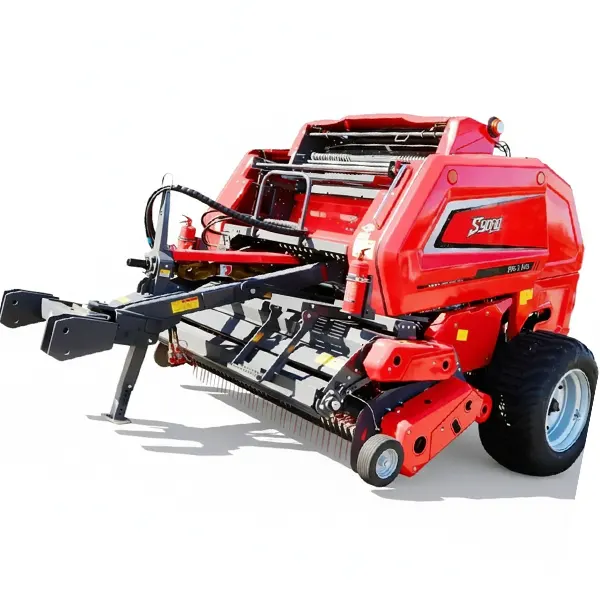
Understanding where fires start is the prerequisite for preventing them. Five distinct ignition mechanisms account for the large majority of round baler fires. Each has a different location, a different physical mechanism, and a different preventive response. An operator who inspects only for bearing problems while ignoring crop accumulation on the exhaust shield is addressing one of five sources and leaving four unaddressed.
CAUSE 1
Bearing failure — the most common cause
A bearing that is running rough, under-lubricated, or at the end of its service life generates friction heat at the rolling elements. Under normal operation, a baler bearing surface runs at 110–140°F. A failing bearing runs at 160–200°F or higher, generating enough radiant heat to ignite fine crop dust (alfalfa leaf dust ignites at approximately 350°F) when the dust accumulates within inches of the bearing housing. The bearing does not need to visibly fail or seize — sustained running at 180°F near an accumulation of bone-dry crop dust is sufficient. Location: most commonly the drive roller bearing, the pickup drive bearing, or the main gearbox output bearing.
CAUSE 2
Belt slippage at the drive roller — the second most common cause
When a belt slips against the drive roller rather than gripping and turning with it, the friction between the belt and roller surface generates significant heat. A belt that is glazed (hardened rubber surface from prior heat exposure), over-elongated, or running at incorrect tension is most likely to slip. The heat generated at the slip point can exceed 300°F within minutes of sustained slippage — enough to ignite fine crop material resting between the belt and the roller structure. Symptoms before fire: burning rubber smell, smoke at the belt-roller contact point, bale forming slowly or not at all.
CAUSE 3
Accumulated crop residue on hot surfaces
Even a baler with perfect bearings and correctly tensioned belts can catch fire if fine crop residue accumulates in the wrong locations. Dry crop dust — particularly from over-dry straw, bermudagrass, or wheat straw — settles into every crevice in the drive train area during operation. When this material accumulates on bearing housings, belt shields, gearbox surfaces, or PTO shaft components that run continuously at elevated temperatures, it creates a ready-made fuel source directly in contact with the ignition source. This is the most insidious fire cause because there is no mechanical failure — the fire occurs even when the machine is mechanically sound.
CAUSE 4
Hydraulic fluid on hot surfaces
Agricultural hydraulic fluid has a flash point of approximately 300–400°F depending on formulation. Under normal operation, this is well above the temperature of hydraulic line surfaces. However, a hydraulic line that chafes against a hot bearing housing or exhaust component, or a fitting that develops a pinhole leak that sprays hydraulic mist onto a surface running at 350°F, can produce rapid ignition. A hydraulic fire is particularly dangerous because the burning fluid runs and spreads, distributing fire to adjacent crop material in the bale chamber. Inspect all hydraulic lines annually for chafe wear, particularly where lines pass near bearing housings.
CAUSE 5
Metallic spark from debris or shear bolt failure
A metal object — a stone, a length of wire, a dropped tool — entering the bale chamber produces sparks when it contacts the rotating roller or drive mechanism at speed. PTO shaft specifications, driveline torque ratings, and gearbox component condition all influence the mechanical temperature environment — detailed driveline service data is in 农业机械变速箱和动力输出轴传动系统部件规格. In most conditions these sparks are harmless, but in extremely dry crop material (moisture below 10%) with accumulated dry dust in the chamber, a spark can be sufficient for ignition. Shear bolt failure — which produces a brief high-energy event as the bolt shears — can also generate sparks. This cause is the least preventable but the least common; the primary defenses are crop moisture management above 12% and clearing the field of obvious metallic debris before baling.
High-Risk Crops and Field Conditions: When to Raise Your Vigilance Level
Not all baling situations carry equal fire risk. The combination of crop species, field conditions, weather, and time of day creates a risk environment that varies from low to critical within the same operation on the same day. Operators who treat every baling session as equivalent fire risk miss the predictable patterns that allow targeted risk management on the highest-risk days.
| Crop / material |
Base fire risk |
Primary risk factor |
Conditions that escalate to critical |
| Wheat / barley straw |
⚠⚠⚠ VERY HIGH |
Hollow, low-moisture stems; extreme dust generation; silica content creates abrasive friction |
Humidity below 25%, temp above 95°F, afternoon hours, any bearing irregularity |
| Bermudagrass (mature) |
⚠⚠⚠ VERY HIGH |
Fine stems generate extremely fine dust; late-season cuts particularly prone at low moisture |
Over-mature or drought-stressed; crop below 10% moisture; late afternoon baling |
| Corn stover / residue |
⚠⚠ HIGH |
Dry leaf fraction ignites readily; high dust generation during pickup and chamber filling |
Post-harvest drought conditions; any wind gusting into bale chamber area |
| Native grass / CRP hay |
⚠⚠ HIGH |
Mixed fine-stem grasses generate significant dust; often baled at very low moisture in western states |
Late-season western U.S. conditions (Aug–Oct) with relative humidity below 20% |
| Alfalfa (dry hay) |
⚠ MEDIUM |
Leaf dust from over-dried cuts; higher moisture content limits ignition window |
Third cut or later under drought; crop baled below 12% in arid western conditions |
| 提摩西草/果园草 |
⚠ MEDIUM |
Lower dust generation; higher moisture retention in thicker stems reduces risk |
Over-mature cuts with heavy seed-head fraction; drought stress reducing moisture below 12% |
| Haylage / baleage (40%+ moisture) |
低的 |
High moisture prevents dust generation; crop does not support combustion at 40%+ moisture |
Not a meaningful fire risk from the crop; mechanical risks (bearing, hydraulic) still apply |
Weather conditions that elevate every risk category
Relative humidity below 30%, ambient temperature above 95°F, and wind speed above 10 mph simultaneously create the highest-risk field environment regardless of crop type. Under these conditions, fine crop dust stays airborne longer near hot surfaces, ignition temperature thresholds are reached faster, and any fire that starts spreads more rapidly than normal. Consider stopping baling by 2 PM on days meeting all three criteria, particularly in straw or bermudagrass.
The post-drought season hazard
A season following drought produces unusually fire-prone conditions in two ways: the crop itself is at abnormally low moisture (fields that normally bale at 14–15% may be at 9–11% in a drought year), and the accumulated dust from the previous season’s operation inside the baler is heavier than normal due to the drier crop material. The first cutting of a drought-stress season through a machine that was not thoroughly cleaned at storage is the single highest-risk combination encountered in normal commercial operations.
Pre-Season Fire Prevention Inspection: The Checklist Before the First Bale
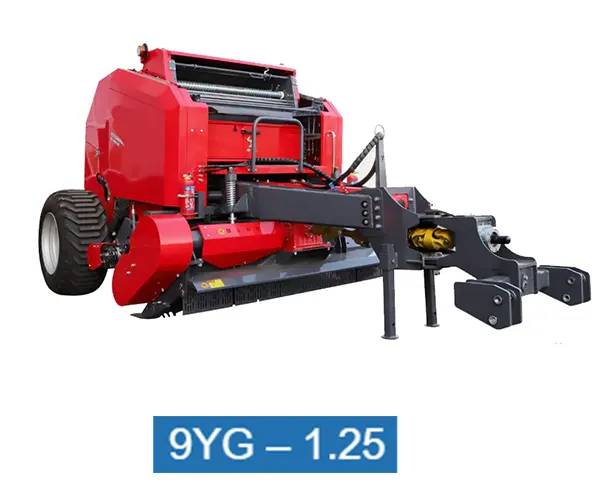
The pre-season inspection is the most cost-effective fire prevention measure available. A baler that is clean, has correctly lubricated bearings running at normal temperature, and has no accumulated crop residue near hot surfaces is a baler that is unlikely to produce a fire regardless of crop type or weather conditions. Every item on this checklist costs less time to check than the time lost to a single fire event — even a contained fire that damages only the baler and not the crop field.
BEARING SYSTEM — Inspect every accessible bearing
☐ Spin every accessible bearing by hand with the PTO disconnected. A bearing in good condition turns smoothly with slight resistance. Roughness, catching, or grinding indicates worn races — replace before operation.
☐ Check for side-play (axial movement) at bearing locations by pushing the shaft sideways. More than 1–2mm of play indicates a worn tapered bearing or loose mounting that will accelerate to failure under load.
☐ Grease all bearing zerks until fresh grease appears at the seal — but do not over-grease. Over-greasing a sealed bearing blows the seal outward, allowing crop dust direct entry to the bearing races. Follow the manufacturer’s grease specification: NLGI Grade 2 EP grease for most baler bearings.
BELT AND DRIVE SYSTEM
☐ Inspect drive roller surface for glazing — a shiny, hardened appearance that indicates past heat events from belt slippage. A glazed drive roller dramatically increases future slip risk. Light abrasion with coarse emery cloth restores grip; severe glazing requires roller replacement.
☐ Measure belt elongation (12-link method) on all belts. Belts at or beyond the elongation replacement threshold create slip risk at the drive roller — replace before the season rather than running an over-stretched belt into the highest-fire-risk conditions.
☐ Check belt edge condition. A belt tracking against a side wall leaves black rubber marks on the housing wall and frays the belt edge — both a fire risk (rubber dust accumulation) and a belt failure risk. Correct tracking before operating.
CROP RESIDUE REMOVAL
☐ Blow out the entire drive train area with compressed air before the first operating day. Open all access panels and shields. Direct compressed air to all bearing housings, drive roller areas, belt shields, gearbox surfaces, and the PTO shaft area. The volume of dry crop dust that accumulates in a baler during a full season is typically measured in pounds — this dust is the fuel source for most bearing-caused fires.
☐ Inspect and clean around hydraulic line routing, especially where lines pass near bearing housings or gearbox surfaces. A line that has been pressed against a hot surface will show a flat, discolored, or hard spot — reroute and secure with additional clamps to prevent contact.
HYDRAULIC AND ELECTRICAL SYSTEMS
☐ Inspect all hydraulic fittings and line connections for seeping or weeping. A fitting that left an oil stain during the previous season will weep again — replace the fitting, not just tighten it. The residual oil from a seeping fitting on the ground is a minor nuisance; the same oil on a hot surface in the drive train is a serious fire hazard.
☐ Inspect all monitor and sensor wiring for cracked insulation, bare spots, or rodent damage at wiring harness connections. Rodents target baler wiring in winter storage — an exposed wire shorting against the baler frame during operation produces heat and sparks in the worst possible location (inside crop-contact areas). Replace damaged wiring before operation.
The complete pre-season maintenance schedule — including lubrication intervals, belt elongation measurement procedure, and hydraulic system service — is in the 圆捆机季节性维护检查清单. Wear item replacement intervals that prevent the mechanical degradation that creates fire risk are in the round baler parts and wear items replacement guide.
In-Season Warning Signs: What to Watch and Smell During Active Baling
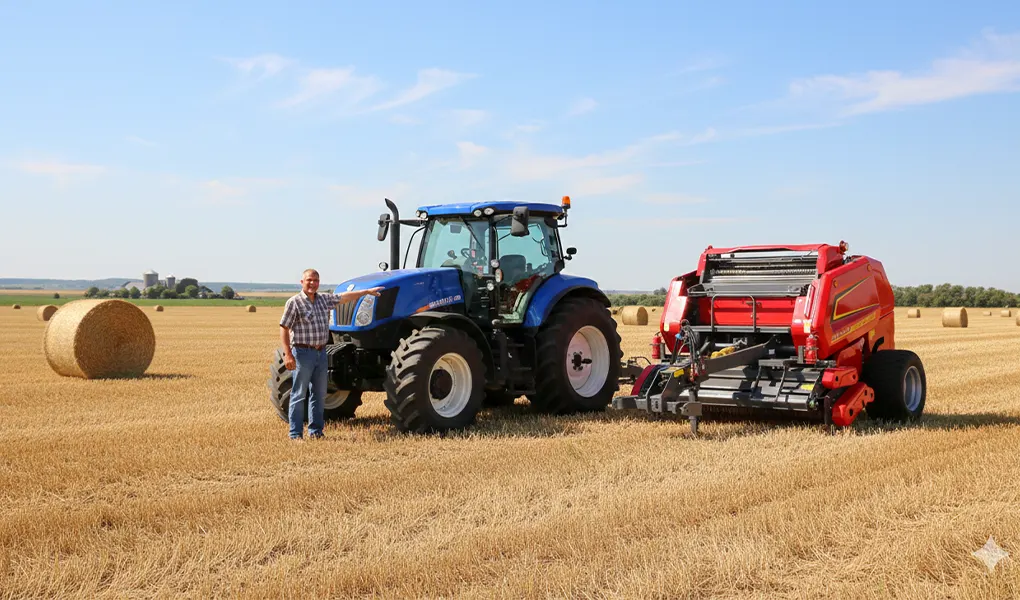
Pre-season inspection addresses the conditions that existed before harvest began. In-season monitoring catches the conditions that develop during operation — a bearing that checked out fine in May and begins failing in July, a belt that tracks normally until a heavy windrow pushes it against the side wall, a hydraulic fitting that tightens under vibration all season and then develops a pinhole leak at the worst moment. Active monitoring requires stopping periodically and physically checking the baler, not just watching from the tractor seat.
Smell — most reliable early indicator
Burning rubber smell: belt slippage at the drive roller. Stop immediately, disengage PTO, and check belt tracking and drive roller condition before any crop reaches that location. Burning dust smell (different from hot rubber — more like overheated electronics or paper): bearing or crop accumulation heating. Stop and locate the source. Acrid petroleum smell: hydraulic fluid on a hot surface. This is an immediate fire hazard — stop, disengage PTO, and locate before restarting.
Touch — the bearing temperature check
At every break during baling (minimum every 2 hours, more frequently in hot/dry conditions), physically touch accessible bearing housings. A bearing running correctly feels warm but not uncomfortably hot — you can hold your hand on it for 5 seconds. A bearing running above 160°F (approaching failure) is too hot to hold your hand against for 2 seconds. Any bearing in that range is a stop-work condition: disengage PTO, complete the current bale only if safe, then investigate before continuing. Do not use this test while the machine is running — wait for PTO to stop completely.
Sound — changes that indicate developing problems
A new grinding or whirring sound that wasn’t present at the start of the day: bearing failure beginning. A squealing sound from the belt area: belt-roller slippage. A rhythmic thumping from the drive system: a bearing race defect cycling once per revolution. Any new sound should be investigated before continuing rather than monitored for worsening — by the time a failing bearing sounds dramatically worse, it is very close to the temperature range where fire risk becomes real.
The most dangerous baling position: Windows-up, air-conditioned tractor cab, radio on, watching from the monitor screen rather than looking at the baler. This configuration eliminates two of the three early warning senses (smell and sound) and leaves only the monitor display. By the time smoke appears on a camera feed or a fire is visible in the rear-view mirror, the baler is already on fire. Consider baling high-risk crops (straw, dry bermudagrass) with the cab window cracked or open to maintain smell sensitivity. Stop at every headland turn and visually inspect the baler exterior — the 30 seconds this adds per field pass is the most cost-effective fire prevention action available during operation.
Fire Suppression Equipment: What to Carry, Where to Mount It, and When to Use It
A fire extinguisher stored in the tractor cab is the wrong location for baler fire suppression. By the time a driver parks the tractor, exits the cab, retrieves the extinguisher from a mount in the cab, and walks to the fire, 60–90 seconds have elapsed — enough time for a small crop smolder in the bale chamber to develop into an active fire throughout the bale and begin spreading to the floor of the machine. The extinguisher needs to be on the baler, accessible within 10 seconds of stopping.
Minimum suppression equipment — every baler
10-lb ABC dry chemical extinguisher mounted directly on the baler frame in an accessible location (not behind a panel, not requiring a tool to reach). ABC rating covers burning crop material (Class A), hydraulic fluid (Class B), and electrical fires (Class C). Mount with a quick-release bracket at hip height on the curbside of the baler — accessible from outside the machine without entering the fire zone.
Inspect monthly: verify pin is present, gauge reads in green zone, and nozzle is clear of crop debris that may have packed into the opening during operation.
Upgraded suppression — high-risk crop operations
20-lb ABC extinguisher on the baler for straw, bermudagrass, or any operation in very high-risk conditions. The additional discharge time (approximately 25 seconds vs 14 seconds for a 10-lb unit) matters when the fire has progressed beyond a smolder before detection. Additionally: a 25-50 gallon water tank on the tractor 3-point or a pulled trailer, connected to a pump sprayer with a 15-foot hose. Water is more effective than dry chemical for crop field fire suppression around the baler — use the extinguisher on the machine fire and the water supply on the ground-level crop fire that is spreading away from the baler.
Straw and bermudagrass operations: treat the water tank as standard equipment, not optional equipment.
Field Emergency Response: The First Four Minutes After Ignition
The actions taken in the first four minutes after a baler fire is detected determine whether the outcome is a contained equipment fire or a complete loss of the baler, the tractor, and potentially the crop field. The sequence matters as much as the speed — the wrong first action (reaching for an extinguisher before disconnecting the PTO) can place the operator in greater danger than the fire itself.
0–30 sec
Stop, disengage PTO, move tractor clear
Stop forward motion immediately. Disengage the PTO before doing anything else — a running baler actively feeds crop material into the fire. Move the tractor 30–50 feet forward to disconnect the baler from the tractor’s fuel tank and cab — a fire that spreads to the tractor becomes a much larger emergency. Do not turn the tractor off until it is clear of the baler; you may need the hydraulics to disconnect the hitch under load. Once clear, shut down the engine. This single step — moving the tractor clear — is the most important survival action in a baler fire.
30–90 sec
Call fire department, then assess the fire
Call 911 immediately after the tractor is clear — do not wait to assess the size of the fire before calling. Field fires escalate faster than fire departments can respond, and a call made when the fire looks manageable is far better than a call made when it isn’t. Give your location precisely: GPS coordinates if possible, or intersection and field description. While on the phone, assess the fire location: is it confined to the bale chamber, or has it spread to the drive system or frame? Is the current bale still in the chamber?
90–180 sec
Eject burning bale and suppress with extinguisher
If the fire is in the bale chamber and the bale is actively burning but the tailgate mechanism is still functional: reconnect PTO briefly to eject the bale onto bare ground — not onto a windrow. Eject direction matters: eject away from uncut standing crop and existing windrows. After ejection, use the mounted extinguisher on the baler fire, directing the discharge at the base of the flames from upwind. Discharge in sweeping motions across the fire base, not at the flames above. Do not enter between the baler and the ejected bale — the bale may roll.
2–4 min
Manage ground fire spread; do not re-enter a burning machine
Use the water tank (if equipped) on any ground fire spreading away from the baler into windrows or standing crop — this is where the largest dollar loss occurs if not contained. Do not attempt to tow a burning baler. Do not re-enter a baler that has structural fire in progress. Stand upwind of any burning machine and direct suppression at the fire perimeter. Your safety and the tractor’s safety are the priorities — the baler is replaceable; neither you nor the tractor is worth a baler that is already a complete loss.
After a Baler Fire: Inspection, Documentation, and Return to Service
A baler that has experienced any fire event — even a contained smolder in the bale chamber that was extinguished within seconds — requires a thorough inspection before returning to service. The fire event itself may have caused secondary damage that is not visible from the outside: wiring melted inside conduit, bearing races annealed (softened) by heat exposure, belt structure compromised, or hydraulic fittings that expand-and-contracted under heat and are now weeping.
Photograph before touching anything
Take photos of the fire damage location, surrounding structure, any visible component damage, and the ground area where the ejected bale or burning material fell. These photos are the primary evidence for an insurance claim. Contact your equipment insurer before any cleaning, part removal, or repair — most policies require the insurer to inspect a loss before repair begins. Repairs made before inspection may void the claim.
Root cause investigation
The fire investigation should identify the primary ignition source before repairs are completed. Repairing a burned baler without finding the bearing that failed or the belt that was slipping produces a repaired baler that will produce another fire. Look for: the bearing with annealed or discolored races (heat exposure changes color of steel), the belt with glazed contact surface, the wiring with melted insulation upstream of the fire location, or the hydraulic fitting with evidence of oil residue on adjacent surfaces. The diagnostic process for identifying baler mechanical failures is in the 圆捆机故障排除指南.
Return to service criteria
Before returning the baler to field operation after any fire event: all bearings in or adjacent to the fire zone replaced (not inspected — replaced); all belts in the fire zone replaced; all wiring inspected for 18 inches beyond any visible damage and replaced where any discoloration is present; all hydraulic fittings inspected and replaced where evidence of heat exposure exists; complete compressed-air cleaning of the entire drive system area; fresh fire extinguisher mounted on the repaired baler. For 圆捆打捆机型号 and PTO driveline components that may require replacement after a fire event, contact us directly for parts specifications and compatibility.
Round Baler Fire Prevention FAQs
What causes most hay baler fires?+
Bearing failure — specifically, a bearing running above normal operating temperature near accumulated dry crop dust — is the leading cause of round baler fires, accounting for an estimated 40–50% of baler fire incidents. Belt friction against the drive roller (from slippage caused by over-elongated or glazed belts) is the second most common cause. Together these two mechanical causes account for the substantial majority of baler fires. The third most common cause is accumulated crop residue on hot surfaces — a cause that occurs even with mechanically sound balers and perfectly maintained bearings when crop dust accumulates over a season without being cleaned. All three causes are preventable through inspection and cleaning; the relatively small fraction caused by metallic debris sparks and electrical faults is harder to prevent but contributes a much smaller share of incidents.
How do I know if a baler bearing is hot enough to start a fire?+
Use the contact time test: with the machine completely stopped and PTO disengaged, press the back of your hand against the bearing housing. A bearing running normally feels warm — you can hold contact comfortably for 5 seconds. A bearing approaching failure temperature (160–180°F) is uncomfortably hot but you can hold contact for 2–3 seconds. A bearing at fire-risk temperature (200°F+) is immediately painful — you cannot maintain contact for even 1 second. This is a rough but reliable field test that requires no equipment. A more precise measurement uses an infrared thermometer (cost: $25–$60), which reads bearing housing surface temperature without contact. Any bearing housing above 180°F surface temperature is a stop-work condition in high-risk crop conditions. The same bearing at 180°F in a clean machine with no crop dust accumulation carries lower (but not zero) risk than the same bearing temperature near accumulated straw dust from a season of operation.
Should I use a fire extinguisher on a baler fire or disconnect the tractor and run?+
Always move the tractor clear before using the extinguisher — never the reverse. A tractor connected to a burning baler with its fuel tank within a few feet of the fire is a catastrophic risk. Move the tractor clear first, then use the extinguisher. The exception: if the fire is in a very early smolder stage (no visible flame, just smoke) and you can access the extinguisher on the baler in under 10 seconds while remaining upwind of the smoke — you may act immediately on the smolder before moving the tractor. But if there is any visible flame, move the tractor first. No baler is worth personal injury or the loss of the tractor. The extinguisher on the baler is for use after the tractor is safe, by a person who is standing upwind of the fire with a clear path away from the machine. Never position yourself between the fire and any windrow, fence, or structure.
I smell something burning during baling but can’t see any fire. What should I do?+
Stop immediately and disengage PTO — never continue baling when you smell something burning, even if the smell seems minor or intermittent. Disengage PTO, complete the current bale ejection if the chamber is nearly full (partial bales left in the chamber are harder to manage later), then eject and stop. With the machine stopped and PTO disengaged: walk around the baler upwind and try to locate the smell source. Check the drive roller area, bearing housings, and the belt-roller contact zone first. If you can identify a bearing that is too hot to touch or a rubber smell coming from the drive roller, you have found the source. Address it before resuming — replace a failing bearing in the field or arrange to get the machine to a workshop rather than continuing. If the smell source is a burning crop dust accumulation (not a mechanical failure), blow the area clean with compressed air from your tool kit, allow the area to cool, and inspect for any residual smolder before resuming. Any visible smolder is a stop-work condition for the day.
Does higher baling moisture reduce fire risk?+
Yes — for crop-ignition fires, higher moisture significantly reduces risk. Hay at 14–16% moisture does not support combustion as readily as hay at 10–12% moisture, and the fine dust generated from higher-moisture hay is coarser and heavier, settling out of the air faster rather than remaining suspended near hot surfaces. This is one practical reason to bale in the morning hours when moisture is at the upper end of the acceptable range rather than waiting for afternoon when crop drops to 10% and fire risk is maximum. However, higher baling moisture does not reduce fire risk from mechanical causes — a failing bearing at 200°F near a 16%-moisture windrow still generates sufficient heat to ignite the crop material at that bearing location. Moisture management reduces fuel readiness but does not eliminate the ignition source. The solution to bearing-caused fire risk is maintaining the bearing, not relying on crop moisture as a safety margin.
My neighbor had a baler fire. What should I inspect on my own baler before going out?+
If your neighbor’s fire occurred in crop conditions similar to what you are about to bale — same species, similar dryness — the triggering conditions are present in your field as well. Before your next session: do the full bearing temperature check described above on every accessible bearing; verify your fire extinguisher is in place on the baler, not in the tractor, and has not been discharged or expired; blow out the drive system area with compressed air to clear any accumulated crop dust from previous operation; confirm your belts are tracking correctly and the drive roller shows no glazing. These five steps take 20–30 minutes. If your neighbor’s fire involved a bearing failure, ask which bearing — the same design is used across similar baler models and the failure mode may affect your machine. Most baler fires that occur in clusters during a season are traceable to equivalent conditions: the same heat, the same dry crop, and the same worn bearings or accumulated dust across multiple machines that were all managed similarly.
编辑:Cxm