How Alfalfa Stands Decline: Understanding What You Are Looking At
Alfalfa stand decline is a gradual process — stands rarely fail suddenly except from severe winter kill or flooding events. More commonly, stands thin over 2–5 years through a combination of natural plant mortality, disease pressure, insect damage, and management-accelerated stress. Understanding the mechanism behind your stand’s thinning is as important as measuring the thinning itself — because the mechanism determines whether renovation will succeed or whether the same problem will destroy the new stand before it establishes.
Established alfalfa naturally loses plants at a rate of 10–20% per year in most environments. A stand seeded at 20 plants per square foot will theoretically decline to 10–12 plants by year 3 and 6–8 plants by year 5 through normal plant mortality from competition, weather stress, and root disease. This is the normal productive stand life cycle — the stand does not fail, it matures into a more open canopy with larger individual crowns that compensate for lower plant density.
Cutting at the wrong growth stage repeatedly removes root carbohydrate reserves before the plant can replenish them. Cutting below 2–3 inches repeatedly removes the growing crowns rather than stem material. Cutting too late in fall prevents adequate winter hardening. Each of these management choices accelerates plant mortality beyond the natural attrition rate. Management-caused decline is fixable — but renovation without correcting the underlying management practice will produce a new stand that fails for the same reason.
Root rots (Phytophthora, Aphanomyces, Fusarium), alfalfa weevil defoliation that exhausts root reserves in spring, and stem nematodes can each cause stand decline that exceeds natural attrition. Disease-caused decline produces characteristic visual patterns — plants that appear healthy at a distance but have dark, water-soaked root crowns when excavated, or plants that collapse suddenly rather than gradually thinning. Pest-caused decline correlates with infestation pressure history. These problems require variety resistance selection and/or soil drainage improvement as part of the renovation plan.
Stand Assessment: The Field Method That Takes Less Than Two Minutes Per Sample Point

Stand assessment should be performed in early spring as the stand breaks dormancy — this is when plant mortality from winter stress is fully visible and when the stand’s actual productive population can be measured before it fills in visually with weed growth or regrowth from survivors. A complete stand assessment has two components: plant count per square foot and root crown health evaluation.
| Plant density (per sq ft) | Stand age / productivity | 建议采取的措施 |
|---|---|---|
| 7–12 plants | Year 1–2 (new stand) | Excellent — maintain standard cutting schedule |
| 4–7 plants | Year 3–6 (mature stand) | Good — monitor annually, plan renovation within 2–3 years |
| 3–4 plants | Mature or stressed stand | Marginal — renovate if weeds are filling gaps; evaluate crown health for urgency |
| Below 3 plants | Any age | Renovate — stand cannot produce economic yield without renovation |
Diagnosing the Cause of Decline Before Choosing Your Renovation Strategy
Renovation is only as durable as the underlying cause of stand failure is addressed. Seeding a new stand on unaddressed soil pH problems, poor drainage, or a severe root disease history produces a new stand that replicates the old stand’s trajectory. This diagnostic step costs two to four hours of field work and laboratory analysis — and it determines whether your renovation investment survives to year three or fails by year two.
Alfalfa requires soil pH of 6.5–7.0 for optimal nitrogen fixation and mineral availability. At pH below 6.0, aluminum and manganese become soluble and toxic to root growth; at pH below 5.8, Rhizobium inoculant survival drops sharply, eliminating biological nitrogen fixation. Test soil pH from 0–6 inch and 6–12 inch depths. Lime takes 6–12 months to fully react in the soil — apply the correction needed to reach pH 6.8 at least one crop cycle before replanting to allow complete reaction.
Phytophthora root rot and Aphanomyces root rot are both soil-borne diseases that persist indefinitely in infected soils. They thrive in poorly drained conditions and cause rapid crown and root death, particularly in spring after wet winters. If excavated roots show dark, water-soaked, or missing lateral roots and a black or brown cortex that peels away from the central stele — diagnose root rot and select a variety with high resistance ratings for the specific pathogen. Drainage improvement (tile drainage or contouring) combined with a resistant variety is the only durable solution.
First-generation alfalfa weevil larvae that strip the growing tips of first-cutting alfalfa in late April–early May exhaust root carbohydrate reserves that the plant had accumulated over winter. Severe spring defoliation (30%+ leaf loss in 2–3 consecutive years) progressively weakens plant vigor and accelerates thinning. If the stand decline correlates with spring defoliation history, variety selection for seedling vigor combined with scouting-based insecticide timing in future years is the renovation complement that prevents recurrence.
Alfalfa Autotoxicity: The Replanting Delay You Cannot Skip

Alfalfa produces and releases allelopathic (autotoxic) compounds — primarily L-tryptophan breakdown products and saponins — that suppress the germination and early growth of new alfalfa seedlings. These compounds are released from decomposing alfalfa roots, crowns, and residue into the soil water. When new alfalfa is seeded into soil containing high levels of these compounds, seedling germination may appear normal but seedling vigor is suppressed 30–70%, and early stands that look adequate at emergence thin dramatically over the first 60–90 days.
University research from multiple land-grant institutions consistently identifies a minimum delay of 4–6 weeks between terminating the old stand and seeding new alfalfa under warm-season conditions (soil temperatures above 65°F), and 8–12 weeks under cooler conditions (soil temperatures below 55°F). Warmer soils accelerate microbial decomposition of autotoxic compounds. The minimum delay is from termination of the old stand — not from seedbed preparation or other operations. A fall-killed stand that overwinters and is replanted in spring has typically met the minimum delay by the time spring planting conditions arrive in most regions.
Incorporation of old alfalfa residue (by tillage or heavy disking) accelerates decomposition of autotoxic compounds by increasing soil-residue contact and microbial activity. A non-alfalfa cover crop or a single rotation crop (oat, corn, sorghum) planted during the delay period occupies the seedbed, suppresses weeds, and further depletes autotoxic compound levels before replanting. This rotation approach is the recommended strategy for fields with severe root disease history — the non-alfalfa crop also breaks the disease cycle by eliminating the host plant for one season.
Soil Preparation: The pH and Nutrient Corrections That Determine Renovation Success
The seedbed for alfalfa renovation requires more precise preparation than for most annual crops — alfalfa seed is small (approximately 220,000 seeds per pound), the seedling taproot is fragile, and the plant’s inability to tolerate soil constraints in its first six months limits its ability to grow through compaction, low pH, or nutrient deficiencies the way a mature plant can. Shortcuts in seedbed preparation that would be acceptable for corn or wheat are renovation failures in waiting for alfalfa.
Variety Selection for Renovation: The Resistance Ratings That Matter in 2026

Alfalfa variety selection for renovation is a 6–8 year commitment to a specific set of agronomic characteristics. The variety you choose in 2026 will be determining your stand’s performance in 2031. The variety landscape has changed significantly in the past decade — varieties now carry meaningful disease resistance packages that were not available 15 years ago, and the resistance ratings published in the National Alfalfa Alliance’s variety testing database are the most reliable screening tool available.
Minimum resistance ratings for renovation (on a 1–5 scale, where R = Resistant): Phytophthora root rot: R or HR required in wet soils; MR acceptable in well-drained soils. Aphanomyces: R for eutrophic soils, MR for normal soils. Stem nematode: R in areas with known history; unnecessary otherwise. Alfalfa mosaic virus: R in aphid-pressure regions. Blue alfalfa aphid: R in California and Southwest irrigated production.
Fall dormancy (FD) rating on a 1–11 scale indicates how quickly the variety goes dormant in fall. FD 2–4: very dormant, best for northern regions with severe winters, excellent winter survival, lower yield potential. FD 5–7: semi-dormant, appropriate for transition zones. FD 8–11: non-dormant, highest yield potential, suitable only in mild-winter regions (California, Arizona, Gulf Coast). Match FD to your regional winter hardiness zone, not to your desired yield — growing a non-dormant variety in a zone 5 winter produces catastrophic winter kill regardless of other management.
Do not rely on seed company yield claims — use land-grant university variety trial data from your state. University trials compare varieties under identical management on soils representative of your region. The top 3–5 varieties in multi-year trials consistently outperform the bottom 3–5 varieties by 0.3–0.8 tons per acre per cutting — a difference that compounds over a 6-year stand into meaningful production advantage. The establishment and cutting management decisions that affect yield beyond variety are covered in the 苜蓿刈割频率和植株寿命指南.
Seeding Method, Rate, and Timing for Renovation Success
Renovation seeding differs from initial establishment in one critical way: the seedbed is typically not the fresh-tilled, weed-free condition achievable on a new field. Terminated old stands leave residue, root channels, and often residual weed pressure that compete with new seedlings for light in the critical first 30–60 days. The seeding method and rate choices compensate for these challenges.
Plow, disk, and firm the seedbed to a smooth, firm condition before seeding. This approach eliminates residue competition and allows the most even seeding depth control. Disadvantage: full tillage causes soil moisture loss during seedbed preparation, risks erosion on sloped fields, and adds time and equipment cost between stand termination and seeding. Advantages: cleanest seedbed, most reliable germination and seedling emergence under ideal conditions.
Spray-terminate the old stand, allow 2–4 weeks for residue to begin decomposing, then interseed new alfalfa directly into the stubble with a no-till or interseeding drill designed to cut through residue and achieve consistent seeding depth. Advantages: conserves soil moisture, reduces erosion risk, lowers equipment cost. Disadvantages: residue competition in the seedling phase can be significant; requires no-till drill with adequate down pressure to achieve seed-to-soil contact through crop residue; weed competition in thinned stands at termination must be managed before seeding.
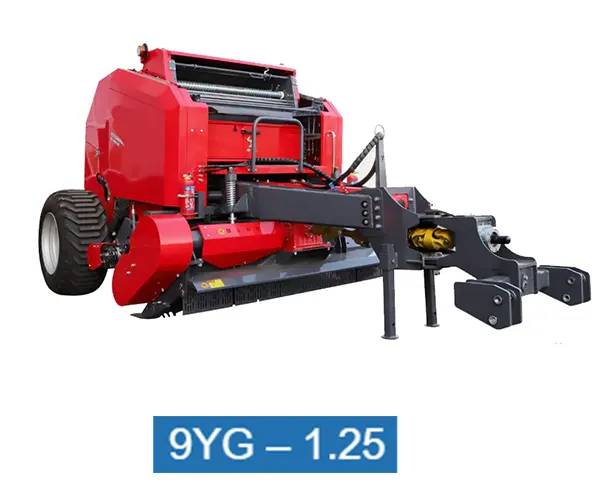
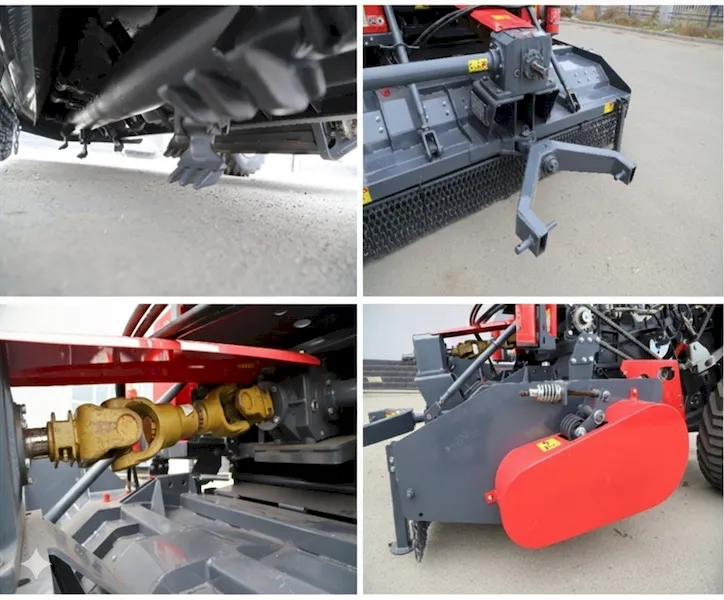
The complete establishment guide for alfalfa — covering inoculant application, seeding depth, companion crop management, and weed control in the seedling year — is in the 紫花苜蓿建植和播种管理指南. Gearbox and drive system specifications for the no-till drills and seedbed preparation equipment used in renovation are in 农业机械变速箱和动力输出轴传动系统部件规格. When your renovated stand reaches baling-ready maturity, browse our round balers for alfalfa hay to select baling capacity matched to your production scale.
First-Year Management After Renovation: Protecting the Investment
The first growing season after renovation is the period when the investment is most vulnerable. The new stand has no competitive advantage over weeds, no tolerance for stress cutting, and no established root reserve to draw on during adverse conditions. The management decisions made between emergence and the end of the first production year determine whether the renovation investment survives to deliver 6+ years of productive yield.
The most important first-year decision: wait for the correct growth stage
The first cutting of a renovation stand should be taken at 10% bloom to first flower — not by elapsed days, not by height, and not by any external schedule. Taking the first cutting too early (early bud stage) in the establishment year depletes root carbohydrate reserves before the plant has established sufficient root mass to recover. Many renovation failures that appear in year 2 as stand thinning can be traced directly to an early first-year harvest that the stand never fully recovered from. Wait until at least 10% of plants show first flowers before the first harvest, regardless of how advanced the growth looks.
Control weeds before they shade out new seedlings
Alfalfa seedlings cannot tolerate shading from taller weeds in the first 30–60 days. If broadleaf or grass weeds are outpacing the alfalfa seedlings, mowing the companion crop or weeds at 8 inches (above the alfalfa seedling canopy) reduces shading without damaging the alfalfa. Selective herbicide application in certified alfalfa seedlings is possible with several labeled products (imazethapyr, EPTC) but timing and alfalfa growth stage restrictions must be followed precisely — herbicide misapplication in the seedling year is one of the most common renovation failures.
Allow 6–8 weeks before expected first frost for the last fall cutting
This is even more critical in the renovation year than in a mature stand, because the new seedlings have not had the 2–3 year period that a mature plant needs to develop its maximum root reserve capacity. In the renovation year, extending the last cutting to 8 weeks (rather than the standard 6-week pre-frost window) gives the newly established root system maximum time to store carbohydrates for winter survival. A renovation stand that enters winter with depleted root reserves is vulnerable to heaving, desiccation, and disease in a way that a mature stand is not.
Yield Recovery Timeline and What to Expect From a Renovated Stand
Understanding the yield trajectory of a renovated stand helps set realistic expectations and allows operations to plan around the transition period. A renovation is not immediately equivalent to the peak yield of a mature stand — it follows a predictable recovery curve that reaches peak output in years 2–3.
Alfalfa Stand Renovation FAQs
Get Baler Recommendations for Your Alfalfa Production System
Tell us your alfalfa acreage, target yield tier, tractor HP available, and target market. We confirm the baler size, bale density settings, and net wrap configuration that matches your renovation stand’s first-year production volume and scales to its peak-yield years.
编辑:Cxm