Hay Field Operations Guide

干し草の列形成:刈り取り、レーキ、ベーラーのピックアップ位置合わせ

The windrow is the bridge between the mowing operation and the baling operation — its width, density, consistency, and straightness determine how efficiently the baler runs, how uniform the bales are, and how much crop remains in the field uncollected. Most producers set windrow formation as an afterthought to mowing and baling, but a correctly sized, straight, and consistently dense windrow is worth 5–15% more productivity from the baler without any change to the baler itself.

From Swath to Windrow

The Windrow Formation System: Three Operations, One Outcome

A well-formed baling windrow is the result of three sequential operations — mowing swath placement, raking consolidation, and windrow-to-pickup alignment — each of which affects the final windrow shape and density. Treating each operation independently rather than as a system produces windrows that are either wrong in width for the pickup, wrong in density for consistent bale formation, or wrong in straightness for efficient baler tracking.

Step 1: Swath
Mower deposits cut crop at a width set by the deflector. This width determines drying surface area and the starting material density before raking.
Step 2: Rake
Rake consolidates the dried swath into a baler-ready windrow, controlling final windrow width and density by rake type, angle, and number of swaths merged.
Step 3: Pickup alignment
Baler tracks the windrow — correct windrow width and centering ensures the pickup collects all material with no edge loss.

Mower Swath Width: Balancing Drying Rate Against Windrow Density

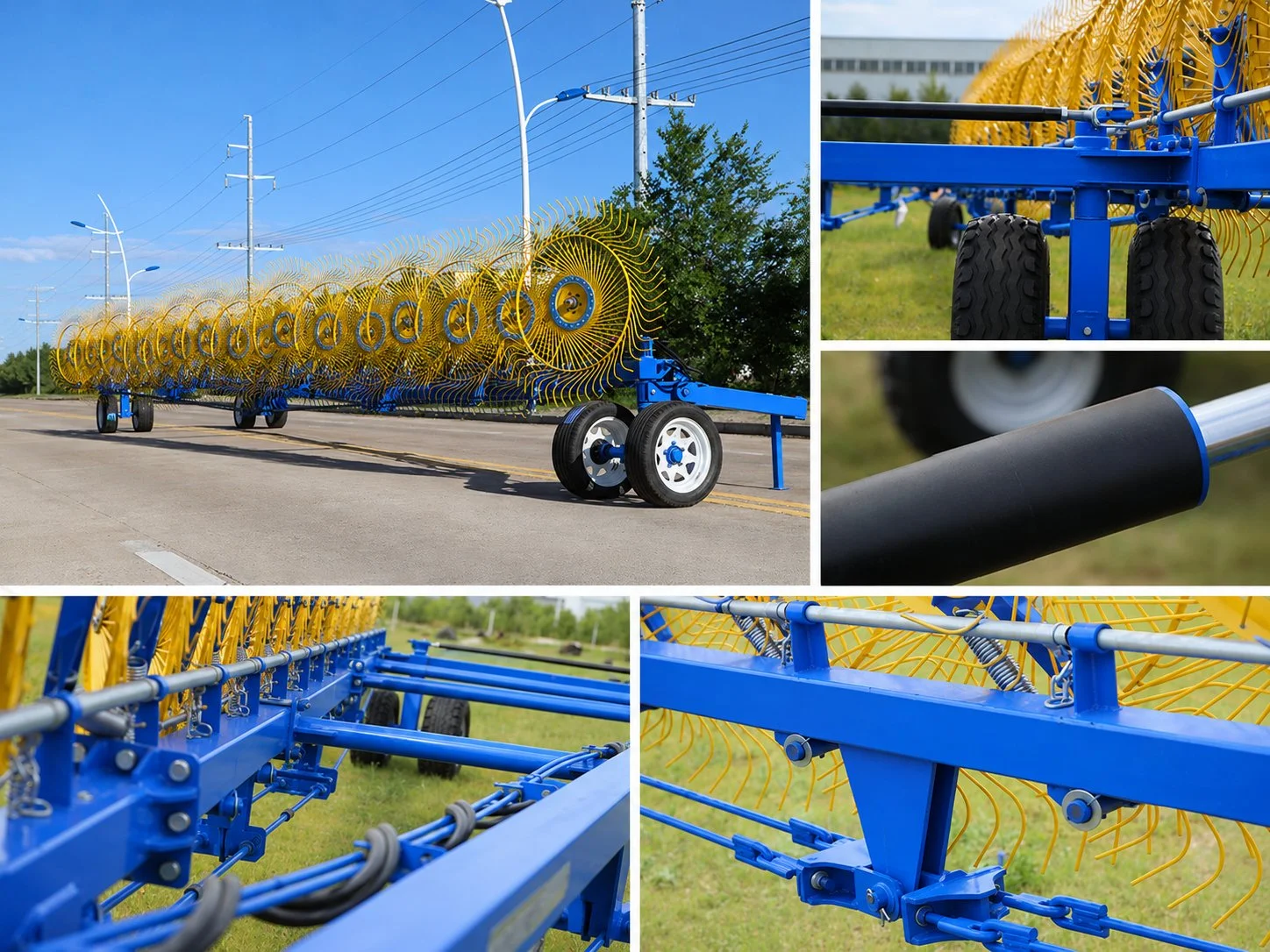
hay rake tine detail — the amount of crop in the windrow after raking is determined by both the mower's swath width and the rake's consolidation angle; matching these two parameters to the target bale weight requires understanding the yield per acre and the baler's optimal feed rate

The mower’s swath width is the width of the crop mat deposited on the field surface. A wider swath increases the crop surface area exposed to drying — reducing drying time. A narrower swath concentrates crop into a denser mat that dries more slowly but requires less consolidation at raking. The optimal swath width is the widest practical setting that still leaves the windrow narrow enough for the baler’s pickup after raking consolidation.

Wide swath (70–85% of cutting width)

Maximizes drying surface area — the best practice for first-cut alfalfa and heavy grass in favorable weather. The wide swath dries the crop 20–30% faster than a narrow-swath deposit of the same material. Requires raking to consolidate into a baler-width windrow, but the faster drying more than compensates for the additional field pass in most conditions. Set the mower’s rear deflector to its widest position when field slope and crop stand conditions allow consistent wide swath placement.

Narrow swath (30–50% of cutting width)

Concentrates crop into a smaller area — appropriate when rain is forecast (smaller exposed surface area reduces rain-contact risk) or when the crop is light enough that wide swath placement produces a mat too thin to consolidate cleanly at raking. Narrow swaths take longer to dry but are more rain-resistant and easier to rake cleanly. In humid climates with frequent shower risks, some producers prefer narrow swath placement on premium alfalfa even accepting the slightly longer drying time.

Windrow Density: Sizing the Windrow to the Baler’s Capacity

Windrow density — how much crop mass is deposited per linear foot of windrow — is the most direct determinant of baling efficiency. A windrow that is too thin forces the baler to travel more distance per bale (producing bales slower), and variable windrow density produces variable bale density because the bale chamber receives inconsistent feed rates. A correctly sized windrow fills the bale chamber at a consistent rate that matches the baler’s design throughput.

Windrow Sizing Formula: Matching Windrow to Target Bale Weight
Target: A 4×5 bale weighing 800 lbs requires approximately 75–85 feet of windrow at 10 lbs/linear foot.
Formula: Target bale weight ÷ lbs per linear foot = feet of windrow per bale
Measuring windrow weight per foot: Collect all crop from a 10-foot section of windrow, weigh it, and divide by 10. Example: 140 lbs from 10 feet = 14 lbs/linear foot. At this density, the baler makes an 800-lb bale every 57 feet.
Adjusting density: If windrow is too light (baler requires 100+ feet per bale), merge two windrows into one at raking. If too heavy (baler struggles through dense windrow), adjust rake angle to produce a wider, lighter windrow or split the windrow during raking.

Rake Angle and Speed: Setting the Consolidation Parameters

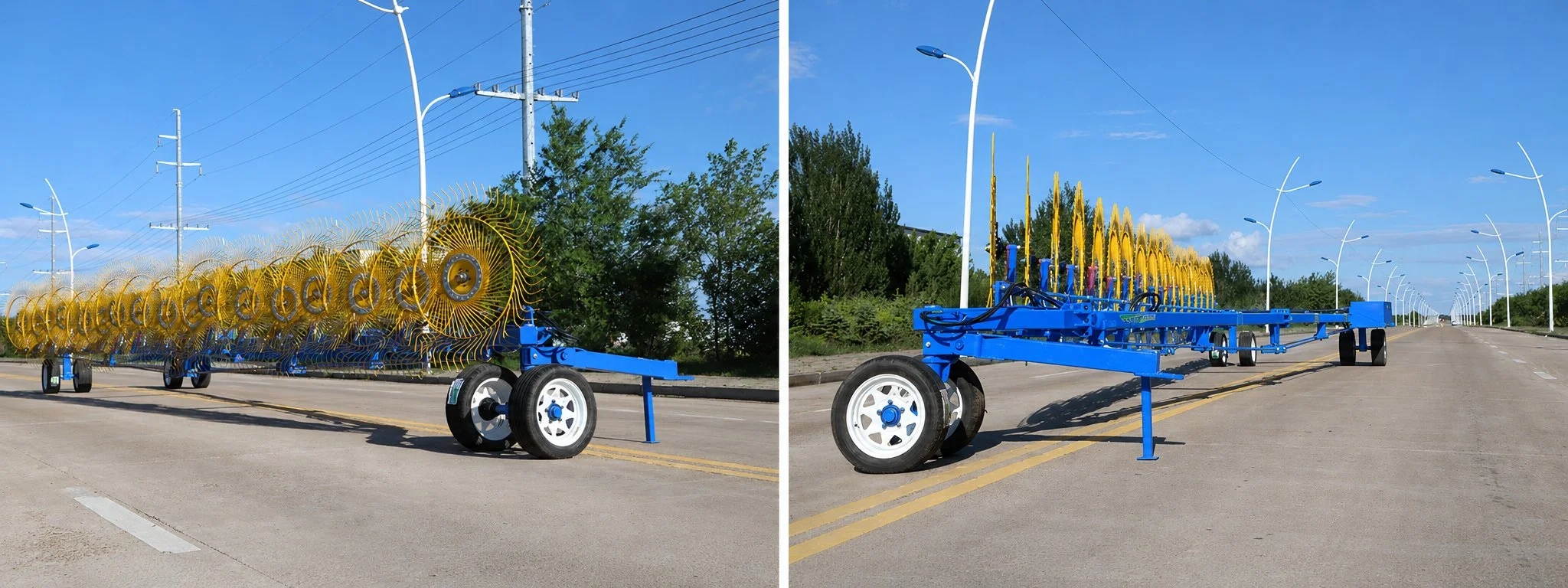
finger-wheel hay rake in field operation — rake wheel angle directly controls the speed at which crop material is moved laterally across the rake's working width; a wider angle produces denser, narrower windrows by moving material more aggressively; a shallower angle produces wider, lighter windrows

The rake wheel angle — the angle of each rake wheel relative to the direction of travel — controls the rate at which crop material is moved laterally and the resulting windrow width and density. A wider angle (more aggressive lateral movement) produces a narrower, denser windrow. A shallower angle produces a wider, lighter windrow. Most commercial rakes allow angle adjustment per wheel or per section, giving significant control over windrow shape.

調整 Effect on windrow When to use
Increase wheel angle Narrower, denser windrow Light yield or wide swath where density must increase to reach target bale weight; merging two swaths into one windrow
Decrease wheel angle Wider, lighter windrow Heavy yield where single-swath windrow is too dense for baler throughput; spreading windrow to expose more surface for drying
Increase rake speed More aggressive tine contact; higher throughput Use when crop moisture is above 25% and leaves are not at leaf-loss risk; never on dry alfalfa below 15%
Decrease rake speed Gentler tine contact; less leaf loss Dry alfalfa or orchardgrass where leaf loss is the primary concern; any crop below 18% moisture

Merging Windrows: When and How to Double Up

In low-yield conditions — thin stands, late-season light cuttings, or short-season native grass — a single-swath windrow may not provide enough material to fill a bale efficiently. Merging two or more windrows into a single baling windrow increases throughput and improves bale density consistency. The decision to merge is straightforward: if a single windrow produces a bale in more than 120–150 feet, merging two windrows will significantly improve baling efficiency.

When merging is appropriate

Yield below 1.5 tons/acre per cutting (single windrow from a 15-foot mower provides less than 6 lbs/linear foot — too light for consistent bale formation at normal baling speed); thin stands with uneven windrow density; native grass or first-year establishment fields with low density; any situation where bale formation time exceeds 3 minutes at normal field speed.

How to merge correctly

Use the rake on its “merger” setting or make a second rake pass that overlays adjacent windrows onto one another. The merged windrow must end up narrow enough to fit the baler’s pickup width — center the merged mass within the pickup width with 2–3 inches of clearance on each side. Avoid merging more than two windrows into one unless yield is extremely low — a triple-merged windrow in 2+ ton/acre alfalfa will be too heavy for efficient baling at any reasonable field speed.

Windrow Straightness: Why Curved Windrows Cost Productivity

mower-conditioner swath formation — straight windrows allow the baler to travel at consistent speed without lateral steering corrections; curved windrows force the baler operator to steer continuously to keep the pickup centered, reducing effective forward speed and increasing per-bale fuel consumption

A straight windrow allows the baler to travel at consistent speed in a straight line — the most efficient baling pattern. A curved or zigzag windrow forces continuous steering corrections, reduces effective forward speed, and causes the pickup to periodically miss the windrow edges at bend points. In commercial baling, windrow straightness is a direct productivity factor — an operator managing curved windrows at 3 mph bales slower than one following straight windrows at 4 mph even with identical equipment.

Common causes of curved windrows

The most common cause is the mower-conditioner drifting off the intended straight pass during the original cutting pass. Asymmetric weight distribution on side-mounted mower-conditioners creates a slight pull to one side; the operator makes continuous minor corrections that produce a gently curved windrow rather than a true straight line. GPS-guided mowing produces nearly straight windrows and significantly reduces the steering workload at raking and baling. Without GPS, using a distant visual reference point (tree, post, barn corner) on every pass produces straighter windrows than watching the mower header.

Straightening at raking

Minor windrow curvature can be corrected at the raking pass by tracking a straight reference line rather than following the curved windrow. The rake’s working width is forgiving of 6–8 inches of lateral windrow position variation — the tines will collect the crop regardless of the windrow’s exact position within this range. Tracking straight at raking produces a straight windrow for the baler even if the original mowed swath was moderately curved.

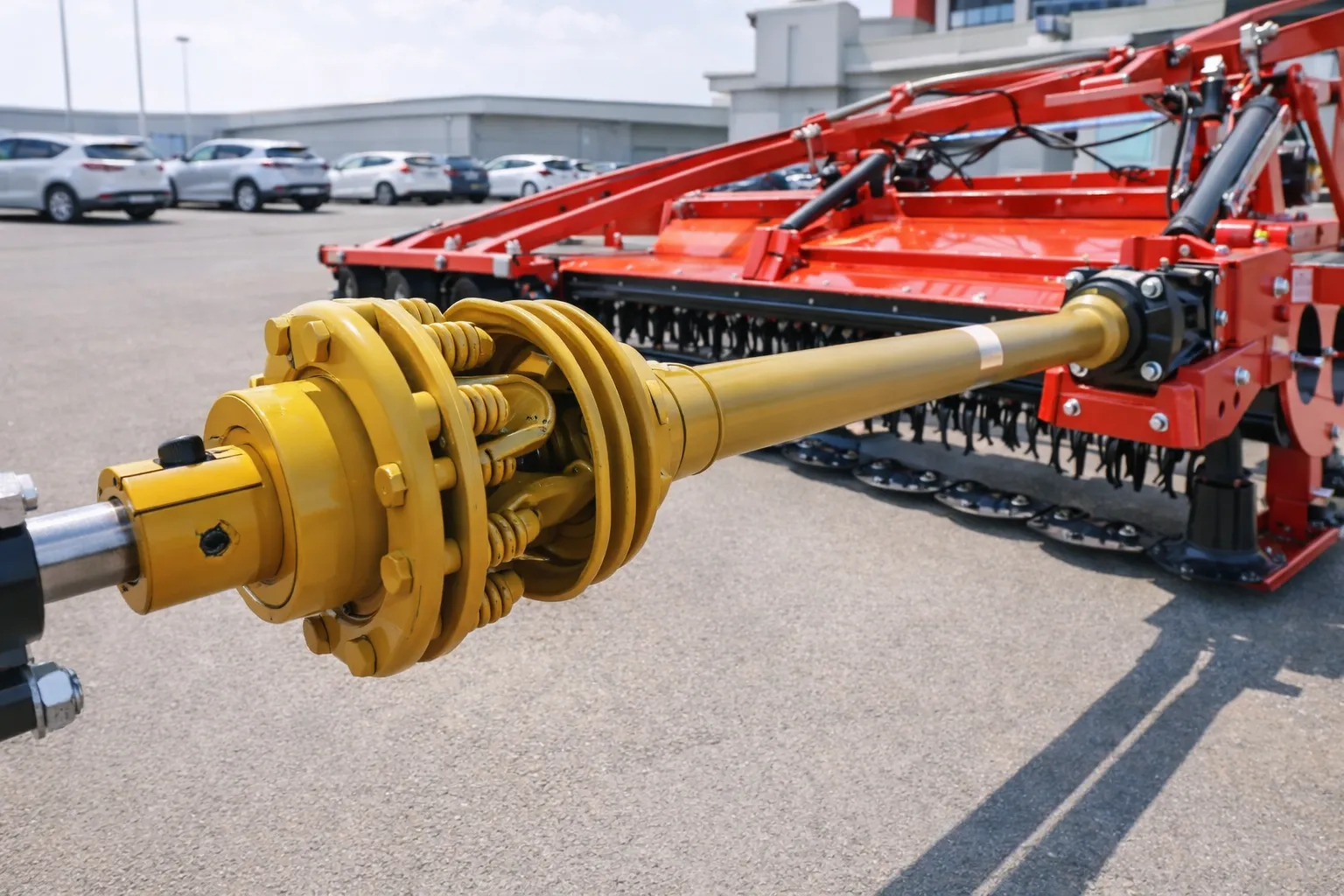
The detailed raking technique guide — covering V-rake vs horizontal rake operating parameters, tine height settings, and the specific adjustments that minimize leaf loss at each raking pass — is in the hay raking techniques guide. The mower-conditioner settings — swath width, conditioning intensity, and the deflector configurations that set initial swath placement — are in the mowing and conditioning quality guide. The rake and mower-conditioner gearbox and PTO driveline specifications are in 農業用ギアボックスおよびPTO駆動系部品の仕様.

Field Patterns: Minimizing Turning Loss at Each Operation

The field pattern used for mowing, raking, and baling affects both operational efficiency and hay quality. Each turning pass at the field headland disrupts windrow continuity, creates an area of over-worked or over-exposed crop, and adds time per acre. Minimizing the number of turning passes through better field pattern selection is a genuine productivity improvement that requires no equipment investment.

Mowing: outside-in pattern

Starting at the field outside and spiraling inward allows the mower to deposit each swath next to the previous one with a consistent turning radius. The final pass in the center is typically narrower than full cutting width — plan the field dimensions to minimize the number of partial-width passes at the field center. Ending at the field center rather than the headland simplifies headland clearing at the start of raking.

Raking: back-and-forth on longest axis

Raking along the longest field axis minimizes the number of turning passes per acre — each turning event interrupts the windrow and requires an extra pass to close the gap at the headland. Pre-clear the headland (rake the headland windrows across the field direction first) so the main raking passes can be driven straight through without stopping at the headland.

Baling: follow the windrow continuously

After the windrow is formed, the baler simply follows it — the field pattern is determined by the windrow layout, not by the baler. The only baling efficiency choice is whether to eject each bale immediately and continue in place, or to hold each bale while moving to a position that minimizes dead-heading back to the windrow. On long straight windrows, eject in place and continue; on short windrows with frequent turning, evaluate whether a staging area reduces dead-head time.

Windrow Formation FAQs

My bales are consistently egg-shaped rather than cylindrical. Is this a windrow problem or a baler problem?+
Egg-shaped bales are most often caused by uneven crop distribution across the bale width — more crop entering the chamber on one side than the other. This can be a windrow problem (windrow positioned off-center relative to the pickup, causing one side to receive more crop), a pickup problem (tines worn on one side), or a baler intake problem (feed auger worn or not conveying crop evenly across the full chamber width). To diagnose: observe whether the bale’s heavier side is consistently the same side (right or left) on every bale. Consistent same-side heaviness indicates either a structural pickup issue or a windrow placement issue (baler always tracks slightly to one side of the windrow). Variable heaviness that changes from bale to bale suggests an intermittent issue rather than a systematic one. Check windrow centering relative to the pickup first — it is the easiest diagnosis. If the windrow is centered and the bale shape is still asymmetric, move to pickup inspection.
How wide should my windrow be relative to my baler’s pickup width?+
Target a windrow width of 70–85% of the baler’s pickup working width. This leaves 2–3 inches of clearance on each side between the windrow and the pickup edge, ensuring all windrow material is collected while keeping the pickup within its effective collection zone. A windrow exactly as wide as the pickup loses crop at the edges because the outermost tines can’t fully collect material at the edge of their reach. A windrow much narrower than the pickup wastes pickup capacity and produces bales with an hourglass shape (more crop collected in the center than the edges). Measure your typical windrow width with a tape after a few raking passes and confirm it falls within the 70–85% range of your pickup’s working width specification.
Can I skip raking and bale directly from the mower swath?+
Yes — for appropriate conditions. Baling directly from a wide mower swath (without a separate raking pass) works well when: the mower’s swath deposit width matches 70–85% of the pickup width; the crop yield is sufficient to form full bales within a reasonable distance; and the crop has dried adequately within the swath depth without a raking pass to turn the mat. The advantage is eliminating a field pass, which reduces leaf loss (particularly on dry alfalfa) and fuel cost. The limitation: most mower-conditioner swath widths (8–12 feet) are too wide for the baler’s pickup to collect cleanly from one pass; a merger or narrower-windrow configuration is required. Wide-pickup balers (75+ inch pickup) can sometimes collect directly from a wide mower swath on crops with moderate yield. Evaluate whether the crop swath width falls within your pickup’s rated collection width before skipping the rake pass.
My windrow has dense patches and thin patches throughout. What causes this and can it be fixed?+
Alternating dense and thin patches in a windrow typically have one of three causes. First, variable stand density in the field — if the crop stand is uneven (thin zones from winterkill, drought stress, or disease), the windrow mirrors the stand variation and cannot be made uniform through raking adjustments. Second, the mowing pattern left periodic overlaps or gaps where the operator made direction corrections — these turn into alternating dense-then-thin zones in the windrow after raking. Third, the rake is not maintaining consistent contact with the full windrow width on every pass — a rake with uneven wheel heights or a rake that bounces over uneven terrain deposits inconsistent windrow density. Diagnose which cause applies by walking a section of windrow and correlating the density pattern to the mowing pass pattern — if the dense patches occur at consistent spacing matching the mowing pattern width, it is a mowing pattern issue. If density variation is random, it reflects stand variability in the field.
Should I rake in the same direction as mowing, or at a different angle?+
In most cases, rake in the same field direction as mowing — this allows the rake to collect the full swath width in a single pass with each raking pass aligned to the mowed row pattern. Raking at a different angle (cross-raking) can produce a more thoroughly tedded windrow in heavy crops but typically causes more leaf loss because tines contact each section of crop twice from different directions. Cross-raking is occasionally useful when the original swath deposit is extremely wide and the crop has not dried uniformly, requiring the turning action to expose the mat’s underside. For standard commercial hay production, same-direction raking is the most efficient and lowest-leaf-loss option for both alfalfa and grass hay.
How does windrow quality affect bale density and bale weight consistency?+
Windrow density variation directly produces bale weight variation: a dense windrow section fills the bale chamber more quickly (shorter bale formation distance), while a thin section requires more travel to fill the same chamber volume. If the baler uses a fixed-diameter chamber with density based on spring tension, the variable windrow input produces bales of equal diameter but inconsistent density — some bales are lighter and softer, others are at target density. If the baler ejects by weight (some advanced models), inconsistent windrow density produces inconsistent ejection distances. Commercial buyers of round bales — dairies that formulate TMR rations on bale count, and hay elevators that price by weight — are sensitive to bale weight inconsistency. A consistent windrow is the most upstream solution to bale weight variation; belt tension, density spring setting, and baler condition are the downstream adjustments that fine-tune density around the windrow’s fundamental input quality.
foragebaler.com hay rake and mower-conditioner systems for complete windrow formation management

Get Rake and Mower-Conditioner Setup Guidance for Your Yield and Baler

Tell us your average crop yield per acre, mowing width, baler model, and pickup width. We recommend the swath placement, rake angle, and merging strategy that produces the optimal windrow for your specific baler’s capacity.

Get Windrow Formation Guidance

編集者: Cxm