
Why Winter Annual Hay Fills a Production Gap That Nothing Else Closes
The forage calendar for most U.S. stocker and cow-calf operations in the Southeast, Mid-South, and Southern Plains has a structural gap: warm-season perennial grasses (bermudagrass, native prairie, bahiagrass) produce nothing from approximately November through April. Cool-season perennials (orchardgrass, tall fescue, timothy) fill part of this gap but require fall-seeded permanent stands on dedicated acreage. Winter annual cereals are uniquely capable of filling the remainder — seeded in fall after cash crop harvest, producing a spring flush of high-quality hay that can be cut at flag leaf or boot stage, then leaving the field for summer crop production. No permanent stand investment is required, and no dedicated hay acreage is consumed.
Triticale: The High-Yield, High-Quality Hybrid Option
Triticale (× Triticosecale) is a hybrid of wheat (Triticum) and rye (Secale) that combines wheat’s palatability and nutritional quality with rye’s cold hardiness and vigorous growth. As a hay crop for the transition zone and Southeast, triticale delivers the best yield-to-quality balance of any winter annual cereal, making it the first choice when soil conditions and planting timing allow its full establishment.
NDF at boot stage: 48–58%
NSC range: 8–14% at boot
Yield: 3.5–6.5 tons/acre
Harvest window: 7–14 days at flag leaf through early boot — the widest cutting window of the three winter annuals; quality declines approximately 1–2 CP points per week of delay past boot stage
Key advantage: Superior yield-quality balance; more forgiving harvest timing than cereal rye
Seeding rate: 100–120 lbs/acre drilled; 120–140 lbs broadcast. Seeding depth: 1–1.5 inches. Fall seeding window Zone 7: September 15 – November 10; Zone 5–6: August 15 – October 1. Nitrogen management: 30–40 lbs N at planting for good establishment; topdress 60–80 lbs N/acre in early spring (February–March in Zone 7) triggers the yield response that produces 5+ ton crops. Without topdress N, triticale yields may be 40–50% below potential. pH tolerance: 5.5–7.5; more tolerant of slightly acidic soils than wheat.
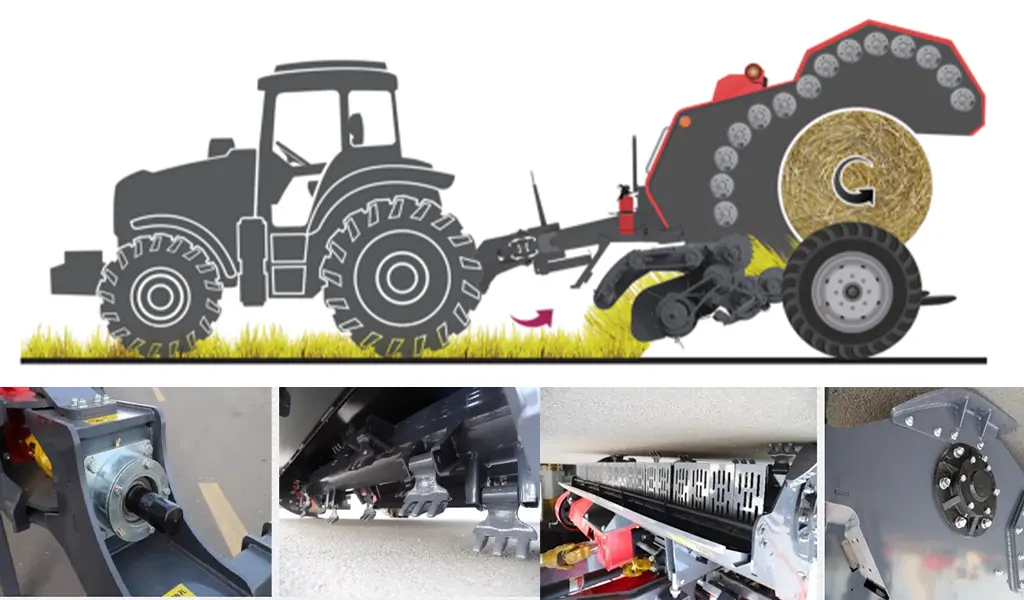
Triticale culms at boot stage reach 40–60 inches in height — significantly taller than orchardgrass or alfalfa at optimum cutting stage. This height creates long-stem windrows where individual stems can bridge across the pickup width and create structural blocks that jam the intake. Reduce ground speed to 2.5–3.5 mph in heavy triticale windrows; if jams occur at this speed, reduce further or narrow the windrow before baling. Conditioning is essential — the thick, hollow triticale culm retains core moisture for 36–48 hours after surface drying. Target baling at 14–17% moisture measured at the windrow core, not the surface.
Cereal Rye: The Winter-Hardy Option and Its Narrow Quality Window
Cereal rye (Secale cereale) is the hardiest winter annual available to U.S. hay producers — it germinates at soil temperatures near 34–38°F, can be seeded later in fall than any other winter cereal, and provides green growth at temperatures where triticale and annual ryegrass are dormant. In production systems where fall planting is delayed past the triticale seeding window, cereal rye is often the only viable winter annual option. Its quality ceiling is somewhat lower than triticale, and its harvest window is the narrowest of the three species — both limitations that are manageable with correct management attention.
Cereal rye’s quality transition from flag leaf to heading is faster than any other common hay crop. At flag leaf stage (the head fully enclosed in the uppermost leaf sheath, visible as a swelling at the top of the plant), rye tests 10–15% CP with moderate NDF. Within 5–7 days at typical spring temperatures, the head emerges and begins to flower — at which point CP drops 3–5 points and the stem elongates dramatically, creating coarse, stemmy hay that tests in the cattle-roughage range rather than hay-quality range. Scouting rye fields daily during the 2-week period before expected heading is not optional for quality hay production — it is the difference between 10–14% CP hay and 6–8% CP roughage from the same stand.
Cereal rye is the most widely grown winter annual cover crop in North America, and large acreages are seeded each fall in cash-crop rotations. Many of these stands have hay production potential that is never realized — the cover crop is terminated rather than harvested. The baling protocols for cover crop cereal rye are in the cover crop baling guide. On the ergot question: ergot (Claviceps purpurea) forms sclerotia (dark bodies) in rye grain, and infected grain can cause ergotism in livestock. Hay cut before heading — at flag leaf stage before seed development — has minimal ergot exposure risk; the danger is primarily in grain-rye straw from combines that leave ergot-infected grain in the residue. Hay from properly timed flag-leaf-stage cutting is essentially an ergot-free product.
Annual Ryegrass: The Highest-Quality Option for Mild-Climate Production
Annual ryegrass (Lolium multiflorum, also called Italian ryegrass) is distinct from perennial ryegrass (Lolium perenne) — a distinction that matters because the two species have completely different management requirements, agronomic persistence, and NSC profiles. Annual ryegrass completes its lifecycle in one season: fall establishment, rapid vegetative growth, spring seed production, then summer death. For hay production, this annual lifecycle means that timing relative to vegetative vs reproductive growth stage determines quality, and the producer gets only one chance per season to capture the quality window.
Annual ryegrass at the vegetative stage (before any seed head emergence) tests CP 14–20% — the highest CP ceiling of the three winter annual species, competitive with first-cut alfalfa. NDF is 45–58%, and the NDFD (48-hour) values for vegetative annual ryegrass are among the highest measured for any cool-season grass (70–80% in some trials), reflecting the very high digestibility of the young leaf tissue. The NSC concern: annual ryegrass accumulates water-soluble carbohydrates (fructans) at high concentrations — 12–22% NSC is typical. For horse markets marketing to metabolic horses, testing is mandatory, and the high NSC ceiling makes annual ryegrass hay inappropriate for insulin-dysregulated horses without a confirmed low-NSC lot test.
In mild climates (Zone 7–8, Southeast coastal plain), annual ryegrass produces 2–3 cuttings: a winter/early spring vegetative cut (highest quality), a late spring cut (declining quality as reproductive development begins), and occasionally a fall regrowth cut in the coolest zones. The bloat concern associated with annual ryegrass relates to fresh grazing of lush vegetative stands — the same soluble protein/foam mechanism as fresh legume grazing. For properly cured dry hay, the drying process denatures the proteins responsible for frothy bloat to a large extent, and hay-related bloat from dried annual ryegrass hay is uncommon. Producers marketing to cattle buyers should be aware of the fresh-grazing caution but are not required to carry a bloat warning specifically for properly cured dry annual ryegrass hay.
The Three-Species Quality and Production Comparison
Choosing among triticale, cereal rye, and annual ryegrass for a specific farm and market requires weighing quality, yield, harvest timing flexibility, and regional adaptation simultaneously. The table below synthesizes the key production parameters for direct comparison. No single species is universally superior — the correct choice depends on your climate zone, planting date flexibility, target market, and baling capacity constraints.
| Parameter | Triticale | Cereal Rye | Annual Ryegrass |
|---|---|---|---|
| Optimum cutting stage | Boot to early head | Flag leaf | Vegetative (pre-head) |
| CP at optimum stage | 12–17% | 10–15% | 14–20% |
| NDF at optimum stage | 48–58% | 55–65% | 45–58% |
| NSC at optimum stage | 8–14% | 9–15% | 12–22% ⚠ test for horses |
| Typical yield (tons/acre) | 3.5–6.5 | 2.0–4.5 | 1.5–3.5 |
| Harvest window (days) | 7–14 | 5–7 ⚠ narrow | Broader (vegetative) |
| Cold hardiness (minimum seeding temp) | 40–45°F soil | 34–38°F soil | 45–50°F soil |
| Drying difficulty | Moderate (thick culm) | Moderate–high (stiff, coarse) | High (very succulent) |
| Seeding rate | 100–120 lbs/acre | 100–120 lbs/acre | 20–30 lbs/acre |
| Best for | High yield + quality balance, stocker market | Late planting, coldest zones, cover crop integration | Dairy roughage, mild climate, multiple cuttings |
Seeding and Establishment: The Calendar That Determines Everything
Winter annual hay quality begins with seeding date — a fact more critical for winter annuals than for perennial hay crops because there is no second chance. A perennial stand that establishes poorly still exists the following year; a winter annual stand that fails in fall or establishes too late to produce its full spring flush is simply lost for that season, with no recovery option.
Topdress nitrogen application in late winter (February in Zone 7; March in Zone 6) is the single input decision that most dramatically affects winter annual yield. Research from University of Georgia extension and LSU AgCenter consistently shows that winter annual cereals receiving 60–90 lbs N/acre topdress produce 40–70% more yield than unfertilized stands. Apply when daytime temperatures are consistently above 40°F and the crop shows active growth — typically 4–6 weeks before expected boot stage. Apply urea or UAN solution; avoid ammonium nitrate in dry conditions where volatilization losses are high. Without topdress N, even excellent varieties will underperform their yield potential.
The three most common winter annual stand failures are seeding too late (insufficient fall growth for winter hardiness), seeding too shallow (rye and triticale drilled less than 1 inch depth frequently have poor germination from soil moisture inconsistency at the surface), and soil compaction from post-harvest traffic that prevents root penetration. Field preparation note: winter annuals seeded directly into corn or soybean stubble with no tillage (no-till or strip-till) consistently show higher establishment success than heavily tilled fields that crust over before germination. The decomposing crop residue reduces evaporation from the seed zone and maintains consistent soil contact for the germinating seed.
Baling Winter Annuals: Shared Challenges and Species-Specific Adjustments
All three winter annual species share a set of baling challenges that differ from the warm-season grasses and cool-season legumes that most producers have calibrated their equipment for. Understanding these shared characteristics — and the species-specific adjustments that make each one behave differently in the bale chamber — prevents the most common quality and mechanical problems.
Triticale stems at 50–60 inches length can span the full 4–5 foot pickup width of the baler and create a structural bridge that blocks the intake rather than feeding through it. This bridge-jam is distinct from the progressive overload that causes most pickup jams — it happens suddenly and cannot be resolved by reducing ground speed after it has formed. Prevention: ensure the windrow width is no more than 85% of the pickup width before baling; use the baler’s pickup deflector to break up any obvious stem clusters before they enter the pickup. PTO drive specifications for the increased load of triticale windrows are in agricultural gearbox and PTO driveline component specifications.
Mature rye cut past flag leaf stage develops one of the coarsest, stiffest stem textures of any hay crop — closer to wheat straw than to timothy hay. Increasing the density spring 15–20% above the alfalfa setting prevents the rye’s rigid stems from creating hollow bale centers. In drought-stressed or dry years, rye produces significant chaff and dust from dried leaf fragments; consider respiratory protection for the baler operator during heavy-dust conditions. The straw-baling protocols that address similar stem textures are in the straw and crop residue baling guide.
Annual ryegrass at first cutting in Zone 7–8 may be at 70–80% moisture — higher than any other hay crop typically encountered. The standard 24–36 hour drying time for alfalfa does not apply; annual ryegrass at this moisture requires 48–72 hours of good drying weather before it reaches baling moisture (14–17% core). Spreading the windrow wide at cutting and conditioning immediately after mowing are both required. A weather window with 3+ days of sunshine and low humidity (below 60%) is the minimum for reliable annual ryegrass drying in the Southeast. Do not attempt first-cutting annual ryegrass in predicted 2-day weather windows; the consequences are 700-lb bales at 22% moisture that will mold within 10 days. Round baler models with inline moisture sensors significantly reduce the risk of baling above target moisture in these long drying windows.
Market Channels: Southern Stocker Cattle and the Double-Crop Economic Model
The primary economic driver for winter annual hay production is the Southern and Southern Plains stocker cattle industry — specifically the segment of operations that purchase lightweight calves or yearlings in fall and sell them as higher-weight feeders or grass-finished animals in spring. This market specifically values winter annual hay because it provides the CP and digestible energy to maintain 1.5–2.5 lbs/day average daily gain during the November–April period when warm-season pastures are dormant. A stocker operation that loses 60 days of winter gain because it has inadequate quality hay experiences a compounding economic penalty: lost weight gain plus the additional days to reach target sale weight.
$90–$145/ton for documented triticale or cereal rye hay at boot-to-flag-leaf quality (CP 12–16%, NDF 50–60%). Tested hay with CP ≥14% on the forage analysis commands the upper end of this range with stocker operations that feed to a specific ADG target. Volume and proximity drive price as much as quality for stocker buyers who need 50–300 bales per winter. Delivery before November 1 is a significant value-add for stocker operations trying to cover early placement.
Annual ryegrass at vegetative stage: CP 16–20% qualifies for some dairy roughage programs at $130–$180/ton with documentation; the high NDFD makes it particularly suitable for supporting milk production where fiber digestibility matters. Horse market: tested annual ryegrass with NSC below 12% can access horse markets at $140–$200/ton; the variable NSC profile makes testing non-optional, and the high ceiling (22% NSC) means not all lots are horse-appropriate regardless of cutting stage.
Many winter annual stands in the Southeast and Midwest are established as cover crops in cash-crop rotations and are terminated in spring rather than harvested. For farms with baling capacity, these cover crop stands represent low-cost hay production: the seed and fertilizer cost is already allocated to the crop protection budget, and the only incremental cost is the cutting, baling, and storage. Custom baling of these stands provides income for hay operations with excess baling capacity. The cover crop baling protocols that address the unique termination timing requirements are documented in cover crop production literature and NRCS cover crop termination guidance.
Winter Annual Hay FAQs
Get Baler Settings for Winter Annual Hay Production
Tell us your winter annual species (triticale, cereal rye, or annual ryegrass), target cutting stage, expected yield range (tons/acre), bale size, and PTO tractor horsepower. We confirm the density spring setting, ground speed range, and conditioning pressure that produces consistent bales from winter annual cereal windrows.
Editor: Cxm


