
Most discussions about hay quality focus on cutting stage, baler selection, and storage — the steps before and after raking. Raking itself is treated as a pass-through operation: run the rake, form the windrow, move on. But the quality of the windrow the rake produces is the single input that controls bale consistency from that point forward. A narrow, uneven, or leaf-shattered windrow from poor hay raking technique cannot be fixed in the bale chamber. The decisions made during raking — timing, speed, width, and technique — determine the ceiling on hay quality for that entire cutting.
Why Windrow Quality Determines Bale Quality — Before the Baler Starts
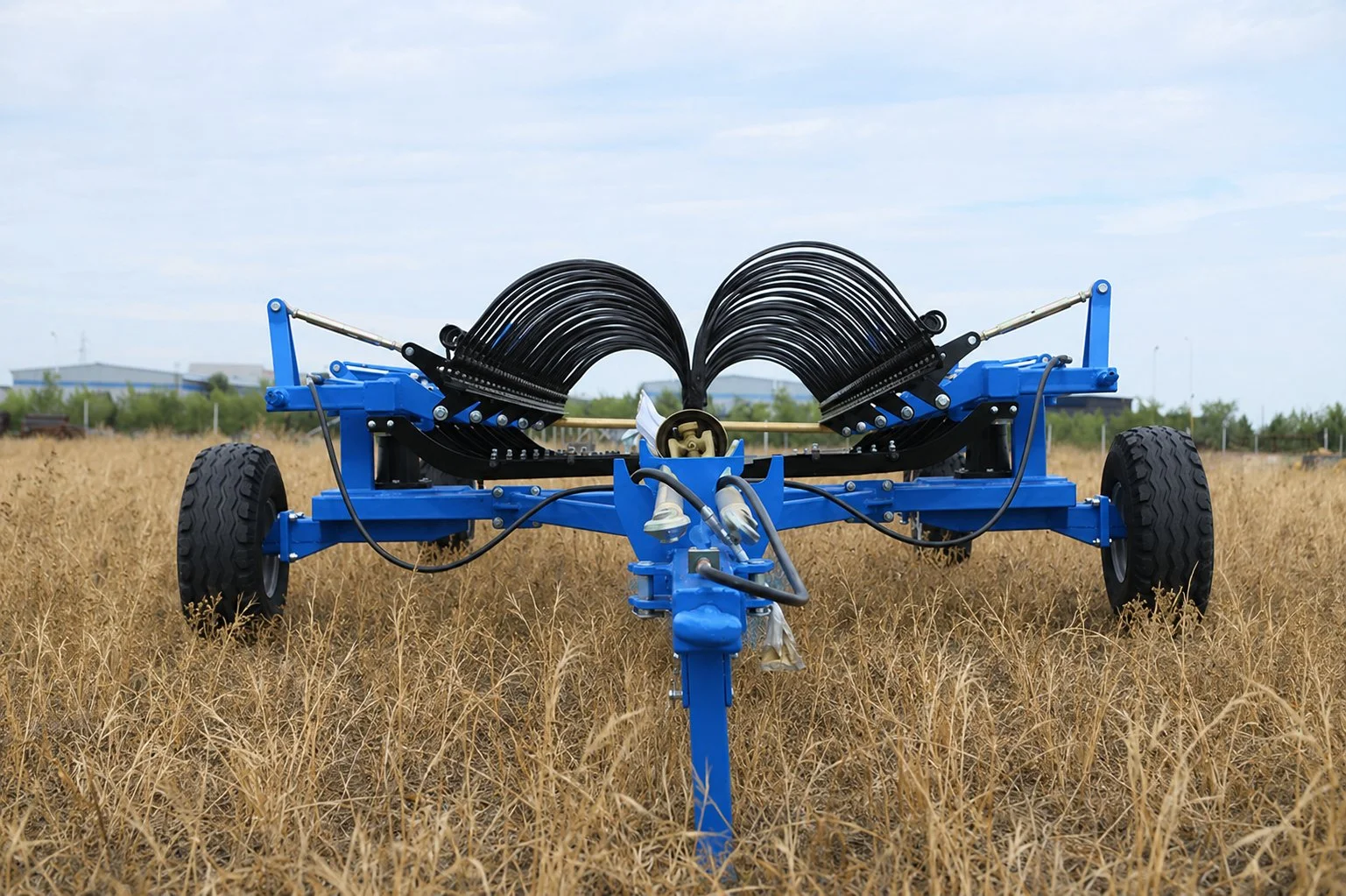
The bale chamber of a round baler is a compression machine — it does what the windrow tells it to do. A wide, deep, uniformly distributed windrow fills the chamber symmetrically on every pass, producing dense, round, consistently shaped bales with predictable weight. A narrow, uneven, or patchy windrow produces the opposite: bales that build more material on one side than the other, complete their fill cycle before the chamber is evenly loaded, and eject with oval cross-sections, variable density zones, and inconsistent weight.
The practical downstream consequences of a poor windrow include: irregular bale shapes that roll when stacked (a handling and safety hazard); density voids that trap oxygen in silage bales and produce localized spoilage zones; below-rated bale weights that distort per-bale costing and transport payloads; and pickup tine overload events at dense windrow patches that accelerate pickup wear. All of these originate in raking decisions, not baling decisions. By the time the baler operator sees the problem, the cause is two steps behind in the field.
What “perfect windrow” means quantitatively: a windrow that fills 70 to 90% of the baler pickup header width uniformly along its full length, with no gaps, and consistent material density throughout. Not “dense,” just uniform. Bale shape and weight consistency follow directly from windrow uniformity — the baler cannot be blamed for what the rake delivered.
Two Rake Types, Two Windrow Profiles: How Each Machine Handles the Crop
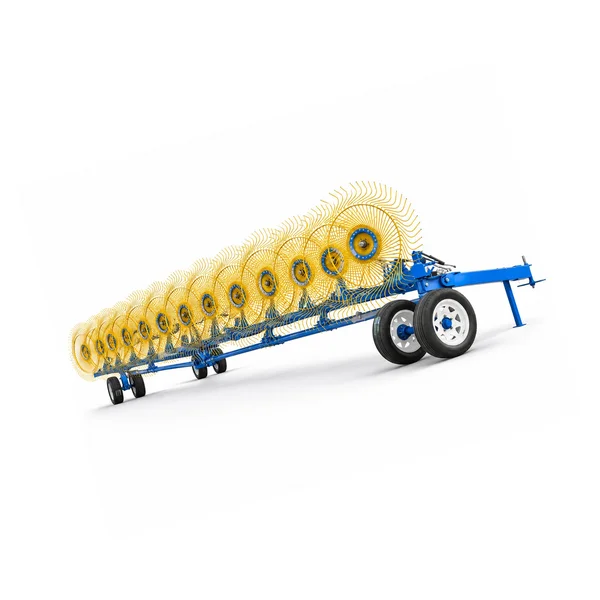
The two dominant hay rake types used with round balers in U.S. hay production are the finger wheel V-rake and the towed horizontal (parallel-bar) rake. They process the cut swath through fundamentally different mechanisms and produce windrows with different cross-section profiles — a physical difference that directly affects how the windrow enters a round baler pickup.
The practical implication of these profile differences: the finger wheel V-rake produces a windrow optimized for baler pickup uniformity and leaf-sensitive crops. The towed horizontal rake produces a windrow optimized for throughput on high-volume grass programs. Both hay rake designs have legitimate primary applications — the error is using either outside its best-fit crop and moisture conditions.
When to Rake: The Moisture Window by Crop and End Use
Hay raking at the wrong moisture is the most common technique mistake — and it produces losses that are immediately measurable. The core hay raking principle: rake when the crop’s outer stems are dry enough to handle without excessive leaf fracture, but the internal stem moisture is still high enough that the stems are flexible rather than brittle. The exact moisture target differs by crop and end use.
The alfalfa timing rule most operators miss: Alfalfa should NOT be raked when leaf moisture is below 35 to 40%. At this moisture level, alfalfa leaves have lost enough internal turgor that the petiole (leaf stem) is brittle rather than flexible. Any raking impact at this stage shatters leaves off the stem at the node — the exact loss mechanism that turns Grade 1 alfalfa into Grade 2. The optimal alfalfa hay raking window — when stem surface is dry but leaf flexibility is maintained — is 18 to 28 hours after mowing in typical summer conditions, when moisture is in the 40 to 55% range. Before 18 hours, the stem interior is still too wet for dry hay; after 30 to 36 hours, the leaf moisture is too low for safe raking.
Raking Speed, Crop Moisture, and Leaf-Loss Risk: Matching Speed to Conditions
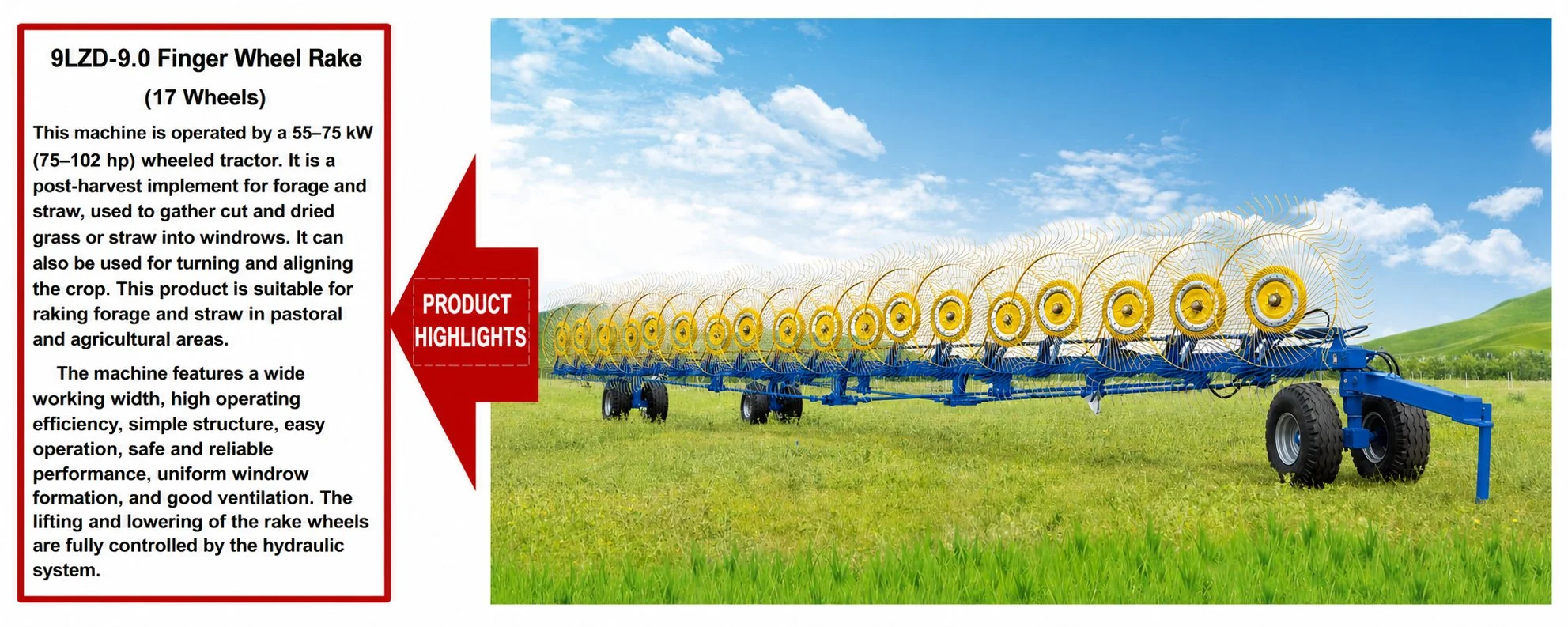
Ground speed during hay raking directly controls tine contact force on the crop. Faster tractor speed → faster disc rotation → higher tine tip velocity → more impact force per tine contact → more leaf separation from stems. The relationship is not linear: at speeds above the hay raking threshold for leaf shatter, each additional km/h produces exponentially more leaf loss because the tine impact force exceeds the fracture resistance of the leaf petiole at multiple contact points simultaneously rather than just at the weakest ones.
Speed ranges apply to finger wheel rakes; horizontal rakes on legume crops should operate at the lower end of each range due to higher lateral sweep impact force. Reduce speed by 1–2 km/h on slopes and rocky ground.
Slope Raking and Rocky Ground: Two Technique Adjustments
Slopes: Rake across the slope (contour direction), never directly up or down. Raking downhill on a slope causes the windrow to roll and drift downhill as it forms, producing a displaced windrow that does not align with the field’s flat-terrain tracks. Raking uphill causes uneven material accumulation — the rake struggles to push material uphill, and the windrow forms thicker at the top of each pass. Contour raking keeps the windrow centered on the rake’s discharge point regardless of gradient.
Rocky ground: Raise the working height of the rake 2 to 4 cm above its normal setting on fields with surface rocks. The tines will have less aggressive ground contact but will not contact the rock surface — which causes both tine fracture and sudden impulse loads on the disc hub bearings. On consistently rocky fields, reducing speed by 1 to 2 km/h below the normal operating range further reduces the tine impact force when a tine does contact a partially buried rock.
Matching Rake Working Width to Your Baler’s Pickup Header
Hay rake working width and baler pickup width are not interchangeable numbers. The baler does not pick up the full rake working width — it picks up the windrow the rake forms, which is substantially narrower than the rake’s working width. The hay raking windrow should be sized to fill 70 to 90% of the baler’s pickup header width for optimum bale uniformity.
Windrow width is adjustable by changing rake working height. Values shown are at standard working height. See the full hay rake lineup for complete specifications.
For the round baler models in the 9YG-2.24D commercial class, the 9LH-12 horizontal rake’s 1.0 to 1.6 m windrow width is the natural match — wide enough to fill the commercial baler’s broader pickup header efficiently without requiring a separate merging pass. For the 9LZD-9.0 paired with the 9YG-2.24D, a merging pass (described below) brings two adjacent windrows together to the required width. The round baler’s own drive gearbox — a precision agricultural gearbox handling the full pickup and chamber load — processes this merged windrow at rated torque and speed when the rake delivers consistent, correctly-sized input.
Merging Windrows for High-Capacity Balers: The Double-Windrow Technique
When a single hay rake pass produces a windrow too narrow for the baler’s rated pickup width, or when individual windrows are too light for efficient baler cycling, merging adjacent windrows into a combined row produces a heavier, wider windrow that matches the commercial baler’s optimal intake range. Hay raking merging is a routine step on large operations pairing 9-meter V-rakes with commercial-class balers.
Merging technique rules: The merging rake pass should be centered between the two windrows, running in the same direction as the original raking passes. The rake’s working height should be raised slightly — the material being re-handled is already partially sorted, and aggressive tine contact during the merge increases leaf loss without adding value. On alfalfa below 40% moisture, avoid the merging pass entirely — at this moisture, every additional tine contact adds to cumulative leaf shatter loss. If the windrow must be widened for the baler on dry alfalfa, raise the windrow width adjustment on the original rake pass instead of adding a merging pass.
Maximum merge limit: Do not merge more than two windrows for standard round balers. A triple-merged windrow (3 passes combined) consistently produces pickup bridging in the baler header — the material piles to a height that prevents the pickup tines from engaging the bottom layer, leaving unraked material on the field and reducing effective pickup efficiency below 90%.
Our Hay Rake Lineup: From 6-Meter Mid-Scale to 12-Meter Commercial
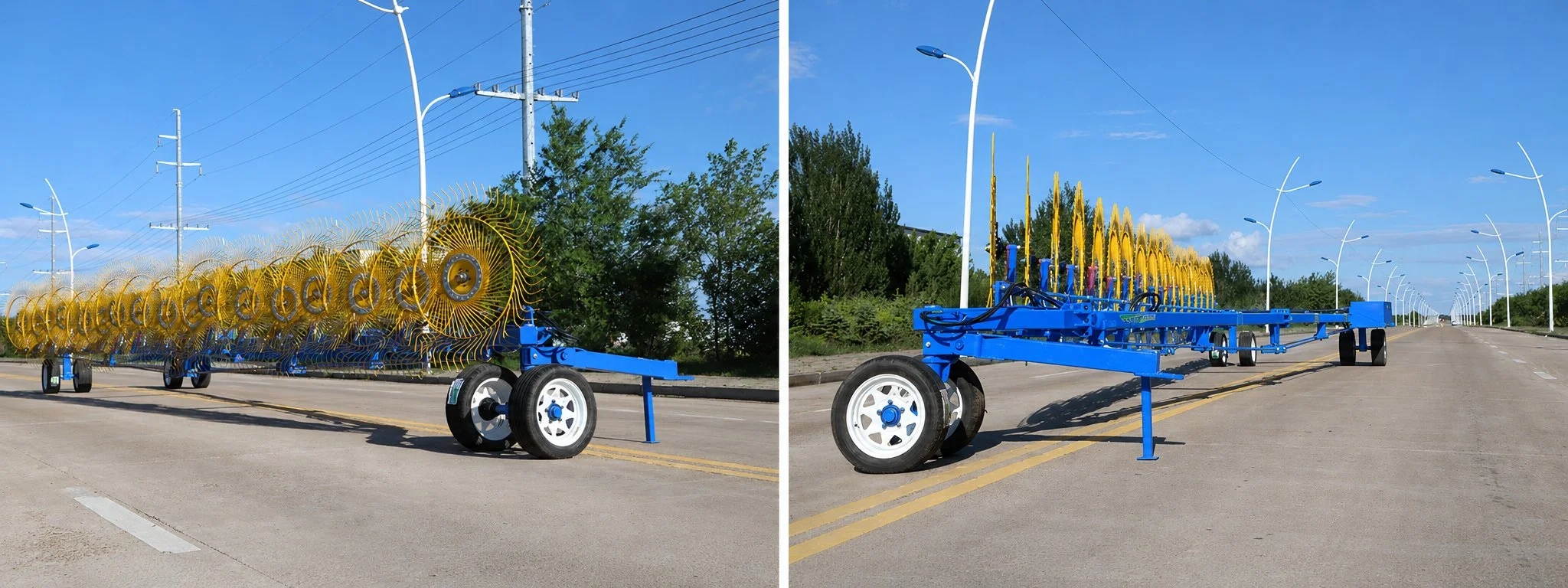
All hay rake models in our lineup are available from the California warehouse with confirmed specifications and same-day parts dispatch. A brief overview of the two primary models most suited to the windrow applications covered in this guide:
Additional models — the 9LZY-9.0 (15-wheel, 9 m), 9LZ-6.0 (12-wheel, 6 m), and the full 9LH-12 horizontal rake — are detailed on the hay rake lineup page. If you are matching a rake to a specific baler model and annual acreage program, contact our U.S. team — we run this matching exercise regularly and can confirm which rake model produces the correct windrow width at your baler’s pickup specification.
Frequently Asked Questions: Hay Raking Techniques
Find the Right Rake for Your Operation
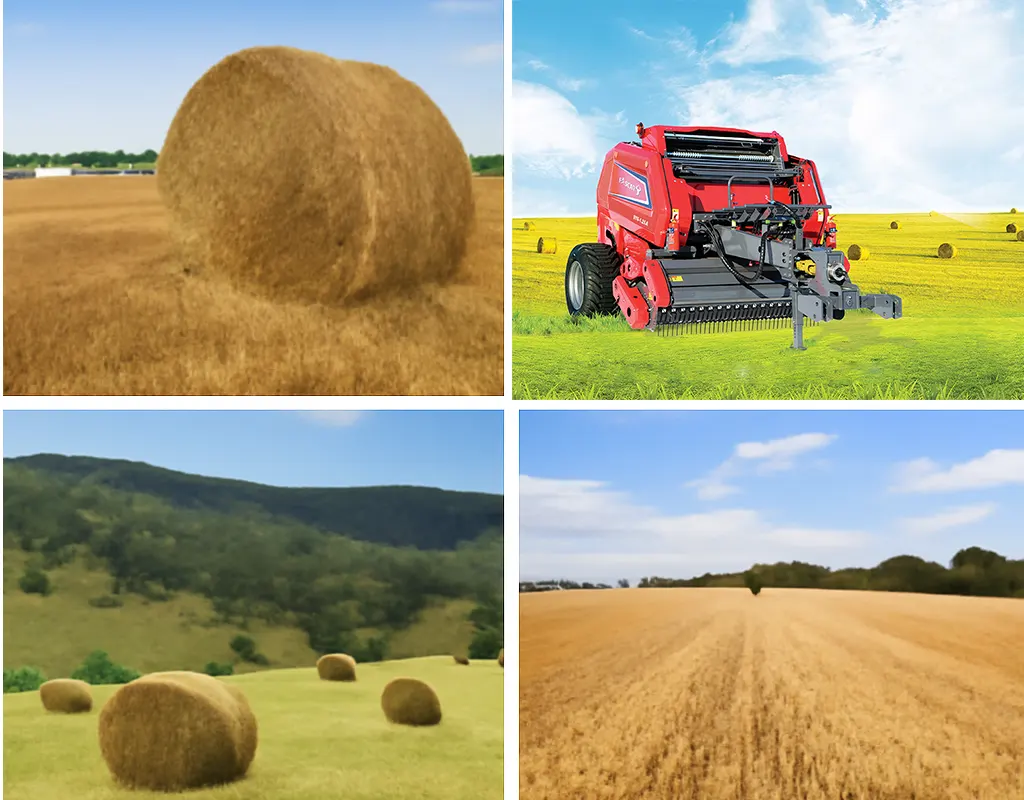
Rake + Baler System Matching
Tell Us Your Crop, Baler Model, and Field Scale — We’ll Match the Hay Rake
Our California-based team matches rake working width, disc type, and windrow width to your specific baler’s pickup header specification and your crop program. All models ship from the U.S. warehouse with same-day parts dispatch and tractor compatibility confirmed before delivery.
6 m, 9 m — no PTO required
12 m — commercial throughput
Windrow width confirmed vs baler pickup
Editor: Cxm


